

wayground logo

Free Printable Worksheets

Font size

S
M
L
XL
Worksheets

10th Phy Trim 2 Electricity

Total questions: 56

Worksheet time: 47mins

Name
Class
Date
1.
In the diagram below, P is a point near a negatively charged sphere. Which direction best represents the direction of the electric field at point P?
a)
Right
b)
Left
c)
Up 
d)
Down
2.
Which quantity and unit are correctly paired?
a)
electric field strength and N/C
b)
electricity and Coulombs
c)
electrostatic force and electrons
d)
electric field strength and E
3.
A point charge Q is far from all other charges. At a distance of 2 m from Q, the electric field is 20 N/C. What is the force a charge of 5 Coulombs feels?
a)
4 N
b)
100 N
c)
40 N
d)
10 N
4.
Which of the following statements is false about electric field lines
a)
electric field lines cannot cross
b)
electric field lines point away from positive charge
c)
electric field lines are always straight lines
d)
electric field lines show how a proton would move in an electric field
5.
At which point is the electric field the strongest
a)
A
b)
B
c)
C
d)
D
6.
At which point is the electric field the weakest?
a)
A because it is the furthest away
b)
A because the field lines are further apart
c)
C because the field lines are further apart
d)
C  because it is the furthest away
7.
Consider the electric field lines shown in the diagram below. From the diagram, it is apparent that object A is ____ and object B is ____.
a)
+,+
b)
+,-
c)
-,+
d)
-,-
8.
Consider the electric field lines drawn at the right for a configuration of two charges. Several locations are labeled on the diagram. Which of these shows the ranking in order of weakest to strongest correctly
a)
A, E, C
b)
D, E, C
c)
D, B, A
d)
A, D, B
9.

An electrostatic force of 2 X 10². newtons is exerted on a charge of 4 coulomb at point P in an electric field. The magnitude of the electric field strength at P is

a)
8 X 10² N/C
b)
5 N/C
c)
2 X 10⁻² N/C
d)
50 N/C
10.
Qand Qare two charges creating an electric field. Based on the electric field lines, we can conclude
a)
Qand Qare both positive
b)
Qand Qare both negative
c)
Qis positive and Qis negative
d)
Qis negative and Qis positive
11.
Which of the following is a true statement about the electric field between the two plates?
a)
The field is attractive between the plates and uniform in strength
b)
The field is repulsive between the plates and uniform in strength
c)
The field is attractive between the plates and strongest near the positive
d)
The field is repulsive between the plates and strongest near the positive
12.
The electrical force between charges is strongest when the charges are
a)
close together
b)
far apart
c)
 the electric force is constant everywhere.
d)
there is no pattern
13.

What is the magnitude of the electric field strength at a point where a proton experiences an electrostatic force of magnitude 2.30 x 10⁻²⁵ newton?

a)
1.44 x 10⁻⁶ N/C
b)
3.68 x 10⁶ N/C
c)
1.44 x 1044 N/C
d)
3.68 x 10-44 N/C
14.
What is the unit for electrical charge?
a)
coulombs
b)
amperes
c)
volts
d)
ohms
15.
What is the symbol for charge?
a)
q
b)
V
c)
I
d)
Ω
16.
What is 'e'?
a)
elementary charge
b)
electron
c)
charge
17.

What is the symbol for electrons?

a)

e-

b)

e

18.

What particle is +1.6x10⁻¹⁹ C?

a)

p+ charge

b)

+e charge

19.
What type of material is when you have free electrons?
a)
conductor
b)
insulator
20.
2 opposite charges …
a)
attract
b)
repel
21.
What does 'k' mean?
a)
Coulomb's constant
b)
Epsilon
c)
Permittivity of free space
d)
Permittivity
22.
Electric Field strength is the electric force per unit charge experienced by a ____.
a)
test charge
b)
point charge
23.

Type the letter for unit of charge

(a)  

24.

Type the symbol for the unit of electrical force

(a)  

25.

Coulomb is the unit for:

a)

electric field

b)

electrical charge

c)

electrical force

d)

electrical current

e)

electric resistance

26.

ohms (Ω) is the unit for:

a)

electric field

b)

electrical charge

c)

electrical force

d)

electrical current

e)

electric resistance

27.

volts (V) is the unit for:

a)

e.m.f.

b)

electrical charge

c)

electrical force

d)

electrical current

e)

electric resistance

28.

newtons per charge (N/C) is the unit for:

a)

e.m.f.

b)

electrical charge

c)

electric field strength

d)

electrical current

e)

electric resistance

29.

amperes (A) is the unit for:

a)

e.m.f.

b)

electrical charge

c)

electric field strength

d)

electrical current

e)

electric resistance

30.

_ is the opposition to the electrical current.

a)

e.m.f.

b)

electrical charge

c)

electric field strength

d)

electrical current

e)

electric resistance

31.

_ is the flow of charges per unit of time in a conductor.

a)

e.m.f.

b)

electrical charge

c)

electric field strength

d)

electrical current

e)

electric resistance

32.

_ is the amount of force per unit charge in a space around an electrical charge..

a)

e.m.f.

b)

electrical charge

c)

electric field strength

d)

electrical current

e)

electric resistance

33.

_ is one of the fundamental properties of matter.

a)

e.m.f.

b)

electrical charge

c)

electric field strength

d)

electrical current

e)

electric resistance

34.

_ is the work done per unit charge to move charges throughout a circuit.

a)

e.m.f.

b)

electrical charge

c)

electric field strength

d)

electrical current

e)

electric resistance

35.
What variable do "Newtons" represent?
a)
Electrostatic Charge
b)
Force
c)
Distance
d)
Mass
36.

Type the symbol for electrical current

(a)  

37.

Type the symbol for electrical resistance

(a)  

38.

Type the symbol for potential difference

(a)  

39.

Type the symbol for internal resistance of a battery

(a)  

40.

Type the symbol for coulomb's constant

(a)  

41.

Type the symbol for the unit of electrical charge

(a)  

42.

Type the symbol for the unit of electrical current

(a)  

43.

Type the symbol for the unit of potential difference

(a)  

44.

Type the symbol that represents this quantity: 8.9 x 10⁹ when we work with electrical charges and coulomb's law.

(a)  
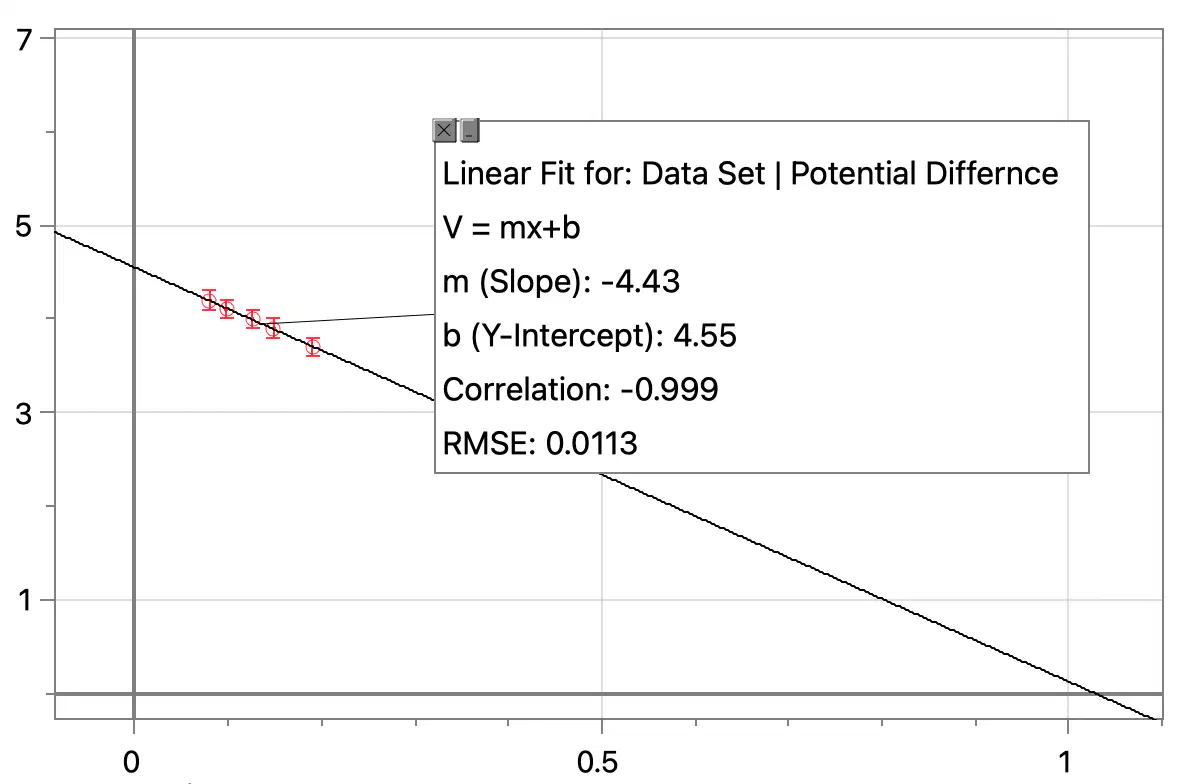
45.

Internal resistance lab.

We used 4 batteries in series.

What is the emf of each battery

a)

4.43/4

b)

4.43*4

c)

4.55/4

d)

4.55*4

46.

Internal resistance lab.

We used 4 batteries in series.

What is the internal resistance of each battery?

a)

4.43/4

b)

4.43*4

c)

4.55/4

d)

4.55*4

47.

Internal resistance lab.

We used 4 batteries in series.

What is the variable used on the x-axis?

a)

Potential Difference

b)

Electrical Current

c)

Electric Resistance

d)

Coulomb's Force

48.

Internal resistance lab.

We used 4 batteries in series.

What is the variable used on the y-axis?

a)

Potential Difference

b)

Electrical Current

c)

Electric Resistance

d)

Coulomb's Force

49.
What is electricity?
a)
a form of energy
b)
heat
c)
power source
50.
What is used to measure the flow of current in a circuit?
a)
Ammeter
b)
Battery
c)
Rheostat
d)
Voltmeter
51.
Ohm's Law states that electrical resistance is the same as long as _____ of resistor is constant.
a)
temperature
b)
voltage
c)
current
d)
emf
52.
I 𝛼 V always in …
a)
Ohm's Law
b)
Coulomb's law
c)
emf
d)
ElectronVolt
53.
In Ohm's Law there is always a positive gradient straight line in …
a)
Current-Voltage graph
b)
Voltage-current graph
c)
Resistance-Current graph
d)
Current-Resistance graph
54.
The ____ is the work done per unit charge in moving charge across the battery terminals.
a)
emf
b)
voltage
c)
current
d)
electronVolt
55.
It is called ___ circuit when there is flow of electrons in battery and resistor.
a)
closed
b)
open
56.
The positive side of the symbol of a battery is the
a)
long line
b)
short line
