
 Worksheets
Biology EOCT Review (3)
Total questions: 51
Worksheet time: 3hrs 33mins

The graph shown above is from one of the most well-known and on-going ecological studies ever performed. Isle Royal National Park, an island on Lake Superior, keeps data of populations of wolves and moose living there. The moose are a major food source for the wolves.
Analyze the graph data to conclude how the moose population affects the population of wolves.
As moose populations increase, wolf populations immediately increase.
As wolf population falls, moose populations fall with a delayed effect.
Moose populations don't really show any relationship to wolf carrying capacity.
The wolf carrying-capacity rises as moose populations increase, but with a delayed effect.

Look at the diagram of the food web. The arrows means “eaten by.”
What will happen if the number of snakes goes down?
The owl will eat the grass.
The number of frogs will go down.
The hawk and owl will have less food.
The number of mice and grasshoppers will go up.
The Great Lakes region is a major source of fresh water and home to a diverse group of plants and animals. Which of these factors could disturb the stability of the ecosystem?
A decrease in fishing throughout the Great Lakes region.
A slowdown of clear cutting and construction in the area.
Normal snowfall in winter, ensuring that water levels remain normal.
The disappearance of a keystone species due to an increase in water temperature.
algae → water flea → small fish → big fish
Use the food chain to answer the question.
What would MOST LIKELY happen to the population of the water flea if the algae decreased?
It would increase.
It would decrease.
It would not change.
It would first increase, then decrease.

The formula for logistic growth rate is shown above. A population of salmon has a carrying capacity of 2500 in a small fishery. What will occur when the population reaches 3000 for the salmon?
The population will stabilize at 3000.
The population can never reach 3000 in this case.
The population will grow because the growth rate will be positive.
The population will decline because the growth rate will be negative.

Loggerhead sea turtles make nests on Georgia’s barrier island beaches. Their numbers are quickly decreasing due to changes in their habitat. The graph above shows the number of nests from the north end of one beach to the south end.
N = North
Mid = Center of Island
S = South
Based on the graph, what conclusion can be made about loggerhead sea turtles and their habitat?
The nesting area of the whole beach has been destroyed.
Loggerhead sea turtles are safer on the north end of the beach.
Loggerhead sea turtles are safest on the south end of the beach.
The central part of the beach has been least affected by habitat loss.

Developers is Florida are building a new theme park that includes several tropical gardens. Their goal is that the gardens become self-sustaining through good conservation practices. They have taken into account the carrying capacity of the gardens, the food webs, niches, and interspecific competition of the species they plan to include. The last task is to design the lay-out of the garden habitats within the park.
According to island theory, which layout is BEST and why?
One habitat is always better than multiple for survival.
Dispersal and movement is easier in a straight path or corridor.
Decreasing distance between habitats increases the likelihood of interaction.
Increasing the distance between habitats decreases the likelihood of predation.
Biodiversity can be measured by the number and relative abundance of species in an ecosystem. Select the statement that best addresses a solution to the issue of loss of biodiversity in a North American ecosystem.
Introduce fast growing plants light kudzu (from Japan) which can become groundcover to prevent erosion.
Identify keystone species in an ecosystem and isolate them in a protected area away from other species.
Remove decomposers by applying fungicide so that more organic material is available to animals and plants.
Inspect ships moving through international waters to prevent the introduction of invasive species, which can potentially
out-compete native species.

The image above is of a kelp bed. In ideal conditions, kelp can grow up to 18 inches per day. In stark contrast to the slow-growing corals, the giant kelp canopies tower above the ocean floor. Like trees in a forest, these giant algae provide food and shelter for thousands of fish, invertebrates, and marine mammal species. Storms and weather events, like El Niño, can tear and dislodge the kelp, leaving a tattered forest to begin its growth again each spring. Sea otters and sea urchins play critical roles in the stable equilibrium of this ecosystem. Sea urchins graze kelp and may reach population densities large enough to destroy kelp forests at the rate of 30 feet per month. Urchins move in herds, and enough urchins may remain in the location of a former kelp forest to stop any regrowth.
In the scenario above, identify the keystone and foundation species. Infer what might happen if the keystone species were greatly reduced.
Keystone species is the kelp. If the kelp is reduced or destroyed the basis for the entire ecosystem is destroyed as is the ecosystem.
Keystone species is the kelp. It is the foundation for this ecosystem. If destroyed it would be replaced by another producer to establish a different ecosystem.
Keystone species is the sea otter. Sea otters, playing a critical role in containing the urchin populations, prey on urchins and thus control the numbers of kelp grazers to maintain the forest.
Keystone species is the sea urchin. If the sea urchin species is greatly reduced by an increase in the sea otter population, the kelp beds would continue to grow unchecked and other populations of herbivores would grow.

Review the desert food web above. What organism, absent in the web, would be MOST responsible for recycling organic matter back through the food web?
cougars
bacteria
sage brush
cactus plants

An ecological pyramid is sometimes used to show both the flow of matter and energy in an ecosystem. The pyramid narrows as matter and energy flow from the bottom to the top. Draw a conclusion about what this pyramid tells you about the energy in this ecosystem.
Energy stays the same. Only the number of living things change.
Energy decreases from the top to the bottom as organisms are larger in size.
Energy increases from bottom to top because the organisms get larger in size.
Energy decreases from bottom to top because some is used at each level for life processes.
In a typical energy pyramid about 10% of the available energy is transferred from one trophic level to the next. Consider an area in which the energy production of the autotrophs equals 200 Kcal/m2/year. What is the amount of energy available to secondary consumers in this energy pyramid?
1 Kcal/m2/year
2 Kcal/m2/year
10 Kcal/m2/year
15 Kcal/m2/year

Review the image of the nitrogen cycle. Nitrogen is an important element needed for plant growth. What living organism plays a big role in adding atmospheric nitrogen to the soil?
Fungi
Animals
Plants
Bacteria

The process of respiration is essential in the oxygen/carbon dioxide cycle. Respiration removes ______ from the atmosphere and produces and releases ______ to the atmosphere.
glucose, oxygen
oxygen, glucose
carbon dioxide, oxygen
oxygen, carbon dioxide

This food chain is incomplete. Two groups of organisms are missing.
One group of organisms that are missing are the producers. These are plants. They turn sunlight into chemical energy.
Evaluate the model to determine the other missing group and explain their role in the food chain.
Carnivores that eat only meat and form the top of the food chain.
Herbivores that eat plants and pass energy and matter on to higher levels.
Predators that prey on all other levels of consumers.
Decomposers that recycle matter back into the food chain.

Biologists in Louisiana have become concerned about cadmium levels in the water near New Orleans and the probability that frogs will die out. They performed an experiment on bullfrog tadpoles to determine how toxic cadmium is to bullfrogs.
Suppose a small river with a population of 10,000 frogs becomes polluted with cadmium to a level of 3 mg per gallon per day. About how many bullfrogs would be expected to die?
about 3,000
about 7,000
about 8,500
about 1,500

To test acidity levels of water, scientists test pH. As acid rain falls, the pH level of the water in lakes and streams decreases. While certain animals can tolerate low pH levels, others are extremely sensitive to the effects of acid rain and cannot live under these conditions. Candice is working on a project to determine whether acid rain is causing a decrease in the number of bass and mayflies in a lake in her hometown. Candice takes a sample of the pH level of the lake, and she finds that the pH level is 5.4. What might Candice predict as a result of her findings?
The lake's pH level of 5.4 is safe for both bass and mayflies, but not for frogs.
The lake's pH level of 5.4 will cause a decrease in the amount of bass and mayflies.
The lake's pH level of 5.4 will affect the number of bass, but probably not the mayflies.
The lake's pH level of 5.4 will not affect the survival of any of the animals listed in the chart.
A changing climate has strong implications for biodiversity. Studies of fossil and pollen distribution show that species are very sensitive to climate changes. When the climate changes, species often die out in their present areas and colonize new areas. Therefore, as the climate changes in the future, there will be disruption of natural communities and extinction of populations and species.
Which of these environmental changes would most affect the arctic polar bears survival?
drought
an ice age
deforestation
global warming

Coral reefs are among the world's richest ecosystems, second only to tropical rain forests. Like the tropical rainforest, the coral reef ecosystem is in danger. Coral is being harmed by all BUT ONE of the following.
soil run-off
blast fishing
global warming
mineral deposit

According to the graph, what abiotic factor influences tadpole survival?
size of pond
cadmium dosage
available food
number of surviving tadpoles

In 1859, two dozen rabbits were introduced to Australia. By 1953, there were an estimated one billion rabbits in Australia. The addition of the rabbits to this established ecosystem caused many problems, including a huge decrease in native plants. This left little food for native animals. Evaluate the effects of the introduction of the rabbits on the ecosystem.
The genetic diversity improves an established ecosystem.
The importation of genetic variation leads to the formation of a new species.
The introduction of non-native species, with no known predators, upsets a balanced system.
Changing in one part of an ecosystem does not affect other parts of the ecosystem.

A simplified food chain and its corresponding food web are shown here. These species are commonly found in deciduous forests of the Southeastern United States. A homeowner in South Carolina, whose house and yard are adjacent to native tree stands, applies a fungicide to the area of his yard and the surrounding area. The fungicide kills fungi and prevents their reproduction. His neighbor advises against this practice and states that the yard and his garden will perform better without the fungicide. Defend the neighbor's statement with accurate justification.
The fungicide will reduce the frog population as it runs off into the adjacent waters, which will cause a reduction in the beetle population as well.
The fungicide will reduce the number of squirrels because the chemical will directly reduce the acorn availability, which will reduce the frog population.
The fungicide will increase the plant biomass, which could lead to overgrazing by herbivores, which will be followed by a decrease in ecosystem stability.
The fungicide will reduce the stability of the ecosystem because nutrients in the soil will be less likely to be recycled, directly impacting plant nutrition and growth.
Conservation biology supports all but one of the following practices.
the preservation of natural habitats
the protection of endangered species
the management of available natural resources
the introduction of alien species to an area outside their normal range

This chart shows the annual catch statistics for the red grouper for the state of North Carolina during the 1990’s. Red grouper begin their lives as females, and the largest fish change sexes to become male during mating season. Only large females mate with these males and lay eggs.
You are a fisheries biologist for the state of North Carolina. You are charged with protecting the fish population, while also keeping professional fishermen from losing their jobs. Based on the chart above, what would you conclude and what would your solution be?
There is a serious problem with overfishing of red grouper, so there must be a problem with other fish as well. All fishing for any species should be banned.
There is not a very serious problem. The smaller size and population are probably just due to some bad years. Do nothing and monitor the situation.
There is a problem with overfishing. Ban fishing for large fish so their size and population can recover, but allow the fishermen to take smaller fish.
There is a problem with overfishing of red grouper, but the fishermen need to stay in business. Bring in another species of grouper from Australia, so that there are more fish to catch.

Animals store most of their excess energy reserves as _______, and this is explained because __________________.
glucose; it is easy to break down.
fat; they store twice as much energy per gram.
protein; it is a compact source of energy in their bodies
carbohydrates; they store twice as much energy per gram of glucose.

This simple bacteria cell has the same structure as more complex cells. It controls what comes in to and leaves the cell and also maintains homeostasis. It is the
capsule.
cytoplasm.
membrane.
wall.

If meiosis continues in this case and produces gametes, what statement concerning their genetic variability would be MOST accurate?
Genetic variability would increase because of insertion.
Genetic variability would increase because of crossing over.
Genetic variability would decrease because of translocation.
There would be no change in the genetic variability in this case.

The picture depicts budding in the yeast cell. What is the result of this process?
The bud develops into a yeast cell with new genes.
The bud develops into a yeast cell with the same genes as the parent cell.
The bud develops into a yeast cell with half the genetic information from the parent.
The bud develops into a yeast cell with double the genetic information from the parents.
All the biological macromolecules contain Carbon, hydrogen and oxygen. However, most do not contain nitrogen. The category that contains nitrogen are
lipids.
proteins.
carbohydrates.
unsaturated fats.

Living organisms use osmoregulation to balance solute and water concentrations in their cells, tissues and organs. Many marine organisms have internal solute concentrations that are similar to their environment. However, this is not typically true of freshwater and terrestrial organisms.
Select what is likely to happen to the cells of a freshwater plant if placed in a marine environment?
The cells will die immediately.
The cells will undergo plasmolysis.
The cells will swell and become turgid.
There will be no obvious change in the plant cells.

A model of a specific event during meiosis is shown with various possible combinations. Which statement correctly cites evidence from the model to support the idea that meiosis increases genetic diversity?
Chromosomes can coil during meiosis, creating a combination of alleles that are new.
Chromosomes can mutate randomly during meiosis creating new phenotypes in the daughter cells.
Chromosomes can replicate during meiosis, producing additional DNA with which to pass on to the daughter cells.
Chromosomes can align in metaphase I in multiple possible arrangements in a process called independent assortment.
Why do we say that "an enzyme is reusable"?
The enzyme does not actively take part in the reaction. It just indicates that the reaction is complete.
Enzymes react with the substrate molecules to form products and become denatured in the process.
Enzymes ensure that the reaction continues without inhibition even if conditions such as temperature and pH are changed.
The products of the reaction are released from the active sites of the enzyme, allowing other substrate molecules to bind with the sites.

The picture shows an experimental set up for the process of osmosis.
The potato has a cavity on top, as shown in the picture. Some sugar solution is poured into the cavity and the potato is placed in a beaker of water. After some time, it is observed that there is a rise in the level of liquid in the cavity. This confirms that
water from the beaker has moved into the cavity.
sugar has moved out of the sugar solution in the cavity.
the sugar solution in the cavity has become more concentrated.
there is equilibrium between the liquids in the beaker and the cavity.

Which statement correctly describes the diagram?
The products of photosynthesis cannot be used by other organisms.
The products of respiration can be used by plants for photosynthesis.
The exchange of oxygen and carbon dioxide occurs only in respiration.
The exchange of oxygen and carbon dioxide occurs only in photosynthesis.
During diffusion, molecules move
in no predictable pattern.
to points equidistant from the point of origin.
from lower concentration to higher concentration.
from higher concentration to lower concentration.
Photosynthesis has two main parts (light-independent and light dependent). Which descriptions can BEST be used to explain the calvin cycle?
I. Light-independent reaction
II. Light-dependent reaction
III. Products are ATP and NADPH.
IV. Occurs in the thylakoid membranes
V. Occurs in the stroma
VI. Glucose is made from CO2
I, V, and VI
II, III, and IV
I, IV, V, and VI
I, II, III, and V

All of the following occur during the Krebs cycle EXCEPT:
I. Acetyl-CoA combines with oxaloacetate to form citrate.
II. FADH2 accepts two electrons to form FAD.
III. NAD+ is reduced to form NADH.
IV. Pyruvate is converted into acetyl-CoA
V. Carbon dioxide, NADH, and FADH2, and ATP are reactants.
I and III
II, IV, and V
II, III, and V
I, II, IV, and V
DNA fingerprinting would most likely be used to
identify human age and lifespan.
determine genetic relationships.
diagnose different types of cancer.
create genetically-identical species.
Translation of the DNA sequence AAGCTGGGA would result in
an mRNA strand with the sequence TTCGACCCT.
an mRNA strand with the sequence UUGCACCCU.
a DNA strand with the base sequence TTCGACCCT.
a sequence of three amino acids linked by peptide bonds.

Each of these four organisms began life as a single 2N cell. Cells in each organisms divided and differentiated. Probably the single most important process that ensured genetic continuity in all four organisms was DNA
alliteration.
replication.
transcription.
translation.
The central dogma of molecular biology is centered upon the process of _________, in which the information from DNA is transcribed and translated, resulting in amino acids being joined into polypeptides.
replication
translation
protein synthesis
carbohydrate synthesis

In this field of sunflowers, variation exists. Some flowers are tall, others short, and finally some plants are an intermediate height. The tallest plants shade the shorter; the taller plants are pollinated first. Over time, we might expect this field of sunflowers to be mostly tall. According to this scenario, identify the type of reproduction and list the processes that aid in variation.
Sexual: mitosis and random assortment of chromosomes; fertilization
Asexual reproduction: meiosis and crossing over; pollination and fertilization
Sexual: meiosis, crossing over, and random assortment of chromosomes; pollination
Asexual: mitosis; reduction division of chromosomes with random assortment; pollination

You inherit the DNA that composes your chromosomes from your mother and your father. You have inherited a protein that STOPS the production of an enzyme, a protein, to help you digest milk. Scientists have figured out that this protein contains an amino acid that really does say STOP whenever the enzyme starts to be produced. What nitrogen bases, found in your DNA, could be arranged to produce this STOP amino acid?
C, G, U
U, A, T
A, T, G
A, T, and C
The heterozygous condition of sickle cell anemia results in resistance to malaria. If a homozygous normal father and a heterozygous mother have a child, what are the chances of that child being resistant to malaria but not having sickle cell anemia?
25%
50%
75%
100%
There are four children in the Smith family. One child has blue eyes and blond hair. The other three children have brown eyes and blond hair. How can you explain this difference in eye color?
Brown eyes are the inherited trait; blue eyes are a mutation.
Eye color is an inherited trait; brown eyes are dominant over blue.
The brown eyed children have spent a lot of time outdoors; it's an environmental change.
The blue eyed child is younger than the children with brown eyes; their eyes will become brown.

In rabbits, white fur is a recessive trait. Based on this fact, what statement BEST describes this rabbit's genotype?
It must have the genotype Bb.
It is homozygous for fur color.
It cannot have the genotype bb.
It is heterozygous for fur color
In flies, long wings are a dominant trait, and short wings are a recessive trait. Medium wings are the heterozygous trait. Based on this information, if a homozygous long-winged fly is crossed with another a heterozygous fly, their offspring will have which percentages for long, medium, and short wings? Assume random chromosome segregation.
25% long, 75% medium, 0% short
50% long, 25% medium, 25% short
50% long, 50% medium, 0% short
100% medium, 0% long, 0% short
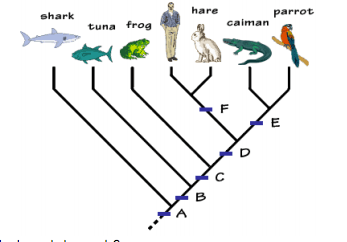
On the cladogram, which organism is the closest relative of the parrot?
Frog
Hare
Caiman
Parrot
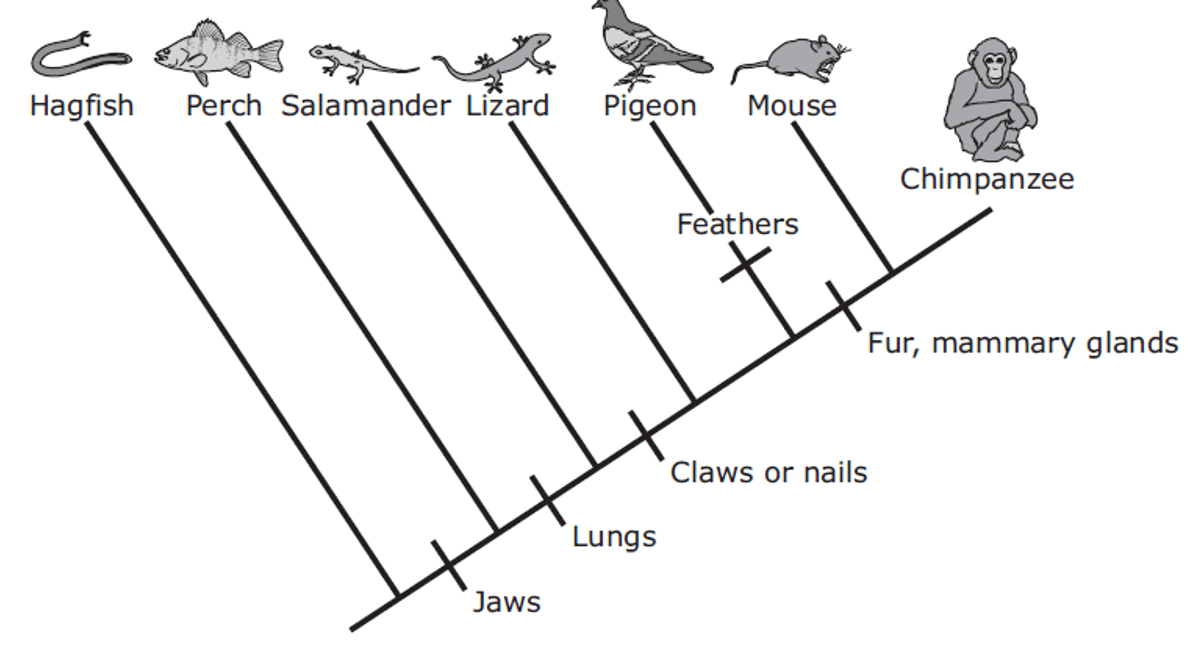
All the animals to the right of the salamander would have the common characteristic of...
Fur
Claws or nails
Lungs
Jaws
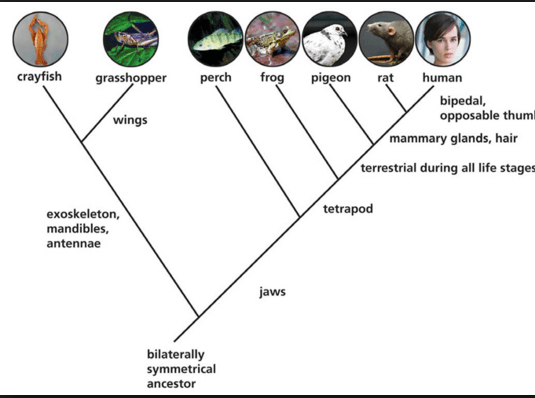
According to the cladogram, which organism is most distantly related to the human?
crayfish
grasshopper
perch
frog

