
 Worksheets
STPM Biology 2022 Term 1 MCQ
Total questions: 15
Worksheet time: 8mins
Which is not true about protein?
The a-helix and P-pleated sheets are formed by the hydrogen bond only.
The insoluble denatured forms could be renatured if placed in a suitable condition.
The conformation depends on the physical and chemical environments.
The sequence of amino acids determines its function.
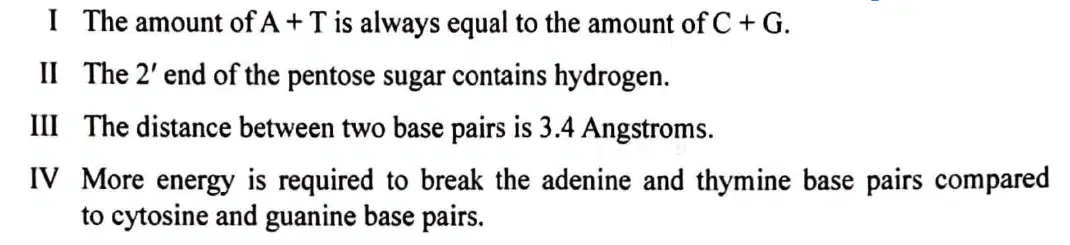
Which are true about DNA molecules according to Watson and Crick's model?
I and III
I and IV
II and III
II and IV
The components of native protein of a cell are isolated and analysed using electrophoresis. The components could not be distinctly separated although accurate procedures of electrophoresis are followed. Which is the possible cause of the problem?
The net charges are identical
The masses are the same
The shapes are different
The sizes are varied
Which is true about the mosaic pattern of the fluid mosaic model of Singer-Nicolson?
Lipids move laterally within the single layer.
The transmembrane proteins function as the receptor.
The characteristic of phospholipid bilayer is amphipathic.
The attached proteins are constantly moving in the bilayer.
Which structure distinguishes prokaryotes and eukaryotes?
Cell wall
Plasma membrane
Ribosome
Endoplasmic reticulum
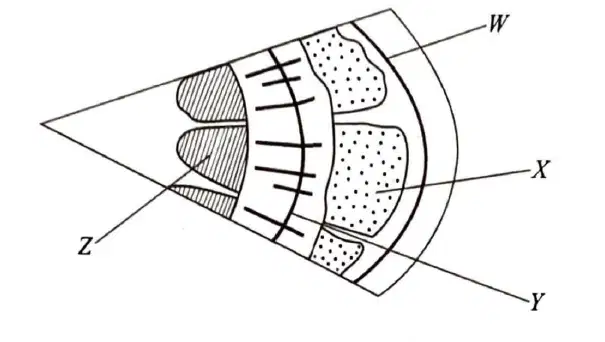
A cross section of a plant stem is shown in the diagram. Which parts of the stem consist of the meristematic tissues?
W and Y
W and Z
X and Y
X and Z
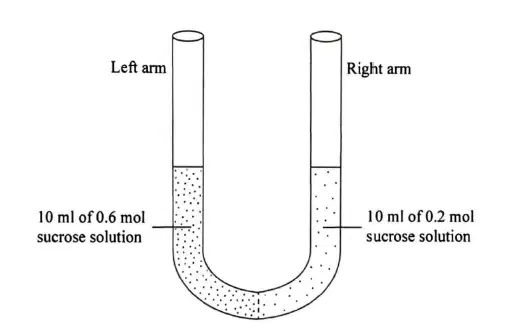
A U-tube which contains sucrose solution of different concentrations is shown in the diagram. Which statements are true about the water potential, the pressure potential and the solute potential of the sucrose solutions in both arms of the U-tube?
I The water potential in the right arm is zero.
ll The solute potentials in both arms are negative.
Ill The water potential in the left arm is lower than that of the right arm.
IV The solute potential in the right arm is more negative than that of the left arm.
I and III
I and IV
II and III
II and IV
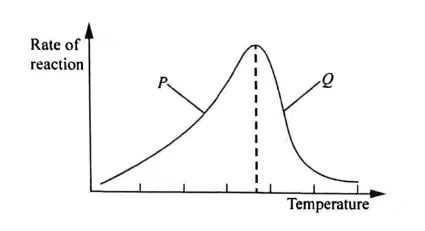
The rate of reaction against temperature in an enzyme catalysed reaction is shown in the graph. Which is true about P and Q?
P: The kinetic energies of the substrate and the enzyme increase.
Q: The kinetic energies of the substrate and the enzyme decrease.
P: The concentration of the substrate increases.
Q: The concentration of the substrate decreases.
P: The number of collisions between the enzyme and substrate increases.
Q: The hydrogen and ionic bonds of the enzyme break.
P: The formation of the enzyme-substrate complex increases.
Q: The peptide bonds and disulphide bridges of the enzyme break.
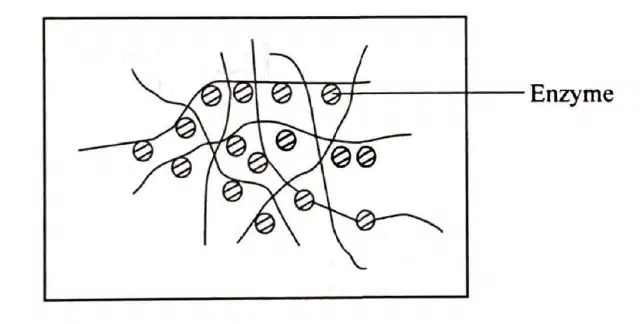
An enzyme immobilisation technique is shown in the diagram. Which is not true about the technique?
The enzymes remain in the natural state.
The method is called an entrapment of enzymes.
The enzymes are chemically bound to the lattice.
The interaction between large molecules and enzymes is difficult.
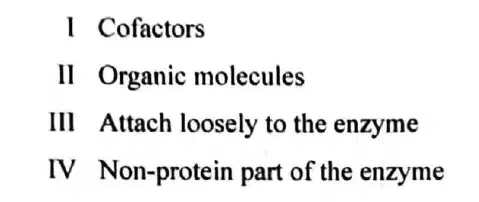
Which are the similarities between Fe2+ and FAD in an enzymatic reaction?
I and III
I and IV
II and III
II and IV
Which is not true about an electron transport system?
Electrons flow from NADH to oxygen.
The process occurs in the mitochondrial matrix.
The process could be inhibited by carbon monoxide.
Each molecule of NADH produces a molecule of water.
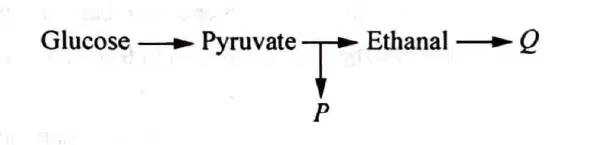
The schematic diagram of an anaerobic respiration in yeast is shown. What are represented by P and Q?
P is CO2
Q is Ethanol
P is CO2
Q is NADH
P is Ethanol
Q is CO2
P is NADH
Q is Ethanol

The characteristics of a mode of nutrition of an organism are given. Which group of organisms illustrates the characteristics?
Photoautotroph
Chemoautotroph
Photoheterotroph
Chemoheterotroph
Which is true about light reactions in photosynthesis?
Water acts a the hydrogen donor to form NADPH.
One molecule of NADPH produces three molecules of ATP.
ATP is produced during photophosphorylation which later used for active transports.
Glucose-3-phosphate combines with two H+ from NADPH2 to form triose phosphate.
Which is true about photosynthesis in C4 plants?
Occurs only in mesophyll cells
Carbon dioxide is fixed directly from the atmosphere
Malate is produced at night and stored in the vacuole
Carbon dioxide combines with phosphoenolpyruvate to form oxaloacetate

