
 Worksheets
Unit 3, Ch. 9 Earth Science Review
Total questions: 60
Worksheet time: 49mins
What are ways that the earth's layers can be classified: (select all)
Composition (chemicals/minerals)
Mechanical properties
Color
Shape
How do scientists learn about Earth's interior?
By analyzing seismic waves from earthquakes
By using satellites to scan the Earth's interior
By drilling deep into the Earth's crust
By studying rocks found on the surface
Which type of seismic wave arrives first at a seismometer?
Secondary waves (S-waves)
Tertiary waves
Surface waves
Primary waves (P-waves)
What type of motion do primary waves (P-waves) have?
Up and down
Side to side
Compression/expansion
Circular
Which layer of the Earth is behaves plastically and can flow?
Asthenosphere
Lithosphere
Outer core
Crust
Which type of wave can only propagate through solids?
Primary waves (P-waves)
Secondary waves (S-waves)
Surface waves
Tertiary waves
What is the composition of the Earth's core?
Magma and sediment
Basalt and gabbro
Silicate minerals
Iron and nickel
What is the average composition of the continental crust?
Peridotite
Gabbro
Granite
Basalt
What is the lithosphere composed of?
Crust and upper mantle
Core and mantle
Mantle and asthenosphere
Crust and core
What is the thickness of the lithosphere?
100 meters
1 kilometer
10 kilometers
100 kilometers
What is the mantle made of?
Sedimentary rock
Liquid metal
Hot, but solid rock
Magma
What causes convection currents in the mantle?
Heat from the crust
Heat from the atmosphere
Heat from the core
Heat from the sun
What elements or minerals make up the Earth's core?
Iron and copper
Silicate minerals
Nickel and Magnesium
Iron and Nickel
What is the source of the heat that keeps the outer core from solidifying?
Heat from the sun
Heat from the crust
Heat from the mantle
Breakdown of radioactive elements
What are the three main layers of the Earth?
Core, Crust, Mantle
Mantle, Core, Crust
Crust, Core, Mantle
Crust, Mantle, Core
Which layer of the Earth is the thinnest?
Crust
Mantle
Core
Hydrosphere
What is the outermost layer of the Earth called?
Crust
Mantle
Core
Atmosphere
What is the innermost layer of the Earth called?
Core
Hydrosphere
Mantle
Crust
What is the name of the largest (by volume) layer of the Earth?
Mantle
Core
Crust
Hydrosphere
What is the name of the thickest (by depth) layer of the Earth?
Mantle
Core (inner + outer)
Crust
Asthenosphere
What is an earthquake?
A strong wind blowing over the ocean
A volcanic eruption
A violent storm with thunder and lightning
A sudden movement of the Earth's crust
What is the surface where two blocks of the Earth slip past each other called?
Fault plane
Epicenter
Hypocenter
Tectonic plate
What are the smaller earthquakes that occur afterwards in the same place as the mainshock called?
Mainshocks
Foreshocks
Aftershocks
Tremors
What are the puzzle pieces that make up the Earth's surface called?
Faults
Earthquakes
Tectonic plates
Seismographs
What causes earthquakes?
Lightning and thunder
Volcanic eruptions
Seismic waves
Friction between tectonic plates
What happens when the force of moving blocks overcomes the friction of a fault?
The Earth's crust expands
Seismic waves are generated
A volcanic eruption occurs
Stored up energy is released
How are earthquakes recorded?
Using seismographs
Through satellite images
By analyzing weather patterns
By measuring fault size
What is the name of the recording made by a seismograph?
Magnitude
Hypocenter
Epicenter
Seismogram
How do scientists measure the size of earthquakes?
By using satellite images
By studying animal behavior
By analyzing seismic waves
By measuring the fault size
How can scientists tell where an earthquake happened?
By measuring fault size
By analyzing seismic waves
By studying animal behavior
By observing weather patterns
What method is used to determine the location of an earthquake?
Triangulation
Satellite imaging
Weather analysis
Animal behavior observation
Primary (p-wave) waves
Secondary (s-wave) waves
Surface Waves

Which Seismic Wave is pictured?
P-Wave
S-Wave
Surface Wave
Love Wave

Which Seismic Wave is pictured?
P-Wave
S-Wave
Surface Wave
Which is the strength of an earthquake?
Plate boundaries
Magnitude
Fault
Seismic
Main type of seismic waves that can only travel through the surface of the Earth.
seismic waves
surface waves
secondary waves
primary waves
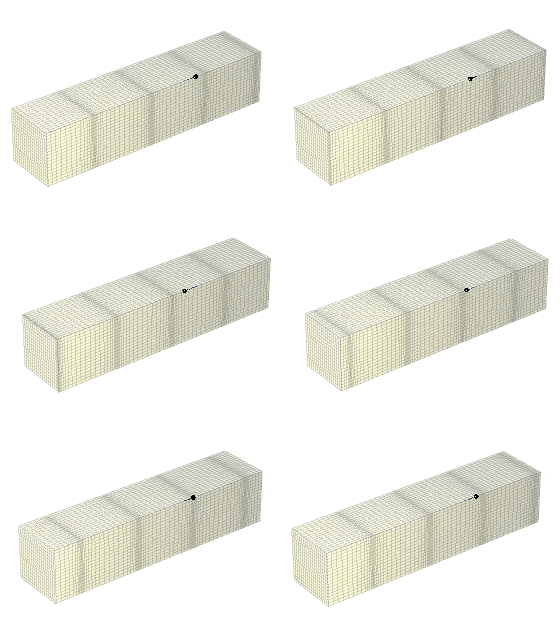
Which type of Seismic Wave is pictured?
P-Wave
S-Wave
Surface Wave
The point beneath the Earth's surface where the earthquake begins.
epicenter
fault
focus
magnitude
Which is the location of an earthquake ON EARTH'S SURFACE?
Landslide
Seismic
Epicenter
Focus
It can travel through only the mantle and the crust.
Seismic waves
Surface waves
Primary waves
Secondary waves

Which of the following statement correctly identifies the focus and epicenter of an earthquake in the given illustration?
Point A is the focus and Point B is the epicenter.
Point A is the epicenter and Point C is the focus
Point A is the epicenter and Point B is the focus.
Point A is the focus and Point C is the epicenter.
What type of wave can travel through all the layers of the Earth?
p wave
s wave
surface wave
none of the above


Which city is closest to the epicenter?
A
B
C
How is the location of an earthquake epicenter determined?
By measuring the depth of the earthquake's focus
By using the data from at least three seismograph stations to triangulate the exact location.
By analyzing the color of the seismic waves
By counting the number of aftershocks

Which seismogram represents a city that is far from the epicenter of an earthquake?
New York, NY
Nome, Alaska
Guadalajara, Mexico
How far is New York from the earthquake epicenter?
Hint: Distance from Epicenter (km) = 8.4 x Δt
0 km
42 km
24 km
56 km

Around what time did the first P wave get detected?
100 sec
120 sec
150 sec
160 sec
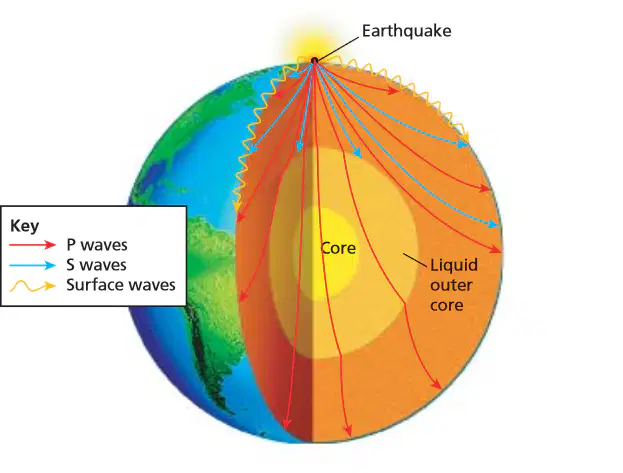
This model represents a
P wave shadow zone
S wave shadow zone
Surface wave shadow zone
Convection currents
The distance between an epicenter and seismograph’s location can be calculated by using the
arrival time of the first P-wave
difference in arrival times between P- and S- waves
amplitude of the p-wave
energy released by an earthquake

Only P-waves were recorded at seismic station C because P-waves travel
only through Earth’s interior, and S-waves travel only on Earth’s surface
fast enough to penetrate the core, and S-waves travel too slowly
through iron and nickel, while S-waves cannot
through liquids, while S-waves cannot

Scientists think that convection currents that move the plates flow in which layer that is said to be viscoelastic?
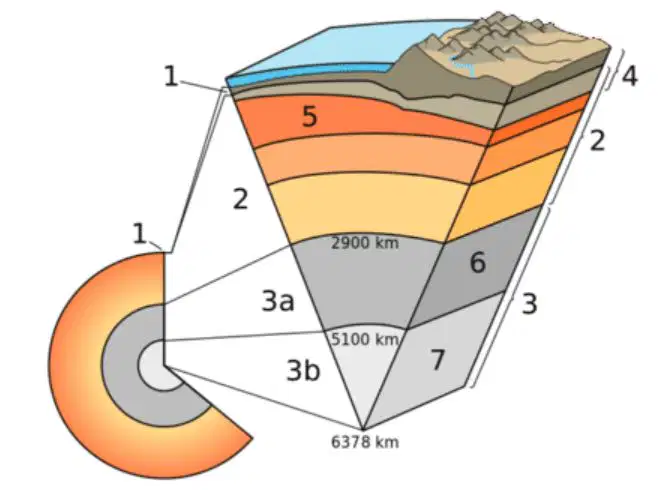
Identify Layer 1.
Crust

Using the numbers on the right side of the diagram, Layer 2 represents the:
Mantle
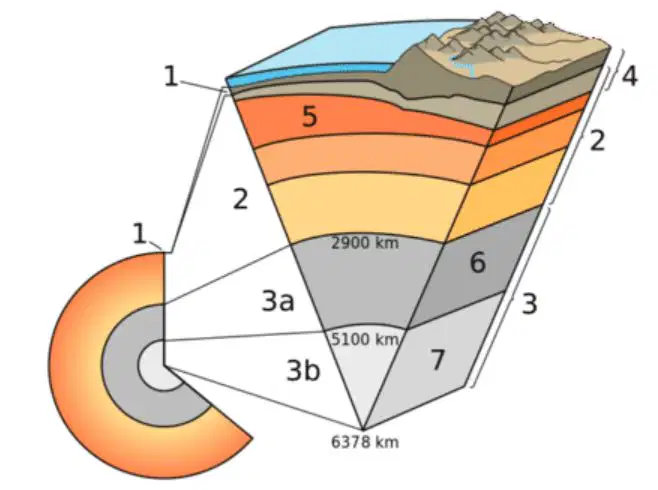
Layer 5 represents the:
inner core
Mantle

The 2 layers that are represented by #4 are called the:
inner core
Lithosphere
Mantle
Asthenosphere
Layer 6 is the:
Inner Core
Outer Core
Mantle
Asthenosphere
Layer 7 is the:
Inner Core
Outer Core
Mantle
Asthenosphere
Which layer is the hottest, but is solid due to the immense pressure?
Inner Crust
Inner Core
Outer Core
When the earth was forming and everything was liquid, what caused the most dense materials to move toward the center?
Gravity
Ions
Solar wind
Angular Momentum

