wayground logo

Free Printable Worksheets

Font size

S
M
L
XL
Worksheets

Circuits and Ohms Law

Total questions: 36

Worksheet time: 47mins

Name
Class
Date
1.

What does the electronic schematic symbol shown represent?

a)

switch

b)

light

c)

battery

d)

wires

2.

What does the electronic schematic symbol shown represent?

a)

light bulb

b)

cell

c)

battery

d)

resistor

3.

What does the electronic schematic symbol shown represent?

a)

Wire

b)

Battery

c)

Buzzer

d)

Fuse

4.

What does the electronic schematic symbol shown represent?

a)

Wire

b)

Resistor

c)

Battery

d)

Switch

5.
The picture shows an electrical circuit. This circuit is a series circuit because: 
a)
It has 3 light bulbs.
b)
The same current flows through all three light bulbs.
c)
It uses a single battery.
d)
The electrical current is divided between the three light bulbs.
6.
This is the symbol for a _____?
a)
an AC current source
b)
a DC current source
c)
a battery
d)
a single cell
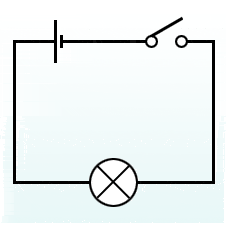
7.
this circuit is .....?
a)
open
b)
parallel
c)
closed
d)
The cutest little circuit evah!
8.
What is one problem with using a series circuit? 
a)
It has a lot of series. 
b)
If one goes down, they all go down! 
c)
It doesn't work properly.
d)
There are no problems. 
9.
Does this diagram represent a series or parallel circuit?
a)
series circuit
b)
parallel circuit
10.
What is Resistance?
a)
The flow of electrons
b)
Electric potential difference
c)
A battery
d)
The ability to reduce the flow of electrons
11.
Electricity that flows in a closed path is called a
a)
path
b)
current
c)
circuit
d)
light
12.
Which circuit (s) are parallel?
a)
A
b)
A and B
c)
B and C
d)
C
13.
In a parallel circuit which of the following is the same value throughout the circuit?
a)
Voltage
b)
Current
c)
Resistance
d)
Charge
14.
If the Voltage is increased and the resistance stays the same, Current will
a)
Increase
b)
Decrease
c)
Stay the same
d)
X
15.

If L2 is unscrewed from its holder, what will happen to L1?

a)

It will stay lit

b)

It will go out

c)

It will get dimmer

d)

It will disappear

16.

Current is...

a)

how fast the electrons are moving

b)

the flow of electrical charge

c)

the power source

d)

the amount of energy gained/lost across two points

17.

If the voltage is 30 volt and current is 10 amps in a circuit, how much is the resistance of the light bulb?

a)

3 ohms

b)

300 ohms

c)

0.3 ohms

18.
What is it called when a circuit is complete?
a)
Closed circuit
b)
Light bulb circuit
c)
Open circuit
d)
Series circuit
19.

How do you calculate resistance?

a)

Divide voltage by current

b)

Divide charge by current

c)

Multiply current by voltage

d)

Multiply voltage and current

20.

What is the resistance if the voltage is 10V and the current is 2A?

a)

20 Ω

b)

5 Ω

c)

12 Ω

d)

8 Ω

21.

What are the units for resistance?

a)

Ohms (Ω)

b)

Voltage (V)

c)

Amps (A)

d)

Charge (C)

22.

To calculate voltage, multiply _______ and _________

a)

current, resistance

b)

volts, current

c)

volts, ohms

d)

ohms, resistance

23.

A thicker wire means ____________ in resistance.

a)

a decrease

b)

an increase

c)

no change

24.
An object through which electrons can easily flow is called a(n) ___________.
a)
Conductor
b)
Insulator
25.
Which of these objects is an insulator?
a)
Copper Wire
b)
Paper Clip
c)
Steel Pole
d)
Rubber Gloves
26.

Ohm's law

a)
b)
c)
d)
27.
In a Series circuit the more lightbulbs you add the brighter they get 
a)
False 
b)
True 
28.
Which best describes a simple series circuit?
a)
Electricity flows along one pathway.
b)
The flow of electricity comes from the switch.
c)
Electricity flows along many pathways.
d)
The flow of electricity comes from the light bulb.
29.
What kind of circuit is this?
a)
series
b)
parallel
30.
What type of circuit is show in the image?
a)
Series Circuit
b)
Parallel Circuit
31.
What particle has a negative charge?
a)
Protons
b)
Neutrons
c)
Atoms
d)
Electrons
32.

What unit is used to measure voltage?

a)

Ohms

b)

Omega

c)

Volts

d)

Amps

33.

What unit is used to measure current?

a)

Ohms

b)

Omega

c)

Volts

d)

Amps

34.

What unit is used to measure resistance?

a)

Ohms

b)

Omega

c)

Volts

d)

Amps

35.

What is the voltage of a circuit with 4 ohms of resistance and 3 amps of current?

a)

12 V

b)

21 V

c)

4/3 V

d)

3/4 V

36.

What is the current in a circuit with 6 ohms of resistance and a battery containing 24 Volts?

a)

1/4 A

b)

144 A

c)

4 A

d)

0.4 A