
 Worksheets
Fall 2023 Final Exam Review Part 1: Functions
Total questions: 70
Worksheet time: 2hrs 59mins
What is the y-coordinate for the point of inflection of the function:
f(x)=3x3−4
What is the x-coordinate for the point of inflection of the function:
f(x)=3(x+6)3

What are the relative maximums for this graph?
{2.2, 3.9}
{-8, 5}
{3.9, 5}
{-8, 2.2}

What is the absolute min?
0
-6.55
36
None
−∞

The blue dot on this graph represents a(n)...
Absolute Maximum
Absolute Minimum
Relative Maximum
Relative Minimum
What are the relative minimums for this graph? (Select all that apply)
−∞
∞
-2.5
-3.3
5

What is the y intercept of the function?
3
4
-2
2
What are the zeros of the function? (select all that apply)
-1
4
2.25
2
-2

Describe the transformation of the graph y = -2(x + 5)3
Vertical compression by 2, Reflected over y-axis, Right 5
Vertical stretch by 2, Reflected over x-axis, Left 5
Vertical stretch by 2, Reflected over x-axis, Right 5
Vertical compression by 2, reflected over y-axis, Left 5


What is the point of inflection for the following cubic function?
(-3, -1)
(0, -4)
(-1, -3)
(0, 0)

Range: (-∞, 2]
Range: (-∞, ∞)
Range: (-∞, ∞)
Range: [2, ∞)
What is the relative max of this function??
-3.333
1.185
-2
0
What is the relative min of this function??
-3.333
1.185
-2
0
How many x-intercepts does the cubic function shown have?
0
2
3
1
y=x2+3x+9
Even Function
Odd Function
Function - neither even nor odd
Not a function
y=7x8−9x2+33
Even Function
Odd Function
Function - neither even nor odd
Not a function
y=12x7+6x5−8x3+4x
Even Function
Odd Function
Function - neither even nor odd
Not a function

The function shown in the graph is:
Even
Odd
Neither Even nor Odd
Not a Function

Is this function even, odd or neither?
Even
Odd
Neither


What is the RANGE of this square root function?
all real numbers
x≥0
y≤0
y≥−3

What is the DOMAIN of this square root function?
all real numbers
x≥1
x≤1
x≥2

What is the X-INTERCEPT of this square root function?
(0,0)
(9,0)
(0,-3)
(1,1)

What is the Y-INTERCEPT of this square root function?
(0,0)
(9,0)
(0,-3)
(1,1)
When finding the inverse of the radical function; f(x)=43x−5 , you must first
cube both sides
square both sides
divide by 4
switch x & y
add 5
The first step in finding the inverse to the function f(x)=(x−4)(x+3)(x−5)(x+5) is to...
multiply by the denominator
cancel out matching factors
perform all transformations
switch x & y
find all the coordinates for the graph
Find the inverse of f(x) = -3x2+5


Select the table that represents the inverse of this relation:


What is the domain for:
g(x) = √(x + 5) - 3
A
-3 ≤ x < ∞
B
− ∞ < x ≤ -3
C
-5 ≤ x < ∞
D
− ∞ < x ≤ -5
f(x)=−2−−2x
Reflect over x-axis
Reflect over y-axis Down 2
Horizontal compression by 2
Reflect over x-axis
Reflect over y-axis Up 2
Vertical compression by 2
Reflect over x-axis
Down 2
Horizontal stretch by 2
Reflect over y-axis Up 2
Horizontal compression by 2

Which function matches the graph?
f(x)=−2+x−4
f(x)=2+x−4
f(x)=−4+x−2
f(x)=−2+x+4

f(x)=−x+3
f(x)=3+−x
f(x)=x+3
f(x)=3−x

What is the Range for the graph?
2 ≤ y < ∞
− ∞ < y ≤ 3
3 ≤ y < ∞
− ∞ < y < ∞

Which function matches the graph?
f(x)=2+3x+3
f(x)=2−3x+3
f(x)=2+3x−3
f(x)=3+3x−2

Which function matches the graph?
f(x)=−1+3x+3
f(x)=−1−3x−3
f(x)=−1−3x+3
f(x)=3+3x−1

What transformations have occurred to get from the parent function f(x) to the transformed function g(x)?
reflection over the x-axis,vertical shrink by a factor of -5
reflection over the x-axis,vertical shrink by a factor of 1/5
reflection over the x-axis,vertical stretch by a factor of 5
reflection over the y-axis,vertical stretch by a factor of 5
If f(x) = ∛(x) is reflected over the x-axis, vertically shrunk by a factor of 1/4, and shifted left 9, which equation is correct?
1/4 ∛(x + 9)
1/4 ∛(x - 9)
- 1/4 ∛(x + 9)
- 1/4 ∛(x - 9)
What is the horizontal asymptote for
f(x)=x−3+2x = -3
x = 0
y = 2
y = -2
What is the vertical asymptote for
f(x)=x+41−5x = -4
x = 4
y = 5
y = -5
What information would help you determine the vertical asymptote? (Check all that apply)
The value of x that makes the denominator equal to zero
The "h" value
The "k" value
The range
The domain
What is the domain of
f(x)=x−2−1−4(−∞, 2)∪(2, ∞)
(−∞,−2)∪(−2, ∞)
(−∞, 4)∪(4, ∞)
(−∞,−4)∪(−4, ∞)
What is the range of
f(x)=x1−1(−∞, 0)∪(0, ∞)
(−∞, 1)∪(1, ∞)
(−∞,−1)∪(−1, ∞)
(−∞,−1)∪(1, −∞)


Write the equation for the graph.
y=x−11−2
y=x+11+2
y=x+11−2
y=x−21+1

Write the equation for the graph.
y=x+21+1
y=x+21−1
y=x−21+1
y=x−21−1

TRUE
FALSE

Fill in the blank
(a)
In order to find a slant asymptote, you must
Multiply the numerator and denominator
Divide the denominator by the numerator
Divide the numerator by the denominator
Subtract the numerator from the denominator


Where is the removable discontinuity/point of discontinuity?
x=2
x=2 and x=3
x=-3
x=3


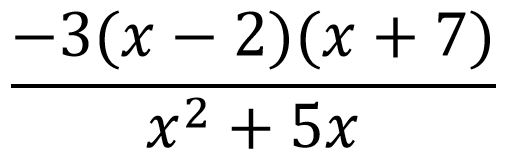

What creates a hole in the graph of a rational function?
Crossing the x-axis
An absence of dirt.
Crossing a vertical asymptote.
A factor that cancels out.

R: All real number y≠ 1
R: All real number y≠ -3
R: All real number y≠ 1
R: All real number y≠ 3

What is the Domain & Range of the function
D: (-∞, 5) (5,∞)
R: (-∞,1) (1,∞)
D: (-∞,1) (1,∞)
R: (-∞, 5) (5,∞)
D: (-∞,-1) (-1,∞)
R: (-∞,-5) (-5,∞)

