wayground logo

Free Printable Worksheets

Font size

S
M
L
XL
Worksheets

PMA 2 Review

Total questions: 60

Worksheet time: 3620secs

Name
Class
Date
1.

Which object has the highest density in this picture?

a)

A

b)

B

c)

C

2.

What is the density of an object if it has a mass of 6g and a volume of 3cm3? (Hint: Density = mass/volume)

a)

6 g/cm3

b)

3 g/cm3

c)

2 g/cm3

d)

1/3 g/cm3

3.

Which substance is the most dense in this picture?

a)

Vegetable Oil

b)

Dish Soap

c)

Honey

d)

Corn Syrup

4.
Calculate the density of the cube.
a)
2 g/cm3
b)
4 g/cm3
c)
6 g/cm3
d)
8 g/cm3
5.
What is the volume of Object X?
a)

10.0 ml

b)

15.0 ml

c)

20.0 ml

d)

25.0 ml

6.
Particles in an atom that are neutral and have no charge are 
a)
negatrons 
b)
electrons 
c)
neutrons 
d)
protons 
7.
the central region of an atom where its neutrons and protons are is its 
a)
nucleus 
b)
electron cloud
c)
core 
d)
center 
8.
The positive particles of an atom are 
a)
electrons 
b)
positrons 
c)
neutrons 
d)
protons 
9.

The Law of Universal Gravitation establishes that the force of gravity between two objects depend on their masses and the distance between them. How would you describe the gravitational relationship between the Sun and each planet.

a)

It is the same, as planets have similar masses and are at similar distances from the Sun.

b)

It is the same, as planets have different masses and are at different distances from the Sun.

c)

It is the different, as planets have similar masses and are at similar distances from the Sun.

d)

It is the different, as planets have different masses and are at different distances from the Sun.

10.
As distance between two objects increase the pull of gravity 
a)
Increases
b)
Decreases
c)
Stays the same
11.
A person would weigh less on on the Moon than on the Earth because . . .
a)
Moon has more mass, and therefore more gravity
b)
Moon has less mass, and therefore more gravity
c)
Moon has more mass, and therefore less gravity
d)
Moon has less mass and therefore less gravity
12.

You weight 200 lbs on Planet A and 150 lbs on Planet B. Which planet has a larger gravitational pull?

a)

Planet A

b)

Planet B

c)

Cannot tell, as the weight does not depend on gravity.

d)

The statement is incorrect because the weight will be the same in both planets.

13.

Which of the following quantities will change depending where you are in space?

a)

your mass

b)

your weight

14.

Which of the following is true?

a)

The closer a planet is to the sun, the longer its day (rotation).

b)

The farther a planet is from the sun, the shorter its day (rotation).

c)

The farther a planet is from the sun, the longer its year (revolution).

d)

The closer a planet is to the sun, the longer its year (revolution).

15.

In general, the farther a planet is from the Sun, the _____ its temperature.

a)

higher

b)

lower

16.

What is the name of this model?

a)

Heliocentric Model

b)

Geocentric Model

c)

Circle Model

d)

Aristotle Model

17.

What does the Heliocentric system look like?

a)
b)
c)
d)
18.

Which of the following statements is true?

a)

During summer in a hemisphere, it receives indirect light.

b)

During winter in a hemisphere, it receives indirect light.

c)

During summer both hemispheres receive indirect light.

d)

During winter both hemispheres receive indirect light.

19.
Which season is taking place in the Northern Hemisphere in Position 1?
a)
Winter
b)
Spring
c)
Summer
d)
Fall
20.
What season is letter A in the northern hemisphere?
a)
Winter
b)
Summer
c)
Spring
d)
Fall
21.

At position 2 the Northern Hemisphere experiences __________ and the Southern Hemisphere experiences __________.

a)

winter, summer

b)

summer, winter

c)

spring, fall

d)

fall, spring

22.
What is a difference between spring and neap tides?
a)
Spring tides occur when the earth and sun are IN LINE with the new or full moon. 
b)
Spring tides occur when moon in 3rd or 1st quarter phases
c)
Spring tides are LOWER than neap tides
d)
Spring tides occur in Spring and neap tides can occur in any season
23.
What type of tides would this arrangement of earth-moon-sun create?
a)
neap tide
b)
spring tide
c)
new moon tide
d)
full moon tide
24.
What type of tide would this arrangement of earth-moon-sun create?
a)
full moon tide
b)
new moon tide
c)
neap tide
d)
spring tide
25.
What type of eclipse is this?
a)
Solar eclipse
b)
Lunar eclipse
26.
What type of eclipse is this?
a)
Solar Eclipse
b)
Lunar Eclipse
27.
What is the correct order (starting from the surface) of Earth's layers?
a)
crust, mantle, inner core, outer core
b)
mantle, outer core, inner core, crust
c)
inner core, outer core, mantle, crust
d)
crust, mantle, outer core, inner core
28.
What layer is shown by letter C?
a)
Crust
b)
Mantle
c)
Outer core
d)
Inner core
29.
What causes tectonic plates to move along the Earth's surface?
a)
wind
b)
ocean currents
c)
convection in the mantle
d)
expansion of the Earth
30.

Which feature forms at convergent boundaries?

a)

mountain range

b)

trench

c)

rift valley

d)

mid-ocean ridges

31.

Boundary where two plates slip past each other, moving in opposite directions are?

a)

divergent

b)

transform

c)

convergent

32.

Boundary where two plates collide?

a)

convergent

b)

divergent

c)

transform

33.

Boundary where plates move away from each other are?

a)

convergent

b)

Divergent

c)

transform

34.
Which process would be most effective in determining the age of fossils embedded in rock?
a)
relative dating
b)
absolute dating
c)
use of index fossils
d)
use of core sampling
35.
What divides Earth’s history into smaller intervals based on major events or changes on earth. 
a)
Geologic timescale
b)
Geologic column
c)
Law of Superposition
d)
Index fossils
36.
oldest layers are at the bottom and the youngest ones are at the top
a)
True
b)
False
37.
Fossils form in which type of rock?
a)
sedimentary
b)
igneous
c)
metamorphic
38.
Which layer is the oldest?
a)
1
b)
2
c)
3
d)
4
39.

The smallest basic unit of all living things is a

a)

cell

b)

tissue

c)

organism

d)

organ

40.

Which of the following correctly lists the levels of biological organization from LEAST complex to MOST complex?

a)

cell, tissue, organ, organ system, organism

b)

cell, organism, organ system, organ, tissue

c)

organ system, organism, organ, tissue, cell

d)

organism, organ system, organ, tissue, cell

41.

The cell theory applies to all organisms, including the five shown. Which of the following statements describes how these organisms are an example of the cell theory?

a)

The organisms have cells that lack a nucleus.

b)

The organisms are made of one or more cells.

c)

The cells of the organisms undergo photosynthesis.

d)

The cells of the organisms are identical to each other.

42.

A scientific theory explains how or why things happen in nature.

a)

True

b)

False

43.

The cell theory developed from the work of many different scientists. Which of the following statements is NOT part of the cell theory?

a)

All cells come from other living cells.

b)

The cell is the basic unit of all living things.

c)

All cells of living things have the same organelles.

d)

All living things are made up of one or more cells.

44.

There were many systems involved in helping the body keeps its normal body temperature. Check all that apply.

a)

Nervous

b)

Circulatory

c)

Muscular

d)

Integumentary

45.
Failure to maintain homeostasis could result in:
a)
lack of internal balance
b)
eventual death
c)
difficulty carrying on metabolism 
d)
all three
46.

What kind of cell is shown above?

a)

Plant Cell

b)

Animal Cell

47.

What kind of cell is shown above?

a)

Plant Cell

b)

Animal Cell

48.

Check ALL of the parts of an animal cell.

a)

cell wall

b)

cell membrane

c)

nucleus

d)

cytoplasm

e)

green chloroplast

49.

Compare animal and plant cells.

a)

They both have cytoplasm, nucleus, and a cell membrane.

b)

They both have different types of organelles that have jobs to do.

c)

They both have chloroplast and make their own food.

d)

They both have a cell wall to help protect the cell.

50.

When there are low levels of water in the blood, the body triggers retention of water from kidneys. Which two body systems interact to maintain homeostasis?

a)

excretory and circulatory

b)

circulatory and respiratory

c)

excretory and nervous

d)

respiratory and nervous

51.
Which two human body systems are most responsible for getting oxygen to cells?
a)
digestive and skeletal
b)
skeletal and circulatory
c)
circulatory and respiratory
d)
respiratory and digestive
52.
Which electromagnetic wave has the shortest wavelength?
a)
radio
b)
gamma
c)
visible
53.
Which of the following forms of electromagnetic radiation has the lowest frequency,longest wavelength, and carries the least amount of energy?
a)
radio
b)
gamma
c)
infrared
d)
visible
54.
Sound is able to travel faster in solids than in air because the molecules in a solid are
a)
closer together than air molecules
b)
more easily moved than air molecules
c)
moving faster than air moleculesmoving faster than air molecules
d)
larger than air molecules
55.
Electromagnetic energy travels in waves. When we describe electromagnetic waves, we often talk about the wave’s length and frequency. Which of these statements accurately describes the relationship between the wavelength and frequency of an electromagnetic wave?
a)
If wavelength increases, frequency increases.
b)
If frequency decreases, wavelength increases.
c)
If frequency remains constant, wavelength increases.
d)
If wavelength remains constant, frequency increases.
56.

Through which of the following light travels faster?

a)

Through vacuum/empty space

b)

Through glass

c)

Through water

d)

Through a solid

57.
Which statement best explains what is happening in this picture?
a)
The light is being reflected which makes the spoon appear broken.
b)
The light is being refracted which makes the spoon appear broken.
c)
The light is being absorbed which makes the spoon appear broken.
d)
The light is being transparent which makes the spoon appear broken.
58.
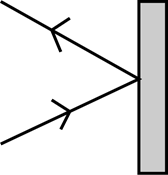
The illustration shows a light ray striking an object.
The light ray is-
a)
absorbed
b)
stopped
c)
reflected
d)
refracted
59.

What is the best description of a transparent material?

a)

no light passes through the material

b)

some light passes through the material

c)

all light passes through the material

60.
Theory or Law???  Is a DESCRIPTION of what a scientists expects to happen every time under a certain set of conditions.
a)
Law
b)
Theory