Wayground logo

Free Printable Worksheets

Font size

S
M
L
XL
Worksheets

Semester 1 Review

Total questions: 40

Worksheet time: 21mins

Name
Class
Date
1.

Which of the following is a characteristic of all minerals?

a)

Crystalline structure

b)

Fills the shape of its container

c)

Usually organic

d)

Random chemical composition

2.
Means that a mineral cannot come from something that was once living.
a)
Inorganic
b)
Organic
c)
Naturally Occurring
d)
Not Living
3.
This is measured on  the Mohs Scale.
a)
Cleavage
b)
Density
c)
Hardness
d)
Luster
4.
_______ is found by rubbing the mineral against an unglazed tile called a plate.
a)
Cleavage
b)
Color
c)
Luster
d)
Streak
5.
This is how a mineral reflects light.
a)
Cleavage
b)
Density
c)
Hardness
d)
Luster
6.
This rock is formed by extreme heat and/or pressure that alters the chemical composition into a new form of rock.
a)
Inorganic
b)
Igneous
c)
Metamorphic
d)
Sedimentary
7.
This rock  is formed from molten rock (magma/lava) that has cooled.
a)
Igneous
b)
Inorganic
c)
Metamorphic
d)
Sedimentary
8.
This rock is formed by erosion (continuously broken down into small fragments) and  then is compressed and  cemented together.
a)
Inorganic
b)
Igneous
c)
Metamorphic
d)
Sedimentary
9.
What happens to a rock when it weathers?
a)
It settles out of water that is carrying it.
b)
It creates a valley.
c)
It forms a delta.
d)
It breaks into small pieces.
10.
Acid rain causes
a)
physical weathering.
b)
chemical weathering.
c)
both chemical and physical weathering.
d)
neither chemical or physical weathering.
11.
Physical and chemical weathering both
a)
change rocks into new materials.
b)
dissolve rocks.
c)
break rocks into smaller pieces.
d)
require exposure to air.
12.

Moving sediment from one place to another

a)

Weathering

b)

Deposition

c)

Erosion

d)

Earthquake

13.

The dropping off of sediments in a new place.

a)

Weathering

b)

Erosion

c)

Deposition

d)

Volcano

14.
Erosion caused by _______________ changes beaches and lakes
a)
glaciers
b)
ice
c)
waves
15.

Topsoil is dark in color because it...

a)

undergoes a lot of chemical weathering.

b)

has a large amount of organic material.

c)

is full of dark rocks.

d)

contains a lot of worms.

16.

a dark-colored substance that forms as plant and animal remains decay

a)

soil

b)

top soil

c)

loam

d)

humus

17.

occurs when frozen precipitation falls over an area and seeps into small cracks in rocks and other materials. As the ice and snow begin to melt, it liquifies and pools into these crevices, and then refreezes at night

a)

ice wedging

b)

weathering

c)

chemical weathering

d)

mechanical weathering

18.

What is the thickest layer?

a)

the core

b)

the mantle

c)

the crust

d)

the uppermantle

19.

What materials make up the inner core?

a)

copper and nickle

b)

iron and nickle

c)

metal and copper

d)

water and nickles

20.

List the layer in order

a)

1.Crust

2.inner core

3.outer core

4.Mantle

b)

1.inner core

2.outer core

3.crust

4.Mantle

c)

1.Mantle

2.outer core

3.inner core

4.crust

d)

1.crust

2.Mantle

3.Outer core

4.inner core

21.
Temperature _____________________ as you go deeper into the earth.
a)
increases
b)
decreases
c)
goes up and down depending on the layer
d)
stays the same
22.
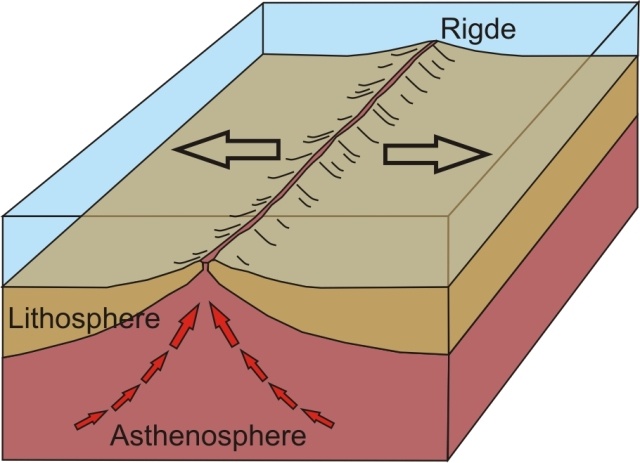
What kind of plate boundary is shown here?
a)
divergent
b)
convergent
c)
transform
d)
submergent
23.
What kind of plate boundary is shown here?
a)
divergent
b)
convergent
c)
transform
d)
subducting
24.
What kind of plate boundary is shown here?
a)
divergent
b)
convergent
c)
transform
d)
strike slip
25.
The area where two or more plates meet is called a __________________.
a)
fault
b)
plate boundary
c)
plate edge
d)
ring of fire
26.

___________, meaning "all land," is the name of the great landmass that existed millions of years ago.

a)

lithosphere

b)

Pangaea

c)

subduction zone

d)

tectonic

e)

Wegener

27.
Who is the scientist who proposed Continental Drift Theory?
a)
Albert Einstein
b)
Alfred Wegener
c)
Isaac Newton
d)
John Dalton
28.

Which of the following resources would be considered renewable?

a)

coal

b)

wind

c)

metal ore

d)

natural gas

29.

What is the term for important nonrenewable resources that formed from the remains of living organisms?

a)

solar particles

b)

mineral sediments

c)

fossil fuels

d)

elemental energy

30.

A resource that is not easily replaced...

a)

Renewable

b)

Nonrenewable

c)

Plants

d)

Animals

31.
Which group includes ALL renewable resources?
a)
Coal, trees, water, oil
b)
Water, wind, sun, plants
c)
Minerals, sun, natural gas, water
32.

Fossil fuels are nonrenewable because...

a)

they are used to produce heat

b)

they take a long time to be replenished

c)

they can be found underground

d)

they produce pollution

33.

What does conserving resources mean?

a)

Using as many of the resources as you can

b)

Wasting resources

c)

Saving resources and using them wisely

d)

Using a lot of resources

34.

What was the most widely used NONRENEWABLE resource in 2009?

a)

Natural gas

b)

Biomass

c)

Petroleum

d)

Hydropower

35.

What was the most widely used RENEWABLE resource in 2017?

a)

Coal

b)

Petroleum

c)

Hydroelectric

d)

Biomass

36.

What determines if a resource is renewable or nonrenewable?

a)

The rate at which they are replenished

b)

The cost of the resources

c)

How much pollution it causes

d)

How the resource will be used

37.

Which one is not a sustainable practice?

a)

b)

c)

d)

38.

Out of the 4 choices, which would be the LEAST sustainable:

a)

Everyone driving their own car

b)

Walking

c)

Taking a bus

d)

carpooling with a friend

39.

Energy from the sun is ___________________.

a)

hydroelectric energy

b)

geothermal energy

c)

solar energy

d)

wind energy

40.

Anything from nature that living things use is called a ______________.

a)

energy

b)

pollution

c)

food

d)

natural resource