
NEW
Font size
 Worksheets
RMSA Waves and Space Technology 2023
Total questions: 43
Worksheet time: 31mins
A big advantages of digital technology is the recording takes up less storage space on a device and can be stored for a longer period of time.
They are higher resolution
This is a signal where the data is represented by binary digits.
Digital
Analog
NTSC
CRT
This is a signal that fluctuates exactly like the original signal with higher resolution.
Analog
Digital
High Definition
Binary

Which of the following is an advantage of analog signals
Less prone to interference
Requires less power
Travels Farther
Can carry more detailed information

What type of electromagnetic wave has a higher frequency than visible light and a larger wavelength than x-rays
Infrared
Gamma
visible
Ultraviolet

What type of wave has the smallest wavelength and the highest frequency on the electromagnetic spectrum?
Radio
Micro
Gamma
X ray

Which electromagnetic waves are useful for Television?
Gamma
x ray
radio
microwave
Why is the Hubble telescope located in space rather than on the surface of earth?
NASA wants to explore the surface features of Mars,
What’s the best space technology to send to the planet?
Telescope
Space Rover
Probe
Satellite
Which type space technology flies by a planetary object, gathering data and images as it passes by the celestial object.
Fly-By/ Space Probe
Telescope
Satellite
Rover
Unmanned space technology needs to send data back to earth for scientists to analyze. Which types of wave signals are sent between the technology and Earth for communication.
electromagnetic waves
sound waves
gravitational energy
seismic waves


They are better at finding alien technology.
Which is the following is NOT a requirement for the classification of dwarf planets?
have not cleared their orbit of other objects
spherically shaped
orbit the Sun
made of ice
Triton is a large, natural body of matter that revolves around Neptune. The classification used to describe Triton is __________.
Star
Comet
Meteor
Moon

What is wrong with the picture of the solar system.
The planets should have been much FARTHER apart from each other.
The planets are NOT colorful. They are white.
We DON’T know exactly what the planets look like
Planets are oval and NOT round.
The FARTHER away from the Sun …
the CLOSER together the planets are to one another.
the FARTHER apart the planets are from one another.
SOME planets are close, OTHERS are farther apart.
NONE of the above.
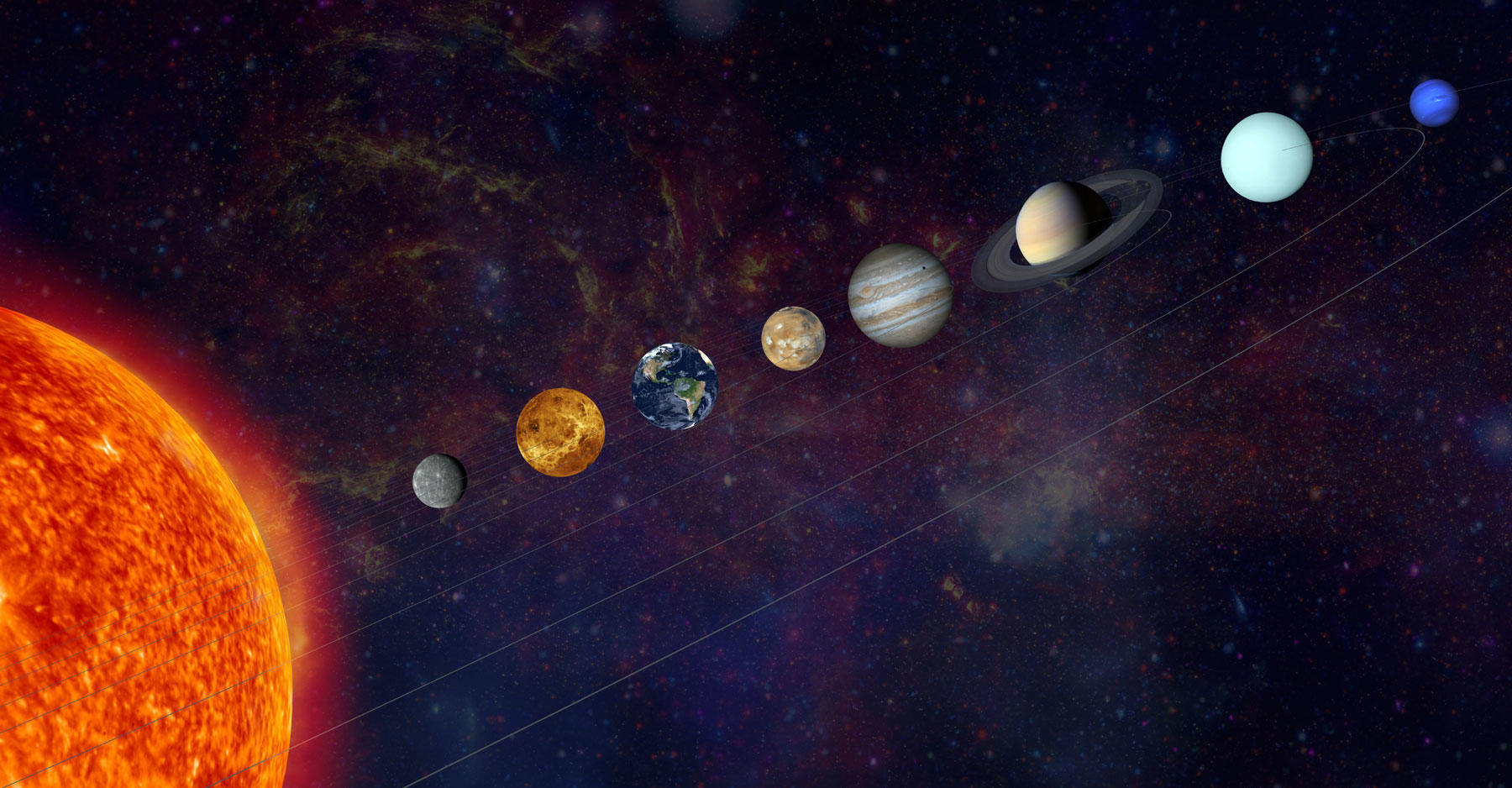
The planets are all equally distanced from each other.
Why do scientists use scale to study the Solar System?
The solar system is too large to study without using scale models
The solar system is too small to study without using scale models
Scientists don't need to use scale because we have satellites
All of the above
Why is making a model of the solar system difficult?
Don't have the right materials
The solar system is so big and the objects in it are so small in comparison
There are too many parts in a model
Because the science concepts are too difficult

Which of the following list the correct hierarchy in the Universe from biggest to smallest?
Universe, galaxies, solar system, stars and planets
Planets, stars, solar system, galaxies, universe
Solar system, galaxies, stars, planets, universe
Universe, solar system, galaxies, planets and stars
Comet Hartley was first spotted in 1986 at Siding Spring Observatory in Australia. It is a small, peanut-shaped comet about 1.6 kilometers across that takes about 6.5 years to orbit the sun. It last passed by in 2017, and the time before, in 2010. In what year will it be visible next?
2030
2023
2026
2075

The strongest parts of the magnet are ...
fronts
backs
poles
middle
What would happen if a north pole of a magnet came close to a north pole of another magnet?
they would be attracted to each other
they would be repelled from each other


Which one represents the magnetic field lines of magnets repelling?
A
B
What happens to the strength of a magnetic field as you move away from the magnet?
The strength of the magnetic field increases.
The strength of the magnetic field doesn't change.
The strength of the magnetic field is doubled.
The strength of the magnetic field decreases.
add more wire coils and/or more voltage to the battery

Where can an electric field be found?
below a force field
in a gravitational field
in the space surrounding a charged object
outside of a magnetic field

Which electromagnet will pick up LESS paper clips?
A
B

Which electromagnet will pick up MORE paperclips?
A
B
Electromagnetic technology is used in many different ways today. Which of these are uses of this technology?
high-speed trains
electric generators
MRI Machines
all of these

