
 Worksheets
Biology Quiz 3 CH 3 Cell transport and enzymes
Total questions: 29
Worksheet time: 20mins
Which process allows carbon dioxide to move across the plasma membrane?
Endocytosis
Passive Transport
Facilitated Diffusion
Exocytosis
Active Transport
What factor influences the rate of diffusion of molecules?
Color of the molecules
Shape of the molecules
Concentration gradient
Sound intensity
Light intensity
What is the process called when a cell uses energy to transport a substance across a membrane, against its concentration gradient?
Osmosis
Passive Transport
Active Transport
Diffusion
Facilitated diffusion
Solution A has a higher solute concentration than solution B. This makes solution A:
Hypertonic
Hypotonic
Isotonic
Isometric
Formative
If red blood cells are placed in a hypotonic solution, what will happen to the cells?
Nothing
Formative
Water will enter into the cell, making it swell and possibly burst
Water will leave the cell, making it shrink
An equal amount of water will enter and exit the cell
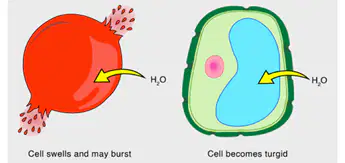
When placed in a type of solution, the cells below will expand and appear as shown in the image.
Hypertonic
Hypotonic
Isotonic
Formative
In the same way as the biological macromolecules in our food, the glucose stored in our body is an example of:
Potential energy
Kinetic energy
A cell is placed in a solution that contains 10% sugar. The cell itself contains 30% sugar. What will happen due to osmosis?
Water will flow from the solution to the cell.
Sugar will flow from the cell to the solution.
Water will flow from the cell to the solution.
Sugar will flow from the solution to the cell.
Salting is a common method used to preserve foods like pickles. This involves a 20-30% salt solution known as brine. How does this high salt concentration prevent the growth of microorganisms that have a similar solute to water ratio as human blood cells (0.9% saline; 99.1% water)?
The high salt concentration creates a hypertonic environment causing the bacteria to lose water and die
The high salt concentration creates a hypotonic environment causing the bacteria to take in too much water and burst
The brine solution creates an isotonic environment that is not suitable for bacterial growth
Energy is stored in ATP within
The ribose sugar
The adenine base
The phosphate bonds
The hydrogen bonds
The oxygen molecule
What is the primary source of energy for photosynthesis in plants?
Wind
Water
Soil nutrients
Sunlight
What is the term for a chemical reaction that breaks down larger molecules into smaller ones?
Anabolic
Metabolic
Catabolic
Formative
Parabolic
What is the term for biological catalysts that accelerate chemical reactions?
Antibodies
Enzymes
Hormones
Vitamins
Which of the following statements about enzymes is FALSE?
Enzymes are proteins that act as biological catalysts.
Enzymes lower the activation energy of a reaction.
Each enzyme is specific to a particular substrate.
Enzymes are consumed in the reactions they catalyze.
Enzymes can function at any pH or temperature.
What is the role of enzymes in the human body?
They help in digestion of food
They help in the production of energy
They help in the synthesis of proteins
All of the above
What happens when an enzyme is denatured?
Its shape changes and it can no longer function
It breaks down into its component amino acids
It becomes more efficient at catalyzing reactions
It can function at any temperature and pH
What is the effect of temperature on enzyme activity?
Enzyme activity increases with temperature
Enzyme activity decreases with temperature
Enzyme activity is not affected by temperature
Enzyme activity increases up to a certain temperature, then decreases
How does an enzyme speed up a chemical reaction?
By increasing the activation energy
By decreasing the activation energy
By changing the products of the reaction
By changing the reactants of the reaction
What is the role of an enzyme in a biochemical reaction?
It acts as a product
It acts as a reactant
It acts as a catalyst
It acts as a solvent
What happens to an enzyme after it has catalyzed a reaction?
It is consumed and cannot be used again
It is unchanged and can be used again
It is converted into a product
It is converted into a reactant
What is the process by which water molecules move from an area of high concentration to an area of low concentration?
Osmosis
Diffusion
Active Transport
Endocytosis
What happens to the rate of an enzyme-catalyzed reaction as the substrate concentration increases?
The rate decreases
The rate remains the same
The rate increases until it reaches a maximum level
The rate increases indefinitely
What is the term for the movement of molecules from an area of high concentration to an area of low concentration?
Osmosis
Active Transport
Passive Transport
Endocytosis
We talked about different types of transport. Describe each type of transport listed. (4 points)
a) Simple diffusion
b) Facilitated diffusion
c) Active transport
d) Endocytosis
Explain how enzymes work to limit energy needed to activate a reaction. by drawing a picture of the reaction with and without.


What is the difference between competitive and noncompetitive inhibitors in terms of their interaction with enzymes?
Competitive inhibitors bind to the active site of the enzyme, while noncompetitive inhibitors bind to an allosteric site
Competitive inhibitors bind to an allosteric site of the enzyme, while noncompetitive inhibitors bind to the active site
Both competitive and noncompetitive inhibitors bind to the active site of the enzyme
Both competitive and noncompetitive inhibitors bind to an allosteric site of the enzyme
How does a noncompetitive inhibitor affect the rate of an enzyme-catalyzed reaction?
It increases the rate of the reaction
It decreases the rate of the reaction
It does not affect the rate of the reaction
It first increases, then decreases the rate of the reaction
What is the difference between competitive and noncompetitive inhibitors in terms of their interaction with enzymes?
Competitive inhibitors bind to the active site of the enzyme, while noncompetitive inhibitors bind to a different site
Competitive inhibitors bind to a different site of the enzyme, while noncompetitive inhibitors bind to the active site
Both competitive and noncompetitive inhibitors bind to the active site of the enzyme
Both competitive and noncompetitive inhibitors bind to a different site of the enzyme
How does a competitive inhibitor affect the rate of an enzyme-catalyzed reaction?
It increases the rate of the reaction
It decreases the rate of the reaction
It does not affect the rate of the reaction
It first increases then decreases the rate of the reaction

