
 Worksheets
Final Exam Review Q2 Math 2 Honors
Total questions: 180
Worksheet time: 14hrs 39mins
k2 -2k - 24
Factor: x2+6x+8
(x - 4)(x + 2)
(x + 4)(x + 2)
(x + 6)(x + 8)
Factor: 3x2+10x−8
(3x + 1)(x - 4)
(2x - 1)(x + 3)
(3x - 2)(x + 4)
If your factors are (x+5)(x−9) , what are your solutions?
{-5, -9}
{-5, 9}
{5, -9}
If your factors are (3x+1)(x−2) , what are your solutions?
{−31, 2}
{31, −2}
{−1, 2}
If your factors are (7x−3)(2x+1) , what are your solutions?
{73, 21}
{73, −21}
{37, −12}
Factor the Difference of Squares: x2−121
(x + 11)(x +10)
(x + 11)(x - 11)
(x - 11)(x - 11)
( x - 4) ( x + 4)
Factor the Perfect Square Trinomial:
n2 + 10n + 25
(n + 5)(n - 5)
(n + 25)(n + 1)
(n - 5)2
(n + 5)2
Factor the Perfect Square Trinomial:
x2 - 20x + 100
(x - 10)2
(x + 10)2
The height of a water balloon that is launched into the air is given by h(t) = -5x2+20x+25. When will the balloon explode on the ground?
5 seconds
1 second
2 seconds
3 seconds
Which is the correct factoring and solutions?
2h2+11h+5 = 0
(2h +5)(h + 1); h = −25 , −1
(2h +1)(h + 5); h = −21, −5
(2h +2)(h + 3) h = −1, −3
(2h +3)(h + 2) h = −23, −2

Solve the equation by factoring.
{−3, −4}
{−6, −1}
{8, 1}
{−1, −2}

Solve the equation by factoring.
{2, −1}
{−5, 5}
{−4, 1}
{−8, 6}

Solve the equation by factoring.
{2, 6}
{2, 0}
{−2, 0}
{−5, 1}
Solve: 2x2−15=x
x=−25 and x=3
x=25 and x=−3
x=25 and x=3
x=−25 and x=−3
Simplify −18
3i2
9i
2i3
3i
Simplify −4
2x
2
2i
-2
√96


Solve for x.
5(x - 3)2 + 1 = 81
x = -1, 7
x = -7, 1
x = ± 9
x = 3, 10
Solve for x.
2(x + 5)2 = 28
5±14
−5±27
−5±14
5±27
12x2+4=−236
±2i5
−20
±20i
±5i2
9r2−2=646
±26
±38
±218
±62
x2 +12x = 5
k2 − 12k + 23 = 0
x2 + 12x + ____
Solve the quadratic equation by completing the square:
x2 + 4x - 35 = 5


Solve the following equation by completing the square. 2n2+4n−12=0
−1+7,1−7
−1+7,−1+7
−1+7,−1−7
Solve by completing the square.
x2−6x+4=0
−3±5
5±3
3±5
−5±3
4 Determine the value of the discriminant and name the nature of the solution for the following:
x2 + 2x - 63
Remember: b2 - 4ac
256 - 2 reals - Rational
√(-256 - 2 imaginary solutions
√(137) - 2 reals - Irrational
123 - 2 reals - Rational
x2 + 7x + 13
Remember: b2 - 4ac

For the function above, is the discriminant positive, negative, or zero?

For the function above, is the discriminant positive, negative, or zero?
What is the discriminant of 6x2 − 2x − 3 = 0
76
29
68
none of these
Look at the equation below.
x2+5x+7=0
2−5±3
2−5±i3
2−5±53
2−5±i53
Solve the following equation. Write your answers in simplest radical form.
x2+10x+35=0
−5±2i5
−5±i5
−5±2i10
−5±i10
Solve using the quadratic formula...
9x2−7x=4


No solution
Solve using the quadratic formula. f(x)=2x2−4x+7
22±2i10
44±40
22±i10
42±2i40
5x2+3x−3=0
10−3±i51
10−3±69
23±69
10−3±323
x2−6x+4=0
3±5
26±20
3±20
3±i13
3x2+5x+9=−5x+4
3−5±10
6−10±40
3−5±5
35±i5
2x2−36=x
x=2−9and 4
x=29 and −4
x=4 and −4
No real solution
Solve with the Quadratic Formula: 2r2+r−2=0
{55, −55}
{52i5, −52i5}
{4−1+5, 4−1−5}
{4−1+17, 4−1−17}
If a toy rocket is launched vertically upward from ground level with an initial velocity of 128 feet per second, then its height h after t seconds is given by the equation
h(t) = -16t2 +128t
When will the object reach its maximum height?
4 ft
0 seconds
0 ft
4 seconds
None of the above
An object in launched directly upward at 64 feet per second (ft/s) from a platform 80 feet high. Its height is represented by the equation
s(t) = –16t2 + 64t + 80
What will be the object's maximum height?
2 ft
80 ft
144 ft
64 ft
A diver is standing on a platform above the pool. He jumps form the platform with an initial upward velocity of 8 ft/s. Use the formula: h(t) = −16 t2 + 8t + 24
How high is the platform?
.25 ft
24 ft
25 ft
8 ft
The profit from selling local ballet tickets depends on the ticket price. Using past receipts, we find that the profit can be modeled by the function:
p= -15x2 +600x +60
What is the maximum profit you can make from selling tickets?
$6060
$20
$600
$10,250
6 seconds
Simplify the expression.
(−16a4+5a2+18a+3)
−16a4+7a+3
−16a4+10a2+7a+3
−16a4+18a+3
Simplify the expression.
3p5+11p3−21p2+10p
3p5+11p3−4p2+10p
3p5+11p3−18p2+10p
3p5+11p3−16p2+10p
Simplify the expression.
−5a4−29a2+2
−5a4−29a2+15
−5a4−17a2+2
−19a4−29a2+15
Simplify the expression.
7x5+5x4−21x
−x5+5x4−18x
−x5+5x4−21x
10x5+5x4−21x
Simplify the expression.
17k4−k2−28
17k4−k2−22
−11k4−21k2+4
17k4−k2−29
Simplify the expression.
−13x5+18x2+6x
−13x5+18x2
−3x5+18x2
−3x5+18x2+6x
The the product.
36n3+36n2−36n
24n2−12n+42
9n2+18n−15
35n3−25n2+20n
Find the product.
16r2−50r+25
16r2+25
16r2−30r−25
16r2+30r−25
Find the product.
−56x3+9x2+99x−56
4x3+15x2+7x−6
−48x3−22x2+79x−24
−7x3+20x2−26x+12
(3x-5) (4x2-2x-3)
What is the standard form of the polynomial,
7x - 125 - 6x4 + 14x2
125 + 7x - 14x2 +6x4
6x4 -14x2 - 7x +125
125 + 14x2 + 7x - 6x4
-6x4+ 14x2 + 7x - 125
Simplify the expression.
(4n4 - 8n + 4) - (8n2 + 4n4 + 1)
-8n2 - 8n + 3
-7n2 - 8n + 3
-6n2 - 8n + 3
-7n2 - 4n + 3
Evaluate f(4).
x3 -2x2 -17x + 1
for x = -2
(5n-8)(5n+8)
Convert the equation y= 5x2 - 40x + 67 into vertex form.
y= -5(x + 4)2 + 13
y= 5(x + 4)2 - 13
y=5(x - 4)2 - 13
y= 5(x - 13)2 + 4
y=4(x+2)2−8
Convert the equation from vertex form to standard form.
y=4x2+16x+8
y=4x2+16x+16
y=16x2+64x−8
y=16x2+256x+8
Convert the equation from Standard Form to Vertex Form.
y = 3(x + 1)2 - 8
y = 3(x - 1) 2 - 8
y = 3(x + 2)2 - 8
y = 3(x - 2)2 - 8
Convert to Standard Form: y = (x+2)2+3
y = x2+2x+3
y = x2+4x+3
y = x2+4x+4
y = x2+4x+7
Convert to Standard Form: y = (x-3)2+5
y = x2-3x+5
y = x2-6x+14
y = x2-6x+9
y = x2+6x+14
Convert to Standard Form: y = -(x+5)2-3
y = -x2-10x-28
y = -x2-10x-25
y = x2-10x-22
y = x2+10x+28
Convert to Vertex Form: y = -x2+4x-2
y = -(x+2)2+2
y = (x-2)2-2
y = -(x-2)2+2
y = (x-2)2+2
Convert to Vertex Form: y = 2x2+8x+15
y = (x+2)2+3.5
y = 2(x+2)2+7
y = (x+4)2+7.5
y = 2(x+8)2+15
Convert to Vertex Form: y = -3x2-6x+24
y = -3(x+1)2+27
y = -3(x+1)2-9
y = 3(x+1)2-27
y = (x+1)2-9
Find the sum.
(5-2i) + (-7+8i)
-2+6i
12+6i
-35-16i2
-35 -16i
(3+8i)(-2-i)
2-19i
23-i
34+5i
23-i
(5+8i)+(6-10i)
-1-18i
11-2i
13-4i
-20i
(-9-5i)-(2-7i)
-40+14i
-7-12i
-59i
-11+2i
Another way to express i2 is?
1
-1
i
−i
Simplify: (−2 + 7i)(4 − 2i)
6+ 32i
−6 + 32i
22+32i
6 + 24i
52+42
94
92
202
320+45
105
165
725
12+518+227
83+152
82+153
252
−52+108+318
242
442
622
Multiply: (4 - i)(4 + i)
16−i2
17
16−8i−i2
17-8i
Multiply (5 + 2i)(5 - 2i)
25−i2
21
29
29-10i

y2816x16z32
y28−16x16z32
16y28x16z32
−8x−8y3z−12
(7r3−8p10)2
-64p20/ 49r6
64p20/ 49r6
-8p20/ 14r6
-64p12/ 49r5
Simplify so there are no negative exponents in the answer.
27n91
n9−27
n6−27
n6−9
Simplify so there are no negative exponents in the answer.
12x5
12x9
7x5
7x4
n3(2m3n2)02m3n−3
Simplify so there are no negative exponents in the answer.
n62m3
2m3
4m6n2
2m6n2


Write the expression in radical form: x43
4x3
3x4
x.75
x2

yx31⋅xy23
x34y25
x32y21
x31y23
x32y34
Simplify . Your answer should contain only positive exponents. 4v32⋅v−1
4v31
v314
4v31
4v311
Simplify . Your answer should contain only positive exponents. 3b−1a43b−1⋅b47
3a43b47
3a43b43
a43b47
3a43b47
Simplify . Your answer should contain only positive exponents. y−1•2y−313y−45
23y121
23y1219
2y1213
2y12193
Simplify
3x4x4
31
3
3x
3x4


Write the above expression in exponential form.


x = -2
x = 3
x = 5
No Solution

x = - 9, x = 7
x = 7
x = 9
x = 9, x = - 7
Solve
3x+10=x+4
x = -2
x = -2, 3
x = -2, -3
x = -3

x = 5
x = 33
x = 85
x = 21
Which transformations apply to the following function? f(x)=−x+23−2
right 2 units
down 2 units
left 2 units
up 2 units
reflection
Choose the correct graph for the following function? f(x)=−x+22+1


Check all the transformations that apply for the following function:
f(x)=x−71+3
down 7 units
right 7 units
right 3 units
up 3 units
up 1 unit
Check the correct asymptotes for the given function:
f(x)=−x+24−2
VA: x = 2
VA: x = -2
HA: y = 2
HA: y = -2
VA: x = 4
What is the Domain and Range for the following function?
f(x)=x+21−1
D: all real numbers
R: all real numbers
D: all real numbers x=−2
R: all real numbers y=1
R: all real numbers y=−1
What are the transformations of this functions compared to the parent function?
Shifted down 2
Shifted up 2
Shifted left 2
Shifted right 2
State the transformations:
reflects over x axis, vertical stretch by 3, right 2, up 1
reflects over y axis, vertical compression by -3, left 2, up 1
reflects over x axis, vertical stretch by -3, left 2, up 1
reflects over y axis, vertical compression by 1/3, right 2, up 1
Find the domain and range of the function
Hint: use the calculator to see the graph
Domain: (-∞, ∞) Range: [-∞, 4]
Domain: [1, ∞) Range: (-∞, 4]
Domain: [-1. ∞) Range: [4, ∞)
Domain: [4, ∞) Range: [-1,∞)
Describe the transformations:
Translate Right 2, Down 4
Translate Left 2, Down 4
Translate Left 2, Up 4
Translate Right 2, Up 4
How did this graph move from the parent function?
y=−x+91+1
Left 9 and Up 1
Left 9 and Down 1
Reflection over the x-axis, left 9 and up 1
Reflection over the x-axis, right 9 and down 1
How did this graph move from the parent function?
y=x3
Vertical Stretch of 3
Horizontal Stretch of 3
Up 3
Right 3
Solve the system of equations f(x)=−2x+6 and f(x)=−x+2
(-2, 0)
(3, 0)
(4.25, -2.5)
(2.5, -4.25)
Solve the system: f(x)=−41x +3 and f(x) = x
(4, 2)
(2, 4)
(0, 0)
No Solution
Find the x-values that satisfy the system of equations below.
y=3x+1 and y=53x+1
x = 1, 4
x = 0, 1
x = 5, 4
x = 0, 5


A relation is shown in the table.
Which statement about this relation is true?
It is a direct variation, because xy=24 .
It is an inverse variation, because xy=24 .
It is a direct variation, because y=23x .
It is an inverse variation, because y=23x .
If y varies inversely as x, and y = 23 when x = 8, find y when x = 4.
26
46
52
92
Points (3,10) and (x, 15) represent an inverse variation. Find x.
30
2
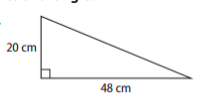
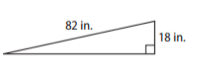

Are the triangles similar?
Yes by AA~
No
Yes by SSS~
Yes by SAS~


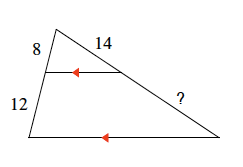

Solve for x.
10
5
7
4

Are the triangles similar? If so, what similarity shortcut is used?
Similar. SSS
Similar. SAS
Similar. AA
Not Similar.
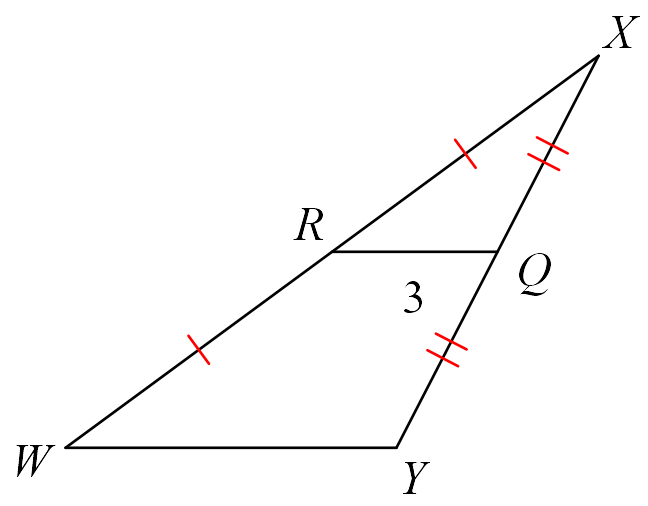
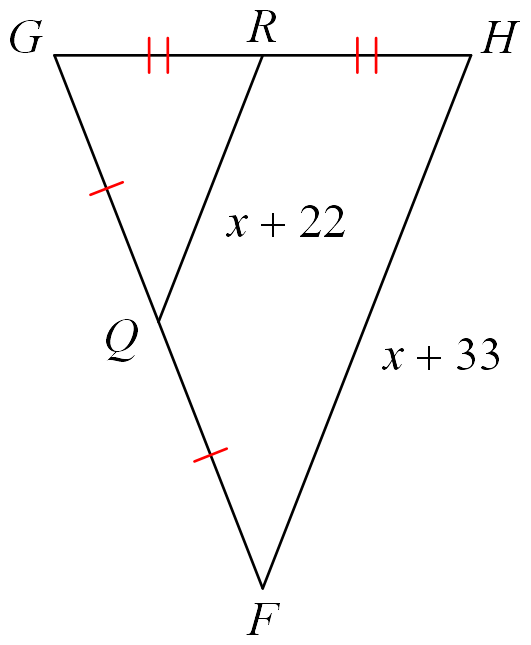


The pair of figures are similar. Find the missing side.
x = 12
x = 3
x = 40
x = 4


Solve:
3
4
-7
15


Which triangle is correctly labeled?


Which one is the easy trick to remember trigonometric ratios?
SAH COH TOA
SOH CAH TOA
SOH CAH TAO
SOH CEH TOA


Find the length of the missing side.
187.7
104.0
164.2
50.4

When solving for a side using SOH CAH TOA, if "x" is on the TOP of the ratio, you
subtract
add
divide
multiply

What is the length of y in this picture?
45
52
90
5
252

What is the length of x in this triangle?
42
4
8
43
2

What are the lengths of u and v in this triangle?
u=8, v=43
u=42, v=8
u=16, v=8
u=43, v=8
u=4, v=42

Find the value of y.
9
182
92
292
63

Find a.
3
33
63
23
9

Choose the correct value for
sin X .1312
135
512
125
513

What is the correct equation for this diagram?
sin40°=28w
cos 40°=28w
tan40°=28w
sin40°=w28
cos40°=w28

Find x.
(Use what you know about special right triangles. Is this 45-45-90 or 30-60-90?)
22
113
112
11

Find a.
(Use what you know about special right triangles. Is this 45-45-90 or 30-60-90?)
23
2
12
6

Solve for x. Round to the nearest tenth.
(Hint: SOH CAH TOA)
103.5
4.7
55.0

Choose the correct ratio. (Hint: SOH CAH TOA)
sin(37)=x/14
cos(37)=x/14
tan(37)=x/14

To the nearest whole degree.
66°
24°
22°
37°

