Worksheets
Physics Mid-Term Review
Total questions: 178
Worksheet time: 6hrs 47mins
The unit we use to measure acceleration is ___.
m/s
m
s
m/s2
Rocket-powered sleds are used to test the human response to acceleration. If a rocket-powered sled is accelerated to a speed of 444 m/s in 1.83 seconds, then what is the distance that the sled travels?
Choose the appropriate equation.
v=vo+at
d=vot+1/2at2
v2=vo2+2ad
d=1/2(v+vo)t
An engineer is designing the runway for an airport. Of the planes that will use the airport, the lowest acceleration rate is likely to be 3 m/s2. The takeoff speed for this plane will be 65 m/s. All airplanes will start from rest. Assuming this minimum acceleration, what is the minimum allowed length for the runway?
v=vo+at
d=vot+1/2at2
v2=vo2+2ad
d=1/2(v+vo)t
The unit we use to measure speed is ___.
m/s
m
s
m/s2
On the moon, a feather dropped from rest from a height of 2 meters reaches the surface in 1.57 seconds. What is the acceleration of gravity on the moon?
0.616 m/s2
1.59 m/s2
1.62 m/s2
2.54 m/s2
Choose the equation that help solve the following problem most easily...
Jake Peralta is in high speed (22.4 m/s) pursuit of his frienemy Doug Judy when he suddenly skids to a stop in 2.55 s. Determine the skidding distance of the car (assume uniform acceleration).


Choose the equation that help solve the following problem most easily...
Flight 828 accelerated down a runway at 3.20 m/s2 for 32.8 s until it finally lifts off the ground. Determine the distance traveled before takeoff.
Choose the equation that help solve the following problem most easily...
Moya is employed an engineer and is designing the runway for an airport. Of the planes that will use the airport, the lowest acceleration rate is likely to be 3 m/s2. The takeoff speed for this plane will be 65 m/s. Assuming this minimum acceleration, what is the minimum allowed length for the runway?
Choose the equation that help solve the following problem most easily...
Kenta drops out of school to pursue a career as a stunt person in Hollywood. h
Her first gig is to ride a rocket-powered sleds that is accelerated to a speed of 444 m/s in 1.83 seconds, then what distance did she travel?
Choose the equation that help solve the following problem most easily...
Sofia decides to take her acrogymnastics to the next level and try out for America's Got Talent. Her routine calls for a final jump that sees her free fall from rest on a platform (a=9.8m/s2 down) for 1.60 seconds, what will be her final velocity?
Choose the equation that help solve the following problem most easily...
Kenta drops out of school to pursue a career as a stunt person in Hollywood. h
Her first gig is to ride a rocket-powered sleds that is accelerated to a speed of 444 m/s in 1.83 seconds, then what distance did she travel?
A car accelerates uniformly from rest at 3.2m/s 2
when the car traveled a distance of 40 m it’s speed will be
12.5 m/s
8.0m/s
16m/s
128m/s
a car is NOT accelerating if it is moving
at constant velocity
only as influenced by gravity
in a circle
at increasing speed
a tiger travels 96 m in 8s. what is his velocity over the interval
0.04m/s
25m/s
225m/s
12m/s

A car can go from 0 m/s to 60 m/s in 10 seconds. What is the acceleration of the car?
6 m/s2
60 m/s2
180 m/s2
10 m/s2
A boat slows from 40 m/s to 10 m/s over a 15 m distance. What is the acceleration of the boat? (Assume the velocity is in the positive direction).
6 m/s2
- 6 m/s2
- 8 m/s2
-2 m/s2
A ball is dropped (starts from rest) and falls for 12 seconds. What is the distance traveled by the ball? (Assume the acceleration due to gravity is 10 m/s2).
720 m
1440 m
60 m
12 m
A car starts at rest and accelerates at a constant 2 m/s2 for 10 seconds. What is the final velocity of the car?
2 m/s
10 m/s
20 m/s
40 m/s
about 9.8 m/s.

If you throw a baseball straight up, what is its vertical velocity at the highest point?
9.8 m/s2
9.8 m/s
0 m/s2
0 m/s
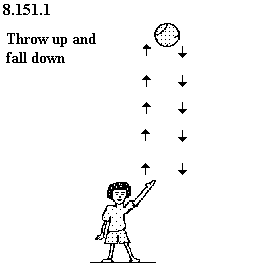
A ball is thrown upwards and caught when it comes back down at the same height. In the absence of air resistance, the speed of the ball when caught would be
less than the speed it had when thrown upwards.
more than the speed it had when thrown upwards.
the same as the speed it had when thrown upwards.
need more information to determine.
A freely falling object starts from rest. After falling for 6 seconds, it will have a speed of about:
6m/s
36m/s
60m/s
12m/s
An object is moving in a circle with constant speed. Which of the following is/are true?
I. The object has constant velocity
II. The object has nonzero acceleration
III. After one revolution, the magnitude of the displacement is a positive value.
I only
II only
III only
I and II only
II and III only

Describe the motion of the velocity vs. time graph pictured
zero velocity
constant velocity
constant acceleration
changing acceleration
Driving a car in a circle at a constant 35 km/h does not change ________ but does change ________.
velocity;direction
acceleration;speed
direction;speed
speed;direction

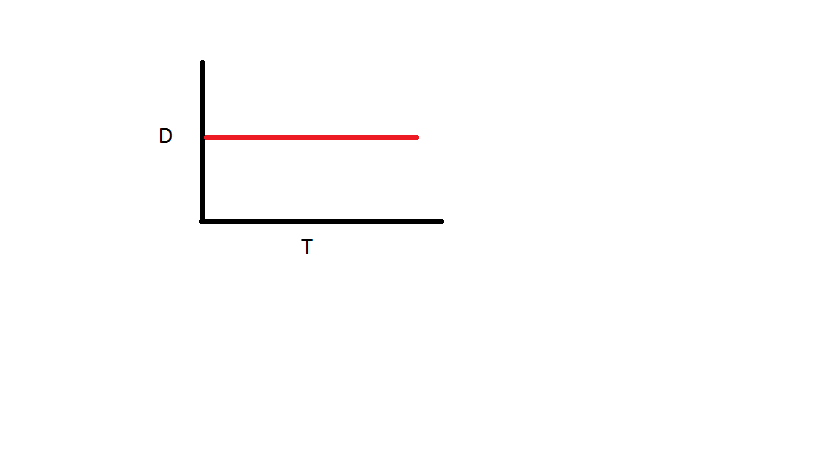
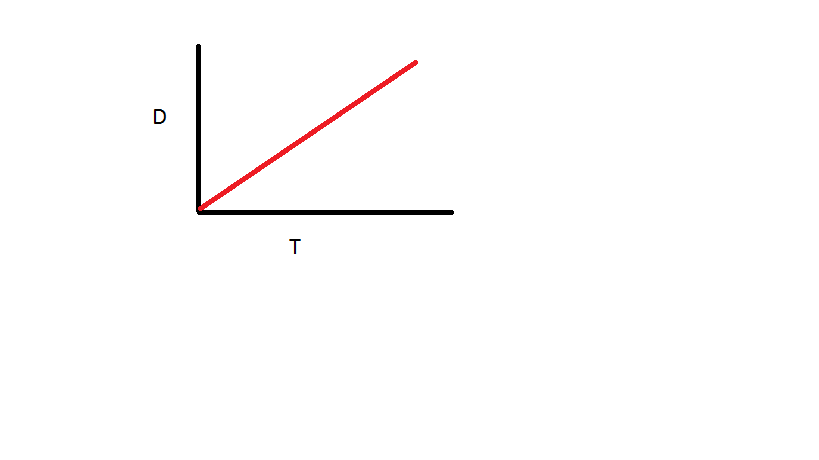
Describe the motion of the distance vs. time graph pictured
zero velocity
constant velocity
constant acceleration
changing acceleration
When velocity is positive and acceleration is negative, what happens to the object’s motion?
the object speeds up
the object slows down
the object remains at rest
the object remains at a constant velocity
Mr. McAliley walks 5 meters forward, then turns around and walks 5 meters backward. What is his distance traveled?
7.07 m
0 m
10 m
1 m
Mr. McAliley walks 5 meters forward, then turns around and walks 5 meters backward. What is his displacement?
7.07 m
0 m
10 m
1 m
While San San is running away from her problems, she runs 300 m forward, stops to catch her breath, then runs another 250 m forward.
True/False: Her distance and displacement are the same.
True
False
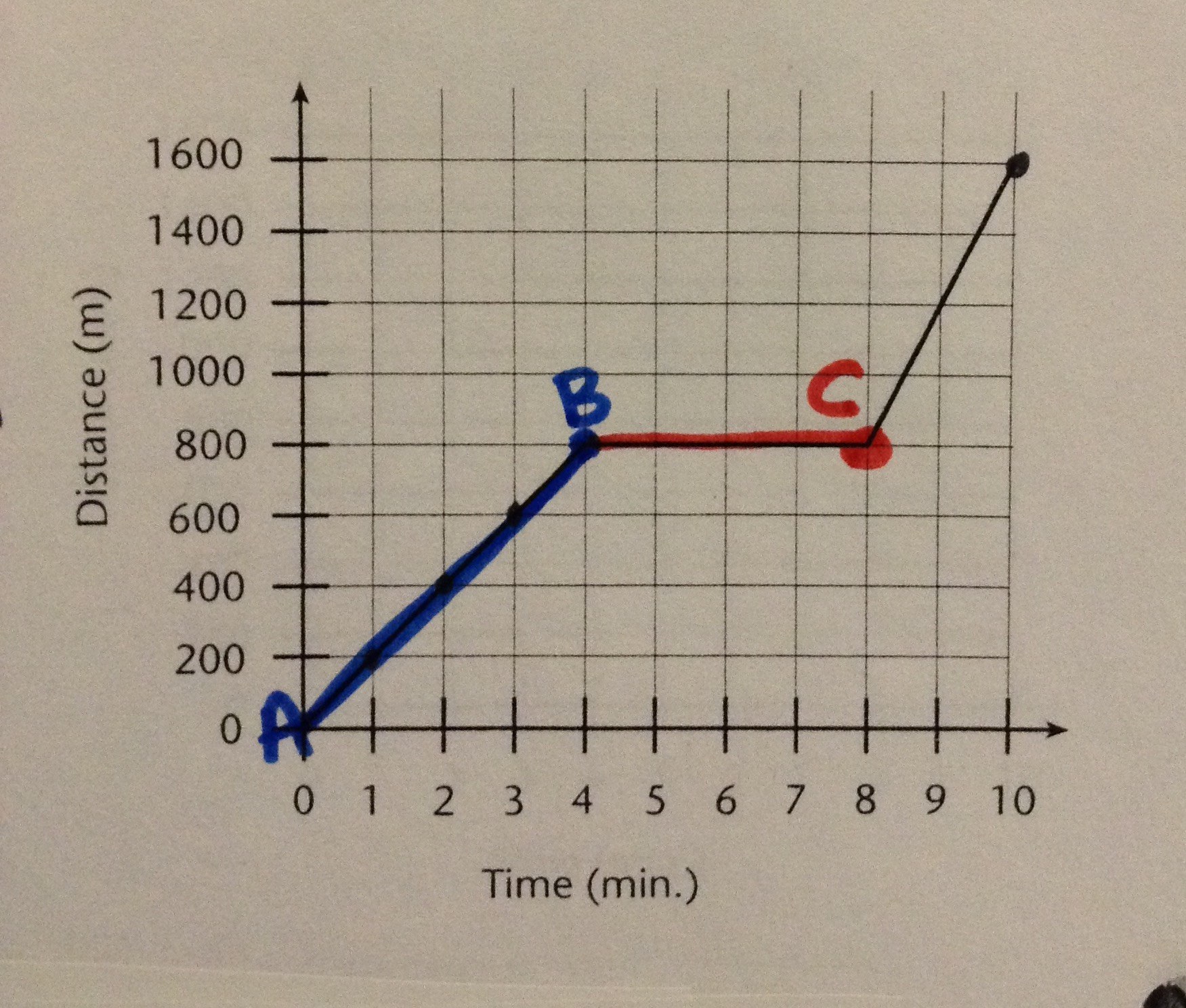
What was occurring from point B to point C?
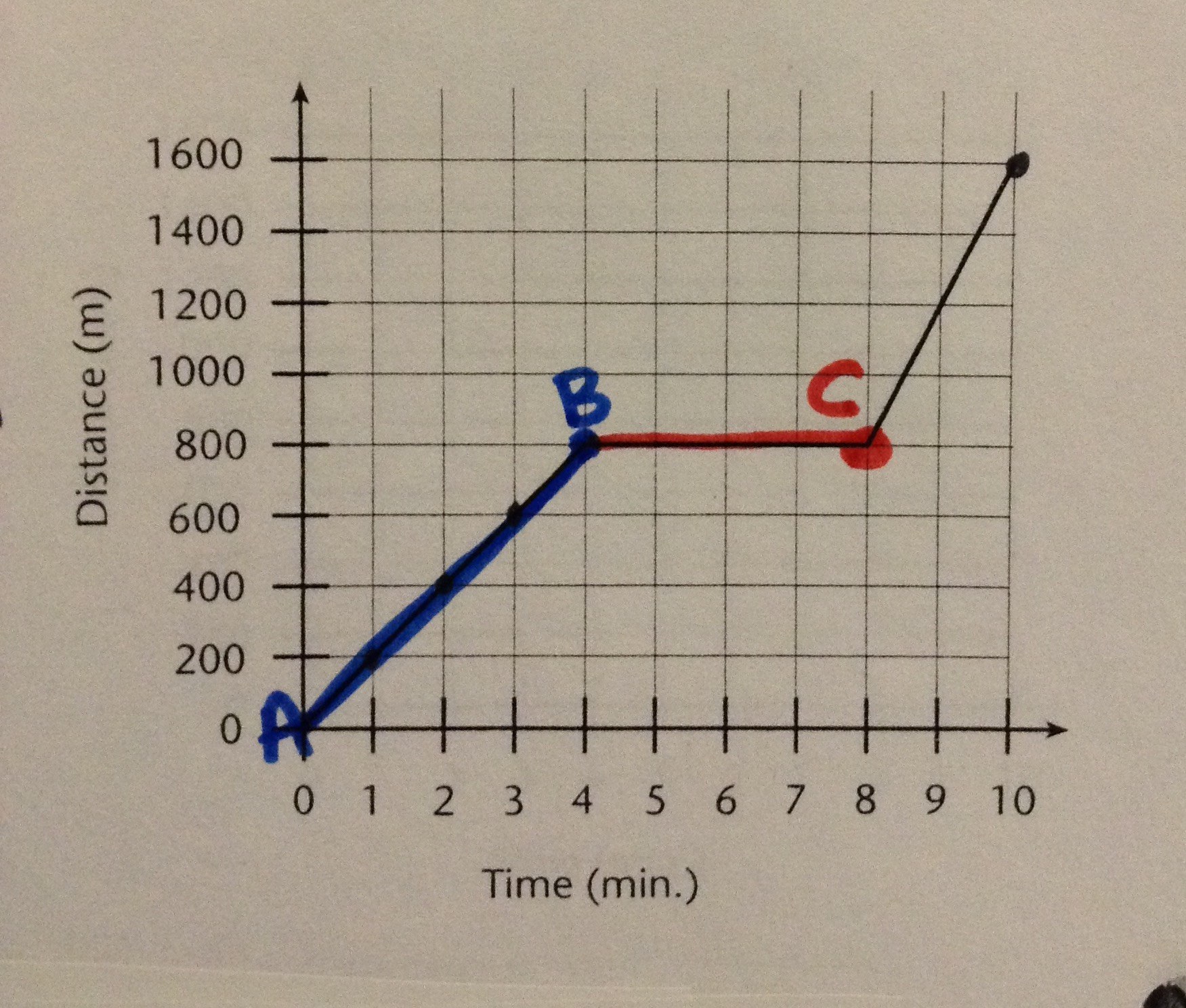
What is occurring from point A to point B?

velocity
displacement
acceleration
time
distance
speed
How long would it take a car, starting from rest and accelerating uniformly in a straight line at 5 m/s2 , to cover a distance of 200 m?
9.0 s
10.5 s
12.0 s
15.5 s
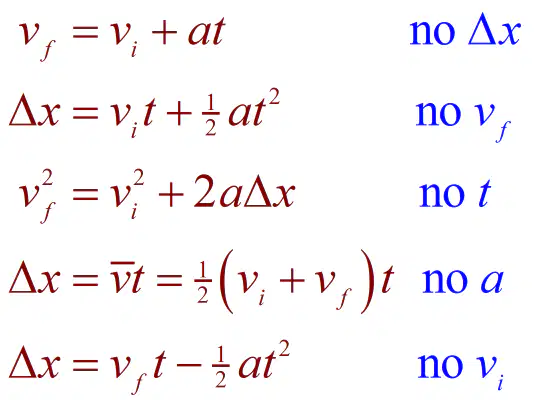
A rock is dropped off a cliff and strikes the ground with an impact velocity of 30 m/s. How high was the cliff?
20 m
30 m
45 m
60 m
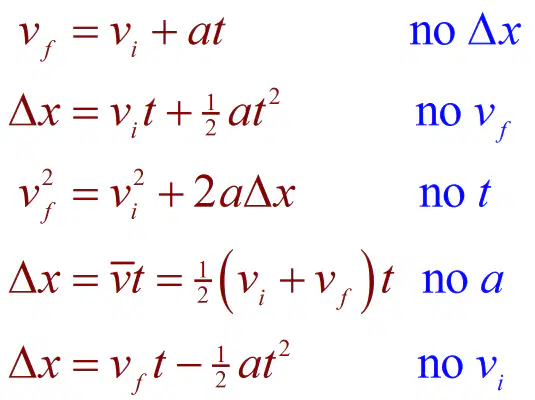
A stone is thrown vertically upward with an initial speed of 5 m/s. What is the velocity of the stone 3 seconds later?
25 m/s, upward
25 m/s, downward
35 m/s, upward
35 m/s, downward
The (a) of a velocity-time graph equals the displacement.
In Newtonian physics, ________________ is any motion of a body where gravity is the only force acting upon it.
kinematics
free fall
mechanics
velocity

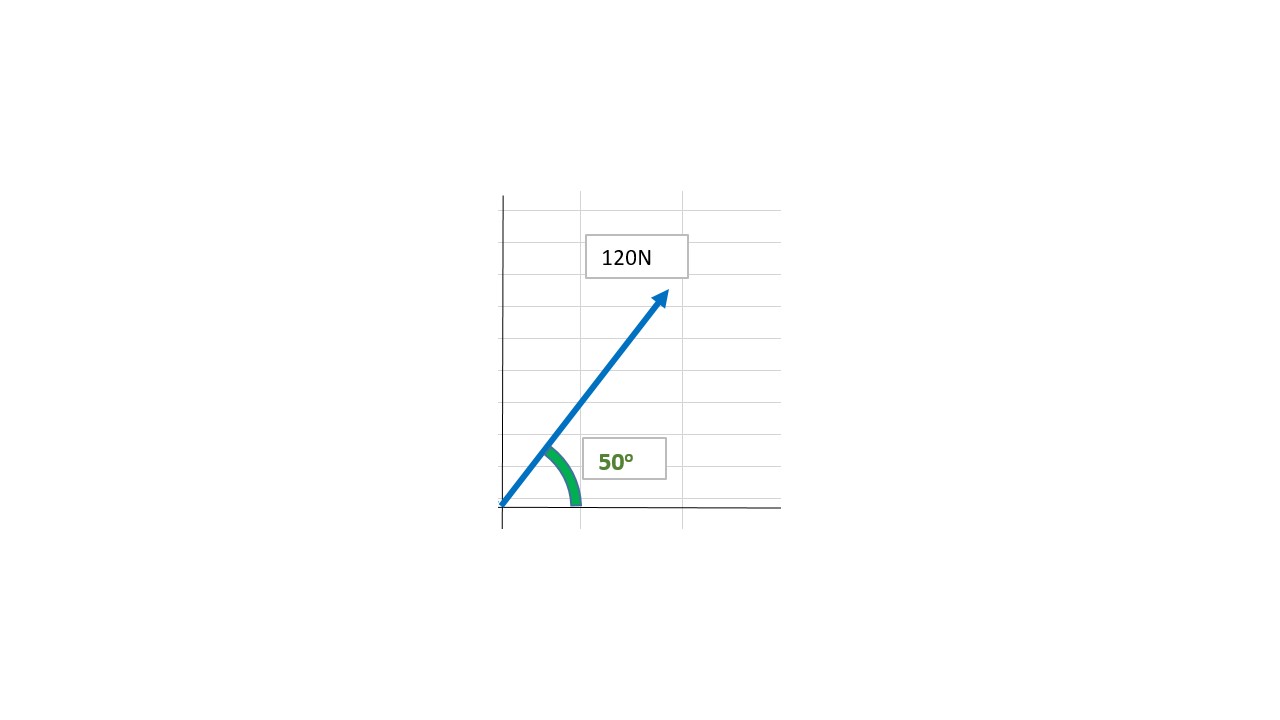
What vector gives the sum of these two vectors?


A vector includes ______ and ________.
direction, magnitude
magnitude, units
direction, units
scalars, scalars
A resultant vector is
equal to the sum of one vector.
equal to the sum of two or more vectors.
equal to the difference of one vector.
Bob walks 2 miles north and turns west and walks 2 miles. What is Bob's general displacement?
4 miles northeast
4 miles northwest
3 miles northwest
3 miles southeast

Aaron Agin was doing his vector homework. He failed to label the resultant. Now he does not know which vector is R. Help him out!
Vector A is the resultant.
Vector B is the resultant.
Vector C is the resultant.
Vector D is the resultant.
When using the head-to-tail method to draw a vector addition diagram, the resultant is drawn from the _____ .
head of the first vector to the tail of the last vector
tail of the first vector to the head of the last vector
head of the last vector to the tail of the first vector
tail of the last vector to the head of the last vector

The diagram is a vector addition diagram. Which equation accurately describes the vectors that are being added?
A + B + C = D
A + B + D = C
C + A + B = D
D + C + A = B

The diagram is a vector addition diagram. Which equation accurately describes the vectors that are being added?
A + D + C = B
B + A + D = C
B + C + D = A
C + B + A = D
Cameron (Cam for short) Per hikes to a campsite where he will spend the evening. He hikes 6.0 km, north and 3.0 km, west. The CCW direction of Cam's overall displacement is ___.
approximately 27°
exactly 30°
approximately 117°
exactly 120°
approximately 127°
Cameron (Cam for short) Per hikes to a campsite where he will spend the evening. He hikes 6.0 km, north and 3.0 km, west. The magnitude of Cam's displacement is ___km
3.0
4.5
6.7
45

Choose the arrow that best represents what the resultant vector would be.


Choose the arrow that best represents what the resultant vector would be.

Find the angle made by adjacent side 7 and hypotenuse is 14.
600
300
450
500
If two vectors to be added are at right angles, you will need to
just add them together.
use the Pythagorean theorem.
use the Law of Cosines.
subtract the smaller for the larger.
The process of breaking a vector into its components is called
vector resultant.
vector displacement.
vector coordinates.
vector resolution.



What is the buoyant force on a 20 𝑘𝑔 box that
displaces 4 𝑚3 of water (density of water is 1000 kg/𝑚3) ?
Fb=pVg
Buoyant Force = (density of fluid)(volume of displaced fluid)(acceleration due to gravity)
800N
40000N
4000N
20000N
What is the magnitude of the buoyant force on a
20 𝑁 ball that is floating in a liquid of density
800𝑘𝑔/𝑚3 .
20N
40N
80N
800N
The force that keeps objects on top of surfaces instead of letting them sink into the surface is known as:
normal
abnormal
static
inertia
what is another name for the "force of gravity"
weight
mass
height
size
Mass is defined as _____
the amount of matter in an object
speed of an object
the weight of an object
the color of an object
What is the force of gravity acting on a person with a mass of 70Kg
700 down
700N up
70N down
70N up
What is the force of gravity acting on a person with a mass of 90Kg
900N up
900N down
90N up
90N down
You have a ball with a weight of 76N. What is the mass of the ball?
76N
76kg
7.6kg
7.6N
An object is moving in a circle with constant speed. Which of the following is/are true?
I. The object has constant velocity
II. The object has nonzero acceleration
III. After one revolution, the magnitude of the displacement is a positive value.
I only
II only
III only
I and II only
II and III only
Which of the following is a vector quantity?
velocity
speed
time
distance
A car traveling at 75 km/h. In order for the car to be traveling at a constant velocity, what must be true? Check any that apply
The car must continue in the same direction
The car must maintain the same speed
The car must be constantly changing speed
The car must be constantly changing direction
What does the area under the slope of a velocity vs time graph represent?
acceleration
velocity
speed
displacement
Describe the motion of the velocity vs. time graph pictured
zero velocity
constant velocity
constant acceleration
changing acceleration
Driving a car in a circle at 35 km/h does not change ________ but does change ________.
velocity;direction
acceleration;speed
direction;speed
speed;direction
True/False: A car driving in a circle at 35 km/h is not accelerating.
True
False

Which pair of graphs represent the same motion?
pair 1
pair 2
pair 3
pair 4
Which of the following quantities is a scalar quantity?
velocity
speed
displacement
acceleration

The diagram pictured represents the relationship between velocity and time of travel for four cars (A, B, C, and D) in uniform motion. Which car has the greatest acceleration during the time interval 10 seconds to 15 seconds?
line A
line B
line C
line D
Describe the motion of the distance vs. time graph pictured
zero velocity
constant velocity
constant acceleration
changing acceleration
When velocity is positive and acceleration is negative, what happens to the object’s motion?
the object speeds up
the object slows down
the object remains at rest
the object remains at a constant velocity
The difference between speed and velocity is that velocity has ________, but speed does not.
amount
magnitude
direction
time

The displacement vs. time graph pictured represents the motion of a cart initially moving forward (away from the reference point) along a straight line. During which interval is the cart moving forward at constant speed?
AB
BC
CD
DE
Mr. McAliley walks 5 meters forward, then turns around and walks 5 meters backward. What is his distance traveled?
7.07 m
0 m
10 m
1 m
Mr. McAliley walks 5 meters forward, then turns around and walks 5 meters backward. What is his displacement?
7.07 m
0 m
10 m
1 m
While San San is running away from her problems, she runs 300 m forward, stops to catch her breath, then runs another 250 m forward.
True/False: Her distance and displacement are the same.
True
False
What was occurring from point B to point C?
What is occurring from point A to point B?

vi
velocity
initial velocity
final velocity
acceleration
vf
velocity
initial velocity
final velocity
acceleration
a
velocity
distance
acceleration
accuracy
acceleration units
m/s
m/s2
m2/s2
m
distance or displacement units
m/s
m/s2
m2/s2
m
a tiger travels 96 m in 8s. what is his velocity over the interval
0.04m/s
25m/s
225m/s
12m/s
7.The actual path covered by a body from initial point to final point is called as______
Displacement
Distance
Velocity
Speed
8.The shortest distance between any two points is called as______
Distance
Speed
Velocity
Displacement
How close a measurement is to the true value is called..
Accuracy
Precision
Significant
Estimate


How many significant figures are in 127.500?
(a)
How many significant figures are in 670?
(a)
How many significant figures are in 300900?
(a)
How many significant figures are in 0.0730?
(a)
Give the answer to the correct number of significant figures to
145.63 - 28.9
116.73
116.7
116.70
117
Give the answer to the correct number of significant figures to
17.3 x 6.2
(a)
Give the answer to the correct number of significant figures to
247.89 ÷ 43.5
5.70
5.7
5.699
5.69
Convert 1 foot to inches. Which equation is set up correctly?


Convert 500 feet to inches. Which equation is set up correctly?


Convert 600 in to cm. Which equation is set up correctly?


Convert 4 cups to tablespoons. Which equation is set up correctly?


4.56 x 10³
Solve & Round to Correct Sig Figs.
2.5 x 4.00 =
10
10.
10.0
10.00
The correct scientific notation for this number is: 67,400,000
6.74 x 10⁷
67.4 x 10⁶
6.74 x 10⁻⁷
674 x 105
Solve & Round to Correct Sig Figs.
0.5 x 5.0 =
2
3
2.5
3.0
Solve & Round to Correct Sig Figs.
4.75 + 0.2 =
4.95
5
5.0
4.9
6 kg = _____ g
6
6000
600
.006
Select the largest unit.
kilogram
centigram
decigram
decagram

Which of the following quantities is not a vector?
velocity
speed
acceleration
displacement
A llama is traveling at 20 m/s when it slows down to 5 m/s in a span of 2 s. What is its acceleration?
-15 m/s^2
-7.5 m/s^2
-25 m/s^2
-12.5 m/s^2
final speed minus initial speed, divided by time
acceleration
speed
relative motion
Which of the following quantities is a scalar quantity?
velocity
speed
displacement
acceleration
Mr. McAliley walks 5 meters forward, then turns around and walks 5 meters backward. What is his distance traveled?
7.07 m
0 m
10 m
1 m
Mr. McAliley walks 5 meters forward, then turns around and walks 5 meters backward. What is his displacement?
7.07 m
0 m
10 m
1 m
While San San is running away from her problems, she runs 300 m forward, stops to catch her breath, then runs another 250 m forward.
True/False: Her distance and displacement are the same.
True
False
acceleration units
m/s
m/s2
m2/s2
m
distance or displacement units
m/s
m/s2
m2/s2
m
a tiger travels 96 m South in 8s. What is his velocity over the interval?
0.04m/s South
25m/s South
225m/s South
12m/s South
7. The actual path covered by a object from initial point to final point is called as______
Displacement
Distance
Velocity
Speed
8. The shortest distance between an object's starting and ending position is called ______
Distance
Speed
Velocity
Displacement
When velocity is positive and acceleration is negative, what happens to the object’s motion?
the object speeds up
the object slows down
the object remains at rest
the object remains at a constant velocity
When velocity is positive and acceleration is positive, what happens to the object’s motion?
the object speeds up
the object slows down
the object remains at rest
the object remains at a constant velocity

What units are used to measure force?
Kilogram
Meter
Pascal
Newton

In a tug of war the left team pulls with a force of 200N. The right team pulls with a force of 150N. What is the net force?
50N to the left.
350N to the left.
350N to the right.
50N to the right.


Based on the information in the diagram, what is the net force acting on this object?
12 N downward
4 N upward
4 N downward
8 N to the left

The force that causes objects to remain at rest on a flat surface and is also called support force
Weight
Mass
Normal force
Gravitational force

What is the name of the force being applied by the person pushing on the box?
normal
gravity
applied
friction
What is the name of the force acting between the floor and the box?
normal
gravity
applied
friction
What is a "negative" force?
a very light tap.
a loss of force
a force in a direction that you've decided to call negative.

If the boy is pulling with a force of 10 N and the girl is pushing with a force 20 N, what is the net force on the box?
10 N
20 N
30 N
0 N

A cannonball with a mass of 0.5 kg is flying at an acceleration of 10 m/sec/sec. What is its force?
50 Newtons
5 Newtons
20 Newtons
9.5 Newtons