
 Worksheets
Textbook 6.1: Where Are Religions Distributed?
Total questions: 55
Worksheet time: 43mins
The spatial distribution of religions is important to geographers because it helps to determine
how many people follow a certain religion at multiple locations.
whether or not people adhere to their religion after they migrate.
how certain religions are dispersed over wide areas while others are clustered.
how often people practice their religion.
how long it will take for folk religions to diffuse from their original location.
The universalizing religion with the most adherents worldwide is
Buddhism
Christianity
Hinduism
Islam
Shintoism
Which of the following would NOT be included among the world's four largest religions in terms of the number of adherents?
Christianity
Buddhism
Hinduism
Judaism
Islam
Chinese traditional and African traditional represent which type of religion?
unaffiliated
universalizing
ethnic
folk
syncretic
Which of the following belief systems states that the existence of God cannot be proven empirically?
Agnosticism
Atheism
Unaffiliation
Assimilation
Amalgamation
The ethnic religion which has the most adherents worldwide is
Confucianism
Taoism
Hinduism
Shintoism
Islam
A classification of a religion that is spatially widespread and philosophically inclusive of all potential adherents is described as
universalizing
folk
ethnic
tribal
animistic
Which of the following is an ethnic religion?
Buddhism
Baháʹí
Islam
Judaism
Christianity
Which is a common characteristic of an ethnic religion?
based on only one language
appealing mostly to one group of people in one place
based on belief in one particular spiritual leader
younger than a universalizing religion
more peaceful than a universalizing religion
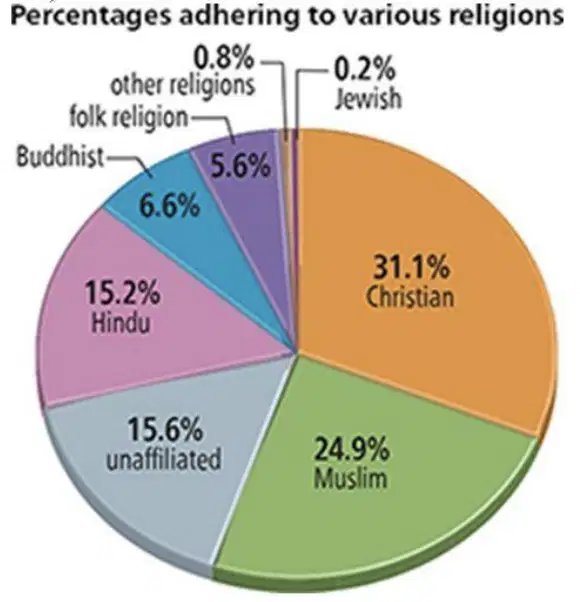
Use Figure 6-1 to answer the question.
Which of the following statements is TRUE regarding religious adherents among the world's population?
more than half of the people are nonreligious
less than one-fifth of the people are non-religious
more than half of the people are Christian
about half of the people are Muslim
about two-thirds of the people are Christian
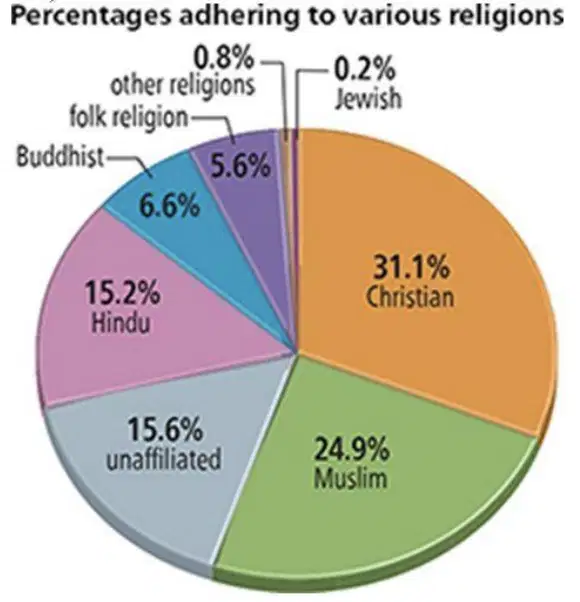
Use Figure 6-1 to answer the question.
Which of the following statements is TRUE regarding religious adherents among the world's population?
About half of the people are nonreligious.
There are more Muslims than Hindus.
There are more Catholics than Muslims.
There are more Muslims than Christians.
There are more Buddhists than Hindus.

Use Figure 6-2: Most Numerous Faiths by County to answer the question.
A person from Minnesota is more likely to be an adherent of
the Lutheran church.
the Roman Catholic church
a Baptist church.
an Eastern Orthodox church.
a Methodist church.

Use Figure 6-3 to answer the question. Many regions of the world are home to a diverse composition of religions.
Which of the following regions is an exception to this trend?
East Asia
North America
South Asia
Southeast Asia
Sub-Saharan Africa
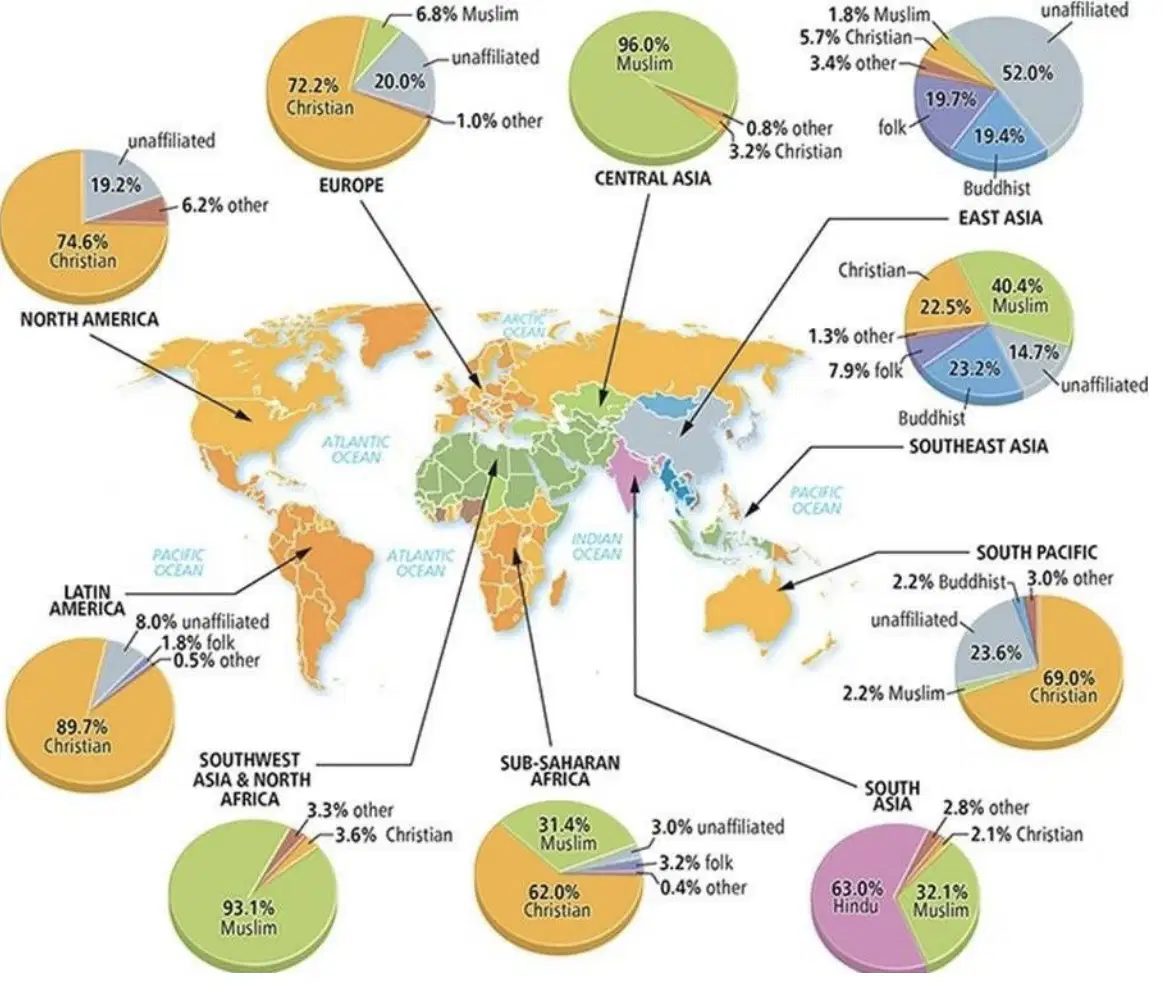
Use Figure 6-3 to answer the question.
In which part of the world would one find over 50 percent of the population described as unaffiliated with the remainder of the population either Buddhist or affiliated with a folk religion?
South Asia
Southeast Asia
Central Asia
Southwest Asia
East Asia

Use Figure 6-3: Most Numerous Religions by Region to answer the question.
Which statement about religion in Latin America is TRUE?
nearly all of the people are Christian
the great majority of the people are non-religious
nearly all of the people practice folk religions
the population is almost equally divided between Christians and Muslims
about one- fourth of the people are Christian, one- fourth non-religious, and the remainder practice folk religions

Use Figure 6-3 to answer the question.
Which statement accurately describes the distribution of religions throughout the world?
Europe has a higher percentage of Christians than Latin America.
There is a higher percentage of Hindus in South Asia than the percentage of Christians in subSaharan Africa.
East Asia has a highest percentage of Buddhists in the world
The percentage of Muslims in Southeast Asia is higher than the percentage of Muslims in sub-Saharan Africa.
Unaffiliated comprises over half of the religions in Europe.
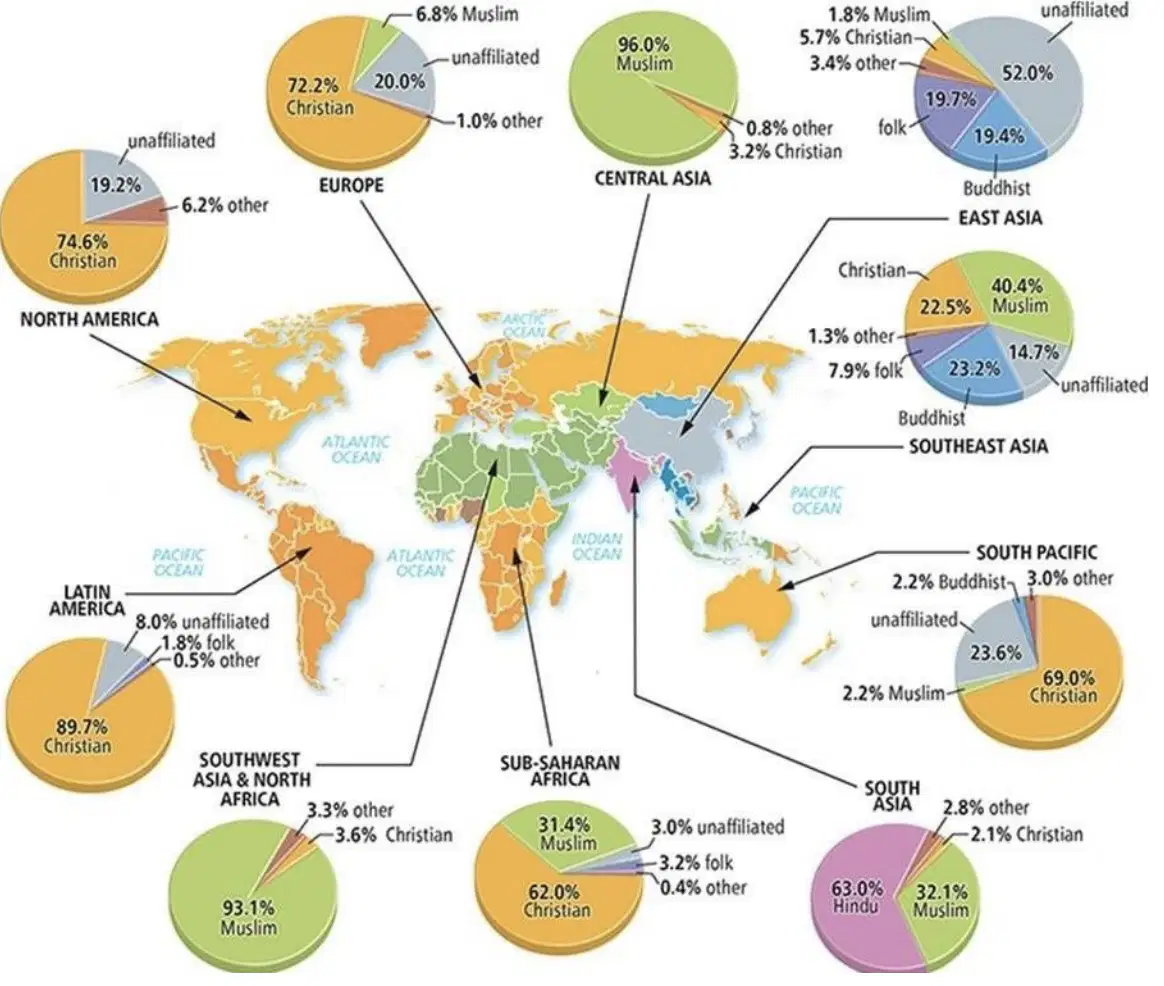
Use Figure 6-3 to answer the question.
Almost 90 percent of people in the Western Hemisphere claim adherence to
Christianity
Roman Catholicism.
Protestantism
Eastern Orthodoxy.
Fundamentalist and nondenominational Christian churches.
A number of local congregations united in a single legal and administrative body is a
branch
denomination
sect
dialect
family
A fundamental division within a religion it is known as a
branch
denomination
sect
dialect
family
Which of the following is considered a branch of Christianity?
Druze
Eastern Orthodox
Shi'ite
Theravadist
Judaism
Within the Christian faith, Lutheranism is an example of a
branch
denomination
religion
sect
family
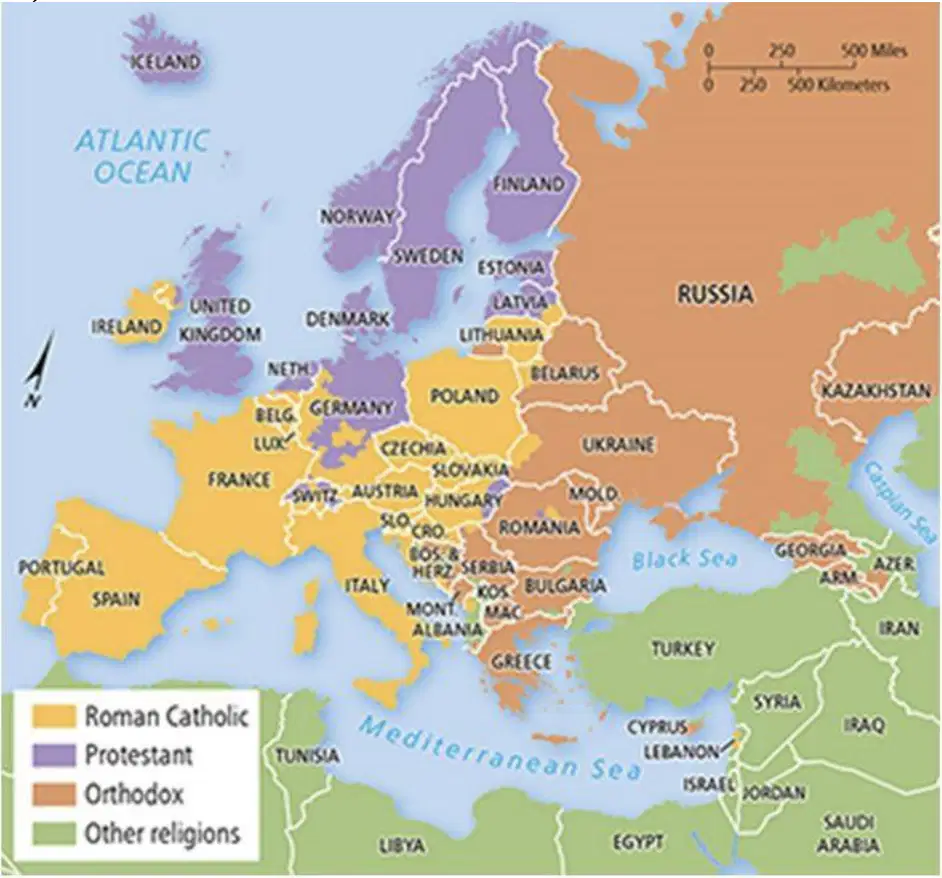
Use Figure 6-4 to answer the question.
Which statement is TRUE regarding the distribution of religions and branches in Europe?
most of the people in Ireland are Protestant
most of the people in the eastern part of Europe are Catholic
about half of the people in Europe are Catholic and half are Protestant
about one-fourth of the people are Protestant
northwestern Europe is mostly Protestant
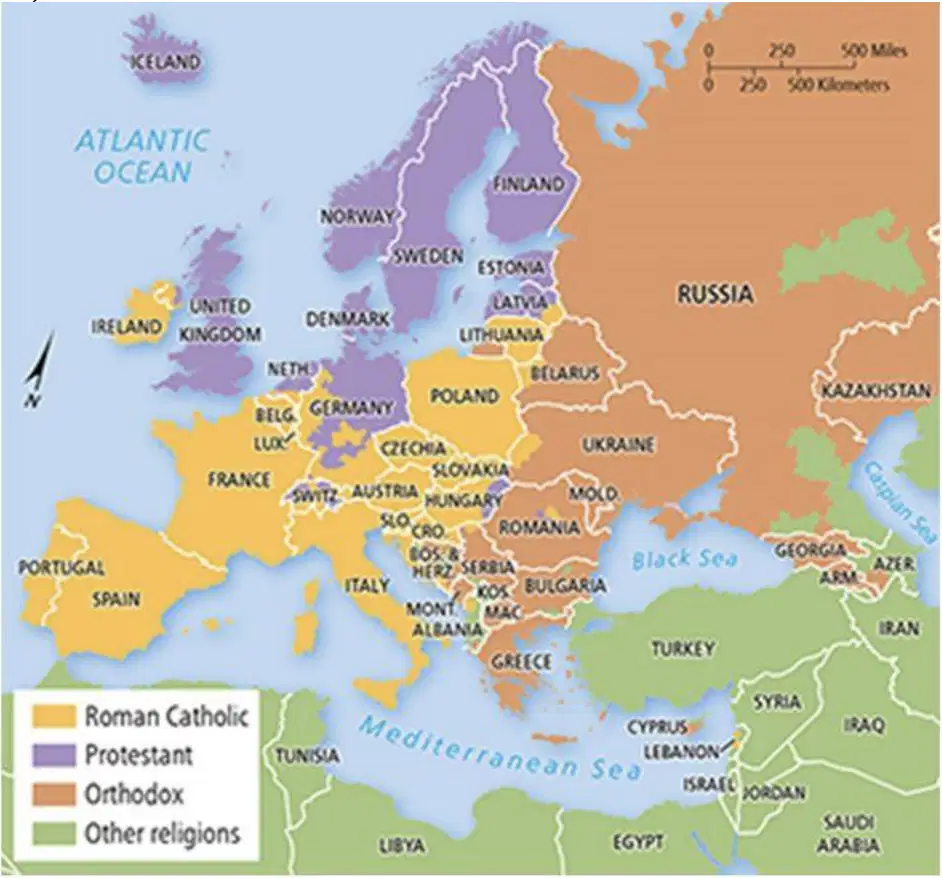
Use Figure 6-4 to answer the question.
Which statement is TRUE regarding the distribution of religions in Germany?
Catholics are the majority in the north, while Protestants are the majority in the west and southeast.
Catholics are the majority in the west and southeast, while Protestants are the majority in the north.
the majority are nonreligious in the center and north, while Catholics are the majority in the south.
Protestants account for the majority in every region of the country.
Catholics are the majority throughout the country.
Which of the following statements is TRUE regarding historically black churches in the United States?
they were founded by escaped slaves
they were integrated into existing white churches in the south after 1800
they developed unique forms of worship distinct from other churches
they evolved into a new religion that is not considered Christian
they chose to have different churches that used African languages
Which statement best reflects the distribution of Christians in North America?
The Methodist Church is a minority branch within the Mainline Protestant Church.
Evangelical Protestants are most numerous in the Southeast.
Roman Catholics make up 21 percent of the population in the Southwest.
Members of the Church Jesus Christ of Latter-day Saints are clustered in the South.
The Southern Baptist Convention is the most numerous Catholic Church.
Which of the following Asian religions would be classified as universalizing?
Buddhism
Confucianism
Shintoism
Daoism
Hinduism
Which spiritual leader is known as the founder of Buddhism?
Siddhartha Gautama
Dalai Lama
Lao-Zi
Confucius
Guru Nanak
Most Buddhist religious functions are performed by
members of the general public.
monks
government officials.
government designated teachers.
parents
Compared to other universalizing religions, which unique characteristic of Buddhism makes its adherents more difficult to count?
most rituals are performed in secret
Buddhism was illegal for centuries and adherents feared retribution
Buddhists attend services in remote mountainous villages
governments of Buddhist majority countries do not provide religious data to outsiders
Buddhists may be practicing Buddhism along with another religion
Unlike other universalizing religions, Buddhism
remains primarily concentrated in one region of the world.
was not begun by an individual founder and then diffused elsewhere.
was founded in China.
worships more than one god.
diffused primarily by colonization.
The dominant branch of Islam is
Druze.
Eastern Orthodoxy.
Sikh.
Sunni.
Shi'ite.
Forty percent of the world's Muslims live in four countries. Which of the following countries would not be among the four countries with the highest number of Muslims?
Indonesia
Pakistan
Saudi Arabia
India
Bangladesh
The dominant branch of Islam in Iran is
Maliki.
Ismali.
Zaidi.
Sunni.
Shi'ite.
The largest percentage of Muslims living in the United States are from which region?
China and other East Asian countries
North Africa and Central Asia
Arab countries of Southwest Asia
Indonesia and other Southeast Asian countries
Pakistan and other South Asian countries
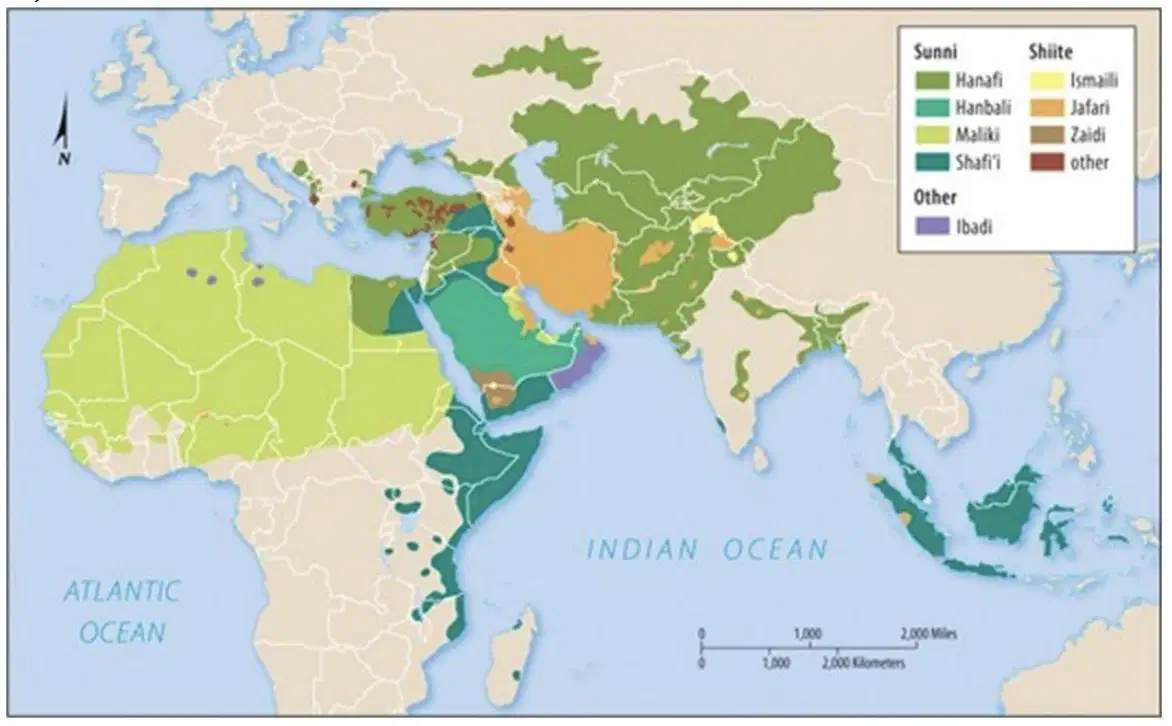
Use Figure 6-5 to answer the question.
In which of the following regions are Sunni Muslims clustered?
Southwestern Asia, Sub-Saharan Africa, and parts of South Asia.
Southwestern Asia, North Africa, South America, and parts of North America.
Eastern Europe, North America, South Asia, and parts of Russia, China, and Japan.
East Asia, South Asia, and North Africa.
Western Asia, North Africa, parts of South Asia, and East Africa.
France's growing Muslim population is largely a result of
French policy to encourage diversification.
French policy to attract guest workers.
emigration from former French colonies.
emigration from Southwest Asian countries.
French policy to encourage equal representation of religions.
Which statement is TRUE regarding the distribution of ethnic religions?
Ethnic religions are typically more wide-spread than universalizing religions.
Ethnic religions diffuse from one culture to another.
Adherents to an ethnic religion typically have a shared history, culture, and language.
Adherents to an ethnic religion tend to migrate away from where the religion was founded.
Ethnic religions may be clustered because they are surrounded by universalizing religions.
Which of the following is true of both universalizing and ethnic religions?
They appeal primarily to one group of people living in one place.
They can diffuse to different populations around the world.
They attempt to be global and appeal to all people.
Examples can be expressed as Christianity and Islam.
They both arose from changes in the physical environment.
Which of the following ethnic religions has the most adherents?
Judaism
Zoroastrianism
Hinduism
Jainism
Sikhism
Which term describes a religion that combines beliefs from several religious traditions?
spiritist
syncretic
synchronized
animistic
shamanistic
A philosophy founded on a series of ethical principles for daily life based on li, meaning propriety, is attributed to which religious leader?
Siddhartha Gautama
Dalai Lama
Laozi
Confucius
Guru Nanak
This government administrator was the founder of Taoism, a Chinese ethnic religion. He also authored writings which emphasized the mystical and magical aspects of life.
Siddhartha Gautama
Dalai Lama
Laozi
Confucius
Guru Nanak
Followers of primal indigenous ethnic religions do NOT
believe everything is spiritual.
believe in narratives that are specific to a physical landscape.
believe in multiple gods.
invoke shamanistic spirits to affect the lives of the living.
generally live in Southeast Asia and the South Pacific.
Animism can be defined as
the desire to change the world based on reverence towards all mammals.
a combined reverence for mammals and birds.
the belief that cows are animated and sacred.
the belief that inanimate objects and natural events have a discrete spirit and conscious life.
another term for vegetarianism.
Which of the following statements describes the changes to religious affiliation in Africa?
Since 1900, Islam has continued to expand territory and gain adherents in Sub-Saharan Africa.
Traditional folk religions are experiencing a resurgence in response to universalizing religions.
The number of folk religionists still follows an even distribution pattern across the continent.
Universalizing religions have replaced traditional folk religions in much of the continent.
Beginning in 1980, more people practice both animism and Christianity.
Most of the religions with at least one million adherents originated on which continent?
North America
South America
Africa
Europe
Asia
Most religions with less than 23 million adherents are clustered on a few continents. The exception to this distribution pattern is
Judaism.
Bahá'í.
Shintoism.
Sikhism.
Spiritism.
Juche, a young religion which is sometimes regarded as a government philosophy, is confined to
Vietnam.
Laos.
North Korea.
South Korea.
Taiwan.
After Cao Dai was granted legal status in 1997, in which country did its adherents increase?
Vietnam
Laos
North Korea
South Korea
Taiwan
Founded in the nineteenth century, this universalizing religion advocates the abolition of racial, class, and religious prejudice.
Cao Dai
Christianity
Islam
Zoroastrianism
Bahá'í
Jainism is concentrated in which South Asian country?
Sri Lanka
the Maldives
Bangladesh
India
Nepal
This ethnic religion is also regarded as a cultural feature in Japan.
Spiritism
Juche
Tenrikyo
Shinto
Cao Dai
Both the Bahá'í faith and Zoroastrianism have their roots in which Southwest Asian nation?
Yemen
Oman
Iraq
Saudi Arabia
Iran
Which of the following is the youngest religion?
Jainism
Shinto
Zoroastrianism
Cao Dai
Sikhism
Introduced first within Judaism, the belief in the existence of only one god is called
animism
cosmogony
monotheism
polytheism
pagan

