wayground logo

Free Printable Worksheets

Font size

S
M
L
XL
Worksheets

Geometry Fall Vocabulary Review

Total questions: 221

Worksheet time: 5hrs 51mins

Name
Class
Date
1.

What is an acute angle?

a)

An acute angle is an angle that measures less than 90 degrees.

b)

An acute angle is an angle that measures more than 180 degrees.

c)

An acute angle is an angle that measures exactly 90 degrees.

d)

An acute angle is an angle that measures more than 90 degrees.

2.

What is an obtuse angle?

a)

An obtuse angle is an angle that measures more than 90 degrees but less than 180 degrees.

b)

An obtuse angle is an angle that measures more than 180 degrees.

c)

An obtuse angle is an angle that measures exactly 90 degrees.

d)

An obtuse angle is an angle that measures less than 90 degrees.

3.

What is a right angle?

a)

An angle that measures exactly 90 degrees.

b)

An angle that measures more than 90 degrees.

c)

An angle that measures less than 90 degrees.

d)

An angle that measures exactly 180 degrees.

4.

What is a straight angle?

a)

An angle that measures more than 180 degrees.

b)

An angle that measures exactly 90 degrees.

c)

An angle that measures exactly 180 degrees.

d)

An angle that measures less than 180 degrees.

5.

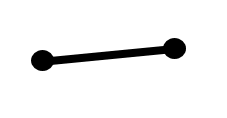
What is a line segment?

a)

A line segment has infinite length.

b)

A line segment is a curved line.

c)

A line segment has only one endpoint.

d)

A line segment is a part of a line that is bounded by two distinct endpoints.

6.

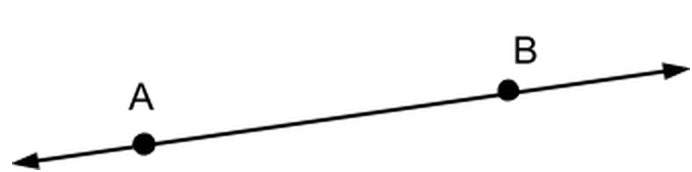
What is a line?

a)

A line is a curved path that extends infinitely in both directions.

b)

A line is a straight path that extends infinitely in both directions.

c)

A line is a two-dimensional shape with length but no width or height.

d)

A line is a closed shape with three or more sides.

7.

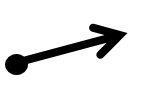
What is a ray?

a)

A ray is a line that starts at a point and extends infinitely in one direction.

b)

A ray is a line segment with a fixed length.

c)

A ray is a line that starts at a point and extends infinitely in both directions.

d)

A ray is a curved line that changes direction at every point.

8.

What is a point?

a)

A point is a small dot on a surface.

b)

A point is a precise location in space that has no size or dimension.

c)

A point is a unit of measurement in geometry.

d)

A point is a line segment with two endpoints.

9.

What is a midpoint?

a)

The point that divides a line segment into four equal parts.

b)

The point that divides a line segment into three equal parts.

c)

The point that divides a line segment into two equal parts.

d)

The point that divides a line segment into two unequal parts.

10.

What is a plane?

a)

A plane is a type of tool used for smoothing wood surfaces.

b)

A plane is a mathematical term used to describe a flat surface.

c)

A plane is a type of vehicle used for air travel.

d)

A plane is a flat, two-dimensional surface.

11.

What are collinear points?

a)

Points that form a triangle.

b)

Points that do not lie on the same straight line.

c)

Points that are equidistant from each other.

d)

Points that lie on the same straight line.

12.

What are coplanar points?

a)

Points that lie on the same plane.

b)

Points that are collinear.

c)

Points that are not on a plane.

d)

Points that lie on different planes.

13.

What are vertical angles?

a)

Congruent angles formed opposite each other by the intersection of two lines.

b)

Angles formed by the intersection of two intersecting lines at a right angle.

c)

Angles formed by the intersection of two perpendicular lines.

d)

Angles formed by the intersection of two parallel lines.

14.

What are adjacent angles?

a)

Two angles that share a common side but do not have a common vertex.

b)

Two angles that share a common vertex and a common side, but do not overlap.

c)

Two angles that do not share a common vertex.

d)

Two angles that share a common vertex and overlap.

15.

What are complimentary angles?

a)

Two angles that add up to 180 degrees.

b)

Two angles that add up to 45 degrees.

c)

Two angles that add up to 270 degrees.

d)

Two angles that add up to 90 degrees.

16.

What are supplementary angles?

a)

Two angles that add up to 180 degrees.

b)

Two angles that add up to 45 degrees.

c)

Two angles that add up to 270 degrees.

d)

Two angles that add up to 90 degrees.

17.

Two items are congruent if they...

a)

have the same size and shape.

b)

have a different size and shape.

c)

have the same size but a different shape.

d)

have a different size but are the same shape.

18.
Which of the following words means the same as congruent?
a)
different
b)
same
c)
greater
d)
less
19.
The vertex is the point where 2 lines or line segments intersect. 
a)
True
b)
False
20.
Perpendicular lines never intersect.
a)
True
b)
False
21.
A point that divides, or bisects, a segment into two congruent segments is called a ___________________.
a)
midpoint
b)
congruent segment
c)
angle bisector
d)
endpoint
22.
A continuous straight extent of length, without breadth or thickness is called a ________________. It also has arrowheads on both sides.
a)
line
b)
ray
c)
line segment
d)
linear pair
23.
Points that are at the ends of a line segment are called _____________________________.
a)
endpoints
b)
arrows
c)
rays
d)
midpoints
24.

Match the following

a)
1.

Lines

b)
2.

Segments

c)
3.

Rays

d)
4.

Points

25.

Which of the following name a segment?

a)

FE\overline{FE}

b)

MN\overrightarrow{MN}

c)

IK\overleftarrow{I}\overrightarrow{K}

d)

m

26.

Which of the following name a ray?

a)

FE\overleftarrow{FE}

b)

MN\overrightarrow{MN}

c)

IK\overleftarrow{I}\overrightarrow{K}

d)

m

27.

Which symbol matches the following word?


Ray

a)
b)
c)
d)
28.

Which word matches the symbol?

a)

line

b)

segment

c)

point

d)

ray

29.

Name the figure using geometric notation.

a)

SR\overrightarrow{SR}

b)

RS\overline{RS}

c)

RS\overrightarrow{RS}

30.

Name the figure using geometric notation.

a)

FG\overleftarrow{F}\overrightarrow{G}

b)

FG\overline{FG}

c)

FG\overrightarrow{FG}

31.

Name the figure using geometric notation.

a)

QR\overline{QR}

b)

RQ\overrightarrow{RQ}

c)

QR\overrightarrow{QR}

32.

True or False,

WB\overline{WB}  and  BW\overline{BW}  are both names for the segment.

a)

True

b)

False

33.

What best describes these points?

a)

Collinear

b)

Noncollinear

c)

Coplanar

d)

Noncoplanar

34.
When naming a plane, we should use ________
a)
2 points
b)
a lower case cursive letter
c)
3 points
d)
3 noncollinear points
35.
Name the figure.
a)
line segment
b)
line
c)
point
d)
ray
36.
Name the figure.
a)
point
b)
line
c)
ray
d)
line segment
37.

A line contains _____________ points.

a)

One

b)

Two

c)

At least two

d)

Infinitely many

38.

What are two ways to name the line here?

a)

Line W

b)

AB\overleftarrow{A}\overrightarrow{B}  

c)

Line m

d)

 AW \overleftarrow{\ A}\overrightarrow{W\ }

39.

What is a name for this line?

a)
b)
c)
d)
40.

When naming a ray, the order matters.

a)

True

b)

False

41.

Which is NOT a name of the given plane.

a)

HDG

b)

FGH

c)

DGI

42.
What is the name of this ray?
a)

AB\overrightarrow{AB}

b)

BA\overrightarrow{BA}

c)

AB\overleftarrow{AB}

d)

 BA \overleftarrow{\ B}\overrightarrow{A\ }

43.
A line that contains point M.
a)
Line q
b)

 NO \overleftarrow{\ N}\overrightarrow{O\ }

c)
Line r
d)

 NH  \overleftarrow{\ N}\overrightarrow{H\ \ }

44.

Name a point collinear to H, K, and I

a)

M

b)

O

c)

N

d)

J

45.
What does this image show?
a)
dot
b)
point
c)
circle
d)
angle
46.

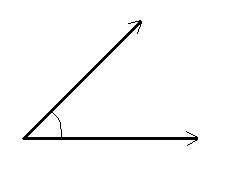
Two rays that meet at a common end point are called an...

a)

point

b)

line

c)

angle

d)

line segment

47.

A flat surface is called a...

a)

plane

b)

line

c)

point

d)

ray

48.
The common endpoint of 2 rays
a)
Point
b)
Midpoint
c)
Vertex
d)
Bisect of an Angle
49.

Pick the figure that represents

XZ\overline{XZ}  

a)

b)

c)

d)

50.

MULTIPLE CHOICE

Click on the image. Which of the following correctly describes the two geometric figures?

a)

(a) is segment QP and (b) is line CN

b)

(a) is line QP and (b) is segment CN

c)

(a) is ray QP and (b) is line NC

d)

(a) is segment QP and (b) is line N

51.
Name the Image
a)
Angle
b)
Line
c)
Line Segment
d)
Ray
52.
Name two points collinear to Point K
a)
H & M
b)
J & L
c)
N & J
d)
M & L
53.
When naming a plane, we should use ________
a)
2 points
b)
a lower case cursive letter
c)
3 points
d)
3 noncollinear points
54.
Baymax's eyes make a...
a)
Line
b)
Line segment
c)
Ray
d)
Angle
55.
Triangle that has two congruent sides
a)
Isosceles Triangle
b)
Scalene Triangle
c)
Acute Triangle
d)
Obtuse Triangle
56.
Triangle that has three congruent sides
a)
Equilateral Triangle
b)
Acute Triangle
c)
Equiangular Triangle
d)
Exterior Angle
57.
Triangle that has three congruent angles
a)
Straight Angle
b)
Right Triangle
c)
Isosceles Triangle
d)
Equiangular Triangle
58.
Triangle that has one obtuse angle
a)
Isosceles Triangle
b)
Scalene Triangle
c)
Acute Triangle
d)
Obtuse Triangle
59.
Triangle that has no congruent sides
a)
Equilateral Triangle
b)
Scalene Triangle
c)
Isosceles Triangle
d)
Acute Triangle
60.
Triangle that has three acute angles
a)
Right Triangle
b)
Vertical Angles
c)
Acute Triangle
d)
Obtuse Triangle
61.
Triangle that has one right angle
a)
Acute Triangle
b)
Isosceles Triangle
c)
Obtuse Triangle
d)
Right Triangle
62.
The measure of this angle of a triangle is equal to the sum measures of the two nonadjacent interior angles.
a)
Vertical Angles
b)
Straight Angle
c)
Congruent Angles
d)
Exterior Angle
63.
Sum of the interior angles of a triangle
a)
90*
b)
180*
c)
Congruent
64.
Two angles that their sides form two pairs of opposite rays.
a)
Vertical Angles
b)
Linear Pair
c)
Exterior Angle
d)
Straight Angle
65.
Two adjacent angles that form a straight angle equal to 180*
a)
Linear Pair
b)
Exterior Angle
c)
Vertical Angles
d)
Congruent
66.
Two angles or lengths that have the same measure
a)
Straight Angle
b)
Linear Pair
c)
Exterior Angle
d)
Congruent
67.
a)
Acute Triangle
b)
Scalene Triangle
c)
Isosceles Triangle
d)
Obtuse Triangle
68.
a)
Equilateral
b)
Isosceles
c)
Scalene
d)
Acute
69.
a)
Acute
b)
Vertical
c)
Obtuse
d)
Equiangular
70.
a)
acute
b)
isosceles
c)
right
d)
scalene
71.
What is angle 1 in this picture?
a)
congruent
b)
exterior
c)
interior
d)
acute
72.
These two angles are...
a)
linear pair
b)
vertical angles
c)
straight angle
d)
exterior angles
73.
What type of angle is shown?
a)
acute
b)
obtuse
c)
right 
d)
straight
74.
The angle relationship shown is -
a)
complementary angles
b)
supplementary angles
c)
vertical angles
d)
angle bisector
75.
∠1 and ∠3 can best be described as -
a)
complementary angles
b)
supplementary angles
c)
vertical angles
d)
adjacent angles
76.
∠AOB and ∠COB can best be described as - 
a)
complementary angles
b)
supplementary angles
c)
vertical angles
d)
adjacent angles
77.
∠XOZ is bisected by ray OY. Which statement is true?
a)
∠XOZ ≅ ∠XOY
b)
∠XOZ ≅ ∠ZOY
c)
∠XOY ≅ ∠ZOY
d)
∠OXY ≅ ∠OZY
78.
The angle relationship shown is - 
a)
complementary angles
b)
supplementary angles
c)
vertical angles
d)
adjacent angles
79.
What is the measure of the following angle?  
a)
10 degrees.
b)
40 degrees.
c)
67 degrees.
d)
168 degrees. 
80.
Angles are measured using a ______.
a)
compass
b)
protractor
c)
ruler
d)
prospector
81.
Which would be the best classification for the triangle shown?
a)
acute isosceles
b)
equiangular scalene
c)
equiangular isosceles
d)
equiangular equilateral
82.
What are vertical angles?
a)
Angles that are adjacent to each other
b)
Angles that add up to 180°
c)
Angles that are opposite of each other when lines intersect
d)
Angles that add up to 90°
83.
Which are pairs of vertical angles?
a)
∠COB & ∠COA
b)
∠AOD & ∠AOC
c)
∠COB & ∠AOD
d)
∠BOD & ∠AOD
84.
What is the value of x?
a)
37
b)
72
c)
108
d)
18
85.
Vertical angles are always
a)
acute
b)
total 180 degrees
c)
congruent (equal measures)
d)
adjacent angles
86.
Given, "If I have a Siberian Husky, then I have a dog." Identify the hypothesis.
a)
If I have a Siberian Husky.
b)
I have a Siberian Husky.
c)
Then I have a dog.
d)
I have a dog.
87.
Given, "If I have a Siberian Husky, then I have a dog." Identify the conclusion.
a)
If I have a Siberian Husky.
b)
I have a Siberian Husky.
c)
Then I have a dog.
d)
I have a dog.
88.
Given, "If angles are congruent, then the measures of the angles are equal." Identify the hypothesis.
a)
If angles are congruent.
b)
Angles are congruent.
c)
Then the measures of the angles are equal.
d)
The measures of the angles are equal.
89.
Given, "If angles are congruent, then the measures of the angles are equal." Identify the conclusion.
a)
If the angles are congruent.
b)
The angles are congruent.
c)
Then the measures of the angles are equal.
d)
The measures of the angles are equal.
90.

Which of the following is a counterexample:

All birds can fly

a)

Robin

b)

Pig

c)

Penguin

d)

Crow

91.

Which of the following is a counterexample:

All animals have 4 legs

a)

Person

b)

Fish

c)

Spider

d)

All of the options

92.

While sitting at the bus stop, Josh saw three blue cars drive by in a row. Based off this observation, Josh concluded that the next car to drive by would also be blue.

a)

Definition

b)

Conjecture

c)

Postulate

d)

Theorem

93.

While sitting at the bus stop, Josh saw three blue cars drive by in a row. Based off this observation, Josh concluded that the next car to drive by would also be blue.

a)

Definition

b)

Conjecture

c)

Postulate

d)

Theorem

94.

A triangle is a plane figure with three sides.

a)

Definition

b)

Conjecture

c)

Postulate

d)

Theorem

95.

If two lines intersect, then they intersect at exactly one point.

a)

Definition

b)

Conjecture

c)

Postulate

d)

Theorem

96.

A line segment is a part of a line that is bounded by two distinct endpoints.

a)

Definition

b)

Conjecture

c)

Postulate

d)

Theorem

97.

Two planes can intersect in exactly one line.

a)

Definition

b)

Conjecture

c)

Postulate

d)

Theorem

98.
Name the property:
 2(x + 3) = 2x + 6
a)
Division
b)
Distributive
c)
Reflexive
d)
Substitution
99.
Which is an example of transitive property?
a)
If a=b and b=m, then a = m.
b)
If a=b then b=a.
c)
Given a number a, a=a
d)
If a=5, then 3a-5 = 3(5)-5
100.
∠1 and ∠3 can best be described as -
a)
complementary angles
b)
supplementary angles
c)
vertical angles
d)
adjacent angles
101.
AB=AB is an example of:
a)
Reflexive property
b)
associative property
c)
communitive property
102.
A way to reach a conclusion based on a pattern
a)
inductive reasoning
b)
deductive reasioning
c)
given statement
103.
All numbers ending in 0 or 5 are divisible by 5.  The number 35 ends with a 5, so it is divisible by 5. 
a)
Deductive
b)
Inductive 
104.
If k = 3, then 3 = k.
a)
Substitution Property of Equality
b)
Reflexive Property of Equality
c)
Symmetric Property of Equality
d)
Transitive Property of Equality
105.
∠4 = ∠4
a)
Substitution Property of Equality
b)
Reflexive Property of Equality
c)
Symmetric Property of Equality
d)
Transitive Property of Equality
106.
What is the formula used to solve for the hypotenuse?
a)
a2+b2=c2
b)
a+b=c
c)
a-b=c
d)
c-a=c
107.
The Pythagorean Theorem ONLY works on which triangle? 
a)
obtuse
b)
scalene
c)
isosceles
d)
right
108.
Which of these figures are considered polygons?
a)
a, b, c, d
b)
b, d, e, f
c)
a, b, c
d)
a, e, f
109.
Which of the following is not a polygon?
a)
trapezoid
b)
semicircle
c)
rhombus
d)
octagon
110.
A  POLYGON  is:
A figure with closed lines
a)
correct
b)
incorrect
c)
not sure
111.
Is this a polygon?
a)
yes
b)
no
112.
Which is NOT a polygon?
a)
square
b)
cube
c)
pentagon
d)
rectangle
113.
Select the best answer choice.
a)
A
b)
B
c)
C
d)
D
114.
Select the best answer choice.
a)
F
b)
G
c)
H
d)
J
115.
Select the best answer choice.
a)
A
b)
B
c)
C
d)
D
116.
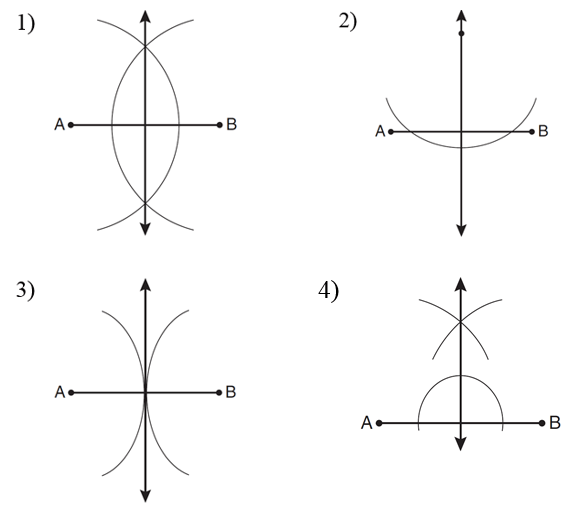
Take a guess! Which one is the correct construction for a perpendicular bisector?
a)
1
b)
2
c)
3
d)
4
117.
What does the word BISECT mean?
a)
To cut something into more than five pieces.
b)
It is a plane with two sets of wings.
c)
A shape that has three sides. 
d)
To cut something into two congruent pieces or in half.
118.
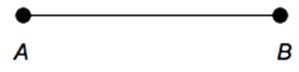
When copying line segment AB using a straight edge and a compass, the compass should be used to:
a)
Draw an arc above point A
b)
Measure the length of segment AB
c)
Draw an arc between point A and point B
d)
Measure half the length of line segment AB
119.
Perfectly flat surface that extends forever in all directions.
a)
plane
b)
line
c)
square
d)
point
120.
Angles in a linear pair are _____ ?
a)
Congruent
b)
Supplementary
c)
Complementary
d)
Non-adjacent
121.

Which angles are congruent?

a)

2 4\angle2\ \cong\angle4

only

b)

1 3\angle1\ \cong\angle3

only

c)

1 3\angle1\ \cong\angle3

and

2 3\angle2\ \cong\angle3

d)

1 3\angle1\ \cong\angle3  

and

24\angle2\cong\angle4  

e)

1 2\angle1\ \cong\angle2

and

3 4\angle3\ \cong\angle4

122.

Which angles are supplementary?

a)

2 and 4\angle2\ and\ \angle4

only

b)

1 and 3\angle1\ and\ \angle3

only

c)

1 and3\angle1\ and\angle3

and

2 and3\angle2\ and\angle3

d)

1 and 3\angle1\ and\ \angle3  

and

2 and 4\angle2\ and\ \angle4  

e)

1 and 2\angle1\ and\ \angle2

2 and 3\angle2\ and\ \angle3  

3 and 4\angle3\ and\ \angle4

and

1 and 4\angle1\ and\ \angle4  

123.

What is the converse of this conditional statement?

If you are over the age of 5, then you know how to tie your shoes.

a)

If you know how to tie your shoes, then you are over the age of 5.

b)

If you don't know how to tie your shoes, then you are not over the age of 5.

c)

If you aren't over the age of 5, then you don't know how to tie your shoes.

d)

All people over the age of 5 know how to tie their shoes.

124.

What is the inverse of this conditional statement?

If you are over the age of 5, then you know how to tie your shoes.

a)

If you know how to tie your shoes, then you are over the age of 5.

b)

If you don't know how to tie your shoes, then you are not over the age of 5.

c)

If you aren't over the age of 5, then you don't know how to tie your shoes.

d)

All people over the age of 5 know how to tie their shoes.

125.

What is the contrapositive of this conditional statement?

If you are over the age of 5, then you know how to tie your shoes.

a)

If you know how to tie your shoes, then you are over the age of 5.

b)

If you don't know how to tie your shoes, then you are not over the age of 5.

c)

If you aren't over the age of 5, then you don't know how to tie your shoes.

d)

All people over the age of 5 know how to tie their shoes.

126.

What has to be true for a statement to be biconditional?

a)

The conditional and its inverse have to both be true.

b)

The conditional and its contrapositive have to both be true.

c)

The conditional and its converse have to both be true.

d)

The conditional has to be true and the converse has to be false.

127.
What is this?
a)
Conditional
b)
Inverse
c)
Converse
d)
Contrapositive
128.
What does this mean?
a)
Conditional 
b)
Inverse 
c)
Converse 
d)
Contrapositive 
129.

A statement that can be written in the form "if-then."

a)

Compound Statement

b)

Conjuction

c)

Converse

d)

Conditional Statement

130.

the statement formed by exchanging the hypothesis and the conclusion of a statement

a)

biconditional

b)

conjecture

c)

contrapositive

d)

converse

131.

What type of angle pair are the angles shown?

a)

postulate

b)

theorem

c)

vertical angles

d)

linear pair

132.

a conjecture (rule) that has been proven

a)

postulate

b)

theorem

c)

vertical angles

d)

linear pair

133.

an accepted statement of fact; a rule that is always true but is not proven

a)

postulate

b)

theorem

c)

vertical angles

d)

linear pair

134.

The ​ ​ (a)   is the longest side of a right triangle.

Choose from the below words
hypotenuse
altitude
perpendicular bisector
135.

Similar triangles have congruent corresponding ​ (a)   & the corresponding ​ (b)   are proportional.

Choose from the below words
angles
sides
points
altitudes
midpoint
vertex
136.

The segment of a triangle that runs from the vertex of the triangle to the midpoint of the opposite side.

a)

median

b)

ray

c)

perpendicular bisector

d)

altitude

137.

A line, segment, or ray that is perpendicular to a another line, segment, or ray at its midpoint

a)

altitude

b)

perpendicular bisector

c)

vertex

d)

same side interior

138.

Two angles whose sum measures 90 degrees

a)

Supplementary

b)

Complementary

139.

Two angles whose sum measures 180 degrees.

a)

supplementary

b)

complementary

140.

Two lines intersect at a ...

a)

point

b)

line

c)

plane

d)

collinear

141.

Two planes intersect at a ...

a)

point

b)

line

c)

plane

d)

collinear

142.

If 4 points all lie on the same line, then the points are ...

a)

coplaner

b)

collinear

c)

intersecting

d)

perpendicular

143.

Supplementary angles add up to...

a)

90°90\degree  

b)

180°180\degree  

144.

Vertical angles are...

a)

equal

b)

not equal

145.

Name one pair of Alternate Interior Angles...

a)

e and f

b)

e and g

c)

e and d

d)

e and b

146.

Name another pair of Alternate Interior Angles...

a)

60°60\degree  and g

b)

60°60\degree  and c

c)

60°60\degree  and f

d)

60°60\degree  and a

147.

Name a pair of vertical angles... SELECT ALL THAT APPLY...

a)

b and c

b)

b and d

c)

c and a

d)

e and g

e)

60°60\degree  and f

148.

Name a pair of supplementary angles...

SELECT ALL THAT APPLY...

a)

b and c

b)

b and d

c)

60°60\degree  and e

d)

e and f

e)

e and g

149.

Identify each pair of angles.

a)

alternate exterior

b)

same-side interior

c)

corresponding

d)

alternate interior

150.

Identify each pair of angles.

a)

vertical

b)

corresponding

c)

alternate exterior

d)

alternate interior

151.

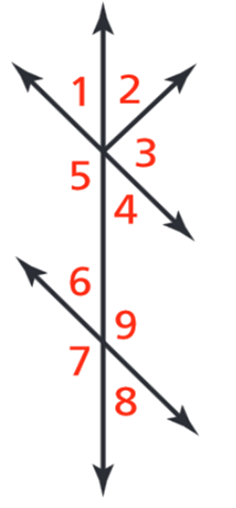
Name the alternate interior angle to 3\angle3  .

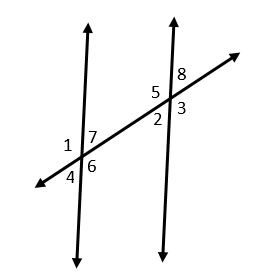
a)

4\angle4  

b)

5\angle5  

c)

6\angle6  

d)

8\angle8  

152.
Find the value of x. 
a)
x = 133
b)
x = 47
153.
Name the angle relationship.
a)
Alternate Interior
b)
Alternate Exterior
c)
Corresponding
d)
Vertical Angles
154.

Which angle is a vertical angle to with 7\angle7  ?

a)

1\angle1  

b)

5\angle5  

c)

3\angle3  

d)

6\angle6  

e)

9\angle9  

155.
A line that passes through parallel lines is called a ______________.
a)
transitive
b)
passer through line
c)
transversal
d)
bisector
156.
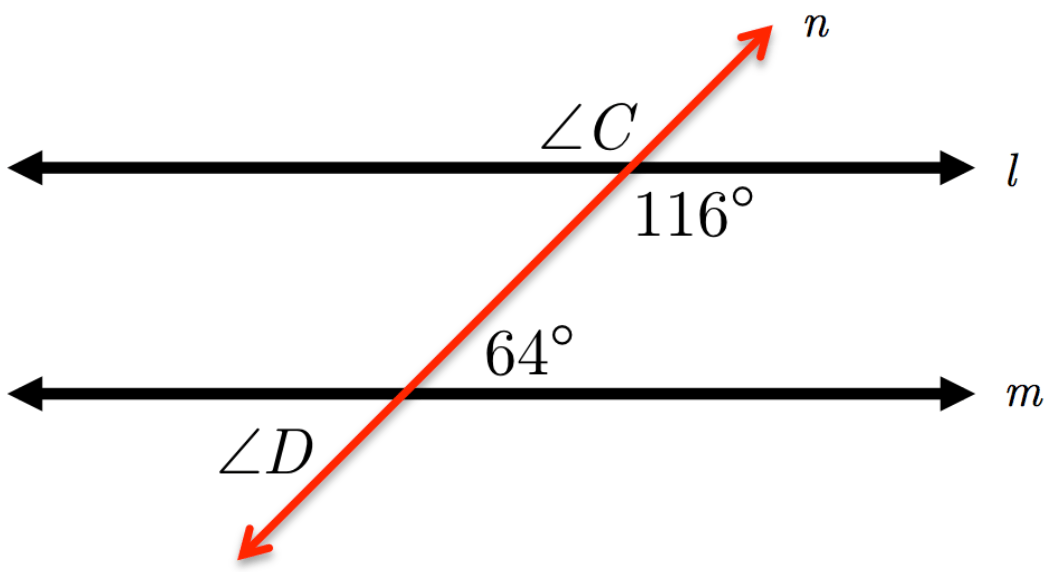
Find D
a)
∠D=116°
b)
∠D=64°
c)
∠D=180°
d)
∠D=26°
157.
Name the angle relationship.
a)
Alternate Interior
b)
Alternate Exterior
c)
Corresponding
d)
Vertical Angles
158.
Name the angle relationship.
a)
Alternate Interior
b)
Alternate Exterior
c)
Corresponding
d)
Vertical Angles
159.
Two lines going the exact same way and will never intersect
a)
Alternate exterior angles
b)
Parallel lines
c)
Alternate interior angles
d)
Vertical lines
160.

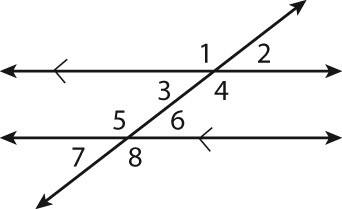
2) Given the following two parallel lines cut by a transversal.


Which pair of angles represents corresponding angles?

a)

1\angle1  and  6\angle6  

b)

6\angle6  and 5\angle5  

c)

7\angle7  and 8\angle8  

d)

4\angle4  and 8\angle8  

161.

3) Given the following two parallel lines cut by a transversal.


Which pair of angles represents alternate interior angles?

a)

3\angle3  and 8\angle8  

b)

7\angle7  and 2\angle2  

c)

7\angle7  and 8\angle8  

d)

4\angle4  and 8\angle8  

162.

7) Given the following two parallel lines that have been cut by a transversal.

True or False, 6\angle6  and 4\angle4  are vertical angles?

a)

True

b)

False

163.
Which of these angles is NOT congruent to angle 5?
a)
Angle 6
b)
Angle 8
c)
Angle 1
d)
Angle 4
164.
A slide is also called a _________.
a)
Translation
b)
Reflection
c)
Rotation
d)
Transformation
165.
A turn is also called a ___________.
a)
Translation
b)
Reflection
c)
Rotation
d)
Transformation
166.
Name the transformation.
a)
Translation
b)
Reflection
c)
Rotation
167.

Translations are always _______

a)

Congruent

b)

Bigger

c)

Smaller

d)

Rotated

168.

The image shows what type of transformation?

a)

Rotation

b)

Translation

c)

Reflection

169.
What is this picture an example of? 
a)
An angle
b)
A cat vertex 
c)
Rotation 
170.
What transformation is happening to the red triangle to get to the blue triangle?
a)
Translation
b)
Rotation
c)
Reflection
171.
 Describe the Transformation
a)
Translation
b)
Rotation
c)
Reflection
172.
 Describe the Transformation
a)
Translation
b)
Rotation
c)
Reflection
173.

What quadrant is the image now in?

a)

I

b)

II

c)

III

d)

IV

174.
 Describe the Transformation
a)
Translation
b)
Rotation
c)
Reflection
175.
Reflection or Rotation
a)
Reflection
b)
Rotation
176.
Is this rotation or reflection symmetry?
a)
Rotation
b)
Reflection
c)
Translation
177.

Describe the Transformation

a)

Reflection

b)

Translation

c)

Rotation

178.
Describe the Transformation
a)
Translation
b)
Reflection
c)
Rotation
179.
Turning an Object
a)
Reflection
b)
Rotation
c)
Translation
180.
a)
Reflections
b)
Translations
c)
Reflections and Rotations
d)
Translations and Rotations
181.

What does congruent mean?

a)

your nose is plugged up

b)

your pre image and image are the same color

c)

your image is the same type of shape as the pre image

d)

your image is the same shape AND size as the pre image

182.

Which came first? The image or the pre image?

a)

image

b)

pre image

c)

egg

183.

After a transformation, your new vertices should have what symbol on them?

a)

$

b)

#

c)

'

d)

&

184.

Justify why PRSR\overline{PR}\cong\overline{SR}

a)

Given (it's marked in the diagram)

b)

Alternate Interior Angles

c)

Vertical Angles

d)

Supplementary Angles

e)

Corresponding Angles

185.

What is the RELATIONSHIP between PQ\overline{PQ} and ST\overline{ST} ?

a)

Given (it's marked in the diagram)

b)

Parallel

c)

Perpendicular

d)

Alternate Interior Angles

e)

Corresponding Angles

186.

C is the midpoint of BE\overline{BE}

Justify why BCEC\overline{BC}\cong\overline{EC}

a)

Given (marked in the diagram)

b)

Definition of Midpoint

c)

Definition of Perpendicular

d)

Definition of Bisects

e)

Vertical Angles

187.

Justify why BADBCD\angle BAD\cong\angle BCD

a)

Given (marked in the diagram)

b)

Definition of midpoint

c)

Definition of perpendicular

d)

Definition of Bisects

e)

both are right angles

188.

Justify why CDBABD\angle CDB\cong\angle ABD

a)

Corresponding Angles

b)

Supplementary Angles

c)

Alternate Interior Angles

d)

Vertical Angles

189.

If, C is the midpoint of AD\overline{AD} , then

a)

ABED\overline{AB}\cong\overline{ED}

b)

ACDC\overline{AC}\cong\overline{DC}

c)

BCEC\overline{BC}\cong\overline{EC}

d)

definition of midpoint

190.

If QP\overline{QP} bisects RQT\angle RQT then...

a)

RQPTQP\angle RQP\cong\angle TQP

b)

RQTRPT\angle RQT\cong\angle RPT

c)

RPTTPQ\angle RPT\cong\angle TPQ

d)

RPQTPQ\angle RPQ\cong\angle TPQ

191.

Justify QPQP\overline{QP}\cong\overline{QP}

a)

Alternate Interior Angles

b)

Vertical Angles

c)

Supplementary Angles

d)

Reflexive Property (congruent to itself)

e)

Given (marked in the diagram)

192.

Justify why AEBCED\angle AEB\cong\angle CED

a)

Reflexive Property (Congruent to itself)

b)

Corresponding Angles

c)

Vertical Angles

d)

Alternate Interior Angles

193.

What is the RELATIONSHIP between line segment AB and line segment CD?

a)

Reflexive Property (Congruent to itself)

b)

Corresponding Angles

c)

Perpendicular

d)

Alternate Interior Angles

e)

Parallel

194.

If Y is the midpoint of XZ\overline{XZ} , then...

a)

definition of midpoint

b)

XAYB\overline{XA}\cong\overline{YB}

c)

XYZY\overline{XY}\cong\overline{ZY}

d)

AYBZ\overline{AY}\cong\overline{BZ}

195.

Justify why KMKM\overline{KM}\cong\overline{KM}

a)

reflexive property (congruent to itself)

b)

definition of midpoint

c)

definition of bisect

d)

vertical angles

196.

If AM\overline{AM} bisects BAC\angle BAC

then we know that...

a)

AMAM\overline{AM}\cong\overline{AM}

b)

BAMCAM\angle BAM\cong\angle CAM

c)

AMBAMC\angle AMB\cong\angle AMC

197.

Which angles are Vertical Angles?

a)

SUTWUV\angle SUT\cong\angle WUV

b)

STUWVU\angle STU\cong\angle WVU

c)

TSUVWU\angle TSU\cong\angle VWU

198.

Which angles are Alternate Interior Angles?

a)

DACBCA\angle DAC\cong\angle BCA

b)

DABBCD\angle DAB\cong\angle BCD

c)

BACDCA\angle BAC\cong\angle DCA

199.

Justify why DCABAC\angle DCA\cong\angle BAC

a)

Corresponding Angles

b)

Vertical Angles

c)

Supplementary Angles

d)

Alternate Interior Angles

200.

Justify why BCAECD\angle BCA\cong\angle ECD

a)

Vertical Angles

b)

Corresponding Angles

c)

Alternate Interior Angles

d)

Supplementary Angles

201.

Justify why ABDE\overline{AB}\cong\overline{DE}

a)

Vertical Angles

b)

Given (marked in the diagram)

c)

Alternate Interior Angles

d)

Corresponding Angles

202.

Justify why EABECD\angle EAB\cong\angle ECD

a)

Reflexive Property (Congruent to itself)

b)

Corresponding Angles

c)

Vertical Angles

d)

Alternate Interior Angles

203.

Justify why QSRUST\angle QSR\cong\angle UST

a)

Corresponding Angles

b)

Alternate Interior Angles

c)

Reflexive Property (congruent to itself)

d)

Vertical Angles

204.

Justify why QRSUTS\angle QRS\cong\angle UTS

a)

Corresponding Angles

b)

Alternate Interior Angles

c)

Reflexive Property (congruent to itself)

d)

Vertical Angles

205.

Justify why KMMK\overline{KM}\cong\overline{MK}

a)

Reflexive Property (congruent to itself)

b)

Alternate Interior Angles

c)

Vertical Angles

d)

Corresponding Angles

206.

Name the angle opposite side AB.

a)

 A\angle\ A

b)

 B\angle\ B

c)

 C\angle\ C

207.

Name the side opposite of  C\angle\ C  

a)

Side AB

b)

Side BC

c)

Side AC

208.

Are these triangles similar?

a)

Yes

b)

No

209.

Are the two angles below congruent?

a)

yes

b)

no

210.

When three sides of a triangle are congruent to the corresponding sides of another triangle, the triangles are said to be congruent.

a)

SSS Congruence

b)

SAS Congruence

c)

ASA Congruence

d)

AAS Congruence

211.

How we state that a triangle is congruent to another triangle.

a)

Similarity statement

b)

Congruence statement

c)

Proof

d)

CPCTC

212.

When two sides of a triangle and its included angle are congruent to the corresponding sides and included angle of another triangle, the triangles are said to be congruent.

a)

SSS

b)

SAS

c)

ASA

d)

AAS

213.

When two angles and the included side of a triangle are congruent to two angles and the included side of another triangle, the triangles are said to be congruent.

a)

SSS

b)

SAS

c)

ASA

d)

AAS

214.

When two angles and the non-included side of a triangle are congruent to two angles and the non-included side of another triangle, the triangles are said to be congruent.

a)

SSS

b)

SAS

c)

ASA

d)

AAS

215.

If the hypotenuse and one leg of a right triangle are congruent to the hypotenuse and leg of another right triangle, the triangles are congruent.

a)

SSS

b)

SAS

c)

AAA

d)

HL

216.

The segment that connects the midpoints of two sides of a triangle.

a)

midpoint

b)

midsegment

c)

midline

d)

midlife crisis

217.

\parallel  

a)

parallel

b)

perpendicular

c)

skew

d)

coplanar

218.

\sim  

a)

similar

b)

congruent

c)

less than

d)

greater than

219.

\perp  

a)

parallel

b)

perpendicular

c)

skew

d)

coplanar

220.

\cong  

a)

similar

b)

congruent

c)

proportional

d)

skew

221.

\angle  

a)

ray

b)

angle

c)

segment

d)

line