
 Worksheets
Cell Membrane and Transport
Total questions: 26
Worksheet time: 18mins
Osmosis is the diffusion of _____________ across a cell membrane.
Air
Oxygen
Water
Food
An animal cell placed in a hypertonic (salty) solution will ___________
Shrink (get smaller)
Swell up (grow bigger)
Stay the same

_______ regulates what enters and leaves a cell.
Cell Membrane
Nucleus
Mitochondria
Cytoplasm
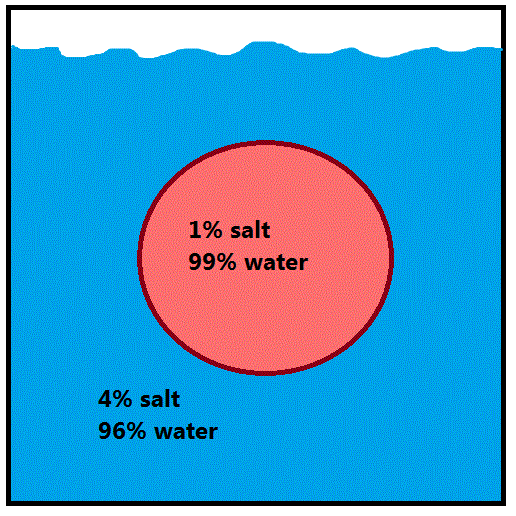
Where will the water go?
Into the cell
Out of the cell
Equally in & out - it's isotonic
There is no water
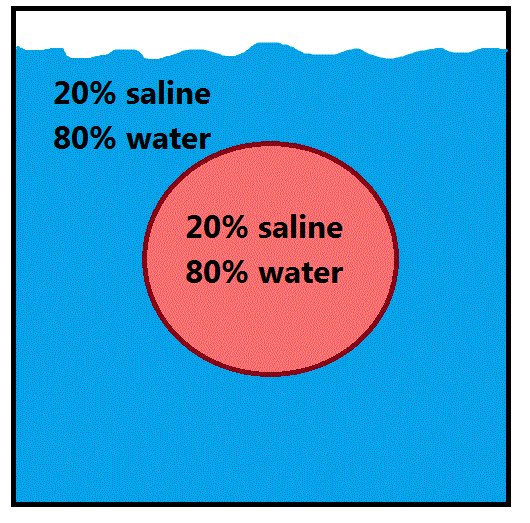
A blood cell is placed into the jar, as seen. Where will the water go?
Into the cell
Out of the cell
Equally in & out - it's isotonic
The water is a lie
Which of the following are forms of passive transport?
diffusion & endocytosis
endocytosis & exocytosis
diffusion & osmosis
osmosis & endocytosis
Active transport is the movement of large materials across a cell membrane from ______ to ______ concentration
high to low
low to high
high to high
low to low
Active transport across a cell membrane from low to high concentration, requires
energy (ATP)
no energy
water
oxygen
Large particles (or large quantities of smaller particles) are moved across the cell membrane with the use of energy.
pump transport
osmosis
bulk transport
CO2 + O2 Transport
small compartment enclosed by a membrane formed during transport of material during endo + exocytosis
vesicles
large vacuole
mitochondria
lysosome
Diffusion & Facilitated Diffusion are both __________ transport.
Passive
Active
Easy
Free
Passive Transport uses ____ energy
no
a lot of
a little bit of
some

The type of transport that requires the use of transport proteins
Passive Transport
Facilitated Diffusion
Active Transport
Vesicular Transport

The energy molecule that powers some modes of transport
ADP
ATP
AGP
ABP
Which type of biological macromolecule is the main component of the plasma membrane?
carbohydrate
lipid
protein
nucleic acid

This image is an example of a phospholipid. Which part of a phospholipid is HYDROPHOBIC?
the phosphate "head"
the lipid "tails"

Where can carbohydrates be found when part of a plasma membrane?
On the outside of the membrane
On the inside of the membrane
Embedded part of the way into the membrane
Embedded the whole way through the membrane
All of the above
What does "hydrophobic" mean?
water loving, associates with water
water fearing, does not associate with water
a world war II submarine
an example would be solutes like sugar or salt

Cell membrane structures that are embedded in the phospholipid bilayer that identify and communicate with extracellular surroundings.
Cholesterol
Carbohydrate Chains
Proteins

Identify what part of the cell membrane that is represented by letter A.
Phospholipid Bilayer
Integral Protein
Cholesterol
Carbohydrate Chain

