wayground logo

Free Printable Worksheets

NEW

Font size

S
M
L
XL
Worksheets

24-25 Midterm Exam Review - Unit 5 & 6

Total questions: 65

Worksheet time: 2hrs 43mins

Name
Class
Date
1.

Most elements bond to create compounds because

a)

their outer electron level is full

b)

they are unstable

c)

they are positively charged

2.

After a chemical reaction occurs, atoms are not created nor destroyed,

a)

just rearranged into a new substance

b)

just changed into different elements

c)

just turned into unstable elements

3.

Ionic bonds happen when valence electrons are

a)

shared

b)

too heavy

c)

transferred

4.

Is H2O2 an element or a compound?

a)

element

b)

compound

5.

A type of chemical bond where electrons are transferred.

a)

Ionic Bond

b)

Covalent Bond

6.

In this chemical bond type, the electrons are shared.

a)

Ionic Bond

b)

Covalent Bond

7.
Ionic bonds are between...
a)
Metal and Non-metal
b)
Non-metal and Non-metal
c)
Metal and Metal
8.
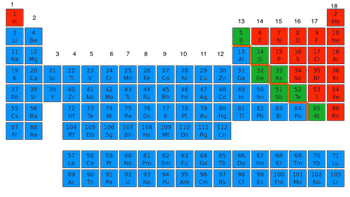
Where are metals located on the periodic table?
a)
Blue
b)
Green
c)
Red
9.
Is this ionic bond drawn correctly?
a)
Yes
b)
No
10.

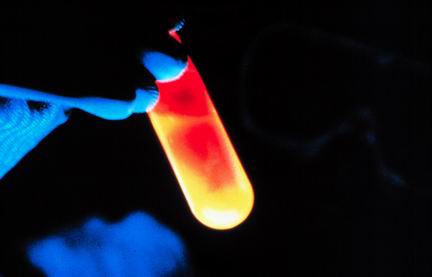
These atoms show electrons being

a)

transferred

b)

shared

c)

traded

11.

What are the properties of covalent compounds?

a)

Shared protons, high melting and boiling points, non-conductive

b)

Shared neutrons, low melting and boiling points, conductive

c)

Shared electrons, low melting and boiling points, non-conductive

d)

Transferred electrons, high melting and boiling points, conductive

12.

What is the bond in NaCl?

a)

Ionic bond

b)

Hydrogen bond

c)

Metallic bond

d)

Covalent bond

13.
A binary covalent bond exists between
a)
2 metals
b)
1 metal and 1 nonmetal
c)
2 nonmetals
d)
Any 2 elements
14.
What is the correct name for NO?
a)
Mononitrogen Monoxide
b)
Nitrogen Monoxide
c)
Mononitrogen Dioxide
d)
Nitrogen Oxide
15.
What is the formula for Tricarbon Octahydride?
a)
Ca3O
b)
C2H8
c)
C3H8
d)
Ca3H8
16.
Phosphorous trichloride
a)
PCl3
b)
P3Cl
c)
P3Cl3
d)
PCL
17.
A covalent compound made of one sulfur and two oxygen atoms would be named
a)
sulfur dioxide.
b)
sulfur oxide.
c)
disulfur oxide.
d)
sulfide oxygen.
18.

Cation

a)

An atom with a negative charge, or a negative ion

b)

smallest unit into which matter can be divided

c)

An atom with a positive charge, or a positive ion.

d)

The force that holds atoms together in a chemical compound

19.
Ba+2, Br-1
a)
BrBa
b)
Br2Ba2
c)
BaBr2
d)
Br2Ba
20.
What is the correct formula for dichlorine monoxide?
a)
Co₃O
b)
ClO₂
c)
Cl₂O
d)
(Cl₂)₂O
21.

The anion for a binary compound ends in

a)

ate

b)

ite

c)

ide

d)

all are correct possible endings

22.

Name the prefix used for a subscript of 7.

a)

septa

b)

hexa

c)

octa

d)

hepta

23.
Ca+2, O-2
a)
CaO
b)
OCa
c)
Ca-2O+2
d)
Ca2O2
24.

Select the choice with the correctly represented cations and anions for the chemical formula: Be3N2Be_3N_2  

a)

Be3+ and   N2Be^{3^{+\ }}and\ \ \ N^{2^-}  

b)

Be3 and   N2+Be^{3^{-\ }}and\ \ \ N^{2^+}  

c)

Be2 and   N3+Be^{2^{-\ }}and\ \ \ N^{3^+}  

d)

Be2+ and   N3Be^{2^{+\ }}and\ \ \ N^{3^-}  

25.

Select the choice that represents the Lewis Structure for the Cation and Anion in this chemical formula: NaCl

a)
b)
c)
d)
26.

States that the total mass of the reactants before a chemical reaction is the same as the total mass of the products after the chemical reaction.

a)

law of conservation of mass

b)

law of superposition

c)

law of gravity

d)

law of conservation of energy

27.

New substance produced by a chemical reaction.

a)

product

b)

reactant

c)

coefficient

28.

Starting substance in a chemical reaction.

a)

reactant

b)

product

c)

coefficient

29.

Minimum amount of energy needed to start a chemical reaction.

a)

activation energy

b)

catalyst

c)

inhibitor

d)

enzyme

30.

Substance that increases the reaction rate by lowering the activation energy of a reaction.

a)

catalyst

b)

endothermic

c)

enzyme

d)

inhibitor

31.
Evidence of a chemical reactions is anything that shows - 
a)
a new substance has formed
b)
a solid dissolved in a liquid
c)
interaction between 2 gases
d)
a change in the state of matter
32.
Which of the following is NOT evidence that that a chemical reaction has occurred?
a)
produces light/heat
b)
production of a gas
c)
formation of a precipitate
d)
melting
33.
Which of the following equations demonstrates an actual chemical reaction that forms a new substance?
a)
A
b)
B
c)
C
d)
D
34.
Which of the following is an example that includes evidence of a chemical reaction?
a)
A sample of zinc is placed in water and it settles to the bottom
b)
A solid block of ice is heated and it completely melts into a liquid. 
c)
Sugar that is burned gives off an odor and turns brown and then black.
d)
A tomato is placed into a blender and chopped up into smaller pieces.
35.

The principle that the total amount of matter is neither created or destroyed during any chemical or physical change.

a)

Open System

b)

Closed System

c)

Law of Conservation of Mass

36.
What is the left part of a chemical equation called?
2H2 + O2 --> 2H2O
a)
Reactants
b)
Products 
c)
Yields 
d)
Chemical Equation 
37.
What is the right part of a chemical equation called...
2H2 + O2 --> 2H2O
a)
Reactants
b)
Products 
c)
Yields 
d)
Chemical Equation 
38.
What is the total number of atoms present in 5Na3PO4
a)
5
b)
40
c)
55
d)
8
39.
What is the little number after an element in a chemical equation called.
Example: H2
a)
Coefficient 
b)
Subscript
c)
Atom
d)
Equation
40.
What is the number before a chemical formula called?
Ex: 2H2 + O2 --> 2H2O
a)
Coefficient
b)
Subscript
c)
Atom
d)
Equation
41.
Is the following equation balanced?
4Fe + 3O2 --> 2Fe2O3
a)
yes
b)
no
42.
Is the following equation balanced?
2C2H2 + 5O2 --> 4CO2 + 2H2O
a)
yes
b)
no
43.
Which of the following equations are correctly balanced?
a)
12CO2 +H2O --> C6H12O6 + O2
b)
CO2 + 9H2O --> C6H12O6 + O2
c)
CO2 + H2O --> 3C6H12O6 + O2
d)
6CO2 + 6H2O --> C6H12O6 + 6O2
44.

Balance this equation

_Al +_HCl --> _H2 +_AlCl3

a)

2,6,3,2

b)

it's already balanced

c)

4,12,3,4

d)

2,1,4,5

45.

The stability of an isotope is based on the ratio of its

a)

neutrons and protons

b)

neutrons and positrons

c)

electrons and positrons

d)

electrons and protons

46.

What do scientists call isotopes with radioactive nuclei that can emit or give off smaller subatomic particles and electromagnetic radiation?

a)

stable isotopes

b)

radioactive isotopes

c)

electromagnetic isotopes

d)

strong nuclear force isotopes

47.

Which subatomic particle seems to have a stabilizing effect on an isotope?

a)

protons

b)

neutrons

c)

electrons

d)

quarks

48.

Which nuclide will most likely turn its neutron into a proton?

a)

A

b)

B

c)

C

d)

D

49.

A force that acts between protons and neutrons of atoms is called a ____________>

a)

Electrostatic force

b)

Chemical reaction

c)

Nuclear Force

50.
The goal in chemistry is always to become more
a)
stable
b)
friendly
c)
intelligent
d)
arrogant
51.
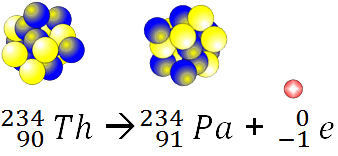
Which type of nuclear radiation is being emitted here?
a)
Alpha
b)
beta
c)
gamma 
d)
none
52.
Solve this equation for alpha decay.
85209At = ___ + 24He
a)
83205Bi
b)
86209Rn
c)
81207Tl
d)
85208At
53.

Gamma rays have

a)

no mass

b)

a huge mass

c)

a small mass

d)

an average mass

54.
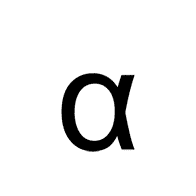
Has the symbol
a)
Alpha
b)
Beta
c)
Gamma
55.
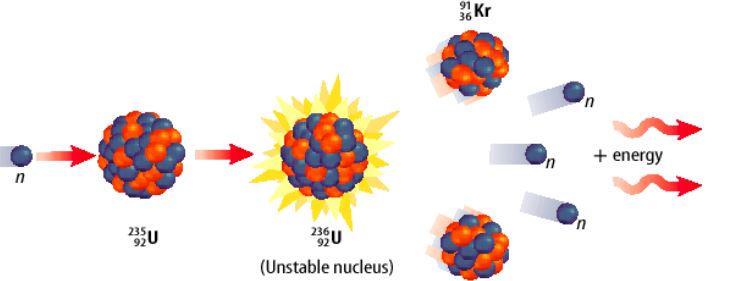
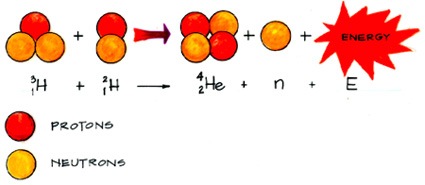
This is an example of...
a)
Fission  reaction
b)
Fusion reaction
c)
Decomposition reaction
d)
Decay
56.
Which process involves the joining of small nuclei?
a)
Beta decay
b)
Alpha decay
c)
Nuclear fission
d)
Nuclear fusion
57.
In a correctly written symbol what would be located in the "A" position?
a)
number of neutrons
b)
atomic number
c)
number of electrons 
d)
mass number
58.

In alpha decay, a ________ particle breaks off of an atom.

a)

hydrogen

b)

helium

c)

carbon

d)

lithium

59.

In gamma emission, ___________ is emitted.

a)

an electron

b)

a proton

c)

energy waves

d)

none of the above

60.
The time it takes for 50% of the nuclei in a radioactive sample to decay to its stable isotope is called _____.
a)
the daughter product
b)
geologic time
c)
the half-life
d)
the half-time
61.
The graph shows the radioactive decay of a 50-gram sample of a radioactive isotope. 
According to the graph, what is the half-life of this isotope
a)
100 years
b)
150 years
c)
200 years
d)
300 years
62.

What percentage of the original isotope is left after 1 half-lives?

a)

100%

b)

75%

c)

50%

d)

25%

63.

Carbon dating is used to determine the age of a fossil. Less than 7% of the original amount of carbon-14 is left. How many half-lives would have passed?

a)

1

b)

2

c)

3

d)

4

64.

The half-life of a substance is 6000 years. How long would it take until only half of the substance is left?

a)

3000

b)

6000

c)

9000

d)

12000

65.

What does "half-life" mean

a)

Half of the time it takes for all of the nuclei to decay

b)

The time it takes for half of the nuclei to decay