

wayground logo

Free Printable Worksheets

Font size

S
M
L
XL
Worksheets

Hydrosphere & Atmosphere/Climate/Change

Total questions: 40

Worksheet time: 20mins

Name
Class
Date
1.

All of the water on Earth is better known as _____

a)
the biosphere
b)
the hydrosphere
c)
the lithosphere
d)
the exosphere
2.

The process by which water soaks into the ground is better known as _____

a)
infiltration
b)
precipitation
c)
condensation
d)
transpiration
3.

The process of removing impurities from water is better known as _____

a)
water refuse
b)
water management
c)
water treatment
d)
water supply
4.

What are the two main causes of ocean currents? select all that apply

a)
uneven heating of Earth's surface
b)
the pull of gravity from the moon
c)
the tilt of Earth's axis
d)
differences in water densities
e)
the equator and poles
5.

What is the nickname of the ocean current that stretches all the way around the planet?

a)
the global conveyor belt
b)
El Niño
c)
The Lazy River
d)
The Big One
6.

How deep are surface currents?

a)
from 0m - 15m
b)
from 15m - 40m
c)
from 40m - 400m
d)
from 0m - 400m
7.

What is the main cause of deep ocean currents?

a)
uneven heating of Earth's surface
b)
the pull of gravity from the moon
c)
the tilt of Earth's axis
d)
differences in water densities
8.

With regards to pH, what is H+? select all that apply

a)
Hydrogen
b)
Hydronium
c)
positively charged Hydrogen
d)
an ion
9.

Which of the following pH measurements would make sense if we were sampling a solution with a high concentration of H+? select the BEST answer

a)
1.4
b)
6.2
c)
7
d)
8.1
e)
13.3
10.

If a solution had a high pH, we would expect a large concentration of _____ select all that apply
a)
OH-
b)
Hydroxide
c)
base
d)
Hydronium
e)
acid
11.

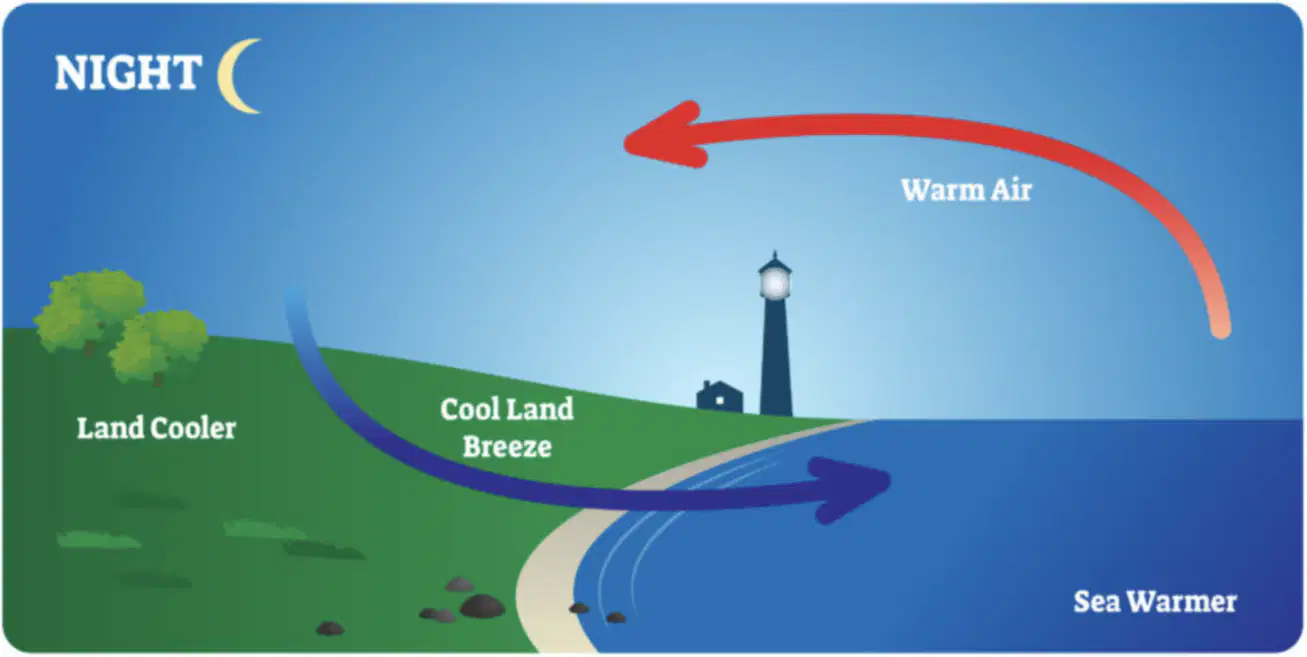
What is shown below? select the BEST answer

a)
how wind forms
b)
how tides form
c)
the creation of surface currents
d)
a land breeze
e)
a sea breeze
12.

Which of the following IS true?

a)
less water is colder than warm water
b)
cold water is less dense than warm water
c)
warm water is less dense than cold water
d)
more dense is water which is warm
13.

Which of the following is true?

a)
warm water is generally more salty because you can increase the amount of solute dissolved with higher temperatures
b)
warm water is generally more salty because freshwater evaporates more in hotter areas leaving behind salt
c)
cold water is generally more salty because as water cools the molecule condenses, not allowing salt to escape
d)
cold water is generally more dense because only freshwater freezes, leaving behind the salt
14.

Oxygen dissolves into water through the process of _____

a)
deflection
b)
dissolution
c)
diffusion
d)
dissociation
15.

Turbidity measures which of the following? select all that apply

a)
the amount of dissolved solids in a solution
b)
how clear or transparent a water sample is
c)
the amount of undissolved solids in a solution
d)
the amount of light that can pass through a water sample
e)
Nephelometric Turbidity Units
16.

Turbidity units include total dissolved solids and _____

a)
DTS
b)
neflometric turbidity units
c)
dissolved turbidity units
d)
mg/L (milligrams per Liter)
17.

Storm drains are a large contributing factor to _____ select all that apply

a)
sedimentation
b)
point source pollution
c)
non-point source pollution
d)
chemical substances from parking lots entering waterways
18.

Though all types of aquatic trash can have potentially harmful impacts, _____ waste is particularly concerning due to its persistence in the environment along with widespread production, use, and disposal.

a)
plastic
b)
toxic
c)
solid
d)
liquid
e)
chemical
19.

A (BMP) is a good example of ______ select the BEST answer

a)
water management
b)
water refuse
c)
water treatment
d)
water supply
20.

What is the main factor which causes wind and ocean currents to NOT travel in straight lines?

a)
the axis of earth
b)
the rotation of earth
c)
the revolution of earth
d)
the size of earth
21.

The process by which gases in Earth's atmosphere trap heat.

a)
greenhouse gases
b)
greenhouse effect
c)
greenhouse trap
d)
global warming
22.

Small amounts of other gases (less than 0.1% by mass), such as neon, helium, methane, and ozone.

a)
Milankovitch cycles
b)
greenhouse gases
c)
trace gases
d)
noble gases
23.

The study of past climates.

a)
Paleoclimatology
b)
Milankovitch cycles
c)
Pollen records
d)
Ice cores
24.

The third layer of the atmosphere, the coldest layer, where most meteors burn up.

a)
stratosphere
b)
thermosphere
c)
troposphere
d)
mesosphere
e)
exosphere
25.

Which of the following is the correct composition of Earth's atmosphere?

a)
Nitrogen = 78%, Oxygen = 21%, Argon = 0.9%, Carbon dioxide = 0.04%
b)
Oxygen = 87%, Nitrogen = 12%, Argon = 0.4%, Carbon dioxide = 0.09%
c)
N2 = 87%, O2 = 12%, CO2 = 0.4%, Ar = 0.09%
d)
O2 = 78%, N2 = 21%, CO2 = 0.9%, Ar = 0.04%
26.

A large collection of ___ is found in the Stratosphere where it blocks most harmful radiation from the sun and traps heat as a greenhouse gas.

a)
CO2
b)
O2
c)
O3
d)
CH4 (methane)
27.

Methane makes up ____ % of the mass of greenhouse gasses. select the BEST answer

a)
12%
b)
21%
c)
78%
d)
0.9%
28.

Several gasses exist in our atmosphere in trace amounts. What does "trace" refer to within this context?

a)
less than 0.1%
b)
less than 0.01%
c)
less than 0.001%
d)
less than 0.0001%
29.

This layer of the atmosphere contains almost all the mass in the entire atmosphere.

a)
stratosphere
b)
thermosphere
c)
troposphere
d)
mesosphere
e)
exosphere
30.

This layer of the atmosphere is known for having the hottest temperatures in the entire atmosphere, its also where the auroras are formed.

a)
stratosphere
b)
thermosphere
c)
troposphere
d)
mesosphere
e)
exosphere
31.

Put the layers in order from Earth to space

a)
strato, thermo, meso, tropo, exo
b)
exo, thermo, meso, strato, tropo
c)
thermo, stato, meno, tropo, exo
d)
tropo, strato, meso, thermo, exo
32.

A stationary front is represented on a weather map by which of the following?

a)
none of the above
b)
red semicirlces
c)
blue triangles
d)
blue semicircles
e)
red triangles
33.

Severe weather is possible when...... select the BEST answer

a)
2 fronts traveling in opposite directions meet head to head
b)
2 air masses with large pressure differences meet
c)
ocean currents from the equator collide with ocean currents from the poles
d)
a front stalls (stops moving or slows down greatly)
34.

Differences in pressure cause differences in weather. What causes differences in pressure? select all that apply

a)
uneven heating of Earth's surface
b)
wind
c)
the movement of air masses
d)
the hole in the ozone layer
35.

The most common greenhouse gas on Earth is ___

a)
Carbon dioxide
b)
Carbon monoxide
c)
Methane
d)
Argon
36.

What period of time shows a large exponential increase in atmospheric gasses tied to global warming?

a)
The Cambrian Explosion
b)
The Ice Age
c)
The Industrial Revolution
d)
The Period of Enlightenment
37.

This atmospheric gas is a pollutant/biological health issue at ground level.

a)
CO2
b)
CO
c)
O2
d)
O3
e)
NOx/SOx
38.

How does temperature behave in the Mesosphere with regards to elevation

a)
as elevation goes up temperature goes up
b)
as elevation goes up temperature goes down
c)
as elevation goes up temperature stays the same
39.

Milankovitch cycles is a theory that states the Earth naturally heats and cools over long periods of time. How long are these cycles?

a)
1,000 years
b)
10,000 years
c)
100,000 years
d)
1,000,000 years
40.

When are we expecting the human population to reach 10 billion? select the BEST answer

a)
this year!
b)
2030
c)
2040
d)
2050