wayground logo

Free Printable Worksheets

Font size

S
M
L
XL
Worksheets

final exam review fall 23 :)

Total questions: 70

Worksheet time: 9hrs 15mins

Name
Class
Date
1.
If the blue function is f(x)=x2, then the red function must be
a)
g(x)=x2-5
b)
g(x)=x2+5
c)
g(x)=(x-5)2
d)
g(x)=(x+5)2
2.
If the blue function is f(x)=√x, the red function must be
a)
g(x)=√(-x)
b)
g(x)=√(x-1)
c)
g(x)=√x-1
d)
g(x)=-√x
3.
  The blue function is the parent function f(x) = x3.  Which of the following is the correct equation for the red function, g(x)?
a)
g(x)=x3+1
b)
g(x)=x3-1
c)
g(x)=(x-1)3
d)
g(x)=(x+1)3
4.

Describe the transformation from the parent graph

a)

Reflect over x-axis, translate right 3 units, translate down 4 units

b)

Reflect over x-axis, translate left 3 units, translate down 4 units

c)

Reflect over x-axis, translate right 3 units, translate up 4 units

d)

Reflect over x-axis, translate left 3 units, translate up 4 units

5.

How is this function transformed from the parent function?

a)

Translated left 2 units

b)

Translated right 2 units

c)

Translated down 2 units

d)

Translated up 2 units

6.

How is this function transformed from the parent function?

a)

Translated left 1 unit

b)

Translated right unit

c)

Translated down unit

d)

Translated up unit

7.

How is this function transformed from the parent function?

a)

Translated left 5 units and up 1 unit

b)

Translated right 5 units and up 1 unit

c)

Translated left 5 units and down 1 unit

d)

Translated right 5 units and down 1 unit

8.

What type of function is y=2xy=2^x ?

a)

Logarithmic

b)

Linear

c)

Quadratic

d)

Exponential

9.

Compare f(x) = 3x- 4 with the basic function g(x) = 3x

a)

translate 4 units up

b)

translate 4 units to the left

c)

translate 4 units to the right

d)

translate 4 units down

10.
Given f(x) = (x-3)2 + 5.  What transformations took place from the original function f(x)?
a)
Left 3 and up 5
b)
Right 3 and down 5
c)
Left 3 and down 5
d)
Right 3 and up 5
11.
Match the equation to its description.
a)
Right 2 and up 2
b)
Left 2 and up 2
c)
Right 2 and down 2
d)
Left 2 and down 2
12.
Which transformation maps the graph of
f(x) = x2 to the graph of g(x) = (x + 4)2?
a)
a translation shifting f(x) 4 units up
b)
a translation shifting f(x) 4 units down
c)
a translation shifting f(x) 4 units to the left
d)
a translation shifting f(x) 4 units to the right
13.
Classify by degree of polynomial:
3x3 – 6x
a)
Constant
b)
Linear
c)
Quadratic
d)
Cubic
14.
Classify by degree of polynomial:
2x – 9
a)
Constant
b)
Linear
c)
Quadratic
d)
Cubic
15.
Classify by degree of polynomial:
3x2 – 8x + 1
a)
Constant
b)
Linear
c)
Quadratic
d)
Cubic
16.
How many total roots/zeros are there in the polynomial.   
a)
A
b)
B
c)
C
d)
D
17.
Find the zeros of the polynomial.
f(x) = (x-5)(2x+3)(7x-4)(x+6)
a)
x = 5, (2/3), 6, (7/4)
b)
x= -5, (3/2), (-4/7), 6
c)
x= 5, (-3/2), (4/7), -6
d)
x= 6, 5, -2/3, -4/7
18.
Given one complex zero use the conjugate root theorem to find another.  Zero is: -12-8i
a)
12+8i
b)
-12+8i
c)
12-8i
d)
-12-8i
19.
What is the degree classification of this polynomial?
x²+4x-8
a)
binomial
b)
trinomial
c)
quadratic
d)
cubic
20.
What is the leading coefficient of the following polynomial?
5x²-3x+6
a)
2
b)
-3
c)
5
d)
6
21.
Which is an example of a linear polynomial?
a)
x²-5
b)
6x+4
c)
5x⁵
d)
2x³-9x²
22.
Classify the polynomial by its degree.
x2 + 2x3 - 4
a)
A
binomial
b)
B
trinomial
c)
C
quadratic
d)
D
cubic
23.

f(x)=(x+4)(x-3)(x-2)

List the zeros for this function.

a)

x= -4, x=3, x= -2

b)

x= -4, x=3, x=2

c)

x=4, x= -3, x= -2

24.
How many zeros does the polynomial function
 P(x) = 3x4+4x-8 have?
a)
1
b)
2
c)
3
d)
4
25.
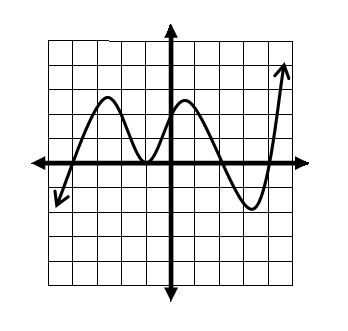
Identify the zeros:
a)
x=-2, x=-1, x=0
b)
x=-2, x=0
c)
x=-1, x=0, x=2
d)
x=-2, x=0, x=1
26.
a)
y=-(x+1)(x-2)(x-4)
b)
y=(x+1)2(x-3)(x-1)3
c)
y = 3x3 – 2x + 1
d)
y=(x+1)3(x-3)(x-1)2
27.
Which of the following could be the equation of this graph in factored form? (Careful-pay attention to multiplicity.)
a)
f(x) = (x-4)(x-1)2(x+2)(x+4)
b)
f(x) = (x-4)(x+1)2(x+2)(x+4)
c)
f(x) = (x-4)(x-1)2(x-2)(x+4)
d)
f(x) = (x+4)(x+1)2(x-2)(x-4)
28.
All imaginary roots comes in pairs.
a)
True
b)
False
29.
What is the side across from the right angle called?
a)
Leg
b)
Pythagoras
c)
Hypotenuse
d)
Altitude
30.
Which trig function would you use with this diagram?
a)
Sin
b)
Cos
c)
Tan
d)
Wha??
31.
What is the correct ratio?
a)
sin 40 = w/28
b)
cos 40 = w/28
c)
tan 40 = w/28
d)
sin 40 = 28/w
32.
Which is the correct ratio?
a)
sin 28 = x/14
b)
cos 28 = x/14
c)
tan 28 = x/14
d)
tan 28 = 14/x
33.
What is the cosine of angle P?
a)
p/q
b)
q/r
c)
p/r
d)
r/q
34.

Find cos A

a)

30/16

b)

30/34

c)

30/15

d)

16/34

35.

FInd tan X

a)

32/40

b)

40/24

c)

32/24

d)

24/32

36.
What does SOH stand for
a)
hypotenuse over opposite
b)
adjacent over opposite
opposite over adjacent
c)
opposite over hypotenuse
d)
adjacent over adjacent
37.

What does CAH stand for

a)

cosine is the adjective over the hypotenuse.

b)

cosine is the adjacent side over the hypotenuse side.

c)

cosine is the adjacent side over the hippopotamus.

d)

cosine is the hypotenuse side over the adjacent side.

38.

Which Trig function would you use to solve this problem?

a)

Sine

b)

Cosine

c)

Tangent

d)

Pythagorean Theorem

39.

Find tangent of θ.

a)

8/12

b)

23/12

c)

8/23

d)

12/23

40.

Find the length of side y.

a)

22.32 cm

b)

36.5 cm

c)

76.34 cm

d)

87.76 cm

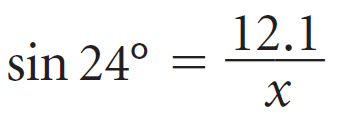
41.
Solve for x.
a)
24.20
b)
4.92
c)
290.4
d)
29.75
42.
Set up the problem...
a)
sin X = 41/28
b)
tan X = 41/28
c)
cos X = 28/41
d)
sin X = 28/41
43.
Find the measure of the missing angle.
a)
49o
b)
50o
c)
41o
d)
33o
44.

What is the formula for Tangent?

a)

Adjacent/Opposite

b)

Adjacent/Hypotenuse

c)

Opposite/Adjacent

d)

Opposite/Hypotenuse

45.

What is the degree of f(x)?  f(x)=x4 +2x313x214x+24f\left(x\right)=x^{4^{\ }}+2x^3-13x^2-14x+24  

a)

1

b)

2

c)

4

d)

24

46.

What is the leading coefficient of f(x)?  f(x)=x4 +2x313x214x+24f\left(x\right)=x^{4^{\ }}+2x^3-13x^2-14x+24  

a)

1

b)

2

c)

4

d)

24

47.

What is the leading coefficient of f(x)?  f(x)=x4 +2x313x214x+24f\left(x\right)=x^{4^{\ }}+2x^3-13x^2-14x+24  

a)

1

b)

2

c)

4

d)

24

48.

Complete the end behavior statement for the graph of f(x). As  x, y ?x\rightarrow\infty,\ y\rightarrow\ ?  

a)

\infty  

b)

-\infty  

49.

Determine the x-intercepts. (Check ALL that apply!)

a)

-4

b)

-2

c)

0

d)

1

e)

3

50.

Allie said the degree of the function below f(x)=x5+2x4+3x32x69x26x+4f\left(x\right)=x^5+2x^4+3x^3-2x^6-9x^2-6x+4  is 5. Explain AND correct her error. 

4 lines
51.

What is the domain of the function?

a)

(,)\left(\infty,-\infty\right)

b)

(, )\left(-\infty,\ \infty\right)

c)

[0,]\left[0,\infty\right]

d)

(,0]\left(-\infty,0\right]

52.

What is the range of the function?

a)

(,)\left(\infty,-\infty\right)

b)

(, )\left(-\infty,\ \infty\right)

c)

[0,]\left[0,\infty\right]

d)

(,0]\left(-\infty,0\right]

53.
The degree of a polynomial can be determined by the largest powered monomial of the polynomial.  
What is the degree of the polynomial:
f(x) = 3x2 + 4x - 5
a)
Degree 2  (quadratic)
b)
Degree 3 (cubic)
c)
Degree 4 (quartic)
d)
Degree 5 (quintic)
54.
The degree of a polynomial can be determined by the largest powered monomial of the polynomial.  
What is the degree of the polynomial:
f(x) = -4x+ 5x - 2
a)
Degree 2 (quadratic)
b)
Degree 3 (cubic)
c)
Degree 4 (quartic)
d)
Degree 5 (quintic)
55.

what the leading coefficient

a)

Postive

b)

Negative

c)

Even

d)

Odd

56.

what the is the degree of the polynomial

a)

Postive

b)

Negative

c)

Even

d)

Odd

57.

What is the degree of the polynomial?

f(x) = 2x43x22x 4?f\left(x\right)\ =\ 2x^4-3x^2-2x\ -4?  

a)

4

b)

3

c)

2

d)

1

58.

Check all the even degree polynomials:

a)
b)
c)
d)
e)
59.

What is the end behavior as xx\rightarrow-\infty

a)

As x, f(x)x\rightarrow-\infty,\ f\left(x\right)\rightarrow-\infty

b)

As x, f(x)x\rightarrow-\infty,\ f\left(x\right)\rightarrow\infty

c)

As x, f(x)x\rightarrow\infty,\ f\left(x\right)\rightarrow-\infty

d)

As x, f(x)x\rightarrow\infty,\ f\left(x\right)\rightarrow\infty

60.

What is the end behavior as xx\rightarrow-\infty

a)

As x, f(x)x\rightarrow-\infty,\ f\left(x\right)\rightarrow-\infty

b)

As x, f(x)x\rightarrow-\infty,\ f\left(x\right)\rightarrow\infty

c)

As x, f(x)x\rightarrow\infty,\ f\left(x\right)\rightarrow-\infty

d)

As x, f(x)x\rightarrow\infty,\ f\left(x\right)\rightarrow\infty

61.

What is the end behavior as xx\rightarrow\infty

a)

As x, f(x)x\rightarrow-\infty,\ f\left(x\right)\rightarrow-\infty

b)

As x, f(x)x\rightarrow-\infty,\ f\left(x\right)\rightarrow\infty

c)

As x, f(x)x\rightarrow\infty,\ f\left(x\right)\rightarrow-\infty

d)

As x, f(x)x\rightarrow\infty,\ f\left(x\right)\rightarrow\infty

62.

What are the inverse points for the coordinates:

(3, 0) , (2, -4), (5, 5) and (-6,8)

a)

(3,0) , (2, -4) , (5,5) , (6,8)

b)

(0,3) , (-4,2) , (5,5) , (8,-6)

c)

(3,2), (0, -4), (5, -6), (5,8)

63.

Find the inverse of  f(x)=10+7xf(x)=10+7x  

a)

f1(x)=x710f^{-1}(x)=\frac{x-7}{10}

b)

f1(x)=x107f^{-1}(x)=\frac{x-10}{7}

c)

f1(x)=110+7xf^{-1}(x)=\frac{1}{10+7x}

64.

Find the inverse of  f(x)=2x+1f(x)=2x+1  

a)

f1(x)=2xf^{-1}(x)=2x

b)

f1(x)=x12f^{-1}(x)=\frac{x-1}{2}

c)

f1(x)=2f^{-1}(x)=2

65.

The inverse of f(x)=8x+30f(x)=8x+30  is f1(x)=830f^{-1}(x)=\frac{8}{30}  .

a)

True

b)

False

66.

The inverse of f(x)=x+30f(x)=x+30   is  f1(x)=x30f^{-1}(x)=x-30  .

a)

True

b)

False

c)

I have no idea how to do this.

67.

Match each operation with the inverse or opposite operation.

a)

Addition

1.

Subtraction

b)

Multiplication

2.

Division

c)

Squared

3.

Square Root

68.

The squareroot  ()\left(\sqrt{ }\right)  and squaring  (   )2\left(\ \ \ \right)^2  are (a)   operations.

69.

The cube root  (3)\ ^{\left(3\sqrt{ }\right)}  and cubing (  )3\left(\ \ \right)^3  are (a)   operations.

70.

What is the degree of the polynomial 3x4 - 2x3 + x2 - 5x + 1?

a)

1

b)

2

c)

3

d)

4