
Font size
 Worksheets
G-CHAPTER 7 TEST 2023-2024
Total questions: 148
Worksheet time: 6hrs 51mins


The original point that is to be transformed is called the:
Pre-Image
Image
Post-Image
Transformation

Translate the blue shape to the pink shape...
5 Right
2 Down
5 Left
2 Up
3 Right
1 Down
3 Left
1 Up
Translate the pink shape to the blue shape...
5 Right
2 Down
5 Left
2 Up
3 Right
1 Down
3 Left
1 Up

Translate the blue shape to the green shape...
3 Left
3 Down
3 Right
3 Up
2 Right
3 Up
2 Left
3 Down


After a translation, figures are no longer congruent.
True
False

Describe the translation that maps point Q to Q'.
7 units up, 2 units right
3 units left, 8 units right
7 units right, 2 units up
3 units right, 8 units left
After a translation, figures face the same direction but have a different size and shape.
True
False

Describe the translation that maps point C to C'
8 units right and 4 units up
9 units right and 4 units up
4 units right and 8 units up
4 units right and 9 units up
What is a translation?
Changing quadrants in the coordinate plane
Transformation that changes the size of a figure
Transformation that changes the color of a figure
Transformation that changes the position of a figure
After a translation, figures face the same direction but have a different size and shape.
True
False
Describe the translation that maps point Q to Q'.
7 units up, 2 units right
3 units left, 8 units right
7 units right, 2 units up
3 units right, 8 units left
After a translation, figures are no longer congruent.
True
False
Describe the translation that maps point C to C'
8 units right and 4 units up
9 units right and 4 units up
4 units right and 8 units up
4 units right and 9 units up

Tell me the coordinates for point R' after a translations 5 units right and 3 units up.
(3,0)
(0,3)
(1,2)
(2,1)

Describe the translation that maps triangle IRT to triangle I'R'T'.
4 units up, 6 units left
6 units right, 4 units down
6 units up 4, units left
4 units right, 6 units down
Joe translates a triangle 4 units right and 3 units up. Check all things that will change about the triangle.
Size
Color
Orientation
Location
Congruence


Select the picture showing a translation of:
2 squares right and 1 square up


Select the picture showing a translation of:
1 square right and 2 squares up
Select the picture showing a translation of:
3 squares right and 2 squares up

Select the picture which shows a translation:
4 squares right and 5 squares down


Select the picture which shows a translation:
2 squares right and 4 squares down
Select the picture which shows a translation:
4 squares right and 2 squares down

Translate the blue shape to the pink shape...
5 Right
2 Down
5 Left
2 Up
3 Right
1 Down
3 Left
1 Up

Translate shape B to shape A...
5 Right
3 Up
5 Left
3 Down
3 Right
3 Up
3 Left
3 Down

Slide 3 up and 2 right

When translating up or down on a coordinate plane, what coordinate is affected?
x-coordinate
y-coordinate
(x, y) -----> (x, y +4)

Determine how to translate triangle ABC to triangle A'B'C' ?
(x + 2, y - 5)
(x + 2, y - 9)
(x - 2, y - 9)
(x - 2, y + 9)
What is the algebraic representation of a figure is Translated 9 units right and 3 units down?
(x, y) -->
(x - 9, y + 3)
(x, y) -->
(x + 9, y - 3)
(x, y) -->
(x + 3, y - 9)
(x, y) -->
(9x, 3y)
(x, y) ----> (x - 1, y)
What are the coordinates of M'?
What does the word translation mean in math?
To change an object by flipping it
To change an object by turning it
To change an objects by sliding it
Select the picture showing a translation of:
4 squares right and 1 square up
Select the picture which shows a translation:
4 squares right and 5 squares down

What color is the pre-image?
blue
purple

What color is the image?
red
blue


The point (a, b) is reflected over the x-axis, then the y-axis, then the y-axis again, and then the x-axis again. What are the coordinates of the new point?
(−a, b)
(−a, −b)
(a, −b)
(a, b)
Reflect over the line y = x


Flipping a figure is a ...
Rotation
Reflection
Dilation
Translation
Reflect the point (3,4) over the y-axis
(a)
Reflect the point (4,5) over the x-axis
(a)
Reflect the point (-1,7) over the x-axis
(a)
Reflect the point (-2,-9) over the y-axis
(a)
Reflect the point (8,-6) over the y-axis
(a)

Describe the transformation in the image
Translation
Reflection
Rotation
The point (2,-2) is reflected to it's image, which is at (2,2). What axis did it reflect across?
x-axis
y-axis
The point (-4,1) is reflected to it's image, which is at (4,1). What axis did it reflect across?
x-axis
y-axis

Reflect Point C over the line x = 1
(-1, 2)
(3, 0)
(0, 2)
(3, -1)

Reflect the shape over the line y = x. Where is A'?
(7, 2)
(-2, 7)
(2, -7)
(-7, -2)
A(3,3) B(6,6) C(9,3)
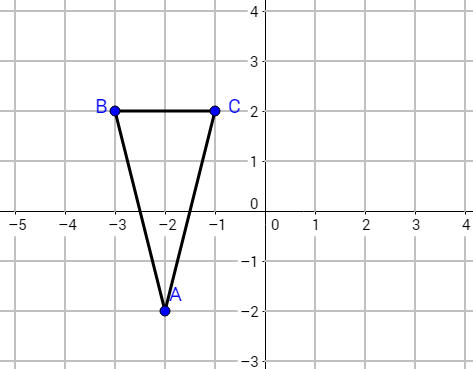

An image is dilated at a scale factor of 1.5. This means the dilation is an enlargement and the dilated image will be bigger.
True
False
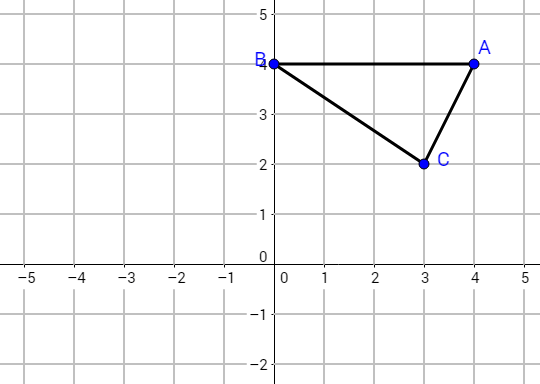

Rotation Rules (clockwise):
90o rotation: (x, y)→(y, -x)
What are the coordinates for A' after a 90⁰ rotation clockwise?
(1, 3)
(3, 1)
(3, -1)
(1, -3)

Rotation Rules (clockwise):
180o rotation: (x, y)→(-x, -y)
What are the coordinates of C' after a rotation of 180° clockwise?
(-3, -1)
(3,1)
(1,3)
(-1, -3)

Rotation Rules (clockwise):
270o rotation: (x, y)→(-y, x)
What are the coordinates of B' after a 270° clockwise?
(4, 4)
(4, -4)
(-3, 4)
(-4, 4)

Determine the degrees of rotation from each petal.
20°
72°
45°
60°

What is the degree of rotations between each blade in the picture?
45°
90°
60°
30°

How many degrees of rotation are there from petal to petal for this flower?
60°
45°
90°
75°
A counterclockwise rotation of 90° is equivalent to how many degrees of rotation clockwise?
90°
180°
270°
360°
A rotation counterclockwise of 120° is equivalent to a clockwise rotation of how many degrees?
60°
120°
180°
240°
A counterclockwise rotation of 125° is equivalent to a clockwise rotation of how many degrees?
235°
55°
125°
180°

What is the only rule that will flip the order of x and y?
180 degree rotation
90 degree or 270 degree rotation
Reflection over the y-axis


If you rotate Pentagon ABCDE 216° clockwise, where will point A end up?
Point B
Point C
Point D
Point E

What is the only rule that will flip the order of x and y?
180 degree rotation
90 degree or 270 degree rotation
Reflection over the y-axis
What is the rule for reflecting a point over the x-axis?
Change the sign of both x and y coordinates
Change the sign of the x-coordinate
Change the sign of the y-coordinate
Add the y-coordinate to the x-coordinate
What is the rule for reflecting a point over the y-axis?
Add the x-coordinate to the y-coordinate
Multiply the x-coordinate by 2
Change the sign of the y-coordinate
Change the sign of the x-coordinate
What is the rule for reflecting a point over the line y=x?
Swap the x and y coordinates of the point
Add the x and y coordinates of the point
Multiply the x and y coordinates of the point
Divide the x and y coordinates of the point
What is the rule for rotating a point 90 degrees counterclockwise?
Switch the x and y coordinates and then negate the new x-coordinate.
Subtract the x and y coordinates and then negate the new x-coordinate.
Add the x and y coordinates and then negate the new x-coordinate.
Multiply the x and y coordinates and then negate the new x-coordinate.
What is the rule for rotating a point 90 degrees clockwise?
Multiply the x and y coordinates and then negate the new x-coordinate.
Add the x and y coordinates and then negate the new x-coordinate.
Switch the x and y coordinates and then negate the new x-coordinate.
Divide the x and y coordinates and then negate the new x-coordinate.
If a point is reflected over the x-axis, what happens to its y-coordinate?
It becomes its reciprocal
It becomes its opposite (negation)
It becomes its absolute value
It becomes zero
If a point is reflected over the y-axis, what happens to its x-coordinate?
It becomes zero
It becomes squared
It becomes positive
It becomes negated or multiplied by -1.
If a point is reflected over the line y=x, what happens to its x and y coordinates?
Both increase
Swapped
Remain the same
Both decrease
What is the result of rotating a point 180 degrees?
90 degrees
45 degrees
180 degrees
360 degrees
What is the result of rotating a point 270 degrees?
The result of rotating a point 270 degrees is equivalent to rotating it 180 degrees in the clockwise direction.
The result of rotating a point 270 degrees is equivalent to rotating it 360 degrees in the clockwise direction.
The result of rotating a point 270 degrees is equivalent to rotating it 90 degrees in the clockwise direction.
The result of rotating a point 270 degrees is equivalent to rotating it 270 degrees in the clockwise direction.
What is the rule for reflecting a point over the x-axis?
Change the sign of both x and y coordinates
Change the sign of the x-coordinate
Change the sign of the y-coordinate
Add the y-coordinate to the x-coordinate
What is the rule for reflecting a point over the y-axis?
Add the x-coordinate to the y-coordinate
Multiply the x-coordinate by 2
Change the sign of the y-coordinate
Change the sign of the x-coordinate
What is the rule for reflecting a point over the line y=x?
Swap the x and y coordinates of the point
Add the x and y coordinates of the point
Multiply the x and y coordinates of the point
Divide the x and y coordinates of the point
What is the rule for rotating a point 90 degrees counterclockwise?
Switch the x and y coordinates and then negate the new x-coordinate.
Subtract the x and y coordinates and then negate the new x-coordinate.
Add the x and y coordinates and then negate the new x-coordinate.
Multiply the x and y coordinates and then negate the new x-coordinate.
What is the rule for rotating a point 90 degrees clockwise?
Multiply the x and y coordinates and then negate the new x-coordinate.
Add the x and y coordinates and then negate the new x-coordinate.
Switch the x and y coordinates and then negate the new x-coordinate.
Divide the x and y coordinates and then negate the new x-coordinate.
If a point is reflected over the x-axis, what happens to its y-coordinate?
It becomes its reciprocal
It becomes its opposite (negation)
It becomes its absolute value
It becomes zero
If a point is reflected over the y-axis, what happens to its x-coordinate?
It becomes zero
It becomes squared
It becomes positive
It becomes negated or multiplied by -1.
If a point is reflected over the line y=x, what happens to its x and y coordinates?
Both increase
Swapped
Remain the same
Both decrease
What is the result of rotating a point 180 degrees?
90 degrees
45 degrees
180 degrees
360 degrees
What is the result of rotating a point 270 degrees?
The result of rotating a point 270 degrees is equivalent to rotating it 180 degrees in the clockwise direction.
The result of rotating a point 270 degrees is equivalent to rotating it 360 degrees in the clockwise direction.
The result of rotating a point 270 degrees is equivalent to rotating it 90 degrees in the clockwise direction.
The result of rotating a point 270 degrees is equivalent to rotating it 270 degrees in the clockwise direction.

CHOOSE BEST ANSWER
A
B
C
D

CHOOSE BEST ANSWER
A
B
C
D

CHOOSE BEST ANSWER
A
B
C
D

CHOOSE BEST ANSWER
A
B
C
D

CHOOSE BEST ANSWER
A
B
C
D

CHOOSE BEST ANSWER
A
B
C
D

CHOOSE BEST ANSWER
A
B
C
D
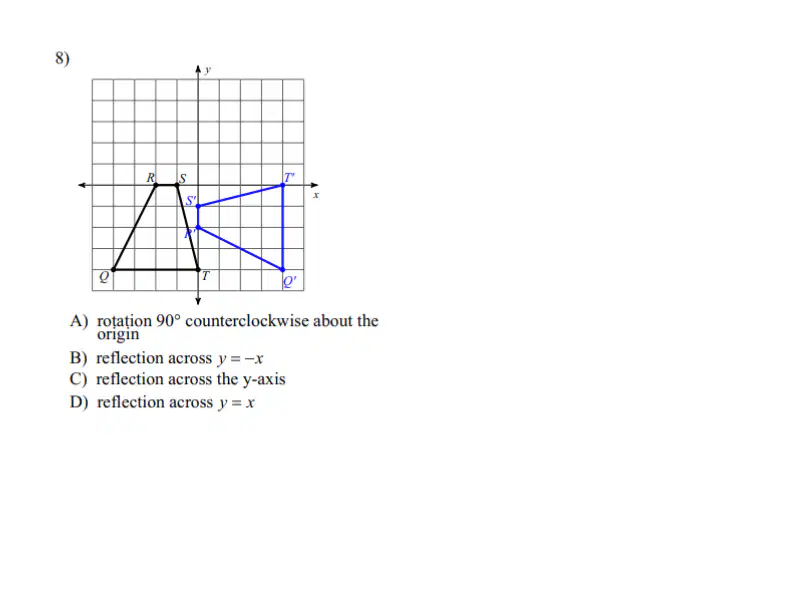
CHOOSE BEST ANSWER
A
B
C
D
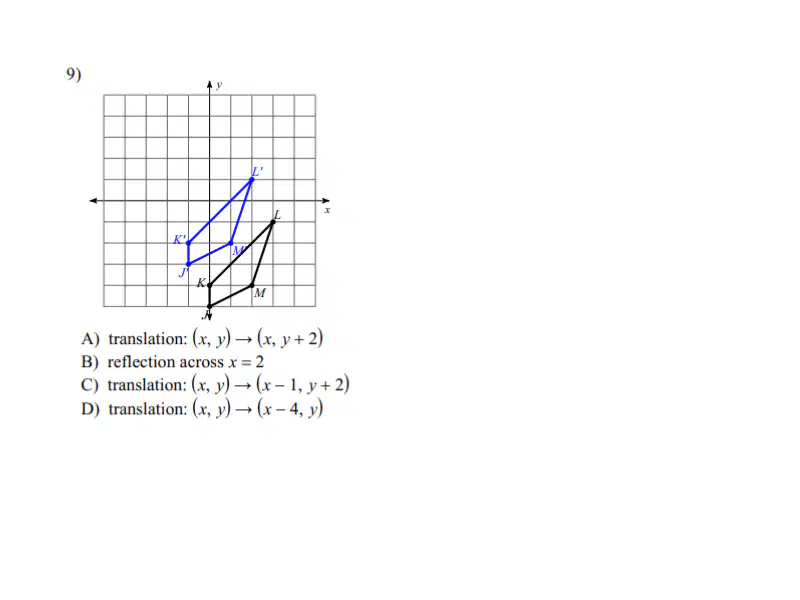
CHOOSE BEST ANSWER
A
B
C
D
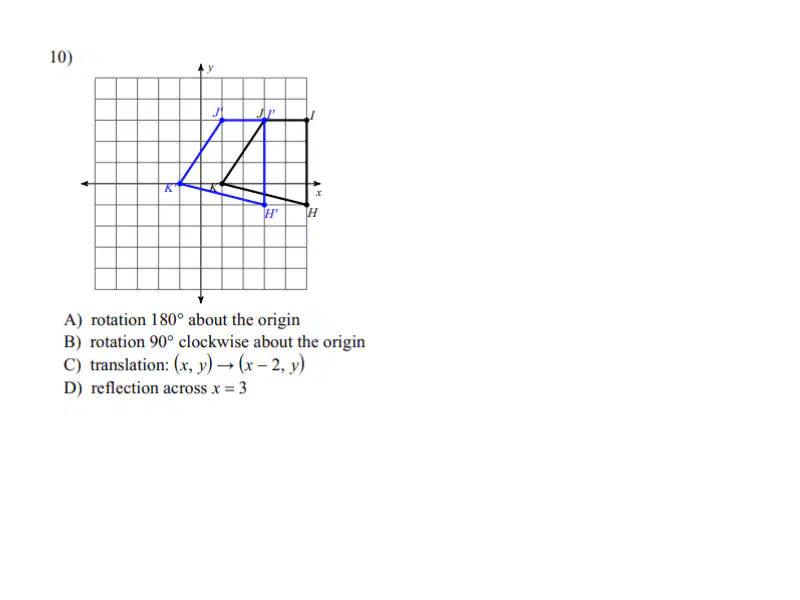
CHOOSE BEST ANSWER
A
B
C
D

