wayground logo

Free Printable Worksheets

Font size

S
M
L
XL
Worksheets

Alg2 Fall Final MC Practice

Total questions: 140

Worksheet time: 8hrs 24mins
Name
Class
Date
1.
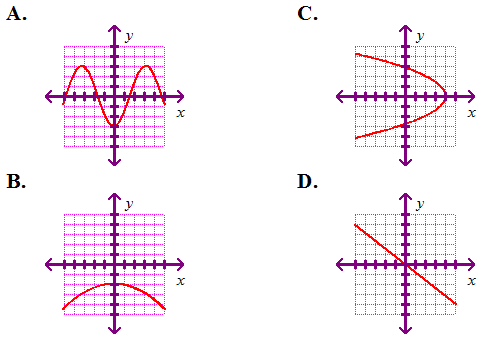
Which graph is linear?
a)
Graph A
b)
Graph B
c)
Graph C
d)
Graph D
2.
Is this function linear or non linear?
a)
Linear
b)
Non Linear
3.
Is the function Linear or Nonlinear?
a)
Linear
b)
Nonlinear
4.
Which of the following is NOT a linear function?
a)
y = 3x
b)
y = x2
c)
y = 5x - 9
d)
y = 3(x + 4)
5.

Describe the transformation of the equation below from the absolute value parent function.

y=x4y=\left|x-4\right|  

a)
Left 4
b)
Right 4
c)
Up 4
d)
Down 4
6.

Choose the equation that best matches the graphed function.

a)

f(x)=x+2f(x)=|x|+2  

b)

f(x)=x2f(x)=|x|-2  

c)

f(x)=xf(x)=-|x|  

d)

f(x)=x+2f(x)=-|x|+2  

7.

Write the equation for an absolute value function that shifts down 9 from the parent function, y=xy=\left|x\right|  .

a)

y=x9y=|x|-9  

b)

y=x9y=|x-9|  

c)

y=9xy=-9|x|  

d)

y=x+9y=|x|+9  

8.

Write an absolute value function given the following transformations from the parent function:

Reflection across the x-axis

Vertical shift right 2 units

Horizontal shift down 7 units

a)

y=x+27y=-|x+2|-7  

b)

y=x27y=|x-2|-7  

c)

y=x27y=-|x-2|-7  

d)

y=x2+7y=-|x-2|+7  

9.

m= 5


(2, 4)

a)

y - 2= 5(x - 4)

b)

y - 4= 5(x - 2)

c)

y- 5 = 4(x - 2)

d)

y - 2 = 4(x - 5)

10.
Which of these represents point-slope form of a linear equation?
a)
y - y1 = m(x - x1)
b)
Ax + By = C
c)
y = mx + b
d)
y=kx
11.

Write the equation in point-slope form of the line that passes through the given point and has the given slope:

(-2, -1); m= -3

a)

y + 1 = -3(x - 2)

b)

y + 1 = -3(x + 2)

c)

y - 1 = 3(x - 1)

d)

y + 2 = -3(x + 1)

12.

Find the slope in simplest form

a)

I have no clue how to do this

b)

1/3

c)

3

13.

Identify the form of this linear equation

y=mx+by=mx+b  

a)

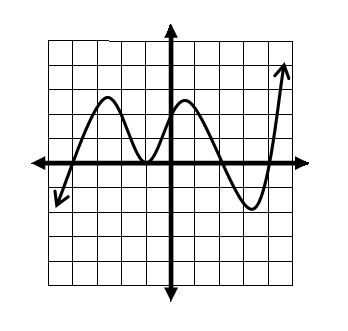
point-slope

b)

slope-intercept

c)

standard

14.
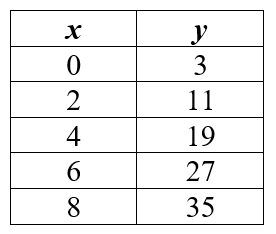
What is the slope of the table?
a)
m=5/6
b)
m=-5/6
c)
m=6/5
d)
m=-6/5
15.
Which equation matches the table?
a)
y = 3x + 9
b)
y = x + 9 
c)
y = x + 3
d)
y = 12x - 3
16.
What is the y-intercept?
a)
0
b)
16
c)
10
d)
3
17.
What is the equation of the relationship?
a)
y = 8x + 3
b)
y = 4x
c)
y = 4x + 3
d)
y = 8x
18.
What is the domain of the absolute value function?
a)
(4, 0)
b)
(0, 4)
c)
(-infinity, infinity)
d)
[4, infinity)
19.
What is the RANGE?
a)
all real numbers
b)
[1, ∞)
c)
(-∞, 1]
d)
none of these
20.
Describe the transformation of the equation below from the parent function of y = I x I
y = I x - 4 I 
a)
Left 4
b)
Right 4
c)
Up 4
d)
Down 4
21.

Describe the transformation of the equation below:


y = I x + 3 I

a)

Left 3

b)

Right 3

c)

Up 3

d)

Down 3

22.
What is the equation of the graph below?
a)
f(x ) = I x + 4 I + 2
b)
f(x ) = -I x - 4 I + 2
c)
f(x ) = I x - 4 I + 2
d)
f(x ) = -I x + 4 I + 2
23.

Describe the transformation of the equation below from the parent function of y = I x I

y = -2 I x - 3 I + 3

a)

reflected across x-axis, vertical stretch by 2, right 3, up 3

b)

reflected across x-axis, vertical stretch by 2, left 3 up 3.

c)

reflected across x-axis, vertical compression by 2, right 3, up 3

d)

reflected across the x-axis, vertical compression by 2, left 3, up 3

24.
What is the range of the absolute value function?
a)
(-infinity, infinity)
b)
[3, infinity)
c)
[0, infinity)
d)
(-infinity, 3]
25.

Find the equation of the parabola that has moved...

5 units to the right

a)

y=x2+5y=x^2+5

b)

y=x25y=x^2-5

c)

y=(x+5)2y=\left(x+5\right)^2

d)

y=(x5)2y=\left(x-5\right)^2

26.

Find the equation of the parabola that has moved...

8 units down

a)

y=x2+8y=x^2+8

b)

y=x28y=x^2-8

c)

y=(x+8)2y=\left(x+8\right)^2

d)

y=(x8)2y=\left(x-8\right)^2

27.

Find the equation of the parabola that has...

stretched by factor of 3

a)

y=3x2y=3x^2

b)

y=13x2y=\frac{1}{3}x^2

c)

y=(x+3)2y=\left(x+3\right)^2

d)

y=x2+3y=x^2+3

28.

Find the equation of the parabola that has been...

reflected

a)

y=x2y=-x^2

b)

y=(x1)2y=\left(x-1\right)^2

c)

y=x2-y=x^2

d)

y=x21y=x^2-1

29.

Find the equation of the parabola that has...

compressed by factor of 3

a)

y=3x2y=3x^2

b)

y=13x2y=\frac{1}{3}x^2

c)

y=(x+3)2y=\left(x+3\right)^2

d)

y=x2+3y=x^2+3

30.

Find the equation of the parabola that has...

been reflected

stretched by 5

a)

y=5x2y=-5x^2

b)

y=15x2y=-\frac{1}{5}x^2

c)

y=5x2-y=5x^2

d)

y=15x2-y=\frac{1}{5}x^2

31.

Match the equation to its description.

a)

Vertically stretched by 2 and shifted up 4

b)

Vertically compressed by 2 and shifted up 4

c)

Vertically stretched by 2 and shifted left 4

d)

Vertically compressed by 2 and shifted left 4

32.
Which list orders the quadratic functions from narrowest to widest?
a)
y = x2 
y = 4x2 
y = 2x2 - 2  
y = 0.5 x2
b)
y = 0.5 x2  
 y = x2 
y = 2x2 - 2 
y = 4x2
c)
y = 4x2 
y = 2x- 2
 y = x2 
y = 0.5 x 
d)
 y = 2x2 - 2
 y = 4x2
 y = 0.5x2
 y = x2
33.

If the blue is f(x)=x2, then the red must be

a)

g(x)=x2 - 5

b)

g(x)=x2 + 5

c)

g(x)=(x - 5)2

d)

g(x)=(x + 5)2

34.
Does the equation open or or down? 
Y = -3x2 +7x - 2
a)
up
b)
down
35.
Does the following quadratic equation have a maximum or minimum value? How can you tell?
y=x
²+2x-3
a)
Minimum value, because the a value is positive
b)
Maximum value, because the b value is positive
c)
Maximum value, because the a value is positive
d)
Minimum value, because the c value is negative
36.
What is the domain of the function?
a)
D:{ x > 3}
b)
D:{x < 3}
c)
D:{all real numbers}
d)
D:{ -1 < x < 5}
37.
Find the axis of symmetry for
f(x) = x2- 8x + 15.
a)
x = -4
b)
x = 4
c)
y = 4
d)
y = -4
38.
Find the vertex of 
f(x) = -x- 4x + 12.
a)
(-2, 16)
b)
(2, 0)
c)
(2, 4)
d)
(-2, 4)
39.
What is the y-intercept of 
f(x)=2x2 + 4x + 6
a)
(6 , 0)
b)
(-6 , 0)
c)
(0, -6)
d)
(0 , 6)
40.
.How many zeros does this parabola have? 
a)
3
b)
2
c)
0
d)
1
41.
How many solutions does this graph have?
a)
one
b)
two
c)
no solutions
d)
cannot be determined
42.
What is the vertex of y=x2+4x+3?
a)
(2,1)
b)
(-2,1)
c)
(0,0)
d)
(-2,-1)
43.

Which graph is generated by this equation?

y=x2+2x+1

a)
b)
c)
d)
44.

Which graph is generated by this equation?

y=x2-4x+4

a)
b)
c)
d)
45.

Find the zeros of this quadratic: y = (x - 3)(5x + 6)

a)

(-3, 0) and (5x, 0)

b)

(3, 0) and

(65,0)\left(-\frac{6}{5},0\right)

c)

(0,3)

d)

There aren't any

46.

Find the zeros:

y=x2+6x7y=x^2+6x-7  Remember to factor first

a)

(7, 0) and (-1, 0)

b)

Can't factor so can't find zeros

c)

(-7, 0) and (1, 0)

47.
What are the x-intercepts of the parabola?
y = -3(x + 5)(x - 9)
a)
-5 and 9
b)
5 and -9
c)
5 and 9
d)
-3 and 5 and -9
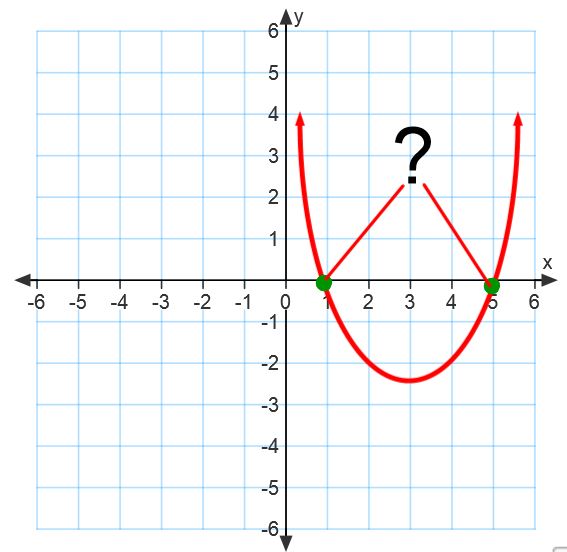
48.
What are the green dots called?
a)
axis of symmetry
b)
vertex
c)
parabola
d)
roots or x-intercepts
49.
Does this parabola have a maximum or minimum?
a)
Maximum
b)
Minimum
50.
Determine the values of
a, b, and c for
the quadratic equation: 
4x2 – 8x = 3
a)
a = 4, b = -8, c = 3
b)
a = 4, b =-8, c =-3
c)
a = 4, b = 8, c = 3
d)
a = 4, b = 8, c = -3
51.

Tammy solved the equation x2x12=0x^2-x-12=0  
Select the factors of  x2x12x^2-x-12  

a)

(x+3)(x+4)

b)

(x-3)(x-4)

c)

(x+6)(x-2)

d)

(x-6)(x+2)

e)

(x+3)(x-4)

52.
State the direction of opening of the following: y = -(x+3)(x-2)
a)
Left
b)
Up
c)
Down
d)
Right
53.

Solve 2x² - 7x + 6 = 0 by factoring

a)

x = -3/2 and x = -2

b)

x = -3 and x = -2

c)

x = 3 and x = 2

d)

x = 3/2 and x = 2

54.
True or false:
The solution, root, x-intercept, and zero of a problem are all the same thing.
a)
True
b)
False, because the solution and root are the same but the x-intercept and zero are different
c)
False, because the x-intercept and root are the same but the zero and solution are different
d)
False, they are all different
55.

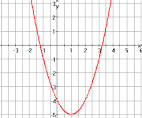
Does this parabola have a minimum or maximum and what is its value?

a)

minimum: 2

b)

maximum: 2

c)

minimum: 5

d)

maximum: 5

56.

Determine the domain and range of the function

a)

Domain: All real numbers

Range: All real numbers

b)

Domain: x ≥ -4

Range: All real numbers

c)

Domain: All real numbers

Range: y ≥ -4

d)

Domain: -1 ≤ x ≤ 5

Range: y ≥ -4

57.

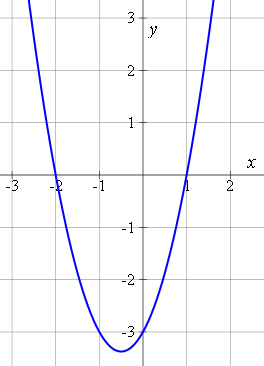
Use the graph to determine the X-intercepts:

a)

(-1,0) and (-3,0)

b)

(1,0) and (3,0)

c)

(0,1) and (0,3)

d)

(0,-1) and (0,-3)

58.

What is the vertex of this quadratic equation?

y=2(x3)2+6y=2\left(x-3\right)^2+6  

a)

(2, 6)

b)

(3, 6)

c)

(2, -3)

d)

(-3, 6)

59.
If given the equation y = 3(x + 5)2 - 4, what is the vertex of the parabola?
a)
(5, -4)
b)
(-5, -4)
c)
(-15, -4)
d)
(15, -4)
60.
Identify the vertex and whether the graph opens up or down.
a)
(5, 2); opens up
b)
(5, 2); opens down
c)
(-5, 2); opens up
d)
(-5, 2); opens down
61.

What are the x- intercepts (roots, solutions)?

a)

x= 0 and x= -4

b)

x= 0 and x= 4

c)

y= 0

d)

x= 2

62.
What is the equation of this graph?
a)
f(x) = (x -5)2 + 1
b)
f(x) = (x - 1)2 - 5
c)
f(x) = (x + 1)2 - 5
d)
f(x) = (x + 5)2 +1
63.
Which equation has a vertex of (-3, 4)?
a)
y = 2(x+3)+ 4
b)
y = (x+3)2 - 4
c)
y = (x-3)2 + 4
d)
y = 2(x - 3)2 + 4
64.

3x2 + 8x + 5

a)

(x - 1) (3x - 5)

b)

(3x - 1) (x - 5)

c)

(x + 1) (3x + 5)

d)

(3x + 1) (x + 5)

65.

7x2 - 16x + 4

a)

(x + 2) (7x - 2)

b)

(x + 2) (7x + 2)

c)

(x - 2) (7x + 2)

d)

(x - 2) (7x - 2)

66.

Factor:

x2 + 11x + 24

a)

(x + 6)(x + 4)

b)

(x + 12)(x + 2)

c)

(x - 8)(x - 3)

d)

(x + 8)(x + 3)

67.

Factor x2 + 11x + 18

a)

(x + 11)(x + 7)

b)

(x + 2)(x + 9)

c)

(x + 6)(x + 3)

d)

(x + 10)(x + 8)

68.

Factor:

x2 - 8x - 33

a)

(x + 3)(x - 11)

b)

(x + 33)(x - 1)

c)

(x - 11)(x + 33)

d)

(x + 11)(x - 3)

69.
What do you do to the b value to correctly complete the square?
a)
square it
b)
divide it by 2 and square the result
c)
divide it by 2 and take the square root of the result
d)
divide it by 2 only
70.
What value of c would make this a perfect sqaure trinomial?
x2 +8x + c
a)
4
b)
16
c)
64
d)
-16
71.
What value of c would make this a perfect square trinomial?
x2 + 2x + c
a)
2
b)
4
c)
-2
d)
1
72.

Complete the Square (this is step before you take square root on both sides)

x2 + 6x = 5

a)

(x + 3)2 = 5

b)

(x + 6)2 = 9

c)

(x + 3)2 = 14

d)

(x + 6)2 = 14

73.

x2+8x+c=20+cx^2+8x+c=20+c  

Rewrite the above equation into a perfect square binomial form. 
(𝑥 +_______) 2^2 = ________

a)

(x4)2=4\left(x-4\right)^2=4  

b)

(x+4)2=36\left(x+4\right)^2=36  

c)

(x8)2=12\left(x-8\right)^2=12  

d)

(x+8)2=28\left(x+8\right)^2=28  

74.
Simplify.
a)
-5i
b)
5
c)
5i
d)
-5
75.

Another way to express √-1 is?

a)

1

b)

-1

c)

i

d)

0

76.

Solve for x

3x2 - 6 = -9

a)

±1

b)

±i

c)

±3

d)

±3i

77.

Simplify

(12 - 4i) + (-2 + 8i)

a)

8 + 104i

b)

10 + 4i

c)

14 - 4i

d)

10 - 12i

78.

Solve by taking the square root:

x2=49x^2=-49  

a)

+-7

b)

+-49i

c)

+-49

d)

+-7i

79.
Find the zeros of this quadratic.
a)
b=4/5, b=3
b)
b=4, b=-3
c)
b=1/5, b=3
d)
b=4/5, b=-3
80.

Solve by factoring!

a)

-2, 4

b)

-8

c)

±8

d)

No real solution

81.
What is another word that describes the zeroes of a quadratic function?  
a)
y-intercepts
b)
vertex
c)
x-intercepts
d)
maximum
82.
Suzie solves the equation below:
x2 + 4x - 12 = 2
(x - 2)(x + 6) = 2, 
by setting x -2 = 0 and x + 6 = 0. 
Her solutions are x = 2 and x = -6.
Is Suzie correct? Why or why not?
a)
Yes, she factored correctly and then used the zero product property
b)
Yes, she factored correctly and then square rooted.
c)
No, she did factor correctly, but she can't use the zero product property as shown.
d)
No, she didn't factor correctly so the rest of her work is wrong. 
83.
What should you do first in solving this equation?
x2 + 6x - 13 = 3
a)
Get factored form
b)
Write down: a=1, b=6, c=-13
c)
Make it equal 0 by subtracting 3 on each side
d)
Type it all in a calculator.
84.

Solve by the Quadratic Formula:

9u211u+7=09u^2-11u+7=0  

a)

11±44118\frac{-11\pm\sqrt{441}}{18}  

b)

11±44118\frac{11\pm\sqrt{441}}{18}  

c)

11±13118\frac{11\pm\sqrt{131}}{-18}  

d)

11±i37318\frac{11\pm i\sqrt{373}}{18}  

85.
Solve by taking square roots:
5b2 - 4 = 41
a)
b = 9, b = -9
b)
b = 3, b = -3
c)
b = 8, b = -8
d)
no solution
86.
Multiply: 
(4 – 3i)(-7 – 2i)
a)
A.  -23 + 13i
b)
B.  -23 - 29i
c)
C.  -34 + 13i
d)
D.  -34 - 29i
87.
Calculate:
(4 − 7i) − (-3 + 6i)
a)
7 − 13i
b)
7 − i 
c)
1 − 13i
d)
1 − i 
88.
What does i=  ?
a)
1
b)
-1
c)
√-1
d)
√1
89.
Calculate (multiply):
(1 − 2i)(6 + 5i)
a)
16 − 7i
b)
-16 + 7i
c)
-16 − 7i
d)
16 + 7i
90.

The largest exponent found in the polynomial

a)

Term

b)

Degree

c)

Constant

d)

Leading Coefficient

91.

The coefficient of the first term of a polynomial written in standard form

a)

Term

b)

Degree

c)

Constant

d)

Leading Coefficient

92.

Standard form is arranging the terms of a polynomial in what order?

a)

highest to lowest coefficient

b)

highest to lowest degree

c)

lowest to highest coefficient

d)

lowest to highest degree

93.

Identify the degree of the polynomial

5x4 - 3x2 + 2x6 - x + 7

a)

2nd degree

b)

4th degree

c)

5th degree

d)

6th degree

94.

Identify the degree of the polynomial

3x4 + 2x2 - 7

a)

1st degree

b)

2nd degree

c)

3rd degree

d)

4th degree

95.

Which of the following polynomials is written in standard form?

a)

9 + 8x - 2x2

b)

10x + x3 - 4x2 - 11

c)

x4 + 5x3 - 6x +1

d)

4x3 + 3x4 + 2x + 1

96.

What is the leading coefficient in the polynomial 3x2 - 2x + 5?

a)

3

b)

2

c)

5

d)

0

97.

Which of these is in Standard Form (Check ALL that apply)?

a)

4x2+12x13x34x^2+12x-13x^3  

b)

53x5-3x  

c)

2x412x2+5x92x^4-12x^2+5x-9  

d)

5x5+4x4+12x323x+155x^5+4x^{\text{4}}+12x^3-23x+15  

98.
Describe the end behavior of the graph.
a)
x → ∞, y→ ∞ and
x→ ∞, y→⁻∞
b)
x → ∞, y→ ∞ and
x→⁻∞, y→∞
c)
None of these
d)
x →∞,y→⁻∞ and
x→∞, y→⁻∞
99.
Describe the end behavior of the graph.
a)
x → ∞, y→ ∞ and x→∞, y→⁻∞
b)
x → ∞, y→ ∞ and x→⁻∞, y→∞
c)
x → ∞, y→ ∞ and x→⁻∞, y→ 0
d)
x → ∞,y→ ∞and x→ ⁻∞, y→ ⁻∞
100.
What is the end behavior for the following polynomial function?
ƒ(x) = 4x4 - 3x³ + 7x² + 4
a)
up, up
b)
up, down
c)
down, down
d)
down, up
101.
Identify the zeros:
a)
x=-2, x=-1, x=0
b)
x=-2, x=0
c)
x=-1, x=0, x=2
d)
x=-2, x=0, x=1
102.

What is the degree?

a)

1

b)

2

c)

3

d)

4

103.

What is the degree of this function?

a)

4

b)

3

c)

2

d)

1

104.

What is the degree of this function?

a)

4

b)

3

c)

2

d)

1

105.
The end behavior of a polynomial function is determined by the degree and the sign of the leading coefficient.
Identify the degree of the polynomial and the sign of the leading coefficient 
a)
Leading Coefficient Positive
Degree - Even
b)
Leading Coefficient Positive
Degree - Odd
c)
Leading Coefficient Negative
Degree - Even
d)
Leading Coefficient Negative
Degree - Odd
106.
The end behavior of a polynomial function is determined by the degree and the sign of the leading coefficient.
Identify the degree of the polynomial and the sign of the leading coefficient 
a)
Leading Coefficient Positive
Degree - Even
b)
Leading Coefficient Positive
Degree - Odd
c)
Leading Coefficient Negative
Degree - Even
d)
Leading Coefficient Negative
Degree - Odd
107.
In the above graph complete the following end behavior:
As x --> -∞, f(x) --> ____
As x --> +∞, f(x) --> ____
a)
-∞
-∞
b)
+∞
-∞
c)
-∞
+∞
d)
+∞
+∞
108.
In the above graph complete the following end behavior: (f(x)=y)
As x --> -∞, f(x) --> ____
As x --> +∞, f(x) --> ____
a)
-∞
-∞
b)
+∞
-∞
c)
-∞
+∞
d)
+∞
+∞
109.
Find the sum.
(2x2 + 5x - 7) + ( 3 - 4x2 + 6x)
a)
2x+ 3x +1
b)
-2x- 11x -4
c)
2x2 + 5x -7
d)
-2x2 + 11x -4
110.
Simplify each expression.
(6b3 + 6 - b4) - (8b3 - 6b4 + 2)
a)
4b4 - 2b3 + 7
b)
5b4 - 2b3 + 4
c)
b4 - 2b3 + 7
d)
5b4 - 2b3 + 7
111.
Find the product:
(3x – 1)(x + 5) 
a)
3x2 + 4x + 5
b)
3x2 + 4x - 5
c)
3x2 + 14x + 5
d)
3x2 + 14x - 5
112.
Simplify:
(3x - 5) ( 4x2 - 2x - 3)
a)
12x3 - 26x2 - 25x + 15
b)
12x3 - 20x2 - 5x + 15
c)
12x3 - 20x2 - 6x + 15
d)
12x3 - 26x2 + x + 15
113.

Simplify

(3x25x8)(2x2+10x+15)\left(3x^2-5x-8\right)-\left(2x^2+10x+15\right)  

a)

5x2+15x+75x^2+15x+7  

b)

x215x23x^2-15x-23  

c)

x215x+7x^2-15x+7  

d)

5x2+5x235x^2+5x-23  

114.

Simplify

(x+8)2\left(x+8\right)^2  

a)

x2+64x^2+64  

b)

x2+8x+64x^2+8x+64  

c)

x2+16x+64x^2+16x+64  

d)

x2+64x+16x^2+64x+16  

115.


Simplify (x3)(x+3)\left(x-3\right)\left(x+3\right)  

a)

x26x9x^2-6x-9  

b)

x2+6x9x^2+6x-9  

c)

x29x^2-9  

d)

x2+9x^2+9  

116.
(x-3)(x2+2x+7)
a)
x3-x2+x-21
b)
x3+5x+13x-21
c)
x3-3x2+7x-21
d)
x2+2x-3
117.
Dividex4 + x3 +2x2 +x -1  by (x+1)
a)
x2 + 2x -1
b)
x3 + 2x-1
c)
x2 - 2x + 1
d)
x3 - 2x + 1
118.
Divide: 

(4x2 - 24x + 35) / (2x - 5)
a)
2x - 7
b)
2x - 12
c)
2x + 12
d)
2x + 7
119.
2x3 + 5x2 + 9 ÷ x + 3
a)
2x2 - x + 3
b)
2x3 - x2 + 3x
c)
2x2 + 11x + 33 + 108/x+3
d)
2x2 - 5x + 12
120.
Factorise x3+64
a)
(x-2)(x2-2x+4)
b)
(x+64)(x-64)
c)
(x-4)2(x+4)
d)
(x+4)(x2-4x+16)
121.
Factorise 27x3 - 1
a)
(9x-1)(81x2+9x+1)
b)
(3x-1)(9x2+3x+1)
c)
(3x-1)(3x2+3x+1)
d)
(3x-1)(9x2+x+1)
122.
Find the solutions of 6x3-5x-2x+1
a)
(x-1)(3x-1)(2x+1)
b)
x = 1, 1/3, -1/2
c)
x = 1, -1/3, 1/2
d)
(x-1)(3x+1)(2x-1)
123.
30x3+15x2-18x-9
a)
(5x2-3)(6x+1)
b)
(5x2-3)(6x+3)
c)
3(5x2+3)(2x-1)
d)
3(5x2-3)(2x+1)
124.
7r3-8r2+42r-48
a)
(r2+6)(7r+8)
b)
(r2+6)(7r-8)
c)
(r2+6)(r2+8)
d)
(r2+6)(7r+6)
125.

Factor the trinomial. 

a)

x(x6)(x+4)x\left(x-6\right)\left(x+4\right)

b)

x(x+6)(x4)x\left(x+6\right)\left(x-4\right)

c)

x(x22x24)x\left(x^2-2x-24\right)

d)

x(x8)(x+3)x\left(x-8\right)\left(x+3\right)

126.

Factor the binomial completely if possible.

a)

4x3(x5)(x+5)4x^3\left(x-5\right)\left(x+5\right)

b)

4x3(x5)(x5)4x^3\left(x-5\right)\left(x-5\right)

c)

4x3(x+5)(x+5)4x^3\left(x+5\right)\left(x+5\right)

d)

can't be factored

127.
8x3 + 27
a)
(3x - 2)(9x2 + 6x + 4)
b)
(3x - 1)(9x2 + 3x + 1)
c)
(2x + 3)(4x2 - 6x + 9)
d)
(2x - 1)(4x2 + 2x + 1)
128.
x3 - 64
a)
(x - 4)(x2 + 4x + 16)
b)
(x - 3)(x2 + 3x + 9)
c)
(x - 5)(x2 + 5x + 25)
d)
(x + 4)(x2 - 4x + 16)
129.
Factor Completely: 
3x2 + 18x +15
a)
3(x2 + 6x + 5)
b)
(x + 5)(x + 1)
c)
3(x + 5)(x + 1)
d)
Prime
130.
Factor Completely:
3x5 - 27x3
a)
3(x3 - 3)(x+ 3)
b)
prime
c)
3x3(x2 - 9)
d)
3x3(x - 3)(x + 3)
131.
Find the expression equivalent to 8x4+22x3-6x2
a)
2x2(4x-1)(x+3)
b)
2x2(4x-1)(x-3)
c)
2x2(4x+1)(x-3)
d)
2x(4x-1)(x+3)
132.
Find the zeros of the polynomial given one factor.
a)
X= 3,4,5
b)
x=-3,-4,-5
c)
x=-3,4,5
d)
x= 3, -4, -5
133.
Find all zeros.
a)
x= 3,1,1/3
b)
x= -3, -1, -1/3
c)
x = -3, 1, 1/3
d)
x = 3, -1, -1/3
134.
What is the equation in factored form of this graph?
a)
f(x) = (x-4)(x-1)2(x+2)(x+4)
b)
f(x) = (x-4)(x+1)2(x+2)(x+4)
c)
f(x) = (x-4)(x-1)2(x-2)(x+4)
d)
f(x) = (x+4)(x+1)2(x-2)(x-4)
135.
Which equation could represent the graph?
a)
y=-(x+1)(x-2)(x-4)
b)
y=(x+1)2(x-3)(x-1)3
c)
y = 3x3 – 2x + 1
d)
y=(x+1)3(x-3)(x-1)2
136.
a)
y=-(x+1)(x-2)(x-4)
b)
y=(x+1)2(x-3)(x-1)3
c)
y = 3x3 – 2x + 1
d)
y=(x+1)3(x-3)(x-1)2
137.
Write a cubic polynomial in factored form that has zeros at x = 1, x = -1, and x = 0. 
a)
(x - 1)(x + 1)
b)
x(x - 1)(x + 1)
c)
x2(x - 1)(x + 1)
d)
x(x - 1)(x - 1)
138.
Which function is graphed?
a)
(x - 4)(x + 2)(x - 8)=0
b)
(x - 4)(x - 2)(x + 8)=0
c)
(x - 4)(x + 2)(x + 8)=0
d)
(x + 4)(x + 2)(x + 8)=0
139.
Write the factors of the polynomial from the zeros in the graph.
a)
(x - 3) (x + 2) (x + 5)
b)
(x - 5) (x - 2) (x + 3)
c)
(x + 3) (x + 2) (x + 5)
d)
(x - 3) (x - 2) (x - 5)
140.
Which of the following could be the equation of this graph in factored form? (Careful-pay attention to multiplicity.)
a)
f(x) = (x-4)(x-1)2(x+2)(x+4)
b)
f(x) = (x-4)(x+1)2(x+2)(x+4)
c)
f(x) = (x-4)(x-1)2(x-2)(x+4)
d)
f(x) = (x+4)(x+1)2(x-2)(x-4)