

wayground logo

Free Printable Worksheets

NEW

Font size

S
M
L
XL
Worksheets

GRADE 9 FIRST SEMESTER SCIENCE FINAL EXAM REVISION TEST

Total questions: 68

Worksheet time: 1hrs 11mins

Name
Class
Date
1.

What are the reactants in photosynthesis?

a)

water,carbon dioxide

b)

water,oxygen

c)

glucose

d)

protein

2.
the products of photosynthesis are...
a)
glucose and sunlight
b)
carbon dioxide and water
c)
glucose and chlorophyll
d)
oxygen and glucose
3.
The leaf structure that allows carbon dioxide to enter the leaf and Oxygen to exit the leaf is...
a)
phloem
b)
stomata
c)
vein
d)
stem
4.
This is ...
a)
mitochondria
b)
chloroplast
c)
cell
d)
phloem
5.
Which of the following is the correct equation for PHOTOSYNTHESIS?
a)
carbon dioxide + water --> oxygen + glucose
b)
carbon dioxide + glucose + water --> oxygen 
c)
oxygen + water --> carbon dioxide + glucose
d)
glucose+ oxygen ---> water + carbon dioxide 
6.
What pigment absorbs sunlight for photosynthesis?
a)
chloroplast
b)
thylakoid
c)
grana
d)
chlorophyll
7.

Which of the following statements best describes the term photosynthesis?

a)

When plants absorb the energy from the sun.

b)

How plants reproduce.

c)

The process by which plants make their own food.

d)

The process by which animals make their own food.

8.

The tubes that carry water through the roots and stems are called:

a)

Stomata

b)

Chlorophyll

c)

Xylem

d)

Chloroplast

9.
What is the name of the green pigment inside plants?
a)
Monophyll
b)
Chlorophyll
c)
Epiphyll
d)
Glorophyll
10.

What happen to plants if they did not have enough magnesium ion?

a)

They remain healthy

b)

Their leaves turn yellow

c)

They will wilt

d)

They did not grow properly

11.

Why do plants need magnesium?

a)

To make chlorophyll

b)

To produce the color green

c)

To make plant grow bigger

d)

To make the plant alive

12.

What happen to plants if they did not have enough nitrate ion?

a)

They become dead

b)

They did not grow properly

c)

They become wilt

d)

All their leaves turn yellow

13.

Why do plants need nitrate ion?

a)

To make the plant strong and healthy

b)

To make amino acid which is then use to make protein for growth

c)

To give green color to leaves

d)

To make the plant alive

14.

How does plant get magnesium ion and nitrate ion?

a)

Plants make their own

b)

Absorb from insects via physical contact

c)

Absorb by leaves from the atmosphere

d)

Absorb by roots from the soil

15.
What does NOT produce carbon dioxide?
a)
Photosynthesis
b)
Burning Fossil Fuels
c)
Animal respiration
d)
Plants decaying
16.
Combustion is another word for __________.
a)
Transportation
b)
Respiration
c)
Fossil Fuels
d)
Burning
17.
What process occurs when coal (fossil fuel) is used for energy?
a)
Decomposition
b)
Combustion
c)
Pressurization 
d)
Respiration 
18.
Respiration is the process by which animals take in _____ and release _____. 
a)
photosynthesis, air
b)
carbon, oxygen
c)
oxygen
d)
oxygen, carbon dioxide
19.
The average temperature of the surface of Earth has increased approximately 1°C in the past century. Which reason best explains this increase in temperature?
a)
lower levels of ozone in the atmosphere
b)
lower levels of nitrogen in the atmosphere
c)
higher levels of carbon dioxide and other greenhouse gases in the atmosphere
d)
higher levels of oxygen in the atmosphere
20.

How do animals get carbon?

a)

By eating plants and or other animals.

b)

They absorb it from the atmosphere.

c)

From the ground

d)

They do not get carbon from anywhere.

21.

What are fossil fuels made from?

a)

Plants and animals that are buried underground for millions of years.

b)

They absorb it from the atmosphere.

c)

Water

d)

Wind

22.
How does the law of conservation of energy relates to photosynthesis?
a)
The energy from glucose is transform into light energy
b)
Light energy from the sun is converted into chemical energy in glucose 
c)
Energy from carbon dioxide is converted into chemical energy in Oxygen
d)
All other answers are correct
23.
What are greenhouse gases?
a)
gases that cause climate change
b)
gases that emit green smoke
c)
gases that are used to make green colored glass
24.
Which of the following gases DOES NOT trap heat?
a)
carbon dioxide
b)
nitrogen
c)
water vapor
d)
methane
25.
Compared to other greenhouse gases, carbon dioxide is very effective in trapping heat near the surface of the Earth.
a)
true
b)
false
26.

What is the main reason sea levels are rising rapidly?

a)

melting sea ice

b)

increase of water vapor in atmosphere

c)

melting land ice

d)

increase in floods

27.
Increased carbon dioxide may cause global warming by trapping more ____________ in the atmosphere.
a)
water
b)
gases
c)
heat
d)
water vapor
28.

MAIN greenhouse gas responsible for Climate Change is:

a)

nitrogen

b)

carbon

c)

carbon dioxide

d)

methane

29.
Before it becomes a "shooting star", the actual bit of solid stuff coming from space is called ___
a)
a meteoroid
b)
a meteor
c)
a meteorite
d)
an asteroid
30.
How many protons does Fluorine-19 have?
a)
19
b)
9
c)
10
d)
18
31.
How many electrons does Chlorine have when it becomes an ion?
a)
16
b)
17
c)
18
d)
19
32.
What is the atomic number of Boron?
a)
5
b)
10.81
c)
11
d)
6
33.
The atomic number of an atom is always the same as the number of 
a)
electrons
b)
protons
c)
neutrons
d)
isotopes
34.
An atom's mass number is equal to 
a)
protons plus electrons
b)
electrons plus neutrons
c)
protons plus neutrons
35.
An atom has a mass number of 36 and atomic number of 16. How many neutrons does the atom have?
a)
36
b)
20
c)
16
d)
6
36.
An atom with an atomic number of 14 and 26 neutrons has a mass number of?
a)
12
b)
14
c)
26
d)
40
37.
The _________ of an element equals the number of protons in an atom of the element. 
a)
mass number
b)
atomic weight
c)
atomic number
d)
isotopes
38.

How many Protons, Neutrons, and Electrons does this element have?

a)

P= 8

N= 8

E= 8

b)

P= 8

N= 15

E= 8

c)

P= 8

N= 7

E= 8

d)

P= 8

N= 8

E= 16

39.

What is name of Family/Group 1?

a)

Alkali Metal

b)

Alkaline Earth Metal

c)

Metalloids

d)

Halogens

40.
Which group on the periodic table is the most reactive Metals?
a)
Alkaline-earth metals - Group 2
b)
Alkali metals - Group 1
c)
Transition metals - Group 3-7
d)
Halogens - Group 17
41.

How do covalent bonds form?

a)

By donating and receiving valence electrons between atoms.

b)

Scientists still aren't sure.

c)

Opposite slight charges attract each atom in the compound.

d)

Sharing valence electrons between atoms

42.

What two types of atoms make a covalent bond?

a)

2 Nonmetals

b)

1 Metal and 1 Nonmetal

c)

2 Metals

d)

2 Noble Gases

43.

When an atom loses an electron, it becomes a

a)

positive ion

b)

negative ion

c)

neutral ion

d)

neutral atom

44.
When an atom loses an electron, it becomes a:
a)
positive ion
b)
negative ion
c)
neutral ion
d)
neutral atom
45.
How are covalent bonds explained?
a)
When one atom takes the other atom's electron
b)
When the atom shares an electron with an another atom
c)
When the two nucleus merge
d)
When the neutrons leave the nucleus
46.
Magnesium (Mg) and Oxygen (O) form an ________ bond.
a)
Ionic
b)
Covalent
c)
Metallic
d)
Nothing
47.
How many electrons are needed in the outer energy levels of an atom to be stable?
a)
2
b)
4
c)
6
d)
8
48.

Ionic compounds are usually formed from _____.

a)

two nonmetals.

b)

a metal and a nonmetal.

c)

two metals.

49.

Is the following compound ionic or covalent?

A material that has a low boiling point

a)

Ionic

b)

Covalent

50.

Is the following compound ionic or covalent?

A material with a high melting point

a)

Ionic

b)

Covalent

51.
When dissolved in water, the solution does NOT conduct electricity.
a)
ionic compounds
b)
covalent compounds
52.
Jack has a rock. The rock has a mass of 14g and a volume of 2cm3. What is the density of the rock?
a)
7 mL
b)
7 g/cm3
c)
28 g/cm3
d)
1/7 g/cm3
53.
What units are used to measure mass?
a)
g
b)
cm3
c)
g/cm3
d)
cm3/g
54.
What is the formula for density?
a)
density = mass x volume
b)
density = mass / volume
c)
density = mass + volume
d)
density = mass - volume
55.
Frank has an eraser. It has a mass of 4g, and a volume of 2cm3. What is its density?
a)
8 g/cm3
b)
2 g/cm3
c)
1/2 g/cm3
d)
24 g/cm3
56.

Which state of matter is most dense?

a)

solid

b)

liquid

c)

gas

57.

An object should float in a liquid if...

a)

Its denser than the liquid

b)

It's the same density as the liquid

c)

It's less dense than the liquid

58.
Helium balloons rise on earth because
a)
helium is less dense than air
b)
helium is more dense than air
c)
helium is cooler than air
d)
helium is warmer than air
59.
Will an object with a density of 0.999 sink or float in water?
a)
sink
b)
float
60.
If an object has a density of .6 g/mL and you put it into water, will it sink or float?  
a)
sink
b)
float
61.

The Law of Conservation of Energy states:

a)

Energy can created or destroyed but not transformed

b)

Energy cannot be created or destroyed, it can only transformed

c)

Energy can't be created, destroyed or transformed

d)

Energy cannot be created or destroyed.

62.
Which of the following are kinds of heat transfer.
a)
Conduction
b)
Convection
c)
Radiation
d)
All of the above
63.

What type of heat transfer takes place in liquids and gasses?

a)

Conduction

b)

Convection

c)

Radiation

d)

Thermal Equilibrium

64.

Heat will always transfer from the ___________ object to the ________ object.

a)

The hottest object to the coolest object.

b)

The coolest object to the hottest object.

c)

The solid object to the liquid object.

d)

The liquid object to the solid object.
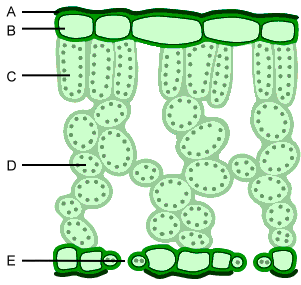
65.
Most of the chloroplast cells are found in the
a)
upper epidermis
b)
pallisade mesophyll layer
c)
lower epidermis
d)
stomata
66.
The water needed for photosynthesis comes into the leaves through the
a)
upper epidermis
b)
stomata
c)
guard cells
d)
xylem cells
67.
carries water and minerals from roots to other parts of the plant
a)
xylem 
b)
phloem
c)
stoma
d)
guard cell
68.

What is letter "D" pointing to?

a)

upper epidermis

b)

palisade mesophyll

c)

spongy mesophyll

d)

bundle sheath
