
 Worksheets
Ecology Review
Total questions: 65
Worksheet time: 51mins

Competition, disease, predators/prey are examples of ______.
Density independent factors
Density dependent factors
Density neutral factors
Density aquatic factors

Natural disasters, temperature, human disturbance are examples of ____.
Density dependent factors
Density neutral factors
Density independent factors
Density zero factors

Praying Mantis lay up to 300 eggs in one sac. Only about 1/5 of them will survive to adulthood. There is no parental care of offspring. What type of reproductive strategy do praying mantis have?
K-selected
R-selected
P-selected
B-selected

Which of the following will cause a population size to INCREASE?
Births & immigration
Births & emigration
Deaths & immigration
Deaths & emigration

Which of the following will cause a population size to decrease?
Births & immigration
Births & emigration
Deaths & immigration
Deaths & emigration

Which survivorship curve is characterized by high mortality (deaths) after reproductive years?
Type I
Type II
Type III
Type IV

Which survivorship curve is characterized by very high early mortality (deaths) but those that survive remain reproductively active for entire lifespan?
Type I
Type II
Type III
Type IV

Which survivorship curve is characterized by constant mortality (deaths) throughout lifespan?
Type I
Type II
Type III
Type IV

Polar bears have 1-3 cubs. Females raise the cubs for 2-3 years. Males begin to reproduce 8-10 years of age & females at 4-6 years. Polar bears live on average 25 years in the wild. What type of reproductive strategy do polar bears have?
K-selected
R-selected
P-selected
B-selectedpo

Which type pf population growth is seen in the picture?
Logistic growth
Exponential growth
Circular growth
Negative growth

Which type of population growth is seen in the picture?
Logistic growth
Exponential growth
Circular growth
Negative growth

The dung beetle consumes dung. They store dung balls in burrows they have dug out and females lay eggs within them. This allows hatched larvae immediate access to food. Digging burrows and tunnels turns over and aerates the soil. The buried dung releases nutrients into the soil that benefits other organisms. In addition, the beetle’s use of dung leaves less available for flies to breed on, thus controlling some of the fly population. This is an example of what ecological concept?
A habitat
A niche
An ecosystem
A community
The idea that no two similar species can occupy the same niche is (a) .

In order to limit competition, some organisms divide resources thus creating microhabitats. This is called __.
competitive exclusion
predation
resource partitioning
mutualism


Which of the following shows the symbiotic relationship between the Rodent and the Bird?
Mutualism
Commensalism
Competition

Hermit Crabs live in shells made and then abandoned by snails.
Commensalism
Parasitism
Competition


Breaking News! A new island has formed off of Hawaii! What must occur for it to become an ecosystem?
Secondary Succession
Aquatic succession
Primary Succession
Ferns must grow
Select all description/s of an ecological niche from the following options.
A fox sleeps in a burrow
A bear helps clear lichen off rocks with it's feet when fishing in a stream
A monkey swings off branches to reach fruit
Two different species of bird exist in the same air space without interacting
Birds eat seeds, then disperse them further away

A species that plays a critical role in the health, maintenance, growth, or definition of an ecosystem.
keystone
invasive
engineer
predator
A keystone species fills a unique ecological niche and therefore carries unique functions in an ecosystem
True
False
Why are bees considered a keystone species?
The honey they make supports the bear population
They pollinate flowers that produce fruit which supports the ecosystem
They sting when threatened
They live in hives
Why are some sharks considered a keystone species?
Because they are a top predator
They scare off smaller fish that may overgraze an area of sea grass
They are tertiary consumers
They are cartilaginous


Observe the food chain above. Which organism’s population would increase if finches were removed from the ecosystem?
Grass
Grasshopper
Snake
Hawk

The roadrunner is a desert bird that eats fruits and seeds. It also eats insects, spiders, scorpions, and rattlesnakes.
What would likely happen if the roadrunner population disappeared from its ecosystem?
There would be no more fruits or seeds.
There would a decrease in spider populations.
The rattlesnake population would stay the same.
There would be an increase in scorpion populations.

In this food chain, where does the lizard get its energy from?
plant
grasshopper
mushrooms
sun
How much energy gets transferred between trophic levels?
90%
50%
10%
0%

In the food chain shown, assume the tree takes in 10,000 kcal of energy. How much energy will the snake get by consuming the mouse?
1000 kcal
100 kcal
10 kcal
1 kcal

What organisms are missing from this food chain and are necessary for the cycling of nutrients?
decomposers
detritivores
sun
quaternary consumers

What would happen to the bird if the green fish died out?
the bird population would grow
the bird population would die out
the smaller fish will die out


The main human activity that releases carbon dioxide is
breathing
burning fossil fuels
texting on cellphones
eating meat

soil

The total amount of the carbon on Earth is constant.
True
False


What process occurs when dead plant and animal matter decomposes and nitrogen is released back into the atmosphere?
Assimilation
Fixation
Ammonification
Denitrification
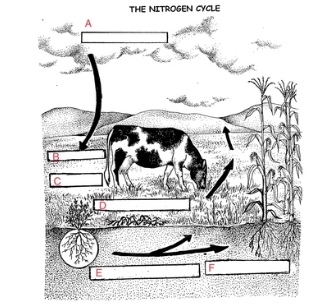
In the nitrogen cycle, what does label A in the diagram represent?
Gas
Clouds
Carbon dioxide in the atmosphere
Nitrogen in the atmosphere

Which nitrogen cycle process is occurring when bacteria convert ammonium to nitrite and then into nitrate?
nitrogen fixation
nitrification
denitrification
ammonification

Which of these nitrogen cycle processes converts atmospheric nitrogen to a soil form of nitrogen that is usable by plants?
nitrogen fixation
nitrification
denitrification
ammonification

