NEW
Font size
 Worksheets
Physical Science Semester Review
Total questions: 70
Worksheet time: 6hrs 47mins
1 A man jogs at a velocity of 2.5 m/s west for 1,200 s. He then walks at a velocity of 1.0 m/s east for 500 s and then stops to rest. What is the displacement of the man when he stops to rest?
3,500 m west
3,000 m west
2,500 m west
700 m west
A rock on Earth has a mass of 750 kg and a weight of 7,350 N. If the rock is taken into outer space, how will its mass and weight be affected?
The weight and mass will remain the same because they are not altered by the effects of gravity.
The weight will remain the same, but the mass will change because of the effects of gravity.
The mass will be 76.5 kg, and the weight will increase because of the effects of gravity.
The mass will be 750 kg, but the weight will decrease because of the effects of gravity.
As the wheels of a train move along the train tracks, what type of friction exists between the wheels and the tracks?
fluid friction
rolling friction
sliding friction
static friction
A 1,500-kg truck has a net force of 4,200 N acting on it. What is the truck’s acceleration?
6,300,000 m/s2
2,700 m/s2
2.8 m/s2
0.36 m/s2
A child fills a bucket with salt water and sand. How are the contents of the bucket classified?
a solution
a compound
a homogeneous mixture
a heterogeneous mixture
How are the processes of melting and freezing similar?
They are both processes that physically change a substance.
They are both processes that chemically change a substance.
They are both processes where heat is released by a substance.
They are both processes where heat is absorbed by a substance.
Which element is classified as a metal?
Boron (B)
Antimony (Sb)
Phosphorus (P)
Cadmium (Cd)
How many valence electrons are in a neutral atom of nitrogen (N)?
2
3
5
15
Electrons are being shared between atoms in a certain compound. Which elements could most likely form this compound?
Lithium (Li) and Fluorine (F)
Aluminum (Al) and Iodine (I)
Sulfur (S) and Oxygen (O)
Iron (Fe) and Chlorine (Cl)
What is the chemical formula for magnesium acetate?
Mg2(C2H3O2)2
Mg(C2H3O2)2
Mg2C4H6O4
MgC4H6O4
Which represents a balanced chemical equation?
CO2 + 2H2O → 2CH4 + 2O2
CH4 + O2 → CO2 + H2O
CH4 + 2O2 → CO2 + 2H2O
CO2 + H2O → CH4 + O2
What type of chemical reaction occurs when beryllium (Be) combines with oxygen (O2) to form beryllium oxide (BeO)?
double replacement
single replacement
decomposition
synthesis
Which equation represents a neutralization reaction?
acid + water → salt + base
acid + base → water + salt
acid + salt → base + water
water + base → salt + acid
Which of these elements is the most chemically reactive?
Beryllium (Be)
Calcium (Ca)
Strontium (Sr)
Radium (Ra)
Which compound contains ionic bonds?
C2H6
PCl5
Ca3N2
SF2
This unbalanced equation represents a chemical reaction:
__Pb(NO3)2 + __ NaI → __NaNO3 + __PbI2
What is the coefficient for NaI once the equation is balanced?
1
2
3
4
What type of bond will form when an element from group 2 (IIA) bonds with an element from group 17 (VIIA)?
hydrogen bond
covalent bond
metallic bond
ionic bond
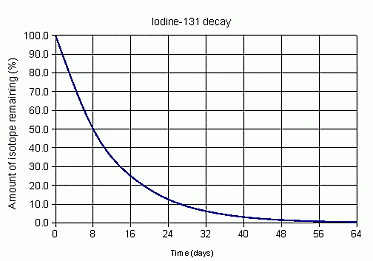
A 100-gram sample of cerium-143 has a half-life of 33 hours. How long will it take until there are only 6.25 grams of cerium-143 left?
66 hours
99 hours
132 hours
165 hours
Thallium-208 has a half-life of 3 minutes. How long will it take 60.0 g of thallium-208 to decay so that 15.0 g of the thallium-208 remains?
3 minutes
6 minutes
9 minutes
12 minutes
A copper wire is connected across a constant voltage source. Which change will cause an increase in the current flowing through the wire?
an increase in the length of the wire
an increase in the resistance of the wire
an increase in the diameter of the wire
an increase in the insulation around the wire
Which will cause an electromagnetic solenoid to increase its strength?
replacing the wire with an insulator inside the solenoid
increasing the temperature surrounding the solenoid
increasing the number of wire coils in the solenoid
removing the iron core from the solenoid
Why does a flat piece of notebook paper take longer to reach the ground than an identical piece of notebook paper crumpled into a ball?
The flat piece of paper has more mass.
The crumpled piece of paper has more mass.
The frictional force of air has more effect on the falling flat piece of paper.
The frictional force of air has more effect on the falling crumpled piece of paper.
Why does the weight of an object change with increasing elevation on Earth?
The mass of the object decreases with higher elevation.
The force of gravity acting on the object increases with higher elevation.
The force of gravity acting on the object decreases with higher elevation.
The mass of the object increases with higher elevation.
Two students pull on the opposite ends of a rope, but neither student is able to move the other. Which statement best explains why neither student is moved?
They each pull on the rope with the same amount of force, so the net force is zero.
They each exert the same amount of friction against the ground, so the net friction is zero.
Their forces are not balanced, but gravity keeps them from moving.
The two students have the same mass.
Why does a student’s hand feel cold when holding an ice cube?
Heat flows from the ice cube to the hand.
Heat flows from the hand to the ice cube.
Cold flows from the hand to the ice cube.
Cold flows from the ice cube to the hand.
Two boxes, X and Y, are on a shelf 10 meters above the floor. Box X has a mass of 4 kg, and Box Y has a mass of 8 kg. Which statement best represents the relationship between boxes X and Y?
Box X and Box Y have no potential energy.
Box X has less potential energy than Box Y.
Box X has more potential energy than Box Y.
Box X and Box Y both have 784 J of potential energy.
Which describes the kinetic energy of a ball in free fall?
The kinetic energy remains the same while the velocity increases.
The kinetic energy decreases because the velocity increases.
The kinetic energy increases because the velocity increases.
The kinetic energy remains the same while the velocity decreases.
Object X and Object Y are rubbed together. Object X acquires a negative charge. What does Object Y experience?
a gain of protons
a loss of protons
a gain of electrons
a loss of electrons
Which is a true statement about a series circuit?
All the current flows through every part of the circuit.
Every part of the circuit is positively charged.
The current through the circuit can take several paths.
Every part of the circuit is negatively charged.
A student wants to build a simple circuit. Which material would be used to design a circuit with the least amount of resistance?
long wires with a thin diameter
long wires with a large diameter
short wires with a thin diameter
short wires with a large diameter
A ball rolling down an incline has its maximum kinetic energy at
the bottom.
halfway down.
the top.
three-quarters of the way down.
The power expended doing 100 J of work in 50 s is
50 W.
1/2 W.
4 W.
2 W.
5,000 W.
An object that has kinetic energy must be
at rest.
moving.
at an elevated position.
falling.
none of the above
Two identical particles move toward each other, one twice as fast as the other. Just before they collide, one has a kinetic energy of 25 J and the other 50 J. At this instant their total kinetic energy is
50 J.
75 J.
25 J.
none of the above
need more information
The work done in pushing a TV set a distance of 2 m with an average force of 20 N is
2 J.
10 J.
40 J.
800 J.
20 J.

An atom of the element fluorine can be represented by the Bohr model as shown.
If the atomic mass of this atom is 19, how many neutrons are in the nucleus?
9
10
19
28

The chart above shows the force applied on four different objects and the distance each object moves.
On which object was the least amount of work done?
W
X
Y
Z
A 200-kg rock is at the top of a cliff. What happens to its energy as it begins to fall?
Its kinetic energy is transformed into potential energy.
Its potential energy is transformed into kinetic energy.
Its potential energy increases.
Its kinetic energy decreases.
It takes 6.0 seconds for a pulley system to lift a crate weighing 300.0 N to a height of 5.0 meters. How much power is required to lift the crate?
360.0 W
250.0 W
10.0 W
0.1 W
The kinetic energies of particles in a sample of matter are increasing. This sample is MOST likely
a liquid that is warming.
a gas that is cooling.
a liquid that is turning into a solid.
a gas that is turning into a liquid.
Which diagram correctly shows how electrically charged balls will act?


This diagram represents a closed circuit with three identical lightbulbs.
If bulb Y stops working in the circuit, what will happen to bulbs X and Z?
Bulb X and bulb Z will not glow.
Bulb X will glow, but bulb Z will not glow.
Bulb X and bulb Z will glow.
Bulb X will not glow, but bulb Z will glow.
A circuit has 2.25 amps of current and a resistance of 4.00 Ω. What is the voltage difference across the circuit?
9.00 V
6.25 V
1.78 V
0.56 V

Using the theory of magnetic domains, which of the following correctly describes the characteristics of the magnetic domains of the three materials as shown?
X is a magnetic material with domains that are not lined up; Y is a magnetic material with domains that are not lined up; Z is a magnet with all domains aligned.
X is a non-magnetic material with no domains; Y is a magnetic material with domains that are not lined up; Z is a magnet with all domains aligned.
X is a non-magnetic material with no domains; Y is a non-magnetic material with domains that are not lined up; Z is a non-magnetic material with all domains aligned.
X is a magnetic material with domains that are not lined up; Y is a magnetic material with domains that are not lined up; Z is a non-magnetic material with no domains.
How could the output voltage of an electrical generator be increased?
by reducing the generator’s rotational speed
by reducing the mechanical work put into the generator
by increasing the resistance of the coils in the generator
by increasing the number of coils in the generator’s electromagnet

The magnet on the right is moved toward the suspended magnet on the left.
Which statement describes the interactions of the magnets in terms of their magnetic fields?
A repulsive force between the two magnets causes the suspended magnet to swing to the left.
A repulsive force between the two magnets causes the suspended magnet to oscillate like a pendulum.
An attractive force between the two magnets causes the suspended magnet to swing to the right.
An attractive force between the two magnets cause the suspended magnet to oscillate like a pendulum.

Three point charges are arranged in fixed positions as in the figure as shown.
Which statement describes the direction of the attractive and/or repulsive forces that Charge 2 experiences?
Charge 2 experiences a repulsive force to the left from Charge 3 and an attractive force down from Charge 1.
Charge 2 experiences an attractive force to the right from Charge 3 and an attractive force down from Charge 1.
Charge 2 experiences a repulsive force to the left from Charge 3 and a repulsive force up from Charge 1.
Charge 2 experiences a repulsive force to the right from Charge 3 and a repulsive force down from Charge 1.

What is the speed of the car relative to the speed of the bicycle?
4 km/hr
30 km/hr
40 km/hr
50 km/hr
When an atomic nucleus emits an alpha particle, what happens to the atomic number of the atom?
increases by one
increases by two
decreases by one
decreases by two
When an atomic nucleus emits a beta particle, what happens to the atomic number of the atom?
increases by one
increases by two
decreases by one
decreases by two

Which set of coefficients correctly balances the following equation?
1, 1.5, 0.5, 3
1, 3, 1, 1
2, 3, 1, 1
2, 3, 1, 3

Potassium is a very reactive metal and does not occur freely in nature. A diagram of a potassium atom is shown.
Which element will have properties most similar to those of potassium?
argon
chlorine
phosphorus
sodium

A smooth card is placed over a drinking glass. A penny is placed in the middle of the card. When the card is hit with the index finger, the card moves away, and the penny drops into the glass.
Which statement BEST explains why the penny does not move in the same direction as the card?
There is an absence of friction between the penny and the card.
There is a little gravity between the card and the penny.
The card exerts too much force on the penny.
The penny has more inertia than the card.
Identify the type of reaction: A + B-----> AB
combustion
synthesis
decomposition
single-displacement
Identify the type of this reaction: AX + B ---->BX + A
combustion
decomposition
double displacement
single displacement
A chemical reaction is shown below.
K + MgBr → KBr + Mg
Which chemical reaction shows a reaction that supports the law of conservation of matter?
2K + 2MgBr → KBr + 2Mg
K + 2MgBr → KBr + 2Mg
2K + MgBr → 2KBr + Mg
K + MgBr → KBr + Mg
Suppose sand was heated by the sun, what happens to the energy absorbed by the sand if the sun goes down?
stays in the sand
it gets destroyed
It is transferred to the air via the process of radiation.
it is soaked back up by the sun before it leaves

The image demonstrates which of newton's three laws?
First Law
Second Law
Third Law
None

The image demonstrates which of Newton's laws?
First Law
Second Law
Third Law
none

The image demonstrates which of Newton's three laws?
First Law
Second Law
Third Law
none

What are the gray particles in the image of an atom?
dust
protons
neutrons
electrons

Which state of matter is described as having fast-moving high energy particles that are far apart?

Four different liquids will be separately poured into a single beaker. The liquids are ethanol, milk, oil, and water. The density for each liquid at room temperature is listed in the table below. How will the liquids be arranged from bottom to top in the beaker?
milk, water, oil, ethanol
milk, water, ethanol, oil
water, milk, oil, ethanol
water, oil, ethanol, milk
How does a piece of paper’s ability to be folded in half compare to its ability to burn?
Its ability to be folded is a physical property, while its ability to burn is a chemical property.
Its ability to be folded is a chemical property, while its ability to burn is a physical property.
Both are physical properties of the piece of paper.
Both are chemical properties of the piece of paper.

The chart below lists the specific heat capacity of four different metals of equal mass. If the temperature of each metal were increased from 20°C to 25°C, which metal would require the least amount of heat to raise its temperature?
copper
gold
nickel
titanium
A student riding a bicycle doubles his speed. By what factor does the kinetic energy of the student and bicycle change?
1/4
1/2
2
4
Which best describes the different mediums in which the speed of light and sound is greatest?
Light travels fastest through air, while sound travels fastest through a diamond.
Light travels fastest through a diamond, while sound travels fastest through air.
Light travels fastest through water, while sound travels fastest through glass.
Light travels fastest through glass, while sound travels fastest through water.
A person uses 25.0 J of kinetic energy to push an object for 11.0 s. How are work and power affected if the person uses the same amount of kinetic energy to push the object in less time?
The power will increase, and the amount of work will increase.
The power will increase, and the amount of work will remain the same.
The power will decrease, and the amount of work will remain the same.
The power will decrease, and the amount of work will decrease.

Three blocks of mass 3m, 2m, and m are connected by strings and pulled with constant acceleration a. What is the relationship between the tension in each of the strings?
a) T1 > T2 > T3
b) T1 < T2 < T3
c) T1 = T2 = T3
d) all tensions are zero
e) tensions are random