
 Worksheets
WH Semester 1 Finals Review
Total questions: 200
Worksheet time: 3hrs 42mins
The White Man's Burden referred to...
the idea that white men were responsible for leading the rest of the world to civilization
the idea that white men should shoulder the duty of labor
Social Darwinism can be summarized best with which statement?
People came from monkeys
Everyone develops at the same speed
All are equal
The strong naturally overcome the weak
Karl Marx though wealthy business owners...
Nationalism can be defined as...
Industrialism spurred the rise of Imperialism because industrialized nations needed...
Where did the Industrial Revolution begin?
Germany
France
Great Britain
United States
The Berlin Conference split up ________ among European nations.
Africa
Asia
Australia
South America
Which of these was NOT a reason European powers colonized Africa and Asia?
They wanted to acquire power and fame
They wanted to gain access to natural resources such as gold, rubber, timber, and metals
They believed they had a mission to civilize "inferior races"
They wanted to protect weaker nations from other foreign influences
A period of time when products went from being made at home to machine made in factories
agricutlure
industrialization
mathamatics
environmentalism
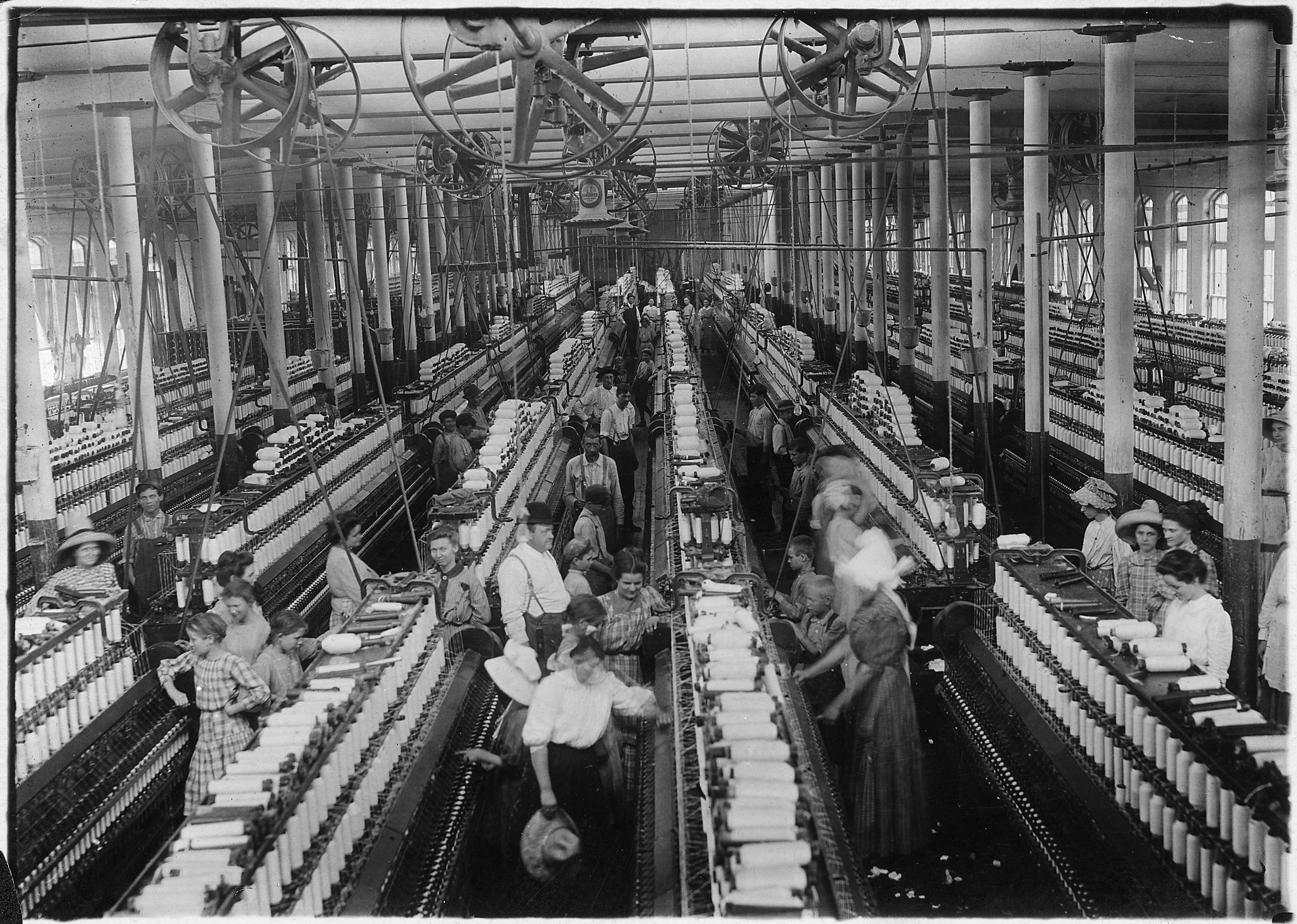
Which of the following is NOT an aspect of nationalism?

Thomas Newcomen created this invention which helped to clear water out of mines. What is it?
Flying Shuttle
The Macerena
Steam Engine
Spinning Jenny

Who improved upon the invention of Thomas Newcomen (and also become much more famous than him)?
John Kay
Albert Einstein
James Watt
Jim Freund

A ______ is a type of woven cloth or fabric.
spinning jenny
wage
textile
steam engine

Before the Industrial Revolution, about 80% of people were farmers.
True
False
A settlement on foreign land is known as a
colony
empire
"mother" country
alliance
A group of countries under a single authority is known as
empire
colony
"mother country
alliance
The desire and attempt to expand a country’s territory
patriotism
expansionism
nationalism
colonialism

The map above is connected to which of the following historical events?
Berlin Conference/ Scramble For Africa
Results of post World War II independence movements
Spread of Christianity throughout Africa
Abolition of slavery through Africa
In the 1800s, a major cause of European imperialism was the
Desire to establish democratic government throughout the world
Emergence of Marxism as an economic system
Desire for cheap raw materials and expanded markets
Religious conflict between European nations

What does the following quote refer to?
The danger of traveling in Africa
Using modern weapons to pacify native inhabitants
Patriotic propaganda for Imperial Europeans
Technological advancements of China
Great Britain’s primary motivation for acquiring control of the Suez Canal in the late 19thc century was --
Protect British trade interests in Asia
Introduce democratic principles in this region
Make up for the loss of the Panama Canal
Prohibit the movement of ships from Russia

Which slogan best reflects the point of view of Cecil Rhodes as shown in this cartoon?
“Unite All Africans.”
“Embrace African Diversity.”
“Imperialism Is a Glorious Pursuit.”
“Connecting Constantinople to Cairo.”
Athens was the first to practice?
Democracy
Medicine
Religion
Theocracy
The Greek city states shared
Religious beliefs
Traditions like the Olympics
Language
All of the above
Citizens are the source of power describes which type of government?
Monarchy
Theocracy
Democracy
Oligarchy
What type of government did Sparta mostly utilize?
Oligarchy
Monarchy
Theocracy
Democracy
Why were the Persian wars fought?
Greeks encroaching on the Persian empire
Sparta wanting control of Persia
Beef between Darius and Pericles
None of the above
A direct result of the Persian wars was
Persian victory leads to a Golden Age
Sparta defeats Athens
A truce between Greece and Persia
Greek victory and Athens establishes itself as leader of the Delian league
Who were Socrates, Plato, and Aristotle
A rock band
Philosophers of Ancient Greece
Leaders of Athenian democracy
Members of the Spartan oligarchy
The Peloponnesian War was fought between Athens and
Persia
Sparta
Egypt
Macedonia
What was a result of the Peloponnesian War?
Sparta victorious and poverty and devastation throughout Greece
Persian Golden Age
Spartan poverty and devastation
Athens Golden Age
Alexander the Great conquered all BUT
Egypt
Persia
Indus Valley
China
What happened to the Greek Empire following Alexander's death
It was overthrown by the Persian Empire
It flourished
Greek art and culture were forgotten
It was divided between his 3 top generals
Hellenistic culture is the blending of all of the following EXCEPT
Egyptian
Chinese
Middle Eastern
Greek
All of the following are characteristics of the Hellenistic culture EXCEPT
The construction of a GREAT library
Fusion of culture
Gaining the Silk Road
Advances in math and science
The common farmer, artisans, and merchants, who made up the majority of the population and held less of the power in the early republic was called...
Plebeian
Patrician
Wealthy land owners who held most of the power in the early republic were called...
Plebeian
Patrician
What type of government did ancient Rome have?
Republic
Senate
Direct Democracy
Dictatorship
Romans created aqueducts to...
Honor their gods
Transport goods
Remove waste water
Bring water to the city from far away
The Twelve Tables explained the legal rights of which two groups of Romans?
Plebeians and patricians
Consuls and rabbis
Greeks and Romans
Bishops and magistrates
How would you describe Rome's early religion?
It included many gods adapted from the Greeks
It was not allowed in peasant communities
It changed from Catholicism to Orthodox Christianity
It was open only to men in an elite society
Rome wanted to expand and control other territories. This practice of conquering other territories is called:
Imperialism
Capitalism
Republic
Monarchy
The Roman republic became an empire under the rule of:
Augustus
Constantine
Hadrian
Julius Caesar
Roman society consisted of
None of the above
Women as the head of the household
Men as the head of the household
All of the above
Women could
Own land and own a business
This isn't the answer
Vote
Become a Roman soldier
Long struggle between the years 246 and 146 B.C. in which Rome and Carthage were at war was called...
Pax Romana
Punic Wars
A leader who has absolute power and commands the army is called...
King
President
Dictator
General
What does a consul's right to reject each other's decisions called?
Affirm
Veto
Tax
Oversee
Who made himself dictator for life and was seen as a hero to the plebeians because he gave them land & food, but was power-hungry to the patricians?
Julius Caesar
Scipio
Mark Antony
Caesar Augustus
What was the period of peace and prosperity that lasted 207 years?
Christianity
Classical
Pax Romana
Augustus time
What famous trade route connected China to Europe?
The Merchant Route of Trade
The Trans Sahara trade route
The Chinese Caravan Road
The Silk Road
Which of the following were traded along the Silk Road?
Luxury goods
All of these
Spices
Silk
Which empire is described as the Golden Age of classical Indian culture?
Gupta Empire
Mauryan Empire
Harappa Empire
Indo-Aryan Empire
All of the following are ideas of Confucius EXCEPT -
Social order is best achieved through less education
Rulers should set a good example for their subjects
Respect for your elders
Family relationships are important
The Chinese invented...
All of these
Paper
Compass
Wheelbarrow
To work as a government official you would need to
Be a high-class citizen and pass a rigorous test
Be high-class citizen who sent silk along the Silk Road
Be handsome
Prove that you were in top athletic condition and curious
The Chinese kept their procedure for making
sundial
wheelbarrow
silk
paper
The Han Dynasty lasted for over
400 years
40 years
100 years
1000 years
During the years of Han rule,
China's population fell while its area expanded
China' s area and population grew
Both the country's population and area fell
China's population increased while its area fell.


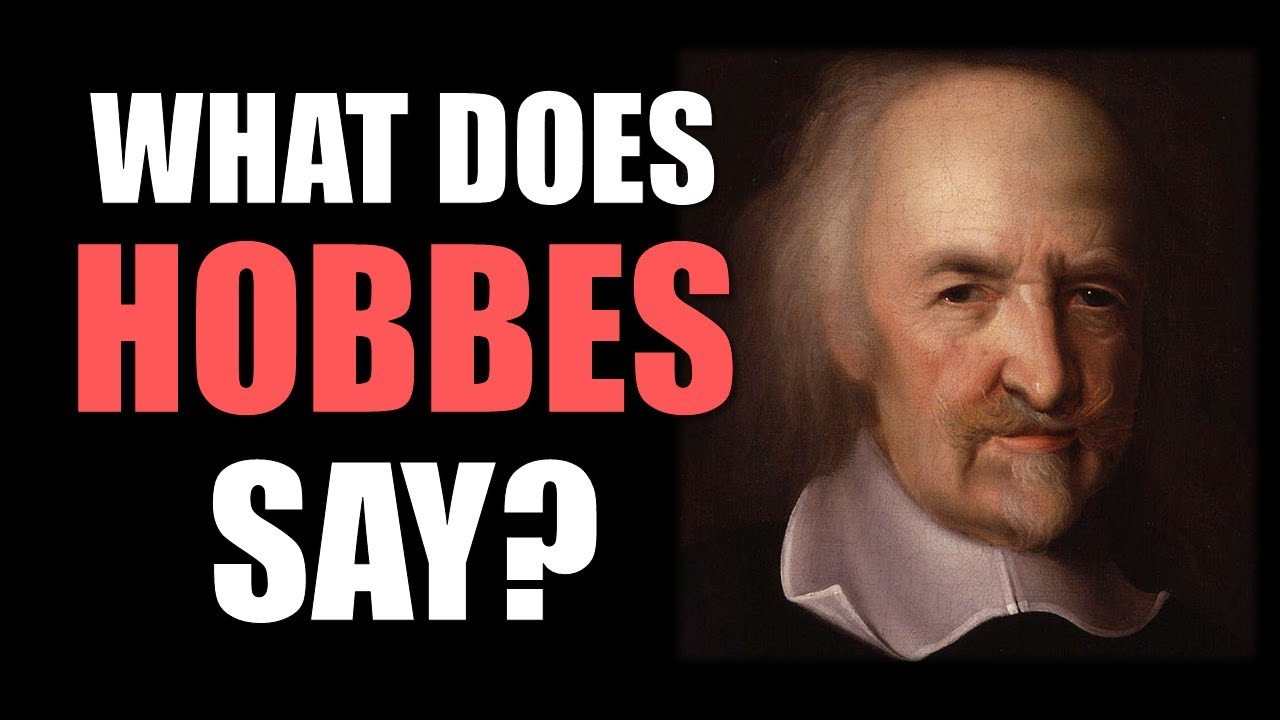


Father of Capitalism
Adam Smith
Adam Samson
Smith Adam
John Locke

They needed a tax collector
That they had no voice in Parliment
That they wanted their tax check
That Parliament had heard them
"We hold these truths to be self-evident, that all men are created equal, that they are endowed, by their Creator, with certain unalienable Rights, that among these are Life, Liberty, and the pursuit of Happiness."
- What document is this from?
Proclamation of 1763
Bill of Rights
Declaration of Independence
The Preamble to the Constitution

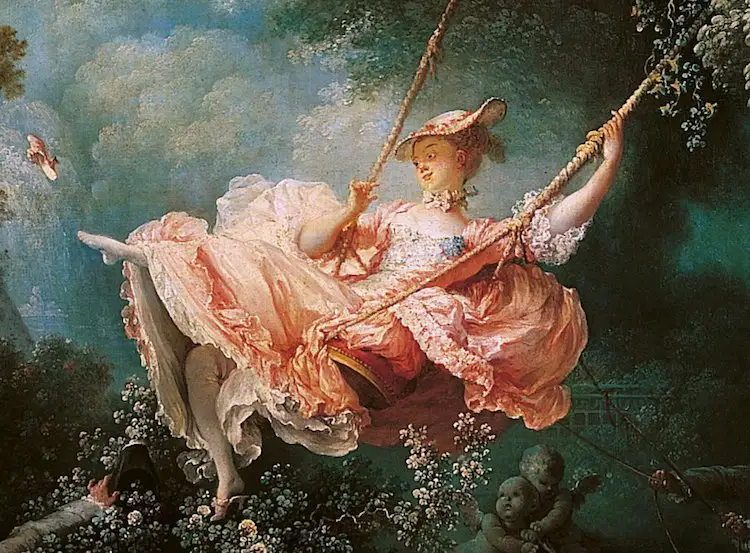
Rococo
Cubism
Baroque
Impressionism

Elegant compositions by Handel, Haydn, and Mozart reflected a new musical style of the Enlightenment known as
romantic
classical
baroque
folk


"No Taxation without Representation."
What does this mean?

This painting is an example of what artistic style?
Renaissance
Baroque
Rococo
Reformation
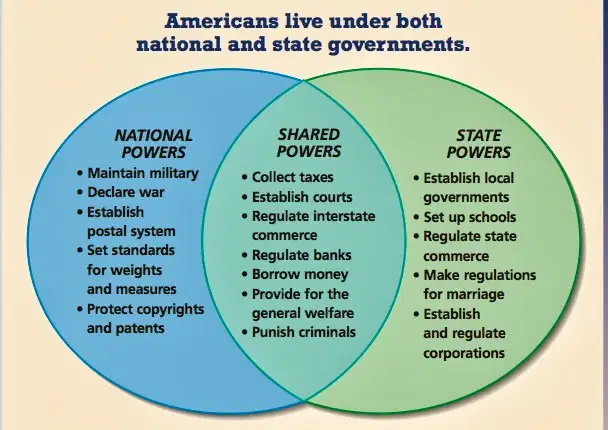
The principle of the United States government illustrated in this Venn diagram is
Federalism
Socialism
Republicanism
Confederation


What pamphlet was written by Karl Marx and Friedrich Engels that describes a radical form of socialism called Marxism?
The Communist Manifesto
The Wealth of Nations
The Social Contract
The Encyclopedia

What type of engine was invented by James Watt?
Gasoline Engine
Steam Engine
Coal Engine
Locomotive

What are identical components that can be used in place of each other?
Interchangeable parts
Factories
Dynamos
Assembly Lines
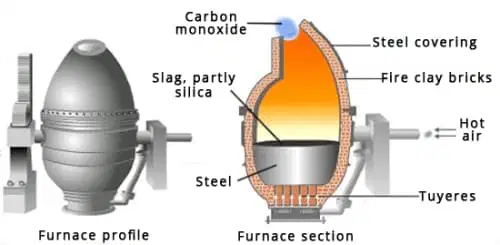
Who invented a process to mass produce steel?
Abraham Darby
Henry Bessemer
Andrew Carnegie
James Watt
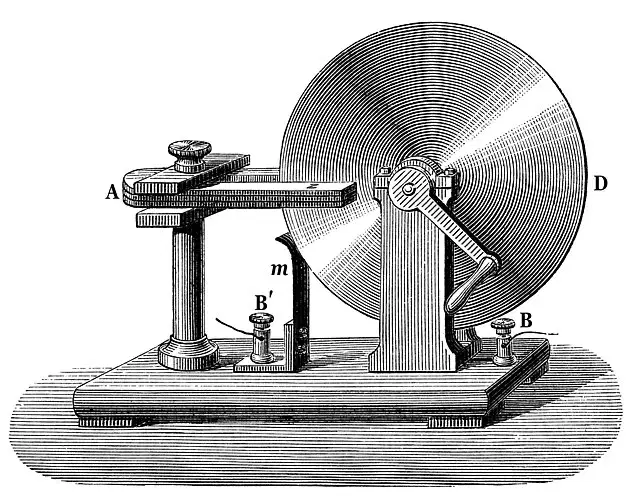
Who invented the electric generator known as a dynamo
Michael Faraday
Nikola Tesla
Nikolas Otto
Thomas Edison
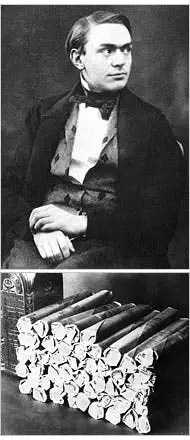
Who invented dynamite?
Guglielmo Marconio
Alfred Nobel
Nicola Tesla
David Fariday

What invention made the automobile and the airplane possible?
movable parts
the dynamo
internal combustion engine
the steam engine

What is the idea that society should be the greatest happiness for the greatest number of citizens is called?
Utopia
Utilitarianism
Socialism
Dynamo
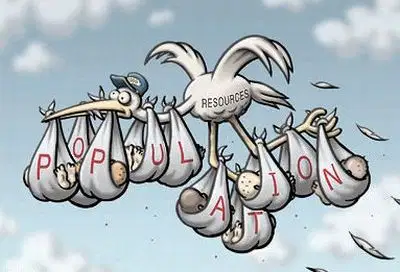
Louis Pasteur
David Ricardo
Charles Darwin
Thomas Mathlus
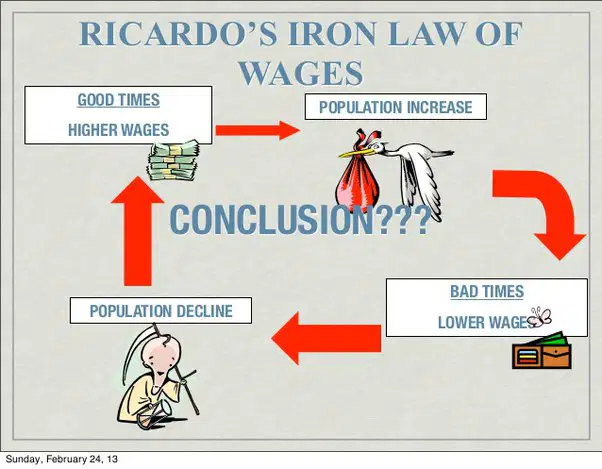
According to his “Iron Law of Wages” wage increases will not raise the standard of living of poor families.
Adam Smith
Karl Marx
David Ricardo
Jeremy Benthem

What is the name for the working class during the Industrial Revolution?
darwinist
proletariat
communist
dynamo
Corporations
Shares of a company sold to investors for needed capital to produce and use new technology.
People employed in an organization or engaged in an organized undertaking such as military service.
The people engaged in or available for work, either in a country or area or in a particular company or industry.
Businesses that are owned by many investors who buy shares of stock.
Which of the following statements best illustrates the idea of laissez-faire capitalism?
The government should pass laws to protect the workers.
Private property will cease to exist. The people will own the means of production.
The workers will rise up and overthrow the privileged class.
Government should not interfere in relations between workers and business owners.

The painting seen here is an example of
impressionism
postimpressionism
expressionism
romanticism

Claude Monet's paintings are an example of the artistic movement known as
impressionism
postimpressionism
expressionism
romanticism
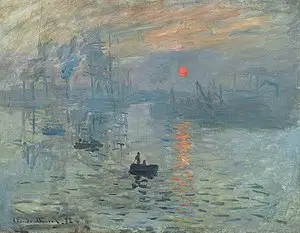
What invention caused artists to turn from realism and embrace impressionism?
the telescope
the microscope
the light bulb
the camera

Mary Shelly's book Frankenstein is an example of the literary movement known as
Realism
Expressionism
Impressionism
Romanticism
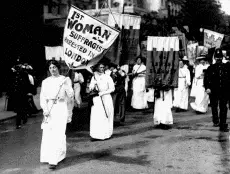
The women in this photograph are protesting
against child labor
for better working conditions
for the right to vote
against women's suffrage

Charles Darwin’s book, On the Origin of Species, was controversial because it
justified withholding welfare from the poor.
differed from the creation story in the Bible.
suggested there were patterns among elements in the periodic table.
stated that all human diseases could be cured.

He discovered that a microbe can change over time and become harmful.
Jacob Lister
Florence Nightingale
Louis Pasteur
Robert Koch

What group of people does the man on the right in this diagram represent?
welfare recipients who are too lazy to work
workers who don't have enough money to go on vacation
employees who work at home
a member of a labor union who has gone on strike

This British doctor and missionary who explored Africa for 30 years believed that the way to end the slave trade was to open up the interior of Africa to Christianity and trade.
Mungo Park
David Livingston
Henry Stanley
Richard Burton

Use the political cartoon and your knowledge of Social Studies to answer the question below.
What was the primary cause of the Opium Wars?
China was upset because Britain refused to sell them Opium.
Britain was upset because China outlawed the Opium trade.
Britain stopped buying Chinese tea.
The Chinese emperor threatened to invade India

Which statement best reflects an effect of Imperialism in Africa?
Land was distributed equally between social classes.
Territorial divisions were primarily established using tribal boundaries.
Timbuktu became the center of great learning.
Natural resources were exploited for the benefit of European powers.

All of the headlines above refer to-
Causes of the Boer War
Motives for Imperialism
Actions of Nationalism
Effects of the Crimean War


What does the phrase "White Man's Burden: in this excerpt refer to?
The belief that Europeans had a duty to "civilize" primitive people.
The challenge of opening up trade with remote regions.
The advantage non-Europeans would gain by trading with Europeans.
The idea that bigger, stronger Europeans could carry more baggage.


Both were led by rich, upper class citizens
Both were led by the government
Both resisted foreign influence over their nation
Both welcomed foreign control by the West

What is Social Darwinism?
Survival of the fittest in society
The idea that some races are better than others
The idea that you need to "civilize" other cultures
all of these options


Which of the following best accounts for the European influence on Africa by 1914?
European countries that were the first to explore Africa in the fifteenth and sixteenth centuries became the most dominant in Africa by 1914.
European countries that were the first to industrialize came to dominate Africa by 1914.
European countries that had republican and democratic governments were less likely to dominate Africa than countries with more authoritarian regimes.
European countries that were strongly influenced by national churches were most likely to dominate Africa for missionary purposes.

This cartoon suggests that political power is often acquired through
the inheritance of land
market demands
religious conversion
the use of technology

This cartoon represents a contemporary characterization of which of the following?
Germany plans to dominate Africa after its unification
a satire on Italy’s inability to win an African colony
British designs for a Cape-to Cairo connection in Africa
an endorsement of the “White Man’s Burden”
The Boers were descendants of
Watusi nomads, who had been driven south by German colonists.
the original Dutch settlers of Cape Town and the surrounding areas.
the indigenous Zulu peoples of South Africa.
German colonists who pushed the Zulu peoples out of Nigeria.


The Zulu leader in the early 1800s who created a strong kingdom by subduing several neighboring peoples. As a result, the Zulu kingdom resisted colonization for over 50 years.
Menelik II
Emperor Meiji
Leopold II
Shaka

What is Spheres of Influence?
Replacing local leaders with foreigners
Putting local leaders in charge (with guidance from foreigners)
Region in which the economic interests of a foreign country outweigh that of the country they are in
Removing the government and having anarchy

Why did Great Britain wish to control the Suez Canal?
Control of the Suez Canal provided ships quicker access to the Indian Ocean from Europe.
Control of the Suez Canal gave Great Britain control of the Silk Road to India and China.
Control of the Suez Canal provided a solution to the irrigation problems in northern Africa.
Control of the Suez Canal allowed Great Britain to make allies of African nations.

How did many native Africans provide resistance to European Imperialism?
Ethnic groups such as the Asante and Zulu often engaged in military skirmishes with European settlers.
Ethnic groups sponsored local elections to make South Africa an independent nation.
Ethnic populations such as the Aztecs and Mayans chased out the Spanish conquistadors.
Ethnic populations developed new weaponries to conquer British forces.

Tensions in the Ottoman Empire between Turkish nationalists led to genocide of this ethnic group.
Algerians
Egyptians
Armenians
Turks

Which of the following is the best example of imperialism?
France building a powerful navy.
England's alliance with France.
German schools teaching English.
England and Germany competing for colonies.

What name is used for the U.S. policy towards China that Secretary Hay negotiated ?
Open Door
Square Deal
Good Neighbor
Manifest Destiny

Why was Japanese rule unpopular in Korea?
The Japanese brought modern transportation systems to Korea
The Japanese allowed all Koreans to vote in elections
The Japanese imposed feudalism on Korea
The Japanese imposed harsh rule and set out to erase the Korean culture and language

Why did the Japanese turn away from the Shogun, returning power to the Emperor in the Meiji Restoration?
Japan's army was defeated by the Americans, who conquered Japan
Japan's military was defeated by the Russians, driving the Japanese out of Korea
The Shogun was unable to avoid giving in to the Americans in the Treaty of Kanagawa
The forces of the Emperor defeated the Shogun's supporters in a coup


Commodore Matthew Perry’s visits to Japan in 1853 and 1854 resulted in the
colonization of Japan by the United States
transfer of spheres of influence to China
introduction of Christianity to Japanese society
opening of trade and diplomatic relations with Japan

Which European country did Japan defeat in war in the early years of the 20th century?
Germany
Britain
France
Russia


The Japanese added Taiwan to their Empire after defeating the China in the Sino-Japanese War. Which number represents Taiwan?
1
2
3
4
Select the choices that are causes of the French Revolution.
Inspiration from American Revolution
Enlightenment Ideas
Strong economy
Low food prices
Inequality among the 3 Estates
What was the Estates-General?
France's hospital system
A meeting of representatives from 3 Estates
France's military leader
the Assembly that executed the king
What was the purpose of the National Assembly's Tennis Court Oath?
To raise taxes of the the Third Estate
Write a constitution for France and limit the king's power
To make plans to storm the Bastille
In a constitutional monarchy...
Monarch shares power with lawmakers
Monarch shares power with all citizens who vote on all laws
Elected officials represent the citizen body
A monarch has all power
In a republican form of government...
a party that favors limited government rules
a monarch shares power with lawmakers
Elected officials represent the citizen body
Who overthrew The Directory in a coup d'etat?
Robespierre
King Louis
Jean Valjean
Napoleon Bonaparte


Which Spanish explorer was the first to circumnavigate the globe after discovering a passage through South America. He died in the Moluccas while fighting in a war to help the Chief of Cebu?
Ferdinand Magellan
Francis Drake
Amerigo Vespucci
John Cabot


Which of these famous structures did Michelangelo paint?
the Louvre
the Coliseum
the Sistine Chapel
the Eiffel Tower
Which of these men of the Renaissance was known equally for his art as well as inventions?
Rueben
Leonardo da Vinci
Michelangelo
Aristotle

One of the most important ideas from the Renaissance that allowed ideas to spread more quickly.
Perspective
Greece and Rome
Building designer
Printing Press

What sculpture is this?
David by Donatello
Danny by Raphael
David by Leonardo
David by Michelangelo
What was an explosion of discoveries and ideas that started in Europe during the 1500s?
Enlightenment
Protestant Reformation
Black Death
Scientific Revolution
A piece of land given from lord to a lesser lord.
Vassal
Royalty
Kingdom
Fief
A nobleman who was trained as a warrior and lived their live according to a code of chivalry
Samurai
Navy
Vassal
Knight
Code of conduct which a knight swore to uphold
Ethics
Semper Fi
Chivalry
Tithe
The Middle Ages began after what event?
Fall of Rome
Renassaince
Peloponesian War
World War I
Code of conduct which a knight swore to uphold
Ethics
Semper Fi
Chivalry
Tithe
The Middle Ages began after what event?
Fall of Rome
Renassaince
Peloponesian War
World War I
Which type of government allows the citizens to vote for laws?
Oligarchy
Democracy
Dictatorship
What is another name for a Greek city-state?
pantheon
ziggurat
town
Polis


What color island is the United Kingdom?
green
blue
orange
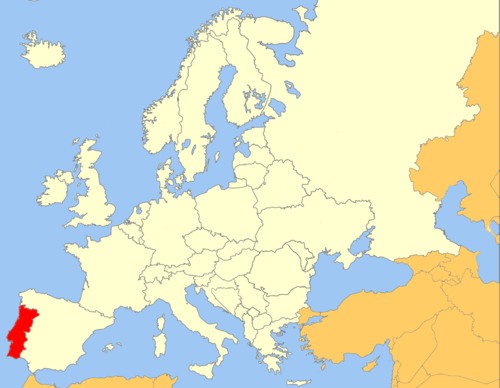
What country is this?
Portugal
Spain
France
Italy
The _________________ is a method of procedure that includes observation, measurement, experimentation, and the formulation and testing of a hypothesis.
Evolution Method
Scientific Method
Law of Conservation of Mass
Counting Method

