
 Worksheets
Physical Science Semester Test Dec 2023
Total questions: 50
Worksheet time: 57mins
This statement is
After performing a lab investigation using chemicals, what should you do before you leave the classroom? (select all that apply)
Clean up your lab area
Pour excess chemicals down the drain
Wash your hands
Store all equipment in the correct locations
Take a victory lap around the room

Type of mixture that has the SAME COMPOSITION in every part.
Homogenous
Heterogeneous
Identify the solvent
Combination of two or more pure substances that are not chemically combined
grass
mixture
a characteristic of matter you observe as it reacts or changes into a different substance
physical property
chemical property
periodic table
conglomerate
What state of matter has no shape and no size?
gas
liquid
solid
What state of matter can move and flow easily?
liquids
solids
gases
What is the definition of SUBLIMATION?
When solid rock melts to form lava
When water vapor cools down to form liquid water
The transition of a substance from a solid directly to a gas

This is an example of
Freezing
Melting
Condensation
Sublimation
All matter is made of _________.


__________ are negatively charged particles that are in the orbitals around the nucleus.
protons
nucleus
neutrons
electrons

The chemical symbol for an element is always represented by only 1 letter
True
False
The first letter of the chemical symbol is always a capital letter and the second is always lowercase
True
False
Atomic Mass equals the combined number of
Protons and Electrons
Electrons and Neutrons
Protons and Neutrons
What is the chart called that organizes all of the elements found on Earth?
Element Chart
Table of Elements
Periodic Table of Elements
A row on the Periodic Table of Elements
family
period
row
isotope
How many elements are there?
100
110
115
118
All Elements are either _________________, _____________________, ____________________. (select all that apply)
Metals
Non-metals
liquids
metalloids
rocks
What Russian Scientist first constructed the Periodic Table?
Victor Hugo
Andrei Kirilenko
Albert Einstein
Dimitri Mendeleev

What is the atomic number for this element?
32.065
16
48.065

What is the atomic mass of Sulfur?
16
32.065
48.065
Same charges repel, opposites charges ______
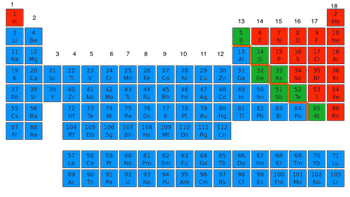

Alloys are created to improve the working properties and appearance of metals, they are made by cobining two or more elements.
True
False
What is the big number placed in front of a element called?
Number written below & to the right of a chemical symbol (not suppose to change ever)
Substances that form as the result (at the end) of a chemical reaction
H2 + O2 --> H2O
What is the Law of Conservation of Mass?
Mass is created in a chemical reaction
Mass is created in a physical change
New chemicals formed from a chemical reaction have a larger overall mass than the original reactants
Mass is never created or destroyed
Al(OH)3 → Al2O3 + H2O
true
false
What is the rate of reaction?
How much energy is needed for a reaction to occur.
The energy required to break a bond.
The time it takes for a reaction to occur.
Collision Theory
What factors effect rate of reaction?
Temperature, Concentration, Pressure and Energy
Surface Area, Concentration, Energy and Pressure
Temperature, Pressure, Concentration and Surface area
Pressure, Surface area, Density and Energy
Increasing the temperature of your solution will.......
Not affect the rate of reaction.
Speed up the rate of reaction
Slow down the rate of reaction
concentration
surface area
temperature
reactants

