
Font size
 Worksheets
Eye & Ear
Total questions: 37
Worksheet time: 32mins

The part of ear that provides equilibrium
cochlea
round window
semicircular canals
labyrinth
The receptors that sense chemicals
thermoreceptors
mechanoreceptors
chemoreceptors
photoreceptors
The receptors that sense light
thermoreceptor
chemoreceptor
mechanoreceptor
photoreceptor
Receptors for taste and smell are classified as:
proprioreptors
thermoreceptors
chemoreceptors
mechanorecptors
Special structures that detect stimuli
Receptors
nerve cells
brain
medulla
Photoreceptors are found in your
eyes
ears
nose
mouth
skin
Receptors found in your mouth are
mechanical receptors
chemical receptors
sound receptors
photoreceptors
Match each term to its correct definition.
lacrimal
gland that produces tears
gustatory cells
taste receptors cells
myopia
nearsightedness
fungiform
papillae that contains taste buds
olfactory bulb
brain area that receives smell impulses
The innermost sensory layer of the eye is the (a) .
The only special sense that is NOT fully functional at birth is...?
Vision
Taste
Hearing
Smell
Which of the following is NOT a primary taste sensation?
salty
spicy
umami
sweet
Which of the following is NOT associated with the middle ear?
auricle
round window
ossicles
pharyngotympanic tube
The gel-like substance that fills the posterior chamber of the eye is the .
(a)
Which of the following lists structures of the eye in the order through which light passes?
cornea, pupil, lens, aqueous humor, vitreous humor
cornea, aqueous humor, pupil, lens, vitreous humor
lens, pupil, aqueous humor, vitreous humor
pupil, cornea, aqueous humor, lens, vitreous humor
Dynamic equilibrium receptors are located in the
semicircular canals
cochlea
papillae
tympanic membrane
Fibers from the medial side of each eye cross over to the
opposite side of the brain at the
fovea centralis
lens
retina
optic chiasm
The sense organ that can detect cold, hot, pain, and pressure
eyes
nose
ears
skin
Proprioception helps us keep track of
touch
body awareness
where your limbs are
hearing

M
A
Choroid
B
Retina
C
vitrious humor
D
sclera
E
Cornea
Match the letter to its name using the diagram
F
Aqueous humor
G
Lens
H
Ciliary Body
I
Optic Nerve
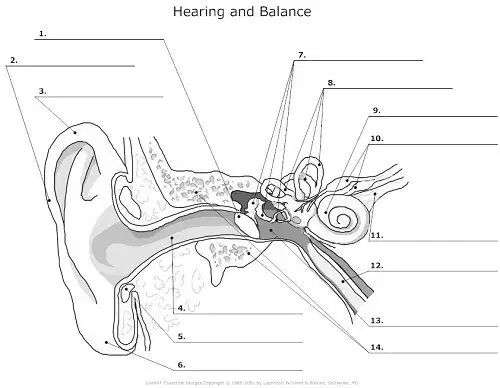
Put the parts of the ear in the correct column
auricle
external auditory meatus
tympanic membrane
cochlea
semicicular canals
stapes
incus
malleus
vestibule
eustian tube
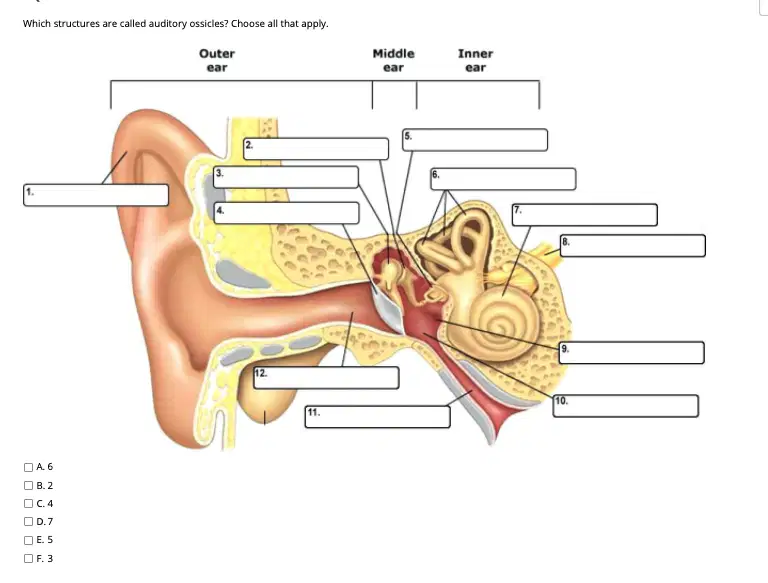
Match the number to its label
1
auricle
2
incus
3
malleus
4
tympanic membrane
5
stapes
Match the number to its label
6
semicircular canals
7
cochlea
8
nerve
11
eustasian tube
12
esternal auditory meatus

Match the number to its name
1
Auricle
2
external auditory meatus
3
tympanic membrane
5
round window
6
eustatian tube
Match the number to its name
7
cochlea
8
nerves
9
semicicular canals
10
stapes
12
i

Match the name with the letter
H
pupil
D
choroid
E
sclera
F
ciliary body
G
ligaments
Match the name with the letter
A
fovea centralis
B
optic nerve
C
retina
I
Cornea
J
Lens

