
 Worksheets
Alg 2 1st Semester Final Study Guide
Total questions: 117
Worksheet time: 10hrs 45mins
For the function y = a ∗ f(bx − ℎ) + k, changes in the value of h cause which of the below changes to the graph?
Horizontal shrink/stretch
Vertical shift up/down
Horizontal shift left/right
Vertical shrink/stretch
For the function y = a ∗ f(bx − ℎ) + k, changes in the value of k cause which of the below changes to the graph?
Horizontal shrink/stretch
Vertical shift up/down
Horizontal shift left/right
Vertical shrink/stretch
For the function y = a ∗ f(bx − ℎ) + k, changes in the value of a cause which of the below changes to the graph?
Horizontal shrink/stretch
Vertical shift up/down
Horizontal shift left/right
Vertical shrink/stretch
For the function y = a ∗ f(bx − ℎ) + k and b < 0, which of the following occurs?
Horizontal shrink/stretch
Reflection over the x-axis
Reflection over the y-axis
Vertical shrink/stretch
For the function y = a ∗ f(bx − ℎ) + k, changes in the value of b cause which of the below changes to the graph?
Horizontal shrink/stretch
Vertical shift up/down
Horizontal shift left/right
Vertical shrink/stretch
For the function y = a ∗ f(bx − ℎ) + k and a < 0, which of the following occurs?
Horizontal shrink/stretch
Reflection over the x-axis
Reflection over the y-axis
Vertical shrink/stretch
Given the function y = f(x − 2) + 4, which of the following represents the transformation of y?
Horizontal shift right 2
Vertical shift down 4
Horizontal shift left 2
Vertical shift up 4
Horizontal shift right 2
Vertical shift up 4
Horizontal shift left 2
Vertical shift down 4
Given the function y = f(x + 2) + 4, which of the following represents the transformation of y?
Horizontal shift right 2
Vertical shift down 4
Horizontal shift left 2
Vertical shift up 4
Horizontal shift right 2
Vertical shift up 4
Horizontal shift left 2
Vertical shift down 4
Given the quadratic function f(x)=(x−h)2+k , and given that ℎ = 3 and k = 4, what is the vertex of the function?
(-3, -4)
(3, 4)
(-3, 4)
(3, -4)
Given the quadratic function f(x)=(x−h)2+k , and given that ℎ = -5 and k = 2, what is the vertex of the function?
(-5, -2)
(5, 2)
(-5, 2)
(5, -2)
Given the quadratic function f(x)=(x−3)2+1 , what is the vertex of the function?
(-3, -1)
(3, 1)
(-3, 1)
(3, -1)
Given the quadratic function f(x)=(x+7)2−2 , what is the vertex of the function?
(-7, -2)
(7, 2)
(-7, 2)
(7, -2)
If f(-x) =f(x) then the function is
odd function
even function
neither nor
log function
If -f(x) =f(-x) then the function is
odd function
even function
neither nor
log function

Identify whether the function is even or odd given the table of values.
Even
Odd
Neither

Identify whether the function is even or odd given the table of values.
Even
Odd
Neither

Identify whether the function is even or odd given the graph.

Identify whether the function is even or odd given the graph.
Even
Odd
Neither

Which of the following is the correct range for the function shown on the graph?
(−∞, 6]
[−10, 6]
[−10, ∞)
(−∞, ∞)
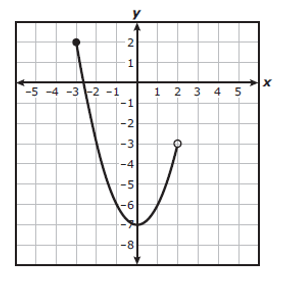
Which of the following is the correct range for the function shown on the graph?
(−7, 2)
[−7, 2]
[−3, 2)
(−3, 2)

Which is the correct domain for the function shown in the graph?
(−∞, −3]
[3, −∞)
(−∞,3]
(−∞,∞)
None of the answer choices

Which is the correct domain for the function shown in the graph?
[-2, 3]
[-2, 3)
(-2, 3]
[-3, 4]
(-3, 4]

Which response correctly represents the interval of increase for the function shown in the graph?
(−∞, 1)
(−∞, 2)
(2, ∞)
(1, ∞)

Which response correctly represents the interval of decrease for the function shown in the graph?
(-∞, 4)
(4, 3)
(0, 1)
(0, -∞)

Identify the absolute maximum value on the graph shown.
5
0
-5
2

Identify the absolute minimum value on the graph shown.
0
-5
-3
-1

Identify all x-intercepts in the given graph.
(-2, 0)
(0, 0) & (4, 0)
(0, 0) & (-2, 0)
(-2, 0) & (4, 0)

Identify all y-intercepts in the given graph.
(0,3)
(3,0)
(1,0)
(2,-1)
If Alucard wanted to solve this equation using the square root method, which answer shows the correct sequence of steps? x2−41=8
Take the square root of both sides.
Subtract 41 from both sides, then square root both sides.
Add 41 to both sides, then square root both sides.
Subtract 8 from both sides, then square root both sides.
If Beauford wanted to solve this equation using factoring by grouping, which answer shows the correct sequence of steps? 2x2−5x−18=0
Multiply 2 and -18 together and factor -36 into -9 and 4.
Split -5x into -9x and +4x. Factor out the GCF from both groups, and factor out the GCF from both terms.
Set both factors equal to 0 and solve for x.
Multiply 2 and -18 together and factor -36 into -9 and 4.
Write the equation in factored form. Set the factors equal to 0 and solve for x.
Multiply 2 and -18 together and factor -36 into -9 and 4.
Split -5x into -9x and +4x. Factor out the GCF from both groups.
Set both terms equal to 0 and solve for x.
Factor 18 into -9 and 2
Write the equation in factored form. Set the factors equal to 0 and solve for x.
If Carly wanted to solve the equation below by using the quadratic formula, which answer shows the correct sequence of steps?
x2−12x+4=0
Identify a=1, b=-12, and c=4.
Plug in the numbers for a, b, and c. Simplify the radical (square root sign). Simplify the numerator and divide by the denominator.
Identify a=1, b=-12, and c=4.
Plug in the numbers for a, b, and c. Simplify the radical (square root sign). Simplify the numerator.
Identify a=1, b=-12, and c=4.
Plug in the numbers for a, b, and c. Simplify the radical (square root sign).
This trinomial cannot be solved by the quadratic formula.
If Delia wanted to solve the equation below by completing the square, which answer shows the correct sequence of steps? x2−6x+4=0
Find (2−6)2 , add 9 to both sides, factor the trinomial, then square root both sides and simplify.
Isolate the constant c value, find (2−6)2 , add 9 to both sides, factor the trinomial, then square root both sides and simplify.
Isolate the constant c value, find (2−6)2 , add -3 to both sides, factor the trinomial, then square root both sides and simplify.
This trinomial cannot be solved by completing the square.
What are the solutions of x2+3x−14=0 ?
x=23±65
x=2−3±65
x = -7, 4
x = -4, 7
What are the solutions of x2−3x+14=0 ?
x=23±i 47
x=2−3±i 47
x = -5,2
x = -2, 5
What are the factors and solutions of x2−7x−18=0 ?
(x-9)(x+2); x = -2, 9
(x+9)(x+2); x = -9, -2
(x-9)(x-2); x = 2, 9
(x+9)(x-2); x = -9, 2
What are the factors and solutions of 6x2+19x−20=0 ?
(6x-5)(x+4); x = -4, 5/6
(6x+5)(x-4); x = -5/6, 4
(6x-5)(x-4); x = 5/6, 4
(6x+5)(x+4); x = -4, -5/6
What are the zeros of z=−25x2+30x ?
x = ± 6/5
x = 6/5
x = 0, 6/5
There are no zeros for z.
What are the zeros of k=6x2−16x ?
x = ± 8/3
x = 8/3
x = 0, 8/3
There are no zeros for k.

Which equation could match the graph?
y = 1/3(x + 1)(x + 4)
y = 1/3(x - 1)(x - 4)
y = 1/3(x - 4)(x - 4)
y = 1/3(x + 2.5)(x + 4)

Which quadratic function is represented by the graph?
y = –(x – 4)2 + 5
y = –(x + 4)2 + 5
y = –2(x – 4)2 + 5
y = –2(x + 4)2 + 5
None of these
1. Which of the following may represent the graph of y=2x2+8x+11 ?


5. Which of the following may represent the graph of y=−2x2+4x+3 ?


What are the increasing and decreasing intervals for the function f(x) = (x+2)2-1?
Increasing: (−∞, −2)
Decreasing: (−2, ∞)
Increasing: (−2, ∞)
Decreasing: (−∞, -2)
Increasing: (−1, ∞)
Decreasing: (−∞, -1)
Increasing: (−∞, −1)
Decreasing: (−1, ∞)
What are the increasing and decreasing intervals for the function: g(x)=−2(x−3)2+1 ?
Increasing: (−∞, 3)
Decreasing: (3, ∞)
Increasing: (−∞, 1)
Decreasing: (1, ∞)
Increasing: (2, ∞)
Decreasing: (-∞, 2)
Increasing: (1, ∞)
Decreasing: (-∞, 1)
What is the vertex of this equation?
y = (x + 3)2 -7
What is the vertex of the quadratic function: 21x2−3x+225=0 ?
What are the x-intercepts of the graph of 2x2 + 7x - 15 = 0?
x = -3/2, 5
x = -7/10, 5
x = -5, 3/2
x = -5, 7/10
What are the x-intercepts of the graph of -4x2+25x+21 = 0?
x = -7, -3/4
x = -3/4, 7
x = -7, 3/4
x = 3/4, 7
2x3 - 11x2 + 12x + 9 = 0
x3 - 7x - 6 = 0
Divide 3x^2 - 4x - 20 by x + 2.
3x + 1
3x - 1
3x + 10
3x - 10
Divide 2x^2 + 5x - 3 by x + 3.
2x - 5
2x - 1
2x + 1
2x + 9
Find all zeros of the polynomial x5 - 5x4 - 64x3 + 236x2 + 672x.
x = 0, -7, -2, 6, 8
x = 0, 7, 2, -6, -8
x = -7, -2, 6, 8
x = 7, 2, -6, -8
Find all factors of the polynomial x4 - 12x3 + 49x2 - 78x + 40.
(x-1)(x-2)(x-4)(x-5)
(x+1)(x-2)(x-4)(x-5)
(x-1)(x-2)(x+4)(x-5)
(x-1)(x-2)(x-4)(x+5)
Find all zeros of the polynomial using synthetic division. 2x2 - 3x − 2 = 0
x = -1/2, 2
x = -2, 1/2
x = -2, -1/2
x = 1/2, 2

Find the remainder when dividing 4x^4 - 6x^3 + 9x^2 - 5x + 2 by x + 3.
-2
11
0
584
What is the remainder when dividing 3x^4 - 4x^3 + 5x^2 - 6x + 1 by x - 1?
-1
-2
0
3


Match the following End Behavior to their Graphs

Degree is Odd, Leading Coefficient is Negative

Degree is Odd, Leading Coefficient is Positive

Degree is Even, Leading Coefficient is Negative

Degree is Even, Leading Coefficient is Positive
Check all the odd degree polynomials:


In the above graph complete the following end behavior:
As x→−∞, f(x)→ _____
As x→∞, f(x)→ ____
-∞
-∞
+∞
+∞

Describe the end behavior of the graph.
As x→−∞, f(x)→∞ As x→∞, f(x)→−∞
As x→−∞, f(x)→∞ As x→∞, f(x)→∞
As x→−∞, f(x)→−∞
As x→∞, f(x)→−∞
As x→−∞, f(x)→−∞
As x→∞, f(x)→∞

Select the interval where y = g(x) is decreasing
(-∞, -2.6) u (2.6, ∞)
(-∞, 2) u (3, ∞)
(-∞, 3) u (4, ∞)
None of these

Select the interval where y = f(x) is increasing.
(-∞, -3) u (-2, ∞)
(-∞, -1.5) u (0, ∞)
(-3.3, 0) u (3.3, ∞)
All of these

What is the domain and range in this graph?
D: (-∞, ∞)
R: (-1, ∞)
D: (-4, 2)
R: (-1, ∞)
D: (-∞, ∞)
R: (-∞, ∞)
D: (-4, 2)
R: (-2.5, 2.5)

For the pictured polynomial, what is the domain and range?
D: (-1, ∞)
R: (-∞, ∞)
D: (-∞, 1)
R: (-∞, ∞)
D: (-∞, ∞)
R: (-∞, 1)
D: (-∞, ∞)
R: (-1, ∞)
To find the y-intercepts, make y = 0 and solve.
True
False
What is an asymptote?
an imaginary line that your function never touches
a part of your function
a point on your graph
a type of fruit
Find the y intercept for x2−4x+3x2−5x+6
(0, 1) and (0, 3)
(0, 2)
(0, 3)
(0, 6)

Find the y-intercept
(0, 3/2)
(0,1)
None
(0, 2/3)
What is the y-intercept of
y=x−42x2−x−3
(0, 2)
(0, 3/4)
(0, -3/4)
What are the y intercept(s) of the function?
(0,−83)
(0,83)
(0,0)
(0,4), (0,-2)

What is the horizontal asymptote?
y=6
y=-6
x=-2
x=2

What is the vertical asymptote?
y=6
y=-6
x=2
x=-2

What is the y-intercept?
(0, 5.5)
(0, -5.5)
(5.5, 0)
(-5.5, 0)

What is the horizontal asymptote?
y=-5
y=5
x=0
x=1
What is the vertical asymptote?
y=-5
y=5
x=0
x=1

Write the equation for the graph.
y=x
y=x2
y=x1
y=∣x∣

Write the equation for the graph.
y=x+31
y=x+3
y=x3
y=x−31


The domain are the ______ values.
y
x
Both x and y
The range are the _____ values.
y
x
Both x and y


What is the range of this function?
(−∞,∞)
(−∞,3)U(3,∞)
(−∞,3]
(−∞,3)(4,∞)
What are the decreasing intervals of this function?
(−∞,∞)
(−∞,3)U(3,∞)
(−∞,3]
(−∞,3)(4,∞)
What is the domain of this function? #7
The dashed blue lines represent asymptotes
(−∞,∞)
(−∞,3)U(3,∞)
(−∞,3]
(−∞,3)(4,∞)

What is the domain and range of this rational function? #44
D: (−∞, 4) U (4, ∞)
R: (−∞, 0) U (0, ∞)
D: (−∞,∞)
R: (−∞,∞)
D: (−∞, 0) U (0, ∞)
R: (−∞, 4) U (4, ∞)
D: (−∞,∞)
R: (−∞,0)
What are the decreasing intervals for this function?
(−∞, 4) U (4, ∞)
(−∞, ∞)
(−4, ∞)
(−∞,0) U (0, ∞)
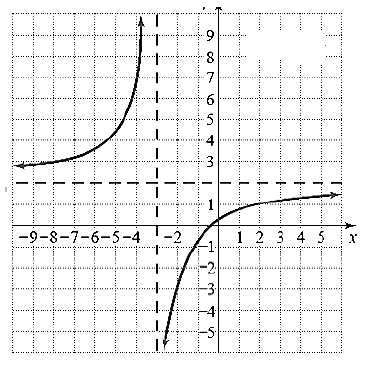
Which of the following represents the graph below?
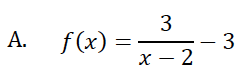
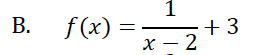
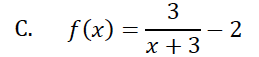
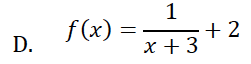
What are the increasing intervals for this function?
(−∞, ∞)
(−∞, 2) U (2, ∞)
(−∞, −2) U (−2, ∞)
(−∞, −3) U (−3, ∞)
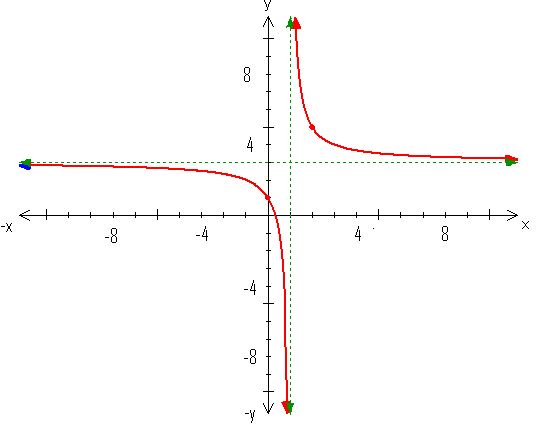
What are the decreasing intervals for the function?
(−∞, −1) U (−1, ∞)
(−∞, 3) U (3, ∞)
(−∞, −3) U (−3, ∞)
(−∞, 1) U (1, ∞)
Find the y intercept for x2−4x+3x2−5x+6
(0, 1) and (0, 3)
(0, 2)
(0, 3)
(0, 6)
Find the y-intercept
(0, 3/2)
(0,1)
None
(0, 2/3)

What is the equation for the horizontal asymptote?
y=1
y=2
x=1
x=2
As x→−∞, f(x)→∞
As x→−∞, f(x)→−∞
As x→−∞, f(x)→∞
As x→−∞, f(x)→−∞

What is the end behavior of the graph given?
As x→−∞, f(x)→2
As x→∞, f(x)→2
As x→−∞, f(x)→∝
As x→∞, f(x)→∝
As x→−∞, f(x)→−∝
As x→∞, f(x)→−∝
As x→−∞, f(x)→1
As x→∞, f(x)→1

What is the end behavior of the function given?
As x→−∞, f(x)→2
As x→∞, f(x)→2
As x→−∞, f(x)→−∝
As x→∞, f(x)→−∝
As x→−∞, f(x)→∝
As x→∞, f(x)→∝
As x→−∞, f(x)→0
As x→−∞, f(x)→0

What is the end behavior of the graph given?
As x→−∞, f(x)→1
As x→∞, f(x)→1
As x→−∞, f(x)→∝
As x→∞, f(x)→∝
As x→−∞, f(x)→−∝
As x→∞, f(x)→−∝
As x→−∞, f(x)→0
As x→∞, f(x)→0
The end behavior of a rational function equals zero when:
the degree of the numerator and denominator are equal
the degree of the numerator is less than the degree of the denominator
the degree of the numerator is greater than the degree of the denominator
the numerator equals zero
no solution
x = 5
x = -5
x = -18
x = -4
x = 4
no solution
x = 6
x = -5
x = 5
x = 2
x = 8
no solution
x = 2
x = -2
x = 8
Solve for n: 2n3−2n23=n3
2
1
-1
-4


What's the horizontal asymptote of the function?
y = 0
No horizontal asymptote
y = 1/2
y = 1


What is the equation of the horizontal asymptote?
y = 0
y = -2
y = 2
There isn't one

