wayground logo

Free Printable Worksheets

Font size

S
M
L
XL
Worksheets

OLD CP Midterm Review

Total questions: 105

Worksheet time: 2hrs 31mins

Name
Class
Date
1.

Which is NOT a property of metals?

a)

Conducts heat & electricity

b)

Ductile

c)

Malleable

d)

Always solid at room temp

e)

Has a metallic lustre

2.

A bar of plain Hershey's milk chocolate would be classified as a....

a)

Element

b)

Compound

c)

Homogenous Mixture

d)

Heterogenous Mixture

3.
Which of these compounds is most likely to contain an ionic bond?
a)
H2
b)
CO2
c)
PCl5
d)
CaO
4.
An atom contains 70 protons, 70 electrons, and 99 neutrons. What is the mass number?
a)
239
b)
169
c)
140
d)
70
5.
In which block does an element with the electron configuration [Xe} 6s24f145d106pbelong?
a)
s block
b)
p block
c)
d block
d)
f block
6.
What compound has the chemical formula MgI2?
a)
di-iodide magnesium
b)
iodide (II) magnesium
c)
magnesium (II) iodide
d)
magnesium iodide
7.
Which element is located in Group 2 and Period 6 of the periodic table?
a)
Ba
b)
Mo
c)
Ra
d)
W
8.
What is the correct chemical formula for sodium sulfate?
a)
NaSO4
b)
Na2SO4
c)
Na(SO4)2
d)
Na2(SO4)2
9.
Which element contains 3 valence electrons?
a)
helium
b)
lithium
c)
beryllium
d)
boron
10.
How does an S-2 ion differ from an electrically neutral sulfur atom?
a)
mass number
b)
atomic number
c)
nuclear charge
d)
number of electrons
11.
If two oxygen atoms combine to make a molecule, what type of bond will they form?
a)
an ionic bond
b)
a hydrogen bond
c)
a metallic bond
d)
a covalent bond
12.
What is the name of the compound with the chemical formula CrCl3?
a)
chromium tetrachloride
b)
chromium trichloride
c)
chromium (II) chloride
d)
chromium (III) chloride
13.

The element hydrogen has three naturally occurring isotopes. Which of the following describes the relationship of these isotopes?

a)

different mass, different atomic number

b)

same mass, different atomic number

c)

different mass, same atomic number

d)

same mass, same atomic number

14.

The number of which type of particle determines the identity of an element?

a)

electrons

b)

neutrons

c)

protons

d)

photons

15.

Which particle has a mass so small, it is considered to be 0 amu?

a)

proton

b)

hydrogen nucleus

c)

neutron

d)

electron

16.
Which two particles make up the nucleus of an atom?
a)
Protons and Electrons
b)
Protons and Neutrons
c)
Molecules and Compounds
d)
Neutrons and Electrons
17.
What is the role of an electron in an atom?
a)
Electrons live inside the nucleus and carry a neutral charge.
b)
Electrons circle the nucleus and have a positive charge.
c)
Electrons circle the nucleus and have a negative charge.
d)
Electrons live inside the nucleus and have a negative charge.
18.
Which of the following determines the type of element that an atom makes?
a)
The size of the nucleus.
b)
The number of protons.
c)
How much the atom weighs.
d)
The number of neutrons.
19.
What is an atomic number?
a)
The sum of protons and neutrons in an atom.
b)
The sum of protons and electrons in an atom.
c)
The number of protons in an atom of a specific element.
d)
The number of neutrons in a specific element.
20.
The number of protons plus neutrons.
a)
Mass number
b)
Mass Weight
c)
Atomic number
d)
Atomic weight
21.

How many neutrons in Carbon-14?

a)

6

b)

7

c)

14

d)

8

22.
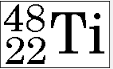
How many protons does this isotope of titanium have?
a)
48
b)
22
c)
26
d)
70
23.
Which letter represents an electron?
a)
A
b)
B
c)
C
d)
D
24.
A straight piece of wire is coiled to form a spring. 
a)
Physical Change
b)
Chemical Change
25.
What are the three states of matter?
a)
solid, volume, mass
b)
density, volume, mass
c)
solid, liquid, gas
d)
density, gas, volume
26.
Something that takes up space and has mass.
a)
volume
b)
matter
c)
mass
d)
density
27.
A state of matter that has a definite volume and shape.
a)
solid
b)
liquid
c)
gas
d)
matter
28.
Iron + oxygen = rust is an example of a ___________.
a)
physical property/change
b)
chemical property/change
c)
mass
d)
volume
29.
Liquid matter takes the shape of _______.
a)
a gas
b)
water
c)
a pet
d)
Its container
30.
Smashing a piece of candy into smaller pieces is an example of a:
a)
Physical change
b)
Chemical change
31.
What is an isotope? 
a)
A charged atom
b)
An atom with different amounts of neutrons
c)
An atom with different amounts of protons
d)
A neutral atom
32.
How many significant figures does the following number have: 0.002040
a)
6
b)
4
c)
3
d)
2
33.
What is the density of a liquid that has a mass of 27g and a volume of 30ml?
a)
0.9 g/ml
b)
3 g/ml
c)
57 g/ml
d)
810 g/ml
34.
In a fireworks show, the fireworks explode giving off heat and light. 
a)
Physical Change
b)
Chemical Change
35.

What is the correct molecular formula for sodium nitrate?

a)

NaNO2

b)

Na3N

c)

Na3NO

d)

NaNO3

36.

What is the correct molecular formula for barium hydroxide?

a)

Ba(OH)2

b)

Ba2OH

c)

BaOH

d)

Ba2OH

37.

What is the name for AlBr3?

a)

aluminum bromide

b)

aluminum tribromide

c)

aluminum bromine

d)

monoaluminum tribromide

38.

What is the chemical formula for Zinc II sulfide

a)

ZnS

b)

Zn2S

c)

ZnSO4

d)

Zn II S

39.
What is the formula for Iron II phosphide
a)
Fe3P2
b)
Fe2P3
c)
Fe3(PO4)4
d)
Fe2(PO4)3
40.
Prefixes are used only for _______________ compounds
a)
Ionic
b)
covalent
41.
What electron configuration matches an oxygen atom?
a)
1s22s22p63s2, 3p64s23d104p5
b)
1s22s22p4
c)
1s22s22p6
d)
1s22s22p63s23p64s23d1
42.
Which electron configuration belongs to Chlorine (Cl)?
a)
1s2s2p3s3p5
b)
1s2s2p3s3p6
c)
1s2s2p3s3p7
43.
What is this element?
1s22s22p63s2
a)
Neon
b)
Magnesium
c)
Aluminum
d)
Potassium
44.
Which atom has the largest atomic radius?
a)
potassium
b)
rubidium 
c)
francium
d)
cesium
45.
The atom with the largest atomic radius in Group 18 is - 
a)
Ar
b)
He
c)
Kr
d)
Rn
46.

Carbon -14 has 6 protons, 8neutrons, and 6 electrons. What is the mass number?

a)

12

b)

8

c)

6

d)

14

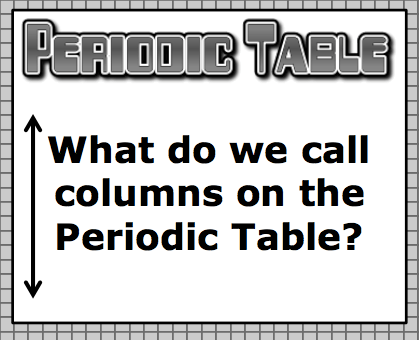
47.
a)
Periods
b)
Groups
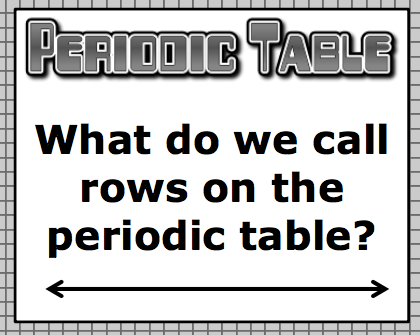
48.
a)
Periods
b)
Groups
49.
Which of the 3 major groups contains the most elements?
a)
Metals
b)
Metalloids
c)
Nonmetals
50.
The yellow atoms are called 
a)
metals
b)
nonmetals
c)
metalloids
d)
noble gases
51.
In what section would Transition Metals be found?
a)
orange
b)
light blue
c)
blue
d)
white
52.

Aluminum

a)

Al3+

b)

A2+

c)

Al3-

d)

A3+

53.

Which is the correct symbol and charge of the Oxide ion?

a)

Ox1-

b)

Ox2-

c)

O2+

d)

O2-

54.

Dissolving sugar in water is a

a)

chemical change

b)

physical change

55.

An example of a heterogeneous mixture is

a)

sugar

b)

sand

c)

oxygen

56.

no definite shape nor volume

a)

solid

b)

liquid

c)

gas

57.

Releases energy (heat)

a)

endothermic

b)

exothermic

58.

Which is NOT a physical property?

a)

boiling point

b)

melting point

c)

flammability

d)

all are chemical properties

59.

Which is NOT an element?

a)

B

b)

Ba

c)

Sn

d)

CO

60.
Jack has a rock. The rock has a mass of 14g and a volume of 2cm3. What is the density of the rock?
a)
7 mL
b)
7 g/cm3
c)
28 g/cm3
d)
1/7 g/cm3
61.

Convert 5 L to mL

a)

0.005

b)

50

c)

500

d)

5000

62.

655 g = ? kg

a)

655 000

b)

0.655

63.

Elements are made up of ________

a)

compounds

b)

mixtures

c)

atoms

64.

In Carbon-12 the 12 represents the

a)

number of protons

b)

number of neutrons

c)

the mass number

65.

When electrons absorb energy and move away from the nucleus, they are in a(n)

a)

exited state

b)

ground state

66.

What group of elements have 1 valence electron?

a)

alkali metals

b)

alkaline earth metals

c)

halogens

d)

noble gases

67.

How many electrons can a p sublevel hold?

a)

2

b)

3

c)

6

68.

How many electrons can fill an s sublevel?

a)

1

b)

2

c)

4

d)

6

69.

A negative ion is called a(n)

a)

anion

b)

cation

70.

S2- has _____ electrons

a)

14

b)

16

c)

18

71.

Which is more easily reversed?

a)

Physical Change

b)

Chemical Change

c)

Neither

72.
The density of pyrite is 5g/cm. This is an example of 
a)
physical intensive property
b)
physical extensive property
c)
chemical change
d)
chemical property
73.
Wood burning is an example of _______
a)
physical intensive property
b)
physical extensive property
c)
chemical change
d)
Physical change
74.
The mass of a lead cube is 64 grams. This is an example of 
a)
physical intensive property
b)
physical extensive property
c)
chemical change
d)
physical change
75.
The rose is red. This is an example of a 
a)
physical extensive property
b)
Chemical property
c)
physical intensive property
d)
physical change
76.

A green powder is heated & a gas is given off while it turns to a black solid. This describes

a)

Physical Change

b)

Chemical Change

c)

Change in State

d)

Change in Temperature

77.

Which of the following could indicate that a chemical change took place?

a)

Change in color

b)

Production of Energy

c)

Formation of Gas

d)

All are correct

78.

The formation of a solid when two liquids combine is called?

a)

Solidification

b)

Freezing

c)

Precipitate

d)

Solubility

79.

The difference between a Physical change and a Chemical change is…

a)

Physical change is only a change to the outside appearance.

b)

Chemical change is when matter is changed into something new.

c)

Atoms are rearranged in chemical changes & not in physical.

d)

All are correct.

80.

Which of the following is an example of a physical change?

a)

A glass falling and shattering on the floor.

b)

Baking a birthday cake.

c)

Burning a piece of paper.

d)

Baking soda and vinegar mixing together.

81.

Which is not a clue that could indicate a chemical change has occurred?

a)

Change in color

b)

Change in shape

c)

Release of energy

d)

Formation of an odor

82.
How many nitrogen atoms in 
Mg(NO3)2
a)
1
b)
2
c)
3
d)
6
83.
How many magnesium atoms in 
Mg(NO3)2
a)
1
b)
2
c)
3
d)
6
84.
How many oxygen atoms in 
Mg(NO3)2
a)
1
b)
2
c)
3
d)
6
85.
How many NO3 polyatomic ions are in 
Mg(NO3)2
a)
1
b)
2
c)
3
d)
6
86.
How many nitrogen atoms are in 
(NH4)3PO4
a)
1
b)
4
c)
3
d)
12
87.
How many oxygen atoms are in 
(NH4)3PO4
a)
1
b)
4
c)
3
d)
12
88.
What is the left part of a chemical equation called?
H2 + O → H2O
a)
Reactants
b)
Products 
c)
Yields 
d)
Chemical Equation 
89.
Is this balanced?
2HgO → 2Hg + O2
a)
Yes
b)
No
90.
Is this balanced?
Al + O2 → 2Al2O3
a)
Yes
b)
No
91.
The substances listed on the right side of a chemical equation are the
a)
Yields
b)
Reactants
c)
Products
d)
Precipitates
92.
2H2O
How many H2O molecules are present?
a)
1
b)
4
c)
2
d)
8
93.
A chemical reaction is balanced when
a)
both sides have the same elements
b)
Both sides have the same  number of atoms
c)
Same subscripts
d)
Same coefficients
94.
If reaction starts with 20g of reactants it should produce 
a)
a total of 40g of products
b)
a total of 10g of products
c)
a total of 80 g of products
d)
a total of 20g of products
95.
In a reaction A + B ----> C,  reactant A has 5g and product  C has 9g. How many grams does reactant B should have? 
a)
4g
b)
5g
c)
9g
d)
14g
96.
Bob puts 200 grams of ice into a pitcher with 900 grams of water. He gets distracted and comes back later to find that the ice has melted in the water. How many grams of water does Bob now have in the pitcher?
a)
200 g
b)
700 g
c)
1,100 g
97.
24 g of magnesium reacts with 38 g of fluorine to produce _____ g magnesium fluoride
a)
62 
b)
38
c)
24
d)
14
98.

Ground state means that an electron is...

a)

at its lowest possible potential energy

b)

in the first shell of an atom

c)

laying low for the weekend

d)

removed from an atom

99.

When an electron returns to ground state from an excited state, the atom will

a)

emit or release energy

b)

absorb energy

c)

rotate

d)

wiggle

100.

Electrons that have not been excited are said to be at:

a)

high level

b)

base line

c)

set state

d)

ground state

101.

The principle quantum number, n, represents the:

a)

spin value

b)

suborbital value

c)

energy level

d)

magnetic value

102.

Which elements are in the mixture?

a)

A only

b)

D only

c)

Z only

d)

A and D

e)

D and Z

103.

Which elements are present in the mixture?

a)

D and E

b)

D and G

c)

E and G

d)

only D

e)

only G

104.

What is the area surrounding the nucleus of an atom where electron are likely to be?

a)

electron cloud

b)

nucleus

105.

Select all that apply

Which of these descriptions match the physical structure of an ionic compound?

a)

Ions are tightly packed but rotate and move around, creating an amorphous solid.

b)

Ions form a pattern with local regions consisting only of positive or negative ions, although the overall charge is zero.

c)

Ions form a regular repeating pattern.

d)

The pattern of ions results in a balance between the forces of attraction and repulsion.

e)

Ions exist in a ratio that results in an overall charge of zero for the compound.