
 Worksheets
milli 8th Grade Science Semester Exam Part 1: Chemistry 2023_ADV/GT/STEM
Total questions: 23
Worksheet time: 12mins
Name
Class
Date
1.
Student Full Name
4 lines
2.
Science Class Period
4 lines
3.
1. How many protons, neutrons, and electrons are present in an atom of hafnium, Hf, with a mass number of 178?
a)
A. 72 protons, 178 neutrons, 106 electrons
b)
B. 72 protons, 106 neutrons, 72 electrons
c)
C. 178 protons, 250 neutrons, 72 electrons
d)
D. 106 protons, 72 neutrons, 106 electrons
4.
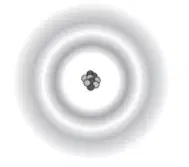
2. A model of a beryllium atom is shown below. What types of particles are found in the cloud surrounding the atom's nucleus?
a)
A. Positively charged particles and negatively charged particles
b)
B. Negatively charged particles only
c)
C. Neutral particles and positively charged particles
d)
D. Positively charged particles only
5.
3. What is the mass number of a potassium (K) atom that has 20 neutrons?
a)
A. 18
b)
B. 19
c)
C. 20
d)
D. 39
6.
4. Which of the following best describes an electron?
a)
A. It has no charge and about the same mass as a proton.
b)
B. It has a negative charge and much less mass than a proton.
c)
C. It has a positive charge and much more mass than a neutron.
d)
D. It has a negative charge and about the same mass as a neutron.
7.
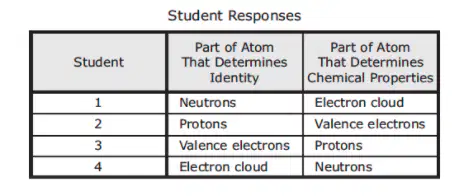
5. Four students were asked to name the parts of an atom that determine the atom's identity and chemical properties. The students' responses are shown in the table below. Which student's responses are correct?
a)
A. Student 1
b)
B. Student 2
c)
C. Student 3
d)
D. Student 4
8.
6. Tin, Sn, is a soft white metal. It has a low melting point compared with other metals. Tin is widely used as a coating for cans of food. Which statement accurately describes atoms of Tin?
a)
A. Tin atoms have 50 protons.
b)
B. Tin atoms have five valence electrons.
c)
C. Tin atoms have 119 neutrons.
d)
D. Tin atoms have 68 electrons.
9.
7. The atoms of a certain element each contain 11 protons and 1 valence electron. Which statement correctly identifies this element and describes its chemical reactivity?
a)
A. The element is sodium, and it is highly reactive
b)
B. The element is fluorine, and it is not very reactive
c)
C. The element is sodium, and it is not very reactive
d)
D. The element is fluorine, and it is highly reactive
10.
8. A chemist is identifying the elements present in a sample of seawater. What characteristic of an element's atoms always determines the element's identity?
a)
A. The number of protons.
b)
B. The number of neutrons.
c)
C. The location of valence electrons.
d)
D. The number of valence electrons.
11.
9. A student is studying Calcium, a highly reactive element that humans need for strong bones. Which characteristic of Calcium is most closely related to its chemical reactivity?
a)
A. The 20 protons in each atom of Calcium.
b)
B. The density of Calcium, which is 1.54g/cm3
c)
C. The atomic mass of Calcium, which is 40.078 amu.
d)
D. The 2 valence electrons in each atom of Calcium.
12.
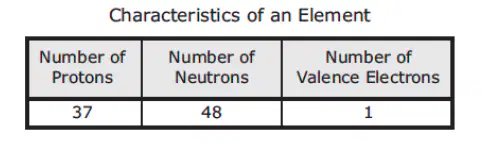
10. The table below lists three characteristics of an atom of an element. An atom of which element is described by the data in the table?
a)
A. Radon (Rn)
b)
B. Cadmium (Cd)
c)
C. Rubidium (Rb)
d)
D. Astatine (At)
13.
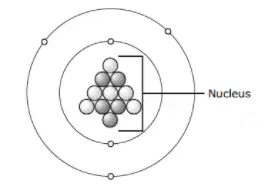
11. A model of an atom is shown below, which element is represented by this model?
a)
A. Boron (B)
b)
B. Carbon (C)
c)
C. Neon (Ne)
d)
D. Sodium (Na)
14.
12. When trying to identify an unknown element, a scientist determines what other elements the unknown element reacts with chemically. Which property of the unknown element determines the other elements it reacts with?
a)
A. The total number of neutrons in the unknown element.
b)
B. The total number of particles in the nucleus of the unknown element.
c)
C. The number of protons in the nucleus of the unknown element.
d)
D. The number of valence electrons in the unknown element.
15.
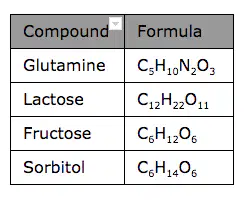
13. The table lists some compounds found in foods and their formulas. Based on this information, which of these statements is NOT true?
a)
A. A molecule of Sorbitol contains three more Oxygen atoms than a molecule of Glutamine.
b)
B. A molecule of Lactose contains twice as many atoms as a molecule of Fructose.
c)
C. A molecule of Fructose contains four more atoms than a molecule of Glutamine.
d)
D. A molecule of Lactose contains twice as many Carbon atoms as a molecule of Sorbitol.
16.

14. Strontium phosphate is a crystalline substance used in medicine and industry. How many Phosphorous atoms are represented in the formula?
a)
A. 2
b)
B. 3
c)
C. 4
d)
D. 8
17.
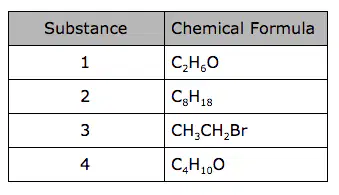
15. The table shows the chemical formulas for four substances. Which substances have the same number of Carbon atoms?
a)
A. Substances 1 and 2
b)
B. Substances 2, 3, and 4
c)
C. Substances 2 and 3 only
d)
D. Substances 1 and 3
18.

16. In which of these compounds are there twice as many Oxygen atoms as Hydrogen atoms?
a)
A
b)
B
c)
C
d)
D
19.

17. The equation below represents a chemical reaction that occurs in living cells. How many atoms are represented in the reactants of this equation?
a)
A. 6
b)
B. 12
c)
C. 24
d)
D. 36
20.

18. The chemical formula for Sodium Sulfate is below. How many Sulfur atoms are in the formula for Sodium Sulfate?
a)
A. 1
b)
B. 2
c)
C. 6
d)
D. 7
21.
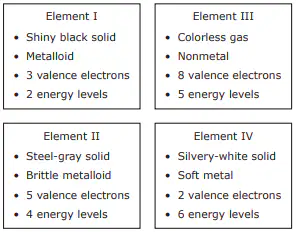
19. Students were asked to identify the location of elements in the periodic table based on clues on game cards. Based on the data, which periodic table shows the correct location of the four elements.
a)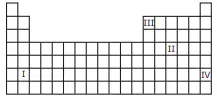
A.
b)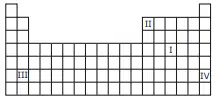
B.
c)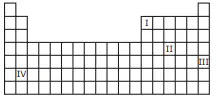
C.
d)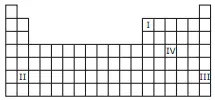
D.
22.
20. Four students were asked to complete a table for a science assignment. Each student selected one chemical element from each of four groups in the periodic table and then classified each element as a metal, a nonmetal, or a metalloid. Which table was completed correctly?
a)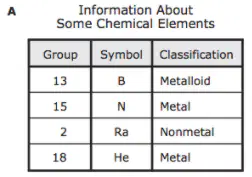
A.
b)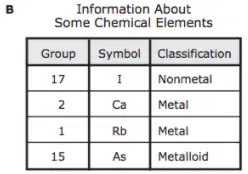
B.
c)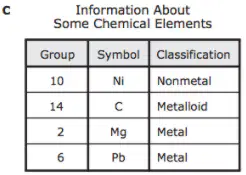
C.
d)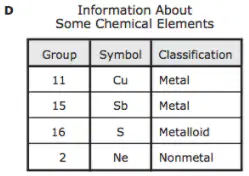
D.
23.
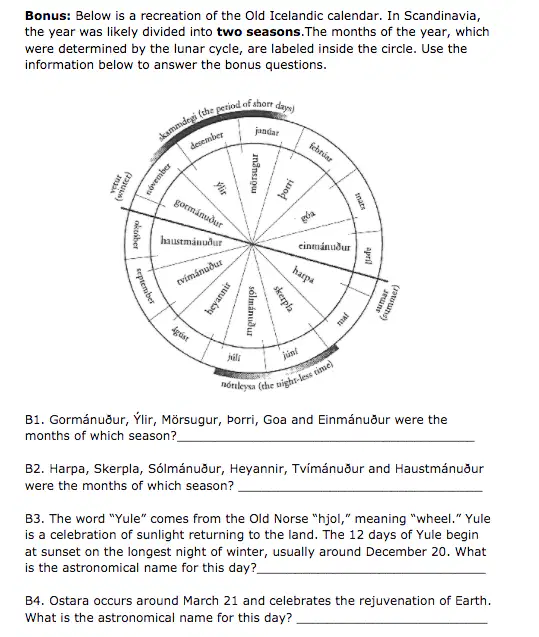
BONUS QUESTION: Answer the 4 questions below by typing in your answer for B1, B2, B3, and B4. Please list/label which question or questions your answer belongs to. (For example.... B1: Typed Answer, B2: Typed Answer)
4 lines
100 %

