wayground logo

Free Printable Worksheets

Font size

S
M
L
XL
Worksheets

IC 3 - Lessons 4 & 5 Quiz

Total questions: 14

Worksheet time: 7mins

Name
Class
Date
1.
Describe what you think happens to protein molecules when you digest them.
a)

Proteins are broken down into subunits called amino acids.

b)

Protein molecules are broken down into glucose.

c)
The protein molecules that we eat go directly to our muscles to build them up.
d)

Proteins are broken down into lipids.

2.
Do you think that food molecules are the only source of energy for the body?
a)
No. You can get energy from sleeping.
b)
No. You can get energy from caffeine.
c)
Yes. Food is the only thing that contains chemical energy that the body can convert into other types of energy to do things.
d)
Yes. Food is the only source of energy for our body since it has kinetic energy.
3.
What evidence do you have that food molecules have energy? Choose all that apply.
a)
We eat food.
b)
Burning other food such as oil, potato chips, and marshmallows is evidence.
c)
The Calories on food labels are evidence.
d)
We eat protein and it is broken down into amino acids.
4.
If you go on a diet and restrict your food intake to particular foods, where does your body get the energy to keep functioning?
a)
The energy only comes from the little food that you eat.
b)
The energy comes from the protein that is in our body.
c)
The energy comes from stored fat to provide energy.
d)
The body starts to break down cells that were meant to replace bone cells, skin cells, and muscle cells.
5.
In the next year you grow 2 inches and gain 6 pounds. Where did the body get the energy for you to grow and gain weight?
a)
The energy comes from the water you drink.
b)
The energy comes from sleeping every night.
c)
The energy came from the food you ate.
d)
The energy comes from the oxygen that you breathe.
6.
Explain why your body is always using energy, but you do not need to be eating all the time.
a)
I eat when I need more food.
b)
I store food in my body when I eat. My body uses this stored food later on to give me the energy to do things when I am not eating.
c)
My body gets the food it needs from my blood.
d)
It takes time for food to digest so there is always some available to provide us energy.
7.
When do humans store fat molecules in their bodies?
a)
Humans store fat molecules every time they eat anything that contains calories.
b)
Humans store fat molecules when they eat food with a lot of fat.
c)
Humans store fat molecules when they eat junk food.
d)
Humans store fat molecules when they eat more calories than they need.
8.
How do children use food molecules to grow taller?
a)
Children grow taller when they use food molecules they eat to build large molecules that make up new cells.
b)
Children grow taller when they use the food molecules they eat to make up new cells without changing the food molecules.
c)
Children grow taller when they use the energy from the food molecules, but all of the molecules leave the body as waste.
d)
Children grow taller when they store food molecules as fat.
9.
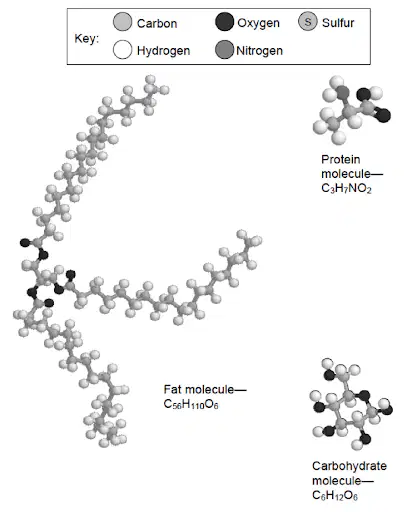
What is the same about carbohydrates, proteins, and fats? (Use the model below)
a)
Carbohydrates, proteins, and fats all have carbon, hydrogen, and oxygen atoms.
b)
Carbohydrates, proteins, and fats are all made of the same number and types of atoms.
c)
Carbohydrates, proteins, and fats all have the same arrangement and types of atoms.
d)
Carbohydrates, proteins, and fats can all form long chains of molecules.
10.

What happens to the carbohydrates when you digest them?

a)

Carbohydrates are broken down into glucose that we use for energy.

b)

Carbohydrates are broken down into amino acids.

c)

Carbohydrates go directly to our muscles to build them up.

d)

Carbohydrates are broken down into lipids.

11.

Why does the body store fat?

a)

The body stores fat to provide energy for when we don't get enough food.

b)

The body stores fat to increase body weight.

c)

The body stores fat to protect the internal organs.

d)

All of the above.

12.

How does the body use proteins?

a)

The body uses proteins to build and repair tissues.

b)

The body uses proteins to make enzymes, hormones, and other body chemicals.

c)

The body uses proteins as a building block of bones and muscles.

d)

All of the above.

13.

What is the role of fats in our body?

a)

Fats are used to store energy for later use.

b)

Fats are used to build and repair tissues.

c)

Fats are used to make enzymes, hormones, and other body chemicals.

d)

All of the above.

14.

Why does the body need proteins, carbohydrates, and fats?

a)

The body needs these nutrients to build and repair tissues, provide energy, and carry out various functions.

b)

The body needs these nutrients to increase body weight.

c)

The body needs these nutrients to protect the internal organs.

d)

The body needs these nutrients to store energy for later use.