
 Worksheets
ML UNIT 1 FULL QUIZ
Total questions: 84
Worksheet time: 21mins
What is Machine learning?
The autonomous acquisition of knowledge through the use of computer programs
The autonomous acquisition of knowledge through the use of manual programs
The selective acquisition of knowledge through the use of computer programs
The selective acquisition of knowledge through the use of manual programs
__________________ algorithms enable the computers to learn from data, and even improve themselves, without being explicitly programmed.
Artificial Intelligence
Machine Learning
Deep Learning
Traditional Learning
What device below is not an example of Machine Learning?
Wearable fitness tracker
Google Assistant
Speech to Text
Google Search
None of the above
_______________________ is a category of an algorithm that allows software applications to become more accurate in predicting outcomes without being explicitly programmed.
Artificial Intelligence
Machine Learning
Deep Learning
Traditional Learning
What are the three types of Machine Learning? Choose three.
Supervised Learning
Learning Differentiated
Unsupervised Learning
Reinforcement Learning
Technical Learning
In this type of Machine Learning, an AI system is presented with unlabeled, uncategorized data and the system’s algorithms act on the data without prior training. The output is dependent upon the coded algorithms.
Supervised Learning
Unsupervised Learning
Reinforcement Learning
Technique Learning
Tom Mitchell of Carnegie Mellon University said that, "A computer program is said to learn from experience E with respect to some "T" and some performance measure P, if its performance on T, as measured by P, improves with experience E." What is "T"?
Time
Test
Task
Temper
What is Machine Learning? (Choose 3 Answers)
Artificial Intelligence
Machine Learning
Data Statistics
Deep Learning
What kind of learning algorithm for "Future stock prices or currency exchange rates"?
Recognizing Anomalies
Prediction
Generating Patterns
Recognition Patterns
Which of the following is not type of learning?
Semi-unsupervised Learning
Unsupervised Learning
Supervised Learning
Reinforcement Learning
What is the main goal of machine learning?
To program computers without human intervention
To enable computers to learn from data and improve performance over time
To create AI systems that can outperform humans
To develop complex algorithms for data processing
Which type of machine learning algorithm is trained on labeled data to make predictions on new, unseen data?
Unsupervised Learning
Reinforcement Learning
Semi-supervised Learning
Supervised Learning
What is the process of preparing raw data by cleaning, transforming, and normalizing it for machine learning?
Data Preprocessing
Data Engineering
Data Wrangling
Data Augmentation
In unsupervised learning, the primary task is
Predicting an output value based on input data
Discovering patterns or structures in data
Maximizing cumulative rewards through interactions with the environment
Learning from expert demonstrations
Which machine learning algorithm is inspired by the behaviour of neurons in the human brain?
Decision Trees
k-Nearest Neighbours (k-NN)
Support Vector Machines (SVM)
Artificial Neural Networks (ANN)
What is the process of feeding a machine learning model with data to adjust its internal parameters and improve performance?
Model Validation
Model Optimization
Model Training
Model Testing
What is the main goal of machine learning?
To program computers without human intervention
To enable computers to learn from data and improve performance over time
To create AI systems that can outperform humans
To develop complex algorithms for data processing
Which type of machine learning algorithm is trained on labeled data to make predictions on new, unseen data?
Unsupervised Learning
Reinforcement Learning
Semi-supervised Learning
Supervised Learning
What is the process of preparing raw data by cleaning, transforming, and normalizing it for machine learning?
Data Preprocessing
Data Engineering
Data Wrangling
Data Augmentation
In unsupervised learning, the primary task is
Predicting an output value based on input data
Discovering patterns or structures in data
Maximizing cumulative rewards through interactions with the environment
Learning from expert demonstrations
Which machine learning algorithm is inspired by the behaviour of neurons in the human brain?
Decision Trees
k-Nearest Neighbours (k-NN)
Support Vector Machines (SVM)
Artificial Neural Networks (ANN)
What is the process of feeding a machine learning model with data to adjust its internal parameters and improve performance?
Model Validation
Model Optimization
Model Training
Model Testing
Which machine learning technique allows models to make decisions based on past experiences and feedback from their environment?
Supervised Learning
Unsupervised Learning
Reinforcement Learning
Semi-supervised Learning
What is the primary advantage of using a deep learning architecture for machine learning tasks?
Easy interpretability of the model
Faster training time compared to traditional algorithms
Ability to automatically extract hierarchical features from data
Less need for large amounts of labeled training data
Which technique is used for reducing the dimensionality of data while preserving its most important features?
Principal Component Analysis (PCA)
Linear Regression
Logistic Regression
Gradient Descent
What does VC dimension do?
Reduces complexity of hypothesis space
Removes noise from dataset
Measures complexity of training dataset
Measures the complexity of hypothesis space H
An instance set S is given. How many dichotomies are possible?
2*|S|
2/|S|
2^|S|
|S|
If h is a straight line, what is the maximum number of points that can be shattered?
4
2
3
5
What is the VC dimension of a straight line?
3
2
4
0
A set of 3 instances is shattered by _____ hypotheses.
4
8
3
2
What is the relation between VC dimension and hypothesis space H?
VC(H) <= |H|
VC(H) != log2|H|
VC(H) <= log2|H|
VC(H) > log2|H|
VC Dimension can be infinite.
True
False
Who invented VC dimension?
Francis Galton
J. Ross Quinlan
Leslie Valiant
Vapnik and Chervonenkis
IF VC(H) increases, number of maximum training examples required (m) increases.
False
True
The algorithm is trying to find a suitable day for swimming. What is the most general hypothesis?
A rainy day is a positive example
A sunny day is a positive example
No day is a positive example
Every day is a positive example
How is the version space represented?
Least general members
Most general members
Most general and least general members
Arbitrary members chosen form hypothesis space
Let G be the set of maximally general hypotheses. While iterating through the dataset, when is it changed for the first time?
Negative example is encountered for the first time
Positive example is encountered for the first time
First example encountered, irrespective of whether it is positive or negative
S, the set of maximally specific hypotheses, is changed
Let S be the set of maximally specific hypotheses. While iterating through the dataset, when is it changed for the first time?
Negative example is encountered for the first time
Positive example is encountered for the first time
First example encountered, irrespective of whether it is positive or negative
G, the set of maximally general hypotheses, is changed
S = <sunny, warm, high, same>. Training data = <sunny, warm, normal, same> => Yes (positive example). How will S be represented after encountering this training data?
<sunny, warm, high, same>
<phi, phi, phi, phi>
<sunny, warm, ?, same>
<sunny, warm, normal, same>
S = <phi, phi, phi, phi>Training data = <rainy, cold, normal, change> => No (negative example). How will S be represented after encountering this training data?
<phi, phi, phi, phi>
<sunny, warm, high, same>
<rainy, cold, normal, change>
<?, ?, ?, ?>
It is possible that in the output, set S contains only phi.
False
True
Which ONE of the following are regression tasks?
Predict the age of a person
Predict the country from where the person comes from
Predict whether the price of petroleum will increase tomorrow
Predict whether a document is related to science
Which of the following are classification problems?
Predicting the temperature (in Celsius) of a room from other environmental features (such as atmospheric pressure, humidity etc).
Predicting if a cricket player is a batsman or bowler given his playing records.
Finding the shorter route between two existing routes between two points.
Predicting if a particular route between two points has traffic jam or not based on the travel time of vehicles.
Which of the following tasks can be best solved using Clustering.
Predicting the amount of rainfall based on various cues.
Detecting fraudulent credit card transactions
Training a robot to solve a maze
All of the above
Which of the following is a regression task?
Predicting the monthly sales of a cloth store in rupees.
Predicting if a user would like to listen to a newly released song or not based on historical data
Predicting the confirmation probability (in fraction) of your train ticket whose current status is waiting list based on
historical data.
Predicting if a patient has diabetes or not based on historical medical records.
Which of the following is a categorical feature?
Number of legs of an animal
Number of hours you study in a day
Branch of an engineering student
Your weekly expenditure in rupees.
What is Machine learning?
The autonomous acquisition of knowledge through the use of computer programs
The autonomous acquisition of knowledge through the use of manual programs
The selective acquisition of knowledge through the use of computer programs
The selective acquisition of knowledge through the use of manual programs
Which of the factors affect the performance of learner system does not include?
Training scenario
Representation scheme used
Good data structures
Type of feedback
Which one is most important supervised algorithm
K-nears neighbors
Linear Regression and Logistic Regression
Neural networks
Support Vector Machine, Decision Tree and Random forest
All of the above
Which one is most important unsupervised algorithms
clustering: k-mean, hierarchical cluster analysis
Association Rule Learning: Eclat, apriori
Kernel PCA & PCA
t-Distributed
All of the above
who is the father of Machine learning
Geoffrey Chaucer
Geoffrey Everest Hinton
Geoffrey Hill
None of the above Answer
Designing a machine learning approach involves
Choosing the target function to be learned
Choosing a function approximation algorithm
Choosing the type of training experience
Choosing a representation for the target function
All of the above
Machine learning is the sub set of AI and deep learning is the subset of ML
True
False
Which of the following is not type of learning?
Supervised Learning
Reinforcement Learning
Unsupervised Learning
Semi-unsupervised Learning
oncept learning inferred a _____valued function from training examples of its input and output.
Decimal
Boolean
Hexadecimal
All of the above
For each attribute, the hypothesis indicates by a “?’ means
That no value is acceptable
That any value is acceptable for this attribute
Specify a single required value for the attribute
None of the above
FIND-S Algorithm starts from the most specific hypothesis and generalize it by considering only
Negative and Positive training examples
Negative training examples
Negative or Positive training examples
Positive training examples
Which of the following are limitation of FIND-S Algorithm?
It has no way to determine whether it has found the only hypothesis in H consistent with the data (i.e., the correct target concept), or whether there are many other consistent hypotheses as well
Inconsistent sets of training examples can mislead FIND-S
we can define hypothesis spaces for which there is no maximally specific consistent hypothesis perform poorly when given noisy training data
All of the above
Machine learning algorithms are especially useful in
Data mining problems where large databases may contain valuable implicit regularities that can be discovered automatically (e.g., to analyze outcomes of medical treatments from patient databases or to learn general rules for credit worthiness from financial databases) Poorly understood domains where human might not have the knowledge needed to develop effective algorithms (e.g., human face recognition from images)
Domains where the program must dynamically adapt to changing conditions
All of the above
Real-Time decisions, Game AI, Learning Tasks, Skill Acquisition, and Robot Navigation are applications of which of the following
Unsupervised Learning: Clustering
Supervised Learning: Regression
Supervised Learning: Classification
Reinforcement Learning

Which of the following is correct for Find-S
<?,?,Round,?,Yes>
<Round,?Round,?,Yes>
<Square, ?, Round,?,Yes>
None of the above

Version space patterns for the given Dataset
<Japan,?,?,?,Economy>
<Japan,?,?,1980,Economy>
<Japan,?,Blue,?,Economy>
<Japan,?,?,?,Economy>
<Japan,?,?,1980,Economy>
<Japan,?,Blue,?,Economy>
None of the above
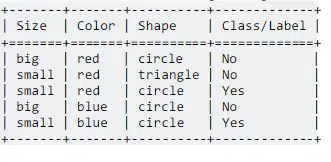
Version space patterns to the given dataset
<Small,?,Circle>
<small,circle,?>
<Small,?,Circle>
<small,circle,?>
<Small,?,Circle>
<small,red,circle>
None of the above
The full form of PAC is ______
Partly Approximation Computation
Probability Approximation Curve
Probably Approximately Correct
Partly Approximately Correct
Who introduced the concept of PAC learning?
Francis Galton
Reverend Thomas Bayes
J.Ross Quinlan
Leslie Valiant
When was PAC learning invented?
1874
1974
1984
1884
What can be explained by PAC learning?
Sample Complexity
Overfitting
Underfitting
Label Function
What is the significance of epsilon in PAC learning?
Probability of approximation <= epsilon
Maximum error <= epsilon
Minimum error > epsilon
Probability of approximation = delta – epsilon
What is the significance of delta in PAC learning?
Probability of approximation < delta
Error < delta
Confidence = 1 - delta
Probability of approximation = delta – epsilon
n terms of the bias-variance trade-off, which of the following is substantially more harmful to the test error than the training error?
Bias
Loss
Variance
Risk
As the amount of training data increases
Training error usually decreases and generalization error usually increases
Training error usually decreases and generalization error usually decreases
Training error usually increases and generalization error usually decreases
Training error usually increases and generalization error usually increases
Adding more basis functions in a linear model…
Decreases model bias
Decreases estimation bias
Decreases variance
Doesn’t affect bias and variance
Regarding bias and variance, which of the following statements are true?
Models which overfit have a high bias and underfit have a high variance
Models which overfit have a high bias and underfit have a low variance
Models which overfit have a low bias and underfit have a high variance
Models which overfit have a low bias and underfit have a low variance
Let’s say your model is overfitting. Which of the following is NOT a suitable method for attempting to decrease overfitting?
Increase the amount of training data.
Improve the optimization algorithm being used for error minimization
Decrease the model complexity.
Reduce the noise in the training data.
Which of the following assertions about bias and variance is true?
Models which overfit have a high bias.
Models which overfit have a low bias
Models which underfit have a high variance
Models which underfit have a low variance.
Consider a model that was built to classify a set of images of animals into that of cats and non-cats.
The model is claiming to have a fairly good performance. But some images were wrongly classified. One of the images of a dog was wrongly classified as that of a cat. This instance is an example of a
True positive
True Negative
False Positive
False Negative
Referring to the example mentioned in the previous question, in one of the instances, the image of a horse was rightly classified as that of a non-cat. This instance is an example of a
True positive
True Negative
False Positive
False Negative
The true-positive rate is also referred to as
recall
accuracy
precision
relative precision
False negatives are
Predicted negatives that are actually positives
Predicted positives that are actually negatives
Predicted negatives that are actually negatives
Predicted positives that are actually positives
Suppose your classification model predicted true for a class which actual value was false. Then this is a-
False positive
False negative
True positive
True negative

You are given with target error of 0.05 and failure of 0.20. Choose correct option.
Both are PAC
h1 is PAC, h2 is not PAC
h1 is not PAC, h2 is PAC
Both are not PAC
you are given with model 95% accuracy what is model error ?
0.05
0.5
5
0.005
You are given with a model confidence of 85% then what is the failure value?
15
0.15
1.5
0.015
Can Most Specific Hypothesis and Most Generic Hypothesis same?
Yes
No
Can not say

