
 Worksheets
Exam- Science 8th Grade
Total questions: 40
Worksheet time: 40mins
Name
Class
Date
1.
The unit of measure that is used when measuring the amount of force applied to an object is called?
a)
net force
b)
newton
c)
pressure
d)
tendency change
2.
The tendency to resist change in motion is called?
a)
weight
b)
mass
c)
amplitude
d)
inertia
3.
An object's' speed in a given direction is called?
a)
time lapse
b)
velocity
c)
distance
d)
inertia
4.
An object's path around another object is known as its?
a)
rotation
b)
revolution
c)
orbit
d)
eclipse
5.
When a celestial object blocks another celestial object, it can cause a?
a)
spring tide
b)
neap tide
c)
earth quake
d)
eclipse
6.
A transverse wave moves through a medium ____________ to the direction of particle movement.
a)
angular
b)
across
c)
parallel
d)
perpendicular
7.
A longitudinal (compressional) wave moves through a medium that is ____________ to the direction of particle motion.
a)
perpendicular
b)
angular
c)
across
d)
parallel
8.
In longitudinal waves, the parts where the coils are spread apart are called?
a)
wavelengths
b)
compressions
c)
rarefractions
d)
frequencies
9.
Forces that are equal in magnitude but opposite in direction are _____ forces.
a)
equilibrium
b)
unbalanced
c)
equinox
d)
balanced
10.
You are pushing a box to the right with 20 N, while your friend is pulling the box to the left with 15N. What is the net force and which direction will the box move?
a)
35 N to the right
b)
5 N to the right
c)
35 N to the left
d)
5 N to the left
11.
Newton’s first law of motion best explains ______.
a)
balanced forces
b)
friction
c)
acceleration
d)
inertia
12.
Which of Newton’s laws states that “for every action, there is an equal and opposite reaction”?
a)
1st
b)
2nd
c)
3rd
d)
4th
13.
A feather falls through the air more slowly than a brick because of _____.
a)
gravity
b)
less mass
c)
more mass
d)
air resistance
14.
What is the BEST explanation for why the moon orbits around the Earth rather than the Earth orbiting around the moon?
a)
The Earth has more mass than the moon
b)
The Earth has less mass than the moon
c)
The Earth rotates faster than the moon
d)
The Earth rotates slower than the moon
15.

Analyze the following graph to answer the question:
What is the motion depicted in the graph?
a)
constant speed
b)
decreasing speed
c)
deceleration
d)
acceleration
16.

Use the graph below to answer the question:
What motion is taking place between points BC and points DE?
a)
no motion
b)
decreasing speed
c)
increasing speed
d)
constant speed
17.
Bob’s dog can run 30 m in 6 seconds. Determine the dog’s speed.
a)
180 m/s
b)
36 m/s
c)
5 m/s
d)
24 m/s
18.
Newton’s 1st Law of Motion states that an object stays at rest unless a(n) ________ force acts on it.
a)
gravitational force
b)
balanced force
c)
strong force
d)
unbalanced force
19.
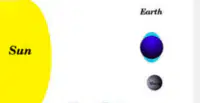
What type of tide would this arrangement of earth-moon-sun create?
a)
new moon tide
b)
neap tide
c)
full moon tide
d)
spring tide
20.

What type of tides would this arrangement of sun-moon-earth create?
a)
new moon tide
b)
neap tide
c)
full moon tide
d)
spring tide
21.
What moon phase is when a large section, not full, of the Moon facing Earth is lighted?
a)
new
b)
full
c)
gibbous
d)
crescent
22.
What moon phase is when a small section, less than half, of the Moon facing Earth is lighted?
a)
new
b)
cresent
c)
full
d)
gibbous
23.

Which type of eclipse is shown in this diagram?
a)
narrow eclipse
b)
neap eclipse
c)
lunar eclipse
d)
solar eclipse
24.

Which type of eclipse is shown in this diagram?
a)
narrow eclipse
b)
neap eclipse
c)
lunar eclipse
d)
solar eclipse
25.
Why do we experience the changing of the seasons on the earth?
a)
distance from sun
b)
solar output
c)
different moon phases
d)
tilt of Earth on its axis
26.
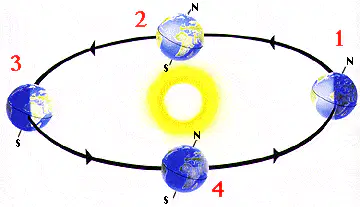
Which season is taking place in the Northern Hemisphere in position 3 of this diagram?
a)
Spring
b)
Summer
c)
Fall
d)
Winter
27.
As the moon's shape appears to get smaller, we say that the moon is...
a)
shrinking
b)
waxing
c)
waning
d)
rarefaction
28.
What causes the moon's phases
a)
tilt of moon on its axis
b)
light reflected from the sun onto the moon
c)
tilt of Earth on its axis
d)
gravitational changes in the moon's atmosphere
29.
How does an atom become negatively charged?
a)
losing electrons
b)
gaining metallic ions
c)
gaining electrons
d)
losing metallic ions
30.
Which of the following would be considered an electrical conductor?
a)
rope
b)
rubber hose
c)
plastic straw
d)
copper wire
31.
Ethan claims that magnetism, electricity, and gravity are all non-contact forces. Which statement best supports his claim?
a)
magnetic fields can create gravitational force
b)
these forces exert a force on other objects without coming in to contact with them
c)
attraction and repulsion only occur with contact being made between forces
d)
these forces must be in contact with an object ot exert force
32.
Where the better adapted organisms survive to pass traits along to offspring.
a)
evolution
b)
extinction
c)
natural selection
d)
artificial selection
33.
In what type of rock would you typically find a fossil?
a)
metamorphic
b)
sedimentary
c)
igneous
d)
slick
34.
Why are advantageous traits more likely to be passed onto offspring?
a)
because they come from dominant alleles
b)
because they come from recessive alleles
c)
because the trait is an acquired phenotype
d)
because they are more likely to survive and reproduce
35.
Artificial selection is also known as
a)
natural selection
b)
selective hearing
c)
selective breeding
d)
survival of the fittest
36.
What does fitness mean in natural selection?
a)
how strong an animal is
b)
how well adapted the animal is to their environement
c)
how fast an animal can run
d)
how long an animal can work
37.
Mutations are a change in ___________.
a)
phenotype
b)
genotype
c)
tRNA
d)
DNA
38.
How is an electromagnet different than a regular magnet?
a)
It is usually much larger in size than a regular magnet
b)
An electromagnet is magnetic when an electric current is ran through it
c)
A regular magnet needs an electric current to work properly
d)
The law of electric charges only applies to regular magnets
39.
When a species of organisms cannot adapt or change to meet its needs in a changing environment, what happens to this species?
a)
it evolves into a new species
b)
it increases in number
c)
it decreases in number and becomes extinct
d)
it goes into hibernation
40.
True/False: Heredity is the passing of traits from one generation to another.
a)
True
b)
False
100 %

