wayground logo

Free Printable Worksheets

Font size

S
M
L
XL
Worksheets

Mod 8 Quiz (Cellular Energy)

Total questions: 52

Worksheet time: 5hrs 2mins
Name
Class
Date
1.
Photoautotrophs convert light energy from the sun into chemical energy
a)
True
b)
False
2.
The final step of aerobic respiration when ATP is created is called glycolysis.
a)
True
b)
False
3.
"Anaerobic" means in the absence of oxygen.
a)
True
b)
False
4.
The chemical equation for photosynthesis is CO2 + H2O → C6H12O6 + O2
a)
True
b)
False
5.
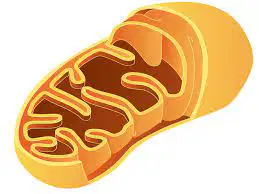
This is a diagram showing a chloroplast.
a)
True
b)
False
6.
ATP is an energy storage molecule that is extremely stable and can be stored for long periods of time.
a)
True
b)
False
7.
Which describes the process of cellular respiration?
a)
anabolic pathway that breaks molecules into energy
b)
catabolic pathway that breaks molecules into energy
c)
catabolic pathway that builds molecules of stored energy
d)
anabolic pathway that builds molecules of stored energy
8.
This is formed during the light-independent phase of photosynthesis.
a)
Pyruvate
b)
ATP
c)
NADPH
d)
Glucose
9.
Which describes the process of glycolysis?
a)
aerobic process that breaks down glucose
b)
anaerobic process that breaks down glucose
c)
aerobic process that manufactures glucose
d)
anaerobic process that manufactures glucose
10.
A black widow spider snaring an insect to eat is an example of an organism called a(n)
a)
autotroph
b)
chemoautotroph
c)
heterotroph
d)
herbivore
11.
Light-dependent reactions take place in saclike membranes called
a)
stomata
b)
thylakoids
c)
stroma
d)
mitochondria
12.
How are photosynthesis and cellular respiration related?
a)
they both have the same reactants
b)
the products of one are the reactants for the other
c)
they both have the same products
d)
they are not related to one another in any way.
13.
In eukaryotic cells, aerobic respiration occurs in organelles called
a)
mitochondria
b)
chloroplasts
c)
nucleus
d)
cytoplasm
14.
Carbon dioxide cannot be converted into organic molecules during the light independent reactions without this enzyme.
a)
RuBisCo
b)
Photosystem II
c)
Photosystem I
d)
Ferredoxin
15.
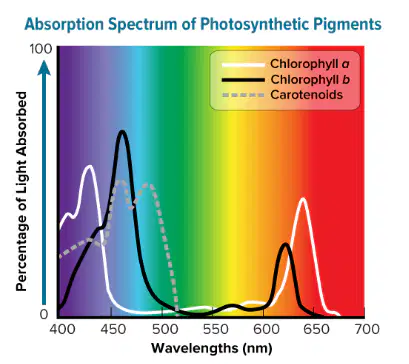
What is the optimal range of light for all three pigments to photosynthesize at one time?
a)
400 nm - 500 nm
b)
500 nm - 600 nm
c)
600 nm - 650 nm
d)
700 nm and higher
16.
Which of the following defines metabolic pathways?
a)
a series of chemical reactions in which organic molecules are broken down to release energy
b)
a series of chemical reactions in which the product of one reaction is the substrate for the next reaction
c)
a series of chemical reactions in which light energy converts into chemical energy
d)
a series of chemical reactions in which mechanical energy converts into chemical energy
17.
In photosynthesis, which of the following are reactants? Select all chemical formulas that apply.
a)
O2
b)
H2O
c)
energy
d)
CO2
e)
C6H12O6
18.
In photosynthesis, which of the following are products? Select all chemical formulas that apply.
a)
O2
b)
H2O
c)
energy
d)
CO2
e)
C6H12O6
19.
Which process does not occur in the mitochondria?
a)
electron transport chain
b)
glycolysis
c)
Krebs cycle
20.
Where does all energy on Earth come from?
a)
deep sea ocean vents
b)
plants
c)
sun
d)
animals
21.
How does a heterotroph get its energy?
a)
the Sun
b)
eating food
c)
breathing air
d)
getting good sleep
22.
What is the main function of the pigment chlorophyll?
a)
sunscreen for the plant
b)
turns leaves red/orange in fall
c)
capture sunlight
d)
helps the mitochondria make ATP more efficiently
23.
Which step in cellular respiration results in the most ATP production?
a)
glycolysis
b)
krebs cycle
c)
citric acid cycle
d)
electron transport chain
24.
Where does the Krebs' Cycle occur? 
a)
mitochondria
b)
cell membrane
c)
chloroplast
d)
cytoplasm
25.
What is the ultimate source of energy for life on Earth?
a)
glucose
b)
sunlight
c)
ATP
d)
H2O
26.
What type(s) of cells perform cellular respiration?
a)
all cells
b)
animals
c)
plants
d)
bacteria
27.
During which portion of photosynthesis is  carbon dioxide absorbed?
a)
light-dependent
b)
light- independent
c)
Krebs Cycle
d)
ETC
28.
Which molecule is broken down by glycolysis?
a)
citric acid
b)
oxygen
c)
ADP 
d)
glucose
29.
What does the light-independent reaction use for energy?
a)
glucose
b)
water
c)
ATP s
d)
sunlight
30.
Which of the following best represents the waste products of cellular respiration?
a)
carbon dioxide and water
b)
carbon dioxide
c)
water
d)
carbon dioxide and oxygen
31.

Which of the following is NOT a stage of aerobic cellular respiration?

a)

glycolysis

b)

Krebs Cycle

c)

fermentation

d)

ETC

32.
During which portion of photosynthesis is glucose created?
a)
light-dependent
b)
light-independent
c)
glycolysis
d)
fermentation
33.
During which step of cellular respiration is the majority of the ATP created?
a)
fermentatio
b)
glycolysis
c)
Krebs Cycle
d)
ETC
34.
What are the reactants for cellular respiration?
a)
oxygen and lactic acid
b)
water and glucose
c)
carbon dioxide and water
d)
glucose and oxygen
35.
Energy is released from ATP when
a)
a phosphate group is added
b)
a phosphate group is removed
c)
adenine binds to ribose
d)
ATP is exposed to sun
36.
When respiration occurs with oxygen, it is called _______
a)
anaerobic
b)
aerobic
c)
light-dependent
d)
fermentation
37.

Chlorophyll

a)

Is a pigment

b)

is an orgenelle

c)

is a phase of mitosis

d)

is a form of energy

38.

Which wave lengths of visible light does chlorophyll absorb in photosynthesis.

(Select all that apply)

a)

green

b)

red

c)

violet

d)

blue

39.

Types of fermentation are ___

(Select all that apply)

a)

Bacteria

b)

Yeast

c)

Lactic Acid Fermentation

d)

Ethanol Fermentation

40.
Which is correct?
a)
Chloroplasts do photosynthesis, mitochondria do respiration
b)
Chloroplasts do both respiration and photosynthesis
c)
Mitochondria do both respiration and photosynthesis
d)
Mitochondria do photosynthesis and chloroplasts do respiration
41.
What are the steps of photosynthesis?
a)
1.  ETC 2. Krebs Cycle 3.  Glycolysis
b)
1.  Glycolysis 2. Krebs Cycle 3. ETC
c)
1. ETC 2. Calvin Cycle
d)
1. Calvin Cycle 2. ETC
42.
What are the reactants of photosynthesis?
a)
Sunlight
b)
Water
c)
Oxygen
d)
Carbon dioxide, water, and sunlight
43.
What are the products of photosynthesis?
a)
Tree
b)
Sunlight
c)
Hydrogen
d)
Oxygen and glucose
44.
What type of living thing did we use to observe fermentation?
a)
Bacteria
b)
Yeast
c)
Foxes
d)
Little Bugs
45.

Energy used in cells for life processes

a)

ADP

b)

ATP

c)

lipids

d)

proteins

46.

Anaerobic means without ________?

a)

Nitrogen

b)

Carbon Dioxide

c)

Oxygen

d)

Phosphorus

47.

Step 1 of cellular respiration is:

a)

Kreb's cycle

b)

Electron Transport chain

c)

Fermentation

d)

Glycolysis

48.

(C6 H12 O6) is the chemical formula for which important molecule?

a)

Glucose

b)

Amylase

c)

Sucrose

d)

Maltose

49.

Glycolysis takes place in the __________?

a)

Mitochondria

b)

Cytoplasm

c)

Matrix

d)

Cell membrane

50.

Where does the Electron Transport Chain take place?

a)

Cytoplasm

b)

Matrix of Mitochondria

c)

Inner membrane of the Mitochondria

d)

Chloroplast

51.

Which step utilizing electrons to accept phosphates make the most ATP? (36-38ATP)

a)

Glycolysis

b)

Kreb's Cycle

c)

Electron Transport Chain

d)

Photosynthesis

52.

Aerobic cellular respiration means ___________is used in the mitochondria?

a)

Glucose

b)

Oxygen

c)

Carbon dioxide

d)

phosphorus