
 Worksheets
Cell Division CFA
Total questions: 35
Worksheet time: 26mins
What is the primary role of mitosis in multicellular organisms?
Growth
Sexual reproduction
cell repair and replacement
development
Genetic recombination
he image shows the genetic code of an organism before and after the occurrence of a spontaneous error during chromosomal crossover.
ATC GCG CCA TAC ----> ATC GCG ATA C
Based on the information provided, which type of mutationmost likelyoccurred?
translocation
addition
substitution
deletion
he image shows the genetic code of an organism before and after the occurrence of a spontaneous error during chromosomal crossover.
ATC GCG CCA TAC ----> ATC GCG CAC ATA C
Based on the information provided, which type of mutationmost likelyoccurred?
translocation
addition
substitution
deletion
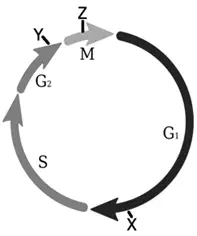
The cell cycle is divided into several phases.
In this figure, M indicates mitosis, when the nucleus is dividing, and G1, S, and G2 are parts of interphase. Points X, Y, and Z represent checkpoints during these phases.
What happens during cell cycle checkpoints?
Chemical signals tell the cell to proceed with division or to stop.
Chemical signals tell the cell when to translocate DNA.
Chemical signals tell the cells to stop making proteins
Chemical signals tell prokaryotic cells when to divide.
Which process could occur in horses to decrease the chromosome number in egg cells from 64 down to 32?
binary fission
mitosis
meiosis
clonal selection
Which description distinguishes the process of meiosis from mitosis?
Unlike mitotic cells, meiotic cells undergo a single division to halve their chromosome number, after which they undergo crossing over to restore their diploid state.
During meiosis cells undergo two divisions to produce haploid cells, allowing for genetic diversity in sexually reproducing organisms.
In meiotic cells, homologous chromosomes remained paired through both rounds of cell division.
Meiotic cells undergo multiple rounds of cell division to produce nearly unlimited diversity.
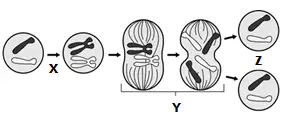
Examine the process shown in the diagram.
How should the two cells shown in step Z be described?
haploid
diploid
gametes
prokaryotic
Which process is important for producing genetic diversity in asexually reproducing species?
mitosis
crossing over
meiosis
mutations
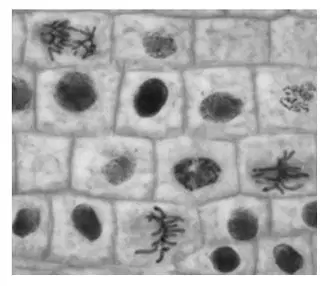
The process of mitosis occurs in all organisms, though the process can be slightly different among different species.
Based on observations of this image, in what type of organism is mitosis occurring?
animal
bacteria
fungi
plant
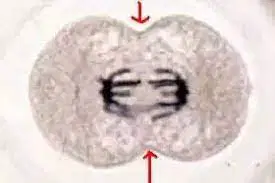
The process of mitosis occurs in all organisms, though the process can be slightly different among different species.
Based on observations of this image, in what type of organism is mitosis occurring?
animal
bacteria
fungi
plant
Meiosis is an important cellular process for organisms that reproduce sexually. Two lab partners (A and B) are shown this diagram of a meiotic cell and asked to identify its phase.
Partner A believes that this cell is in prophase of the first meiotic division. Partner B believes that this cell has moved past prophase of meiosis I and is in a later phase of meiosis.
Which partner is correct, and what evidence accurately would defend their belief?
Partner A is correct. The nuclear membrane is beginning to re-form and centrioles are beginning to migrate to opposite poles of the cell.
Partner A is correct. The chromosomes have clearly replicated during interphase and are beginning to decondense into chromatin.
Partner B is correct. The cell plate is beginning to form between the two centrioles, indicating the cell is actually in later phase of meiosis I.
Partner B is correct. Homologous chromosomes are no longer paired together, so the cell must be in first phase of meiosis II, not meiosis I.
Two students are debating whether or not budding in yeast represents a form of asexual reproduction. What is the best argument that one student could make to the other to demonstrate that budding in yeast is asexual?
Genetic material is exchanged between the nuclei in both meiotic divisions.
The daughter cell that buds off of the parent yeast is genetically identical to the parent.
Genetic material is only exchanged between the nuclei in the first meiotic division.
The daughter cell that buds off of the parent yeast is genetically different than the parent.
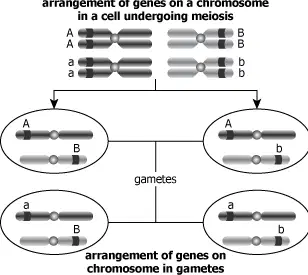
Random assortment is the method by which each gamete formed after meiosis receives different and random combinations of chromosomes. The diagram shows the random assortment of genes.
Which statement best describes the significance of random assortment in sexually reproducing organisms?
It produces gametes.
It is involved in DNA replication in asexually reproducing species.
It contributes to genetic diversity in sexually reproducing species.
It leads to reduction in the chromosome count.
DNA replication occurs before a cell divides to form new daughter cells. What is the significance of DNA replication before mitosis?
It ensures that all cells in an organism have the same genetic information.
It ensures that all reproductive cells in a multicellular organism have the same genetic information.
It ensures that all reproductive cells in a multicellular organism grow faster than other cells.
It ensures that all body cells in a multicellular organism have the same size.
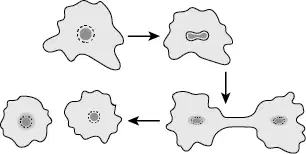
The image shows a dividing amoeba cell.
Which statement is true about the genetic material of the newly formed daughter cells?
Both daughter cells have half the genetic material of the parent cell.
Both daughter cells have double the genetic material of the parent cell.
Both daughter cells have genetic material that is similar to the parent cell.
Both daughter cells have genetic material that is different from the parent cell.

A student notes some events of the cell cycle occurring in a cell.
Which option correctly identifies the stage in which each event of the cell cycle occurs?


The diagram shows the chromosome number during mitosis.
How is mitosis important in the reproduction of organisms?
Mitosis ensures that each daughter cell has the same chromosome count as the parent cell. This allows asexual reproduction of cells.
Mitosis ensures that each daughter cell has the same chromosome count as the parent cell. This allows sexual reproduction of cells.
Mitosis ensures that each daughter cell has half the chromosome count as the parent cell. This allows asexual reproduction of cells.
Mitosis ensures that each daughter cell has half the chromosome count as the parent cell. This allows sexual reproduction of cells.
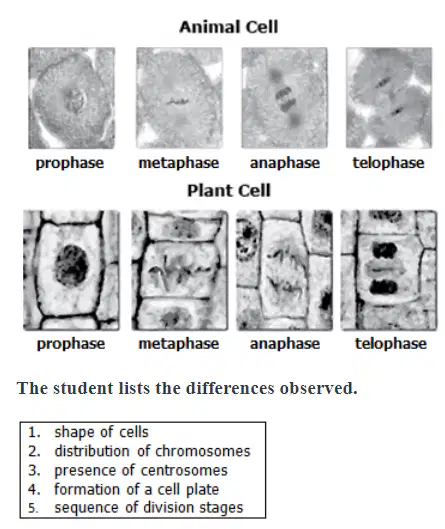
A student uses a microscope to observe a plant cell and an animal cell undergoing the stages of mitosis, as shown in the images.
Which differences between plant and animal cell mitosis are listed correctly?
1 and 2
1,2, and 3
2 and 5
1, 3, and 4
2,3, 4, and 5
What will likely happen if all cell cycle checkpoints stop working?
The cell would undergo programmed cell death.
The cell would grow uncontrollably.
The cell would lose cell volume.
The cell will increase in size.
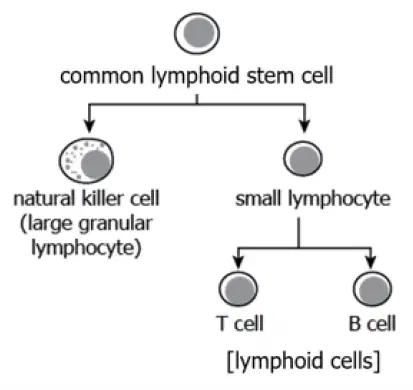
Lymphoid cells are responsible for the immune response in humans. Lymphoid cells are derived from a common lymphoid stem cell, as shown.
Which process explains how the various types of cells can form from the lymphoid stem cell?
cell fusion
programmed cell death
cell differentiation
mitosis
meiosis
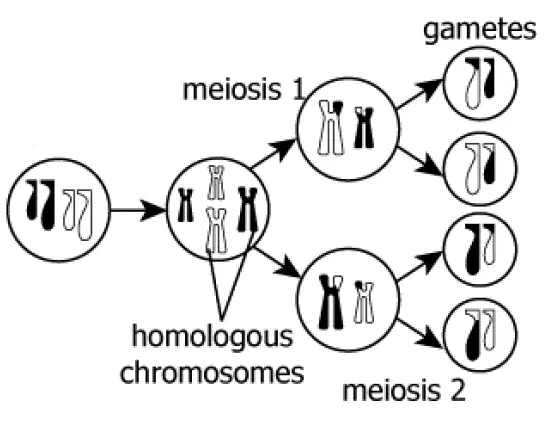
The diagram shows the development of four gametes from a parent cell.
Which argument is true about the gametes formed at the end of meiosis 2?
Meiosis produces gametes that have genetic material different from the parent cell.
Meiosis produces more gametes with the same amount of genetic material as in the parent cell.
Meiosis produces gametes that have genetic material identical to that of the parent cell.
Meiosis produces fewer gametes with double the amount of genetic material as in the parent cell.
When do cells replicate their organelles?
G1 phase
S phase
G2 phase
M phase
Which three processes occur during meiosis?
independent assortment
crossing over
asexual reproduction
sexual reproduction
formation of gametes
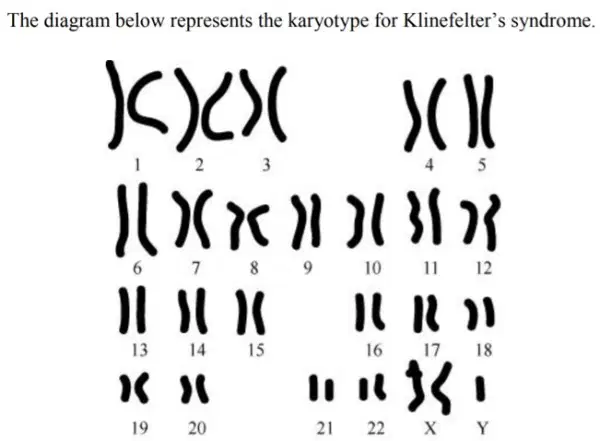
The image represents the karyotype for a Kleinfelter's syndrome.
Which is the likely cause of this condition?
DNA synthesis in S phase
Nondisjunction during mitosis
Nondisjunction during meiosis
a deletion mutation
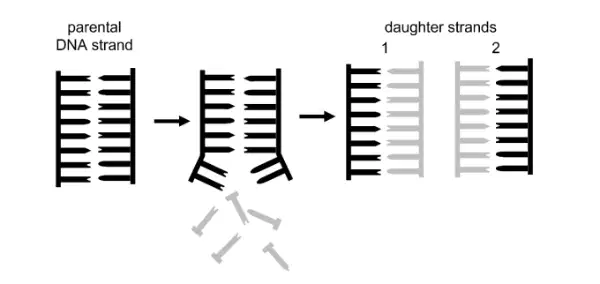
How is the parental DNA strand used in replication?
One parental strand serves as the template to make two different daughter strands.
One parental strand serves as the template to make two identical daughter strands.
Both parental strands serve as templates to make two genetically different daughter strands
Both parental strands serve as templates to make two genetically identical daughter strands
James McBride, a 25-year old police officer, died after a 12-mile bike ride that was part of a training course. Over the course of the ride, James drank roughly three gallons of water that he brought with him in a pack. During a session that focused on how to dismount a bike, an instructor noticed that McBride looked ill and asked him to sit down. McBride complained of dizziness and nausea, and then vomited. Officers initially thought he might have suffered heat stroke. Unaware that James had already consumed so much water, they gave him more water to cool him down while he sat out of the exercise. When another officer hurt himself during the exercise, an ambulance was summoned. The paramedics noticed that James was convulsing and continuing to vomit, so they brought him to the hospital. He died in the hospital the next day.
What sort of environment does consuming excessive amounts of pure water create in the body fluid that/ surrounds your cells?
homeostatic
hypotonic
hypertonic
isotonic
Which of the following correctly describes the differences between Aerobic and Anaerobic Respiration?
Aerobic respiration requires oxygen. Anaerobic respiration does not require oxygen.
Aerobic respiration does not require oxygen while anaerobic respiration does require the presence of oxygen.
Anaerobic respiration produces more ATP than does aerobic respiration.
Aerobic respiration produces considerably more ATP as compared to anaerobic respiration.
A group of biology students is studying the relationship between the cell cycle and cancer. They've learned that cancer is often characterized by uncontrolled cell division.
Question: In the context of cancer and the cell cycle, what aspect differentiates normal cell division from cancerous cell division.?
Normal cell division involves fewer cell cycles, while cancerous cell division involves a higher number of cell cycles.
Normal cell division adheres strictly to the G1,S,G2, and M phases, while cancerous cell division ignores theses phases.
Normal cell division maintains strict checkpoints, while cancerous cell division often bypasses these regulatory points.
Normal cell division only occurs in somatic cells, while cancerous cell division occurs exclusively in gametes.
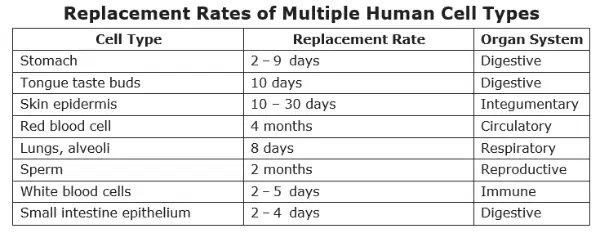
The rate of cell division varies greatly in different types of human cells. The data table shows the replacement rates of many types of human cells.
Which conclusion is most consistent with the data in the table?
Cells in the reproductive and nervous systems are never replaced.
Cells of the respiratory and circulatory systems have faster replacement rates than cells of the digestive system.
Cells in the digestive system are among the most rapidly dividing cells in the body.
Cells in the integumentary system divide faster than any other type of cell in the body.
Which statement is true about meiosis?
It is a source of variation in sexually reproducing organisms.
it produces four genetically identical gametes.
It replaces dead or damaged cells.
It helps an organism grow in size.
The diagram shows the formation of daughter cells during meiosis and mitosis.
Which statement is correct about the two cell division processes?
Meiosis and mitosis both occur in all types of cells.
Meiosis and mitosis produce cells with the same numbers of chromosomes.
The number of chromosomes in a cell is reduced to half during meiosis but remains the same during mitosis.
Cellular material is divided equally into daughter cells during meiosis but is divided unequally during mitosis.
Meiosis in gametes reduces the chromosome number from diploid to haploid. What process is necessary to allow for genetic variation in an organism and to restore the chromosome number to diploid?
fusion of gametes during fertilization
gametes undergoing mitosis
a nondisjunction in gametes
a second meiotic division in gametes
Proteins that regulate the cell cycle are inactive when the cell is not dividing, and they are turned on when the cell begins the cell cycle. What would happen if these proteins remain turned on indefinitely?
Cells would stop dividing and die.
Cells would divide uncontrollably and could become cancerous.
Cells would increase enormously in size and explode.
Cells would divide without replicating their DNA.
Which description represents the daughter cells of mitosis and meiosis correctly?
Daughter cells are similar to the parent cells in both processes.
Daughter cells are different from the parent cells in both processes.
Daughter cells are identical to the parent cell in meiosis while different from the parent cell in mitosis.
Daughter cells are identical to the parent cell in mitosis while different from the parent cell in meiosis.
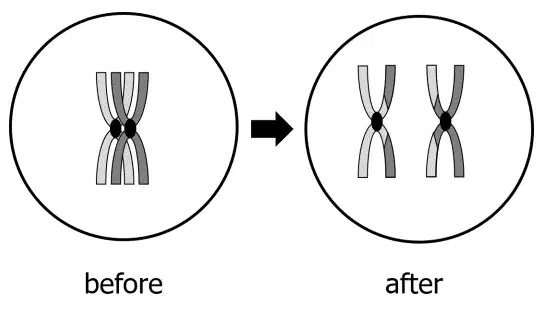
A student makes a before and after image of chromosomes going through meiosis.
How does this process impact daughter cells?
It ensures that all the daughter cells will be identical to one another.
It ensures that all the daughter cells have half the amount of genetic information as the parent cell.
It helps maintain the amount of genetic material present in each daughter cell.
It helps create new genetic combinations that are not seen in the parent cell.

