
 Worksheets
C211 - Practice Competency 3
Total questions: 50
Worksheet time: 3hrs 30mins

Price discrimination is the business practice of
selling the same good at different prices to different customers.
hiring marketing experts to increase consumers' brand loyalty.
pricing above marginal cost.
bundling related products to increase total sales.

A firm's opportunity costs of production are equal to its
implicit costs only.
explicit costs + implicit costs.
explicit costs only.
explicit costs + implicit costs + total revenue.

Price discrimination adds to social welfare in the form of
increased consumer surplus and decreased producer surplus.
increased total surplus.
reduced costs of production.
decreased total surplus

Which of the following statements is true?
Average revenue is the same as price for competitive firms but not monopoly firms.
When a competitive firm sells an additional unit of output, its revenue increases by an amount less than the price.
Average revenue is the same as price for monopoly firms but not competitive firms.
When a monopoly firm sells an additional unit of output, its revenue increases by an amount less than the price.

Which of the following statements regarding a competitive firm is correct?
Because each firm faces a downward sloping demand, if a firm increases its level of output, the firm will have to charge a lower price to sell the additional output.
For all firms, average revenue equals the price of the good.
By lowering its price below the market price, the firm will benefit from selling more units at the lower price than it could have sold by charging the market price.
If a firm raises its price, the firm may be able to increase its total revenue even though it will sell fewer units.

If a firm in a perfectly competitive market triples the quantity of output sold, then total revenue will
more than triple
be reduced by one third.
exactly triple.
less than triple.

Which of the following is a necessary characteristic of a monopoly?
The firm is the sole seller of its product.
The firm generates a large economic profit.
The firm's product has many close substitutes.
The firm is located in a small geographic market.

Which of the following statements is not correct?
Both monopolistic competition and oligopoly fall in between the more extreme market structures of competition and monopoly.
Monopolistic competition is different from oligopoly because each seller in monopolistic competition is small relative to the market, whereas each seller can affect the actions of other sellers in an oligopoly.
Monopolistic competition is different from monopoly because monopolistic competition is characterized by free entry, whereas monopoly is characterized by barriers to entry.
Both monopolistic competition and perfect competition are characterized by product differentiation.
To maximize total surplus with a monopoly firm, a benevolent social planner would choose the level of output where
MR = MC.
MR exceeds MC by the greatest amount.
MR intersects the demand curve.
MC intersects the demand curve.

Antitrust laws have economic benefits that outweigh the costs if they
prevent mergers that would decrease competition and raise the costs of production.
allow mergers that would decrease competition regardless of what happens to the costs of production.
prevent mergers that would decrease competition and lower the costs of production.
allow mergers that would decrease competition and raise the costs of production.
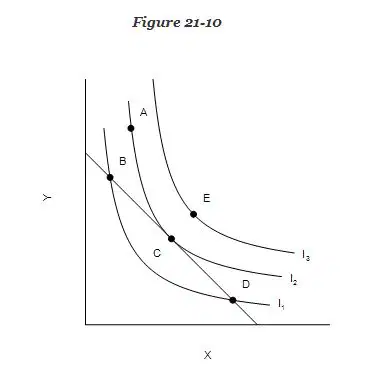
Refer to Figure 21-10 . It would be possible for the consumer to reach I 3 if
the price of X increases.
the price of Y increases.
income decreases
the price of Y decreases.
Which of the following is true about a monopolistically competitive firm?
It cannot earn an economic profit in either the short or long run.
It can earn an economic profit in the short run and the long run.
It can earn an economic profit in the short run, but not the long run
It can earn an economic profit in the long run, but not the short run.
In both perfect competition and monopolistic competition, each firm
sells a product that is at least slightly different from those of other firms.
has many competitors
faces a downward-sloping demand curve for its product
has some monopoly power.
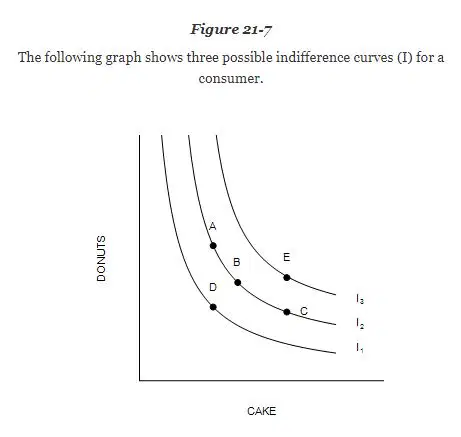
Refer to Figure 21-7. When comparing bundle A to bundle E, the consumer
is indifferent between the two bundles.
prefers bundle A because it contains more donuts.
prefers bundle E because it lies on a higher indifference curve.
prefers bundle E because it contains more donuts.
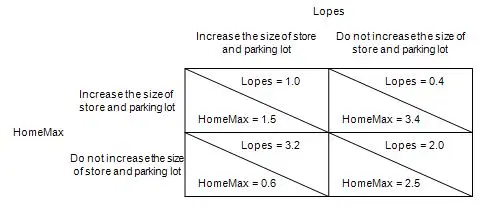
Table 17-6
Two home-improvement stores (Lopes and HomeMax) in a growing urban area are interested in expanding their market share. Both are interested in expanding the size of their store and parking lot to accommodate potential growth in their customer base. The following game depicts the strategic outcomes that result from the game. Increases in annual profits (in millions of dollars) of the two home-improvement stores are shown in the following figure.
Refer to Table 17-6. Pursuing its own best interest, HomeMax will
increase the size of its store and parking lot only if Lopes does not increase the size of its store and parking lot.
increase the size of its store and parking lot regardless of the decision made by Lopes.
increase the size of its store and parking lot only if Lopes also increases the size of its store and parking lot.
not increase the size of its store and parking lot regardless of the decision made by Lopes.
Suppose that Bieber and Rihanna are duopolists in the music industry. In May, they agree to work together as a monopolist, charging the monopoly price for their music and producing the monopoly quantity of songs. By June, each singer is considering breaking the agreement. What would you expect to happen next?
Bieber and Rihanna will determine that it is in each singer's self-interest to maintain the agreement.
Bieber and Rihanna will each break the agreement. Both singers' profits will increase.
Bieber and Rihanna will each break the agreement. The new equilibrium quantity of songs will increase, and the new equilibrium price also will increase.
Bieber and Rihanna will each break the agreement. Both singers' profits will decrease.
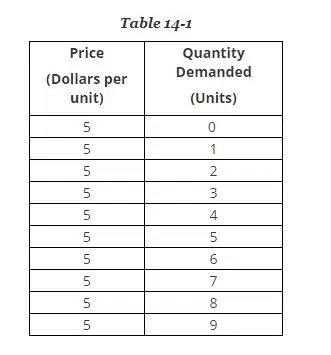
Refer to Table 14-1. Over which range of output is average revenue equal to price?
Average revenue is equal to price over the entire range of output.
3 to 7 units
1 to 5 units
5 to 9 units

Which of the following is unique to a monopolistically competitive firm when compared to an oligopoly?
The monopolistic competition features many buyers.
Monopolistic competition features many sellers.
The monopolistically competitive firm advertises.
The monopolistically competitive firm produces a quantity of output that falls short of the socially optimal level.

Economies of scale occur when
long-run average total costs rise as output increases.
average fixed costs are constant.
long-run average total costs fall as output increases

Marginal cost is equal to average total cost when
average total cost is at its minimum
marginal cost is at its minimum.
average variable cost is falling.
average fixed cost is rising
If a profit-maximizing monopolist faces a downward-sloping market demand curve, its
average revenue is less than the price of the product.
marginal revenue is less than the price of the product.
average revenue is less than marginal revenue.
marginal revenue is greater than the price of the product.
When marginal cost is less than average total cost,
average total cost is rising.
average variable cost must be falling.
marginal cost must be falling.
average total cost is falling
The intersection of a firm's marginal revenue and marginal cost curves determines the level of output at which
total revenue is equal to fixed cost.
profit is maximized
total revenue is equal to total cost
total revenue is equal to variable cost.
A monopolistically competitive firm chooses
the price, but output is determined by a cartel production quota.
he quantity of output to produce, but the price of its output is determined by demand.
the price, but competition in the market determines the quantity.
the quantity of output to produce, but all firms in the market agree upon a single price.
The deadweight loss associated with a monopoly occurs because the monopolist
equates marginal revenue with marginal cost.
maximizes profits.
produces an output level greater than the socially optimal level.
produces an output level less than the socially optimal level.
A difference between explicit and implicit costs is that
implicit costs must be greater than explicit costs.
explicit costs must be greater than implicit costs.
implicit costs do not require a direct monetary outlay by the firm, whereas explicit costs do
explicit costs do not require a direct monetary outlay by the firm, whereas implicit costs do.
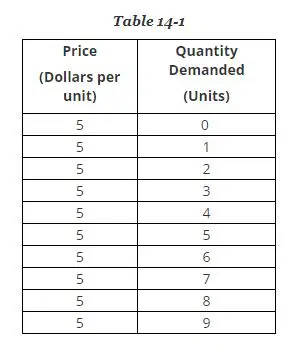
Refer to Table 14-1. If the firm doubles its output from 3 to 6 units, total revenue will
increase by less than $15.
increase by more than $15.
Total revenue cannot be determined from the information provided.
increase by exactly $15.
A government-created monopoly arises when
the government gives a firm the exclusive right to sell some good or service.
government spending in a certain industry gives rise to monopoly power.
he government exercises its market control by encouraging competition among sellers.
the government collects taxes in a particular industry.
Profit-maximizing firms enter a competitive market when existing firms in that market have
total revenues that exceed total variable costs.
average total costs that are less than market price
total revenues that exceed fixed costs.
average total costs that exceed average revenue.
Total revenue equals
output − input.
price/quantity.
(price × quantity) − total cost.
price × quantity.
In the long run,
inputs that were variable in the short run become fixed.
variable inputs are rarely used.
inputs that were fixed in the short run become variable.
inputs that were fixed in the short run remain fixed.
A key characteristic of a competitive market is that
producers sell nearly identical products.
government antitrust laws regulate competition.
firms have price setting power.
firms minimize total costs.
Monopolies are socially inefficient because the price they charge is
above demand.
equal to marginal revenue.
above marginal cost.
equal to demand.

Table 17-7
Two companies, Acme and Pinnacle, each decide whether to produce a good quality product or a poor quality product. In the figure, the dollar amounts are payoffs and they represent annual profits (in millions of dollars) for the two companies.
Refer to Table 17-7. Which of the following statements is correct?
Our knowledge of game theory suggests that the most likely outcome of the game, if it is played only once, is for one firm to produce a poor quality product and for the other firm to produce a good quality product.
Acme can potentially earn its highest possible profit if it produces a good quality product, and for that reason it is a dominant strategy for Acme to produce a good quality product.
Regardless of the strategy pursued by Acme, Pinnacle's best strategy is to produce a good quality product, and for that reason producing a good quality product is a dominant strategy for Pinnacle
The highest possible combined profit for the two firms occurs when both produce a poor quality product, and for that reason producing a poor quality product is a dominant strategy for both firms.
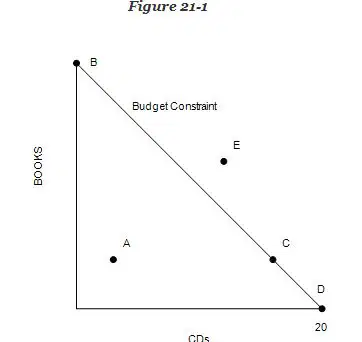
Refer to Figure 21-1. If the consumer's income is $140, then what is the price of a CD?
$7
$9
$3
$5
Which of the following statements is correct?
Assuming that implicit costs are positive, economic profit is positive.
Assuming that explicit costs are positive, accounting profit is equal to economic profit.
Assuming that implicit costs are positive, accounting profit is greater than economic profit
Assuming that explicit costs are positive, economic profit is greater than accounting profit.
When an industry has many firms, the industry is
monopolistically competitive if the firms sell differentiated products, but it is perfectly competitive if the firms sell identical products.
perfectly competitive if the firms sell differentiated products, but it is monopolistically competitive if the firms sell identical products.
an oligopoly if the firms sell differentiated products, but it is perfectly competitive if the firms sell identical products.
an oligopoly if the firms sell differentiated products, but it is monopolistically competitive if the firms sell identical products
In the prisoners' dilemma game, self-interest leads
to an outcome that is better for both prisoners.
to the follow-through of any agreement that the prisoners might have made before being questioned.
each prisoner to confess
each prisoner to stay silent.
Suppose Jamie can choose between consuming two goods. If we observe that Jamie's budget constraint has moved outward, then we know for certain that
her income must have increased.
the price of one or both of the goods must have decreased.
. she will be indifferent between the two goods.
she can reach a higher indifference curve
Which of the following industries is most likely to exhibit the characteristic of free entry?
Dairy farming
Municipal water and sewer
Airport security
Nuclear power
Which of the following is not one of the ways that antitrust laws promote competition?
Antitrust laws allow the government to prevent mergers.
Antitrust laws allow the government to break up big companies into smaller ones.
Antitrust laws prevent companies from coordinating their activities in ways that make markets less competitive.
Antitrust laws allow the government to shut down a firm if the government believes the firm has monopoly power.
Indifference curves illustrate
a firm's profits.
the prices of two goods.
a consumer's budget.
a consumer's preferences.
A monopoly can earn positive profits because it
can sell unlimited quantities at any price it chooses.
can set the price it charges for its output but faces a horizontal demand curve
can maintain a price such that total revenues will exceed total costs.
takes the market price as given and can sell unlimited quantities.
Which of the following statements about oligopolies is not correct?
Oligopolistic firms are interdependent in a way that competitive firms are not
Unlike monopolies and monopolistically competitive markets, oligopolies prices do not exceed their marginal costs.
The actions of any one seller can have a large impact on the profits of all other sellers.
An oligopolistic market has only a few sellers.
Monopoly firms face
downward-sloping demand curves, so they can sell as much output as they desire at the market price.
horizontal demand curves, so they can sell as much output as they desire at the market price.
downward-sloping demand curves, so they can sell only the specific price-quantity combinations that lie on the demand curve.
horizontal demand curves, so they can sell only a limited quantity of output at each price.
The average fixed cost curve
always rises with increased levels of output
always declines with increased levels of output.
declines as long as it is below marginal cost.
declines as long as it is above marginal cost.
When a factory is operating in the short run,
average fixed cost rises as output increases
it cannot adjust the quantity of fixed inputs.
t cannot alter variable costs.
total cost and variable cost are usually the same.
A consumer consumes two normal goods, popcorn and Pepsi. The price of Pepsi rises. The substitution effect, by itself, suggests that the consumer will consume
less popcorn and more Pepsi.
more popcorn and less Pepsi.
less popcorn and less Pepsi.
more popcorn and more Pepsi
When a profit-maximizing firm in a monopolistically competitive market charges a price higher than marginal cost,
the firm must be earning a positive economic profit.
the firm may be incurring economic losses
society benefits due to the firm's excess capacity.
new firms will enter the market in the long run.
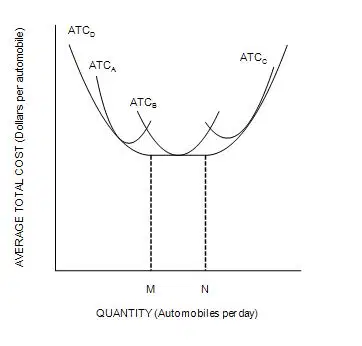
Figure 13-6
The following figure depicts average total cost functions for a firm that produces automobiles.
Refer to Figure 13-6. At levels of output between M and N, the firm experiences
diseconomies of scale.
both the benefits of specialization and diminishing marginal productivity.
constant returns to scale.
economies of scale.

