wayground logo

Free Printable Worksheets

NEW

Font size

S
M
L
XL
Worksheets

Bio20 - Biosphere Unit

Total questions: 55

Worksheet time: 41mins

Name
Class
Date
1.

What is the term for organisms that obtain their energy by consuming other organisms?

a)

Heterotrophs

b)

Decomposers

c)

Producers

d)

Autotrophs

2.

What is the process by which nitrogen gas is converted into ammonia by bacteria?

a)

Ammoniafication

b)

Nitrogen fixation

c)

Denitrification

d)

Nitrification

3.

What is the primary source of energy for most ecosystems?

a)

Sunlight

b)

Geothermal energy

c)

Wind energy

d)

Chemical energy

4.

What is the term for the transfer of energy through a series of organisms, beginning with producers?

a)

Food web

b)

Trophic levels

c)

Food chain

d)

Biogeochemical cycle

5.
The movements of energy and nutrients through living systems are different because
a)
energy flows in one direction, and nutrients recycle.
b)
energy is limited in the biosphere, and nutrients are always available.
c)
nutrients flow in one direction, and energy recycles.
d)
energy forms chemical compounds, and nutrients are lost as heat.
6.
Respiration is the process by which ____________ is consumed and _______________ is produced.
a)
Carbon, Oxygen
b)
Oxygen, Carbon dioxide
c)
H20, oxygen
d)
Carbon, H2O
7.
A particular golf course is using large amounts of nitrogen fertilizer. What process could move this nitrogen into a local stream?
a)
volatilization
b)
nitrogen fixation
c)
runoff
d)
ammonification
8.
Which nutrient is not cycled through the atmosphere?
a)
carbon
b)
nitrogen
c)
phosphorous
d)
water
9.

Where is the largest reservoir for the phosphorus cycle?

a)

rocks and minerals

b)

the ocean

c)

the atmopshere

d)

fossil fuels

10.

What is the process called where bacteria take nitrogen out of the atmosphere and convert it into usable nitrates?

a)

Denitrification

b)

Nitrogen fixation

c)

Ammonification

d)

Nitrification

e)

Assimilation

11.

What nitrogen compounds do decomposers produce?

a)

Nitrites

b)

Nitrates

c)

Nitrogen

d)

Ammonia

12.

I turn unusable ammonia into usable nitrates. Who am I?

a)

Nitrogen fixing bacteria

b)

Denitrifying bacteria

c)

Nitrifying bacteria

d)

Ammonifying bacteria

13.
What does NOT produce carbon dioxide?
a)
Photosynthesis
b)
Burning Fossil Fuels
c)
Animal respiration
d)
Plants decaying
14.
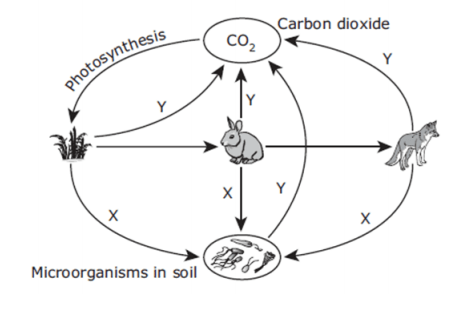
The diagram shows the flow of organic molecules through an ecosystem. What two processes are identified by the labels X and Y?
a)
X : Respiration
Y : Predation
b)
X : Adaptation
Y : Decomposition
c)
X : Fermentation
Y : Nitrogen Fixation
d)
X : Decomposition
Y : Respiration
15.

What are fossil fuels made from?

a)

Plants and animals that are buried underground for millions of years.

b)

They absorb it from the atmosphere.

c)

Water

d)

Wind

16.

How many calories will be passed on from 250 to the next trophic level?

a)

2,500

b)

25

c)

2.5

d)

10%

17.

a primary consumer is always a

a)

omnivore

b)

carnivore

c)

omnivore or herbivore

d)

herbivore

18.

Which of the following is most likely to cause the greatest decrease in the snake population?

a)

an increase in the grasshopper population

b)

a decrease in the mouse population

c)

a decrease in the vulture population

d)

a decrease in the hawk population

19.

Phytoplankton --> Krill --> Fish --> Sea Gull

Which organism in this food chain is the primary consumer?

a)

phytoplankton

b)

krill

c)

fish

d)

sea gull

20.

Which of the following is most likely to cause an increase in the croaker population?

a)

an increase in the anchovy population

b)

a decrease in the crab population

c)

a decrease in the bluefish population

d)

a decrease in the algae population

21.

In which level are producers found?

a)

A

b)

B

c)

C

d)

D

22.

Energy flows into an ecosystem through producers and is ultimately lost as...

a)

food

b)

carbon dioxide

c)

light

d)

heat

23.

In which level are secondary consumers found?

a)

A

b)

B

c)

C

d)

D

24.

A life form that is very sensitive to environmental changes in its ecosystem. They can give us early-warning messages that a habitat is suffering.

a)

Indicator Species

b)

Flagship Species

c)

Predators

d)

Ecosystem Engineers

25.
What might happen if you remove a primary consumer from the ecosystem?
a)
There would be more food for secondary consumers.
b)
The number of primary consumers would increase.
c)
The number of plants would increase.
d)
The number of secondary consumers would increase.
26.
How much of the energy in each level of a ecological pyramid gets lost as heat or used by the organism so that it cannot be passed on to the next trophic level?
a)
80%
b)
90%
c)
10%
d)
20%
27.
What makes an energy pyramid different than a food web or chain?
a)
It shows energy flowing from the top of the chain and downward. 
b)
The tropic levels are the opposite
c)
It shows the amount of energy in each trophic level
d)
It shows specific predator/prey relationships
28.

What is biomass?

a)

the total dry weight of organisms in an ecosystem

b)

the total volume of organisms in an ecosystem

c)

the total dry weight of producers in an ecosystem

d)

the total volume of animals in an ecosystem

29.

Why are energy pyramids never inverted?

a)

because energy is always lost from one trophic level to the next

b)

because energy is always gained from one trophic level to the next

c)

because energy cannot be measured as it transfers from one trophic level to the next

d)

because it just never is

30.
What type of pyramid does this show?
a)
biomass
b)
energy
c)
numbers
d)
producers
31.

What are the "producers" levels in the two pyramids most likely referring to?

a)

different ecosystems, the numbers are different

b)

the same ecosystem, looking whole verses parts of the producer

c)

the same ecosystem, during different times

d)

there is no correct answer, not enough information is given

32.

What can you infer about the biomass of the herbivores verses the autotrophs in this ecosystem?

a)

There are more autotrophs than herbivores

b)

There are more herbivores than autotrophs

c)

The dry weight of the herbivores is greater than that of the autotrophs

d)

The dry weight of the autotrophs is greater than that of the herbivores

33.
Rain, snow, sleet, or hail that fall to the ground.
a)
Precipitation
b)
Evaporation
c)
Condensation
d)
Water Cycle
34.
The process in which vapor turns into liquid water. 
a)
Condensation
b)
Evaporation
c)
Snowmelt
d)
Frozen Water
35.
A body of rock underneath the surface of Earth that contains water. (underground lake)
a)
Aquifer
b)
Glacier
c)
Atmosphere
d)
Cloud
36.
The process where plants absorb water through the roots and then give off water vapor through their leaves.
a)
Transpiration
b)
Respiration
c)
Oxygen
d)
Infiltration
37.

Which is a synonym for an autotroph?

a)

heterotroph

b)

consumer

c)

producer

38.

What is the role of the fungi?

a)

autotroph

b)

heterotroph

c)

decomposer

d)

carnivore

e)

consumer

39.

Which of the following are the main producers of marine ecosystems?

a)

phytoplankton

b)

plants

c)

bacteria

d)

zooplankton

40.
The smallest unit of life that can sustain itself is called...
a)
an organism.
b)
the biosphere.
c)
a population.
d)
a community.
41.
What is it called when a group of the same organisms living together in the same place at the same time?
a)
An organism
b)
A population
c)
A community
d)
A biome
42.
What are groups of different populations living togther in the same place at the same time called?
a)
An organism
b)
A population
c)
A community
d)
A biosphere
43.
What is it called when you have groups of different populations along with their abiotic factors?
a)
An organism
b)
A population
c)
A community
d)
An ecosystem
44.
When all the ecosystems on Earth are combined it is called...
a)
a community.
b)
a biome.
c)
a biosphere.
d)
an Earthsphere.
45.
The temperate decisuous forest, the tropical rain forest, the desert, and the tundra are all examples of...
a)
the biopshere.
b)
biomes.
c)
ecosystems.
d)
communities.
46.
Andrea is on the grils cross country tream. She is heading out for a run when she comes across 20 Canadian geese.  What level of organization is this group of Canadian geese?
a)
organism
b)
population
c)
community
d)
biome
47.
Jacob is going out to his grandparents fram.  On the farm is a stream that he likes to fish at. When he is fishing he sees many differernt speacies of fish as well as maple and oak trees and dragonflies.  What Jacob is seeing is an example of what level of organization?
a)
organism
b)
population
c)
community
d)
ecosystem
48.
What is a group of ecosystems that share similar climates and types of organisms called?
a)
A community
b)
A biome
c)
An ecosystem
d)
A biosphere
49.

The ecological role an organism performs in their specific environment is considered the organism's...

a)

Habitat

b)

Population

c)

Biome

d)

Niche

50.

"Organisms that have moved to a location that does not naturally support them."

a)

Invasive species

b)

Destructive species

c)

Unwelcomed species

d)

Infected species

51.
The ecological niches of three bird species are shown in the diagram. What is the advantage of each bird species having a different niche?
a)
As more birds feed higher in the tree, available energy increases.
b)
More abiotic resources are available for each bird.
c)
Predators are less likely to feed on birds in a variety of locations.
d)
There is less competition for food.
52.

_____________ is the increase in concentration of a pollutant in a food chain

a)

Bioaccumulation

b)

Biomagnification

53.

___________ is the increase in concentration of a pollutant in an organism

a)

Bioaccumulation

b)

Biomagnification

54.

High or low albedo: snow

a)

high

b)

low

55.

What is the scientific definition of the albedo effect?

a)

How much sunlight an object reflects

b)

How much sunlight an object absorbs

c)

How hot an object gets

d)

How cold an object gets