
 Worksheets
Competence Test 4
Total questions: 49
Worksheet time: 2hrs 25mins

The quantity supplied of a good is the amount that
sellers are willing and able to sell.
buyers are willing and able to purchase.
sellers are able to produce.
buyers and sellers agree will be brought to market.

A demand schedule is a table that shows the relationship between
quantity demanded and quantity supplied.
price and quantity demanded.
income and quantity demanded.
price and income.

When conducting an open-market sale, the Fed
sells government bonds, and in so doing increases the money supply
buys government bonds, and in so doing decreases the money supply
buys government bonds, and in so doing increases the money supply.
sells government bonds, and in so doing decreases the money supply.

Suppose that a decrease in the price of good X results in fewer units of good Y being demanded. This implies that X and Y are
inferior goods.
complementary goods.
normal goods.
substitute goods

The price elasticity of demand measures
the extent to which demand increases as additional buyers enter the market.
how much more of a good consumers will demand when incomes rise.
buyers' responsiveness to a change in the price of a good.
the movement along a supply curve when there is a change in demand.

Cross-price elasticity of demand measures how
the price of one good changes in response to a change in the price of another good.
the quantity demanded of one good changes in response to a change in the quantity demanded of another good.
strongly normal or inferior a good is.
the quantity demanded of one good changes in response to a change in the price of another good.

Two goods are substitutes when a decrease in the price of one good
increases the demand for the other good.
decreases the demand for the other good.
decreases the quantity demanded of the other good.
increases the quantity demanded of the other good.

Suppose there was a large increase in net exports. If the Fed wanted to stabilize output, it could
increase the money supply, which will reduce interest rates.
decrease the money supply, which will increase interest rates
decrease the money supply, which will reduce interest rates
increase the money supply, which will increase interest rates.
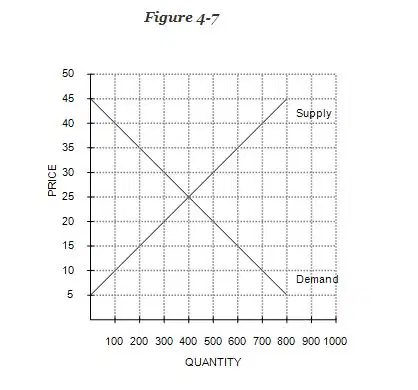
Refer to Figure 4-7. At what price would there be an excess supply of 200 units of the good?
$35
$15
$20
$30

The multiplier effect states that there are additional shifts in aggregate demand from expansionary fiscal policy, because it
reduces investment and thereby increases consumer spending.
decreases income and thereby increases consumer spending.
increases the money supply and thereby reduces interest rates.
increases income and thereby increases consumer spending.

Two goods are complements when a decrease in the price of one good
increases the demand for the other good.
decreases the quantity demanded of the other good.
increases the quantity demanded of the other good.
decreases the demand for the other good.
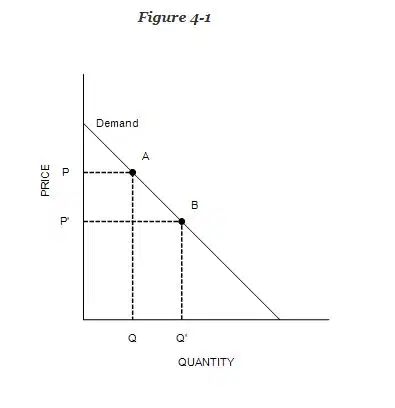
Refer to Figure 4-1 . The movement from point A to point B on the graph is caused by
an increase in income
an increase in price.
a decrease in price
a decrease in the price of a substitute good.

Which of the following is not a determinant of the price elasticity of demand for a good?
The definition of the market for the good
The steepness or flatness of the supply curve for the good
The availability of substitutes for the good
The time horizon

If the public decides to hold more currency and fewer deposits in banks, bank reserves
decrease and the money supply eventually decreases
increase and the money supply eventually increases.
decrease but the money supply does not change.
increase but the money supply does not change.

If the number of buyers in a market decreases, then
demand will decrease.
supply will decrease.
supply will increase.
demand will increase.
The Federal Reserve
was created in 1896.
is only responsible for controlling the money supply.
is part of the executive branch of government.
is the central bank of the United States.

The discount rate is
the interest rate the Fed charges banks.
the interest rate banks receive on reserve deposits with the Fed.
one divided by the difference between one and the reserve ratio.

When we move along a given demand curve,
all determinants of quantity demanded are held constant.
income and price are held constant.
only price is held constant.
all nonprice determinants of demand are held constant
A key determinant of the price elasticity of supply is the
price elasticity of demand.
time horizon.
importance of the good in a consumer’s budget.
income of consumers.

If a surplus exists in a market, then we know that the actual price is
below the equilibrium price, and quantity demanded is greater than quantity supplied.
below the equilibrium price, and the quantity supplied is greater than the quantity demanded.
above the equilibrium price, and quantity supplied is greater than quantity demanded.
above the equilibrium price, and quantity demanded is greater than quantity supplied.
Which of the following both increase the money supply?
A decrease in the discount rate and an increase in the interest rate on reserves
A decrease in the discount rate and a decrease in the interest rate on reserves
An increase in the discount rate and a decrease in the interest rate on reserves
An increase in the discount rate and an increase in the interest rate on reserves
Tom Bradys Bunch of Deflated Balls
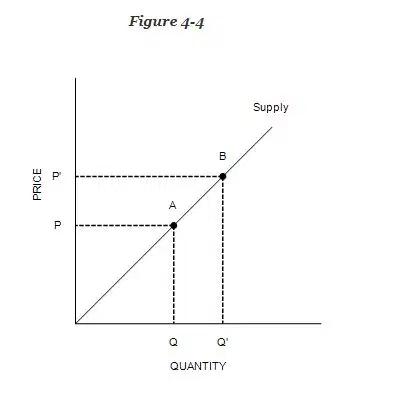
Refer to Figure 4-4. The movement from point A to point B on the graph is called
an increase in supply.
an increase in the quantity supplied.
a decrease in supply.
a decrease in the quantity supplied.
Which of the following is not a function of money?
Store of value
Medium of exchange
Unit of account
Protection against inflation
Which of the following events would cause a movement upward and to the left along the demand curve for olives?
The price of olives rises.
The price of pickles decreases, and pickles are a substitute for olives.
The number of people who purchase olives decreases.
Consumer income decreases, and olives are a normal good.
Other things the same, if reserve requirements are increased, the reserve ratio
increases, the money multiplier decreases, and the money supply decreases.
decreases, the money multiplier decreases, and the money supply increases.
decreases, the money multiplier increases, and the money supply increases
increases, the money multiplier increases, and the money supply increases.
The market demand curve
represents the sum of the prices that all the buyers are willing to pay for a given quantity of the good.
is found by vertically adding the individual demand curves.
represents the sum of the quantities demanded by all the buyers at each price of the good.
slopes upward.
The law of supply states that, other things equal, when the price of a good
falls, the supply of the good rises.
rises, the supply of the good falls.
rises, the quantity supplied of the good rises.
falls, the quantity supplied of the good rises.
Which of the following is NOT an example of monetary policy?
The Federal Reserve facilitates bank transactions by clearing checks.
The Federal Reserve reduces the reserve requirement.
The Federal Open Market Committee decides to buy bonds.
The Federal Open Market Committee decides to sell bonds.
For which pairs of goods is the cross-price elasticity most likely to be positive?
Peanut butter and jelly
Bicycle frames and bicycle tires
Pens and pencils
Digital college textbooks and iPhones
Monetary policy affects the economy with a long lag, in part because
proposals to change monetary policy must go through both the House and Senate before being sent to the president.
monetary policy works through changes in interest rates, and the Fed does not have the ability to change interest rates quickly.
changes in interest rates primarily influence investment spending, and firms make investment plans far in advance.
changes in interest rates primarily influence consumption spending, and households make consumption plans far in advance.
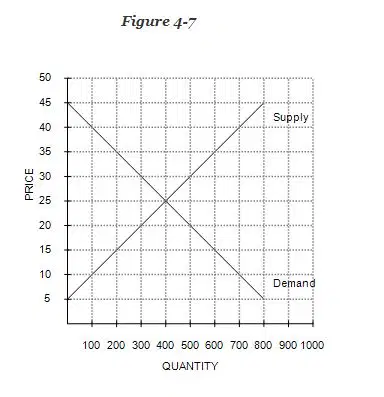
Refer to Figure 4-7. Equilibrium price and quantity are, respectively,
$15 and 200 units.
$25 and 600 units.
$35 and 200 units.
$25 and 400 units.
The government builds a new water-treatment plant. The owner of the company that builds the plant pays her workers. The workers increase their spending. Firms from which the workers buy goods increase their output. This type of effect on spending illustrates
the multiplier effect.
the crowding-out effect.
the wealth effect.
the Fisher effect.
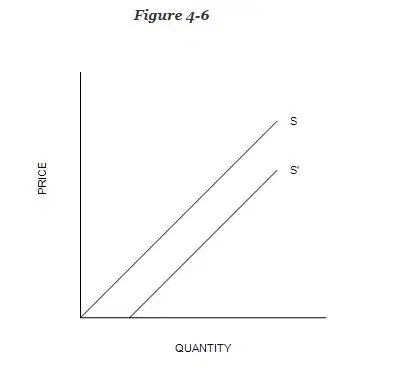
Refer to Figure 4-6 . The shift from S to S' is called
a decrease in quantity supplied.
an increase in quantity supplied.
a decrease in supply
an increase in supply.
If the demand for a product increases, then we would expect equilibrium price
to increase and equilibrium quantity to decrease.
and equilibrium quantity both to increase.
and equilibrium quantity both to decrease.
to decrease and equilibrium quantity to increase.
If the Federal Reserve decided to raise interest rates, it could
buy bonds to raise the money supply.
sell bonds to lower the money supply.
buy bonds to lower the money supply
sell bonds to raise the money supply
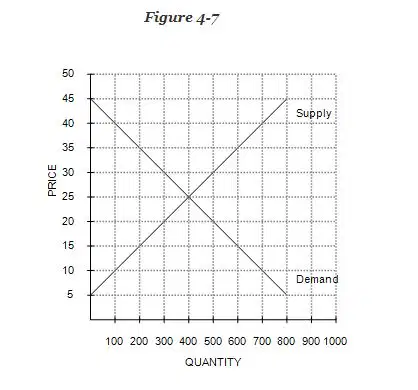
Refer to Figure 4-7. At a price of $35, there would be a
surplus of 400 units.
surplus of 600 units
shortage of 400 units.
surplus of 200 units.
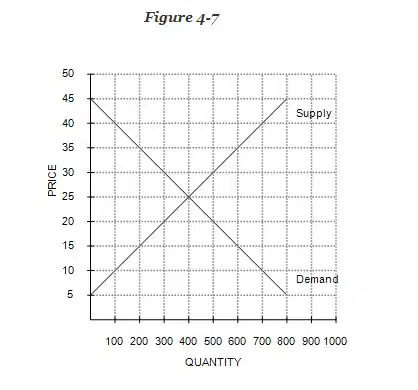
Refer to Figure 4-7. At a price of $35, there would be a
surplus of 400 units.
surplus of 600 units.
shortage of 400 units.
surplus of 200 units
Which of the following events shifts aggregate demand rightward?
A decrease in government expenditures or an increase in the price level
An increase in government expenditures, but not a change in the price level
A decrease in the price level, but not a change in government expenditures
An increase in government expenditures or a decrease in the price level
For a good that is a luxury, demand
has unit elasticity.
cannot be represented by a demand curve in the usual way.
tends to be elastic.
tends to be inelastic
Which of the following would shift the demand curve for gasoline to the right?
A decrease in the expected future price of gasoline
An increase in consumer income, assuming gasoline is a normal good
A decrease in the price of gasoline
An increase in the price of cars, a complement for gasoline
The Federal Open Market Committee is
in charge of tax collection.
the group that sets the amount of government spending.
the group that reviews income assistance programs.
the group at the Federal Reserve that sets monetary policy
If the demand for a good falls when income falls, then the good is called
a regular good.
a normal good.
an inferior good.
an ordinary good.
Elasticity of demand is closely related to the slope of the demand curve. The more responsive buyers are to a change in price, the
flatter the demand curve will be.
steeper the demand curve will be.
closer to the vertical axis the demand curve will sit.
further to the right the demand curve will sit.
Equilibrium quantity must decrease when demand
decreases and supply does not change when demand does not change and supply increases, and when both demand and supply decrease.
increases and supply does not change, when demand does not change and supply increases, and when both demand and supply decrease.
increases and supply does not change, when demand does not change and supply decreases, and when both demand and supply decrease.
decreases and supply does not change, when demand does not change and supply decreases, and when both demand and supply decrease

Refer to Figure 4-3 . The shift from Da to Db in the market for potato chips could be caused by
an announcement by the FDA that potato chips cause cancer.
decrease in income, assuming that potato chips are a normal good.
an increase in the price of a pretzels.
a decrease in the price of potato chips
An increase in the price of a good will
increase quantity demanded.
increase demand
decrease demand.
decrease quantity demanded.
When there is an excess supply of money,
people will try to get rid of money causing interest rates to fall. Investment decreases.
people will try to get rid of money causing interest rates to fall. Investment increases
people will try to get rid of money causing interest rates to rise. Investment decreases.
people will try to get rid of money causing interest rates to rise. Investment increases.
For which of the following goods is the income elasticity of demand likely highest?
Diamonds
Housing
Hamburgers
Water
Dad, how do you win a Super Bowl without cheating?
(a)

