

wayground logo

Free Printable Worksheets

Font size

S
M
L
XL
Worksheets

Liquids Mastery Check

Total questions: 13

Worksheet time: 7mins

Name
Class
Date
1.
Water drops stay together on wax paper and don’t break apart easily. This is mainly because:
a)
Water molecules are small
b)
Water molecules are in motion
c)
Water molecules are attracted to each other
d)
Water molecules are wet
2.
When you bring two drops of water near each other and allow them to touch, they combine immediately and become one drop. This is mainly because:
a)
Water molecules are made of atoms
b)
Water molecules are attracted to each other
c)
Water molecules are magnetic
d)
Water is a liquid
3.
If you put food coloring in room temperature water, the coloring spreads throughout the water. The water causes the color to spread mainly because:
a)
Water molecules are warm
b)
Water molecules are in motion
c)
Water is more dense than food coloring
d)
Food coloring molecules are small
4.
Food coloring spreads out faster in hot water than in cold water. This is mainly because:
a)
The water molecules in hot water move more quickly
b)
The molecules in hot water are larger
c)
The food coloring molecules are small
d)
Hot water is less dense
5.
When a thermometer is heated, the red liquid inside the thermometer moves up. This is mainly because:
a)
The red liquid is thin
b)
The molecules of the liquid move faster and get a little further apart
c)
Hot liquid is lighter
d)
The glass of the thermometer gets hot
6.
When a thermometer is cooled, the red liquid inside the thermometer moves down. This is mainly because:
a)
Cold liquids sink
b)
The glass of the thermometer gets cold
c)
The molecules of the liquid move slower and get a little closer together
d)
The red liquid is thick
7.
To describe a liquid, you could say:
a)
The particles of a liquid are attracted to one another but don't move
b)
The particles of a liquid vibrate, are able to move past one another, and are attracted to one another
c)
The particles of a liquid are not attracted to one another and are very far apart from each other
d)
The particles of a liquid vibrate but don't move past one another
8.
The molecules of the liquid inside the thermometer increase in speed when the thermometer is _______ .
a)
heated
b)
cooled
c)
turned upside down
d)
frozen
9.
What happens when a liquid is heated?
a)
the particles of the liquid get bigger
b)
the particles get closer together
c)
the total number of particles increases
d)
the space between the particles increases
10.
What happens to the kinetic energy of liquid particles when cooled?
a)
the average kinetic energy increases
b)
the average kinetic energy decreases
c)
the average kinetic energy stays the same
d)
the kinetic energy changes into chemical energy
11.

Particles in a solid are arranged in ________ while particles of a liquid are arranged in ________.

a)

Clusters, Rows

b)

Rows, a random & scattered pattern.

c)

loose Rows, Tight Rows

d)

A Circle Pattern, A clustered patter n

12.

When explaining the movement of particles in a solid versus a liquid, you would say...

a)

Particles in a solid do not move, while particles in a liquid vibrate in place.

b)

Particles in neither a liquid or solid will move at all.

c)

Particles in a solid will vibrate in place while particles in a liquid move continually in a random arrangement.

d)

Particles in a solid move fluidly all throughout the objects surface and liquid particles move in a circular motion only.
13.

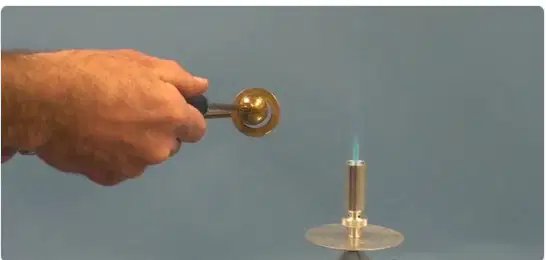
In the Metal Ring and Ball demonstration, the reason the metal ball did not fit through the ring after it was heated is because...

a)

When particles of a solid are heated, they vibrate faster creating more space between them.

b)

The volume of the particles increased.

c)

The particles of the metal ball were both attracted to each other and moved farther apart from each other.

d)

All of the above is true.
