wayground logo

Free Printable Worksheets

Font size

S
M
L
XL
Worksheets

Chemistry Section I Review

Total questions: 58

Worksheet time: 2hrs 35mins

Name
Class
Date
1.

The diameter of a carbon atom is 0.000 000 000 154 m. What is this number expressed in scientific notation?


a)

1.54 x 10¹²

b)

1.54 x 10⁻¹⁰

c)

1.54 x 10⁻¹²

d)

1.54 x 10¹⁰

2.

A farmer applies different fertilizers to his cotton crops, to see which will make his plants grow the highest. What is the Independent Variable?

a)
  1. Type of fertilizer

b)
  1. Height of Plants

c)
  1. Number of Plants

d)

Growth of Plants

3.
Dilcia wants to know how drinking milk affects how tall a Monica grows. Which is the independent variable?
a)
Monica's growth
b)
drinking milk
4.
Ramone wants to know: does the distance a person kicks a soccer ball effect how well they will do on their math test.  What is the dependent variable?
a)
How far they kick the soccer ball
b)
who the person is
c)
how well they do on the math test
d)
Type of soccer ball.
5.
An experiment is performed on plants to see how different liquids affect plant growth. Each plant in the experiment is given a different liquid; water, apple juice, or milk. Each plant has the same amount of soil, sunlight, and listens to the same music. In this investigation, the independent variable is ...
a)
The type of plant
b)
The amount of sunlight
c)
The type of music
d)
The type of liquid
6.
Kreedence wants to know if birds prefer to eat in one place over another. She makes three feeders out of 2-liter bottles and paints all of them red. She fills each of the feeders with the same amount of mixed birdseed, and plans to keep the feeders out for 10 days before measuring how much seed is eaten from each feeder. She puts each of the feeders in her back yard: one feeder in a large dead tree, another feeder she sits on the dog house, and the last she sits in a small bushy tree.
What is the dependent variable?
a)
Length of the birdfeeders
b)
Amount of time feeders are outside
c)
Amount of seed eaten
d)
Location the feeders are put in.
7.
How does adding cardio to one’s daily schedule affect their heart rate?
a)
independent
b)
dependent
8.

The Olympic record for the high jump is just over 2.6 yards. What is that distance in feet? (3 ft = 1 yd)

a)

0.867 ft

b)

7.8 ft

c)

8.07 ft

d)

8.27 ft

9.

How many minutes are in a school year, 187 days?

a)

279,280 min.

b)

16, 200 min.

c)

16, 156 min.

d)

269,280 min.

10.

Convert 20 tons/year to ounces/day

a)

.0004 ounces/day

b)

6.8 ounces/day

c)

109.6 ounces/day

d)

1,753.42 ounces/day

11.

Matter is defined as something that (?) and (?). [2 conditions]

a)

Has mass

b)

Has Weight

c)

Takes up space

d)

Affected by gravity

12.

The 2 types of data are:

a)

independent and dependent

b)

qualitative and quantitative

c)

qualitative and control

d)

quantitative and independent

13.

Which measurement represents a measurement of volume?

a)

2.034 g

b)

100.00 cm2

c)

0.00230 M

d)

2.0 x10⁴

e)

100 ml

14.

Scientific notation of .009870

a)

9.87 x 10³

b)

9.87 x 10⁻³

c)

9.870 x 10³

d)

9.870 x 10⁻³

15.

Standard notation of 7.8 x 10⁻²

a)

.078

b)

.0780

c)

78

d)

780

16.

Uncharged atomic particles

a)

Proton

b)

Nucleus

c)

Neutron

d)

Electron

17.

A pure substance, composed of only one type of atom.

a)

Molecule

b)

Oxygen

c)

Matter

d)

Element

18.

What does a represent?

a)

Proton

b)

Neutron

c)

Electron

19.

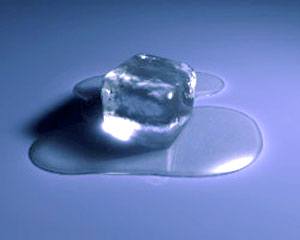
What kind of change is a phase change?

a)

Physical - it's still the same substance

b)

chemical - it's something new

20.
How many protons are in Beryllium?
a)
4
b)
9
c)
5
d)
2
21.

How many neutrons are in the most common isotope of Gold ?

a)

79

b)

196

c)

118

d)

275

22.

What charge does an atom have when it GAINS electrons?

a)

Positive

b)

Negative

c)

Neutral

23.

What is a representation of an ion?

a)

Li

b)

Na-22

c)

O-2

24.

How many electrons does this magnesium ion have?

a)

24

b)

12

c)

10

d)

14

25.

What is the representation of an isotope?

a)

N-3

b)

Al+3

c)

Si

d)

P-33

26.

How many neutrons does this Neon atom have?

a)

21

b)

11

c)

10

d)

12

27.

The ______ are located on the left side of the zig-zag 'staircase' on the Periodic Table. (except for Hydrogen)

a)

metals

b)

non-metals

c)

metalloids

28.

The ___________ are located on the right side of the zig-zag 'staircase' on the Periodic Table (except for Hydrogen)

a)

metals

b)

non-metals

c)

metalloids

29.

The __________ are touching or bordering the zig-zag 'staircase' on the Periodic Table.

a)

metals

b)

non-metals

c)

metalloids

30.
Metals are ___________.
a)
Good Conductors of heat and electricity
b)
Noble Gasses 
c)
Bad Conductors of heat and electricity
d)
sometimes a gas
31.
Beryllium is in group number______.
a)
Group 2
b)
Group 3
c)
Group 4
d)
Group 7
32.

What is the special name for Group 2?

a)

alkali metals

b)

alkaline Earth metals

c)

halogens

d)

Noble gases

33.

Halogens are

a)

the nonmetal group closest to the noble gases

b)

metals in the third group

c)

another name for the transition elements

d)

liquid at room temperature

34.

Name groups 3 - 12 on the periodic table.

a)

noble gases

b)

halogens

c)

metalloids

d)

transition metals

35.

Which of the following shows the correct number of protons, neutrons, and electrons in a neutral cesium-134 atom?

a)

P=55

N=55

E=55

b)

P=55

N=79

E=55

c)

P=55

N=134

E=55

d)

P=134

N=55

E=134

36.

Elements that have the same number of energy levels are said to be in the same ______.

a)

group

b)

period

c)

family

d)

classification

37.

Which of the following would be considered a physical change?

a)

Cutting paper

b)

pH test

c)

Burning marshmellow

d)

Roasting a Turkey

38.
Which of the following is a sign that a chemical reaction has occurred?
a)
change in shape
b)
melting
c)
formation of a gas
d)
dissolving
39.

Rust on an iron bar is an example of chemical change.

a)

True

b)

False

40.
Which is an example of a chemical reaction?
a)
paper cut into small pieces
b)
chocolate melting in a pan
c)
flour and sugar mixed in a bowl
d)
cookies baking in an oven
41.

Which of the following is a heterogeneous mixture?

a)

Kool-air

b)

Ocean Water

c)

Corn Syrup

d)

Dirt

42.
Describe the accuracy and precision of the image
a)
Accurate and Precise
b)
Accurate and not precise
c)
Not Accurate and Precise
d)
not accurate and not precise
43.
Describe the accuracy and precision of the image
a)
Accurate and Precise
b)
Accurate and not precise
c)
Not Accurate and Precise
d)
not accurate and not precise
44.
Describe the accuracy and precision of the image
a)
Accurate and Precise
b)
Accurate and not precise
c)
Not Accurate and Precise
d)
not accurate and not precise
45.

Which of the following is not a characteristic of a liquid?

a)

Takes shape of container

b)
  1. Particles slide/flow past each other

c)

Constant volume

d)

Ductile at room temperature

46.

Calculate the molar mass of Fe2(SO4)3.


a)
  1. 301.2 g/mol

b)

152 g/mol

c)

260 g/mol

d)

399.9 g/mol

47.
Barium-122 has a half-life of 2 minutes. A fresh sample weighing 80 g was obtained. If it takes 10 minutes to set up an experiment using barium-122, how much barium-122 will be left when the experiment begins?
a)
0.25g
b)
2.5g
c)
25g
d)
80g
48.
If the half-life of uranium-232 is 70 years, how many half-lives will it take for 10 g of it to be reduced to 1.25 g?
a)
1 half-life
b)
2 half-lives
c)
3 half-lives
d)
4 half-lives
49.
The splitting of a nucleus into smaller nuclei is
a)
fusion
b)
fission
c)
half-life
d)
gamma radiation
50.
Takes two small nuclei and combines them into a larger nucleus
a)
fission
b)
fusion
51.
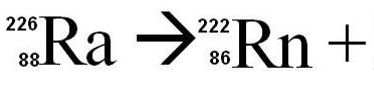
Complete the nuclear equation and determine the type of decay that is occurring in this reaction. 
a)
alpha
b)
beta
c)
gamma
d)
none
52.
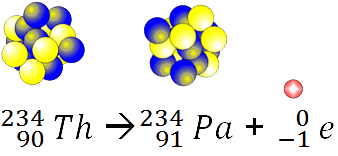
Which type of radioactive decay is occurring in this equation? 
a)
Alpha decay
b)
beta decay
c)
gamma decay
d)
positron emission
53.
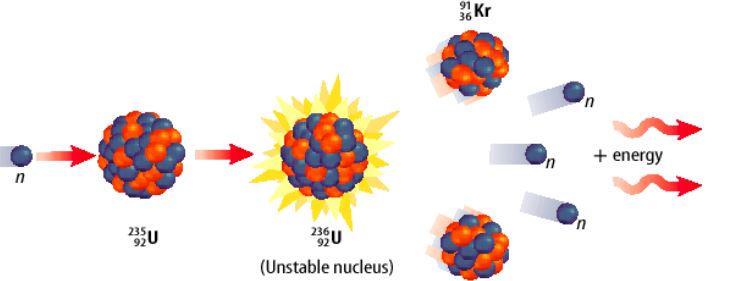
This is an example of...
a)
Fission  reaction
b)
Fusion reaction
c)
Decomposition reaction
d)
Decay
54.
In order of most to least penetrating radiation we have
a)
Alpha , Beta,  Gamma
b)
Beta , Gamma , Alpha
c)
Gamma, Beta, Alpha
d)
Gamma, Alpha, Beta
55.
Which of the following will have a higher electronegativity than arsenic (As)?
a)
Carbon (C)
b)
Neon (Ne)
c)
Antimony (Sb)
d)
Germanium (Ge)
56.
As atoms of elements in group 16 are considered in order from top to bottom, the electronegativity of each successive element....
a)
decreases
b)
increases
c)
remains the same
d)
none of the above
57.
What term is used to describe "The energy required to remove an electron from gaseous atoms"
a)
excitation energy
b)
ionization energy
c)
polarization energy
d)
electrolytic energy 
58.
Which of the following will have a lower ionization energy than Scandium (Sc)?
a)
Helium (He)
b)
Titanium (Ti)
c)
Calcium (Ca)
d)
Magnesium (Mg)