
 Worksheets
USA 5 Practice Quizizz
Total questions: 15
Worksheet time: 9mins
Genetically modified (GM) crops are foods that have had their genomes modified, allowing humans to increase the production of certain crops. Farmer A purchases GM seeds that are immune to a specific herbicide. She plants these seeds in rows over seventeen acres. The following spring, Farmer A's neighbor, Farmer B, tells her that nearly a third of the plants in his crop fields have the same immunity. Which of the following describes the most likely explanation for this occurrence?
Rabbits which frequent both fields carried the seeds across to Farmer B's land.
Farmer A's crops cross-pollinated with Farmer B's crops on the neighboring land.
The two farms share an irrigation system which transmitted the immunity from one field to another.
By increasing the genetic diversity in Farmer A's crops, they have out-competed the crops on Farmer B's land.
Phytopharmaceuticals are pharmaceutical compounds that are found in plants. They can be naturally occurring or a result of biotechnology. Recently, scientists created genetically modified (GM) corn that produces the antibiotic penicillin. The seeds of this GM corn contain a large amount of the antibiotic penicillin, making the cost of producing the penicillin much cheaper and making the method of delivering it to patients in need much easier. Given the benefits of this GM corn, which of the following may be a concern regarding its production?
The GM corn may develop infections from bacteria that are sensitive to the antibiotic.
The GM corn might pass resistant genes to other organisms, like birds, that may eat the seeds.
Because corn uses the wind for pollination, people allergic to penicillin may be at risk for exposure to the antibiotic in the air.
Increased availability of the antibiotic may increase the development of antibiotic resistance in the infectious agents penicillin is used to treat.
Stem cells can become any type of cell in the human body, making them ideal for many types of therapies. One area of possible use is in brain cell transplants that could help people with spinal cord injuries and neurodegenerative diseases such as Parkinson’s disease. Even though there is great potential for helping people, what is one ethical issue that could arise from the use of stem cells?
the source of the stem cells
the cost of obtaining the stem cells
the method of storing the stem cells
the procedure for transplanting the stem cells
Human blood type is determined by multiple alleles (A, B, and O). Which ratio would result from a cross between a man with heterozygous Type A blood and a woman with Type O blood?
50% Type A, 50% Type O
50% Type AB, 50% Type O
100% Type A
100% Type O
A man with red-green color blindness (X^r Y), a recessive sex-linked trait, has a child with a woman that is homozygous dominant (X^R X^R). What is the probability that a child produced from this couple will have red-green color blindness?
0% for male children and 0% for female children
0% for male children and 100% for female children
50% for male children and 50% for female children
100% for male children and 0% for female children
When Mendel crossed hybrid pea plants, he observed that certain traits would appear in the next generation more often than others. He also observed that traits did not show up in offspring in predictable combinations. For example, not all tall plants had green peas, while not all short plants had yellow peas. Which term describes this observation?
dominance
sex linkage
segregation
independent assortment
In rabbits, straight ears (E) are dominant to floppy ears (e). Two rabbits are crossed, and 50% of their offspring have floppy ears. Which cross represents the genotypes of the parents?
EE x EE
EE x ee
Ee x EE
Ee x ee
There is a dominant trait that affects the short arm of chromosome #4 known as Huntington's disease. A woman that is heterozygous for Huntington's disease and a normal, unaffected male have a female child. What is the probability that this child may be affected by the disease?
0%
25%
50%
75%
Which explanation describes why males are more likely to exhibit sex-linked disorders than females?
Males have two X chromosomes that amplify all sex-linked disorders.
Males have one X chromosome on which most sex-linked disorders are located.
Males have only one functional sex chromosome on which all gender traits are located.
Males have multiple sex chromosomes that mutate causing sex-linked disorders to become visible.
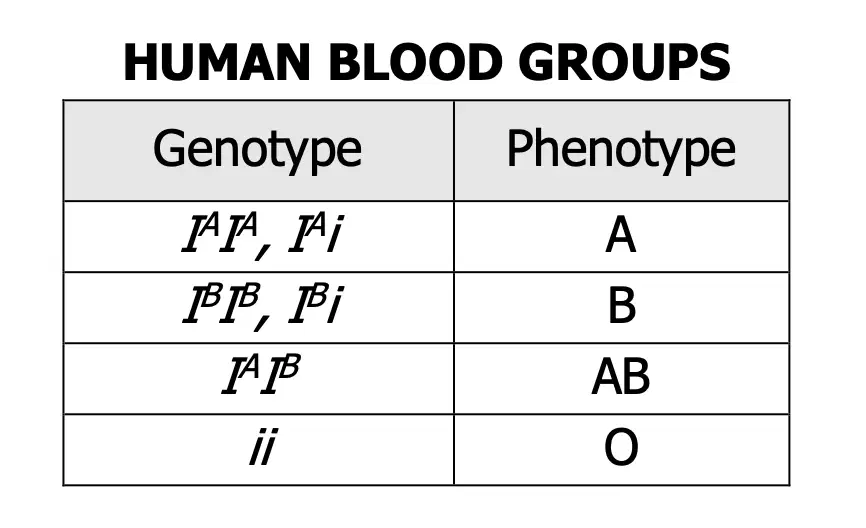
The table lists human blood group genotypes and phenotypes. Why is the AB phenotype a result of codominance?
Neither allele is expressed in the phenotype.
Both alleles are equally expressed in the phenotype.
One allele masks expression of the other during expression of the phenotype.
Both alleles blend together to form an intermediate phenotype during expression.

In which ways can genetic engineering can improve crops
Make them pest or drought resistant
Make them more nutritious
Make them larger
All answers are correct
Match each genotype to its description
HOMOZYGOUS DOMINANT
RR
HETEROZYGOUS
Rr
HOMOZYGOUS
RECESSIVE
rr
Who was the Austrian monk that experimented on pea plants and is called the "father of genetics"? (a)

What is the chromosomal condition of the individual whose karyotype is seen in the image?
Turner's Syndrome
Trisomy 21 (Down Syndrome)
Trisomy 13
Trisomy 18
Which would be a desirable trait scientists may want to create in a transgenic plant?
the ability to resist insects
the ability to grow less fruit
the ability to change color in the winter
the ability to use a lot of water

