Wayground logo

Free Printable Worksheets

Font size

S
M
L
XL
Worksheets

Ecosystems

Total questions: 48

Worksheet time: 43mins

Name
Class
Date
1.
In this food web, which two organisms could be harmed if the mouse population were to decrease?
a)
Deer and caterpillar
b)
Wolf and snake
c)
Oak and grass
d)
Hawk and songbird
2.
In an ecosystem, beetles eat grain, and lizards eat the beetles. Which statement is true?
a)
Beetles are carnivores.
b)
Beetles are producers.
c)
Lizards are decomposers.
d)
Lizards are consumers.
3.
What type of organisms are the first step in a food chain?
a)
Consumers
b)
Predators
c)
Producers
4.
Examples of producers:
a)
flies, fungus, and termites
b)
plants and organisms capable of chemo or photosynthesis
c)
lions, deer, and shrubs
5.
A food web is made up of 
a)
one food chain.
b)
only producers.
c)
many different food chains.
6.
What does an energy pyramid represent?
a)
Food pyramids show the different food chains in a community.
b)
Energy pyramids show the same total matter at all levels.
c)
Shows the amount of energy available at each feeding level in an ecosystem.
7.
What is a consumer?
a)
An organism that makes it's own food
b)
An organisms that eats other organisms for energy
c)
An organism that breaks down dead organisms
8.
What is a food chain?
a)
A chain that shows the flow of energy
b)
A triangle that shows trophic levels
c)
A chain used in fishing
9.
What is pictured in the diagram?
a)
A food web
b)
A food chain
c)
An energy pyramid
10.
What organisms are at the bottom of an energy pyramid?
a)
Producer
b)
Consumer
c)
Decomposer
d)
Scavenger
11.
How much energy is passed on to each trophic level in an energy pyramid?
a)
10%
b)
90%
c)
50%
d)
80%
12.
What is biodiversity?
a)
When there is a variety of organisms in an area
b)
When there are NOT a variety of different organisms in an area
13.
Which organisms have the most available energy in an energy pyramid?
a)
Producer
b)
Consumer
c)
Decomposer
d)
Scavenger
14.
Where do crickets get their energy?
a)
Cattails
b)
Marsh Grass
c)
Grasshoppers
d)
Shrews
15.
Who is the top predator on this food web?
a)
Hawk
b)
Snake
c)
Frog
d)
Cattail
16.
What is an example of a decomposer?
a)
Plum
b)
Mushroom
c)
Deer
d)
Bird
17.
Which organism is likely to be at the beginning of a food chain for a pond?
a)
Sunfish
b)
Freshwater shrimp
c)
Paramecium
d)
Green Algae
18.
What do the arrows indicate in a food web?
a)
What eats what
b)
Where the energy is being transferred
c)
How the animals are related
19.
An organism that eats both plants and animals are know as a 
a)
Carnivore
b)
Omnivore
c)
Herbivore
d)
Decomposer
20.
In an ecosystem, beetles eat grain, and lizards eat the beetles. Which statement is true?
a)
Beetles are carnivores.
b)
Beetles are producers.
c)
Lizards are decomposers.
d)
Lizards are consumers.
21.

A herbivore eats only

a)

meat

b)

plants and meat

c)

plants

d)

none of the above

22.

Bacteria is a

a)

producer

b)

consumer

c)

decomposer

23.

An apple tree is a

a)

producer

b)

consumer

c)

decomposer

24.

A spider is a

a)

producer

b)

consumer

c)

decomposer

25.

A tomato is a

a)

producer

b)

consumer

c)

decomposer

26.

An owl is a

a)

producer

b)

consumer

c)

decomposer

27.

This type of organism uses the sun's radation to make energy

a)

producer

b)

consumer

c)

decomposer

28.

A food web shows the flow of __________ in an ecosystem

a)

energy

b)

food

c)

water

d)

matter

29.

All of the living things in Shongum Lake

a)

population

b)

organism

c)

ecosystem

d)

community

30.

All of the big nosed beetles in Philadelphia

a)

Population

b)

Organism

c)

Ecosystem

d)

Communtiy

31.

Sunlight, water, and air are

a)

biotic factor

b)

abiotic factor

32.

A stinkbug in my classroom

a)

population

b)

organism

c)

ecosystem

d)

community

33.

Lake Moultrie

a)

population

b)

organism

c)

ecosystem

d)

community

34.

All termites in the forest in Yellowstone

a)

population

b)

organism

c)

ecosystem

d)

community

35.

When a species passes carrying capacity in an ecosystem, the population will decrease.

a)

true

b)

false

36.

An animal that has no natural predator in an ecosystem is called a

a)

primary consumer

b)

producer

c)

decomposer

d)

apex predator

37.

What do omnivores eat?

a)

meat

b)

meat and plants

c)

plants

d)

none of the above

38.

Plants and animals are

a)

biotic factor

b)

abiotic factor

39.

Where does the energy needed for the water cycle to occur, come from?

a)

The Moon

b)

The Sun

c)

Producers

d)

Omnivores

40.

Evaporation is:

a)

Gas tuning into liquid

b)

Water gathering into rivers

c)

Liquid turning into gas

d)

Responsible in formation of clouds

41.

Evaporation is:

a)

Gas tuning into liquid

b)

Water gathering into rivers

c)

Liquid turning into gas

d)

Responsible in formation of clouds

42.

Condensation is:

a)

Gas turning into liquid

b)

Liquid turning into gas

c)

Solid turning into gas

d)

Gas turning into solid

43.

Precipitation that flows off from land into oceans is called:

a)

Collection

b)

Infiltration

c)

Runoff

d)

Adsorption

44.

The water cycle is powered by:

a)

The sun's energy

b)

Weather

c)

Water

d)

Electricity

45.
What is the water cycle?
a)
the 3 forms of water
b)
the movement of water on, above, or below the surface of the Earth
c)
when water melts
d)
when clouds form
46.
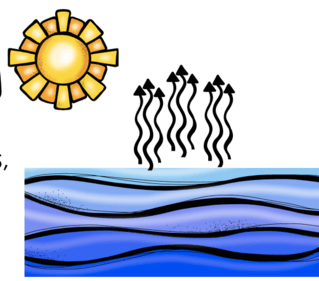
What part of the water cycle does this picture show?
a)
condensation
b)
precipitation
c)
evaporation
47.

the movement of carbon from the nonliving environment into living things and back

a)

Open System

b)

Product

c)

Carbon Cycle

d)

Natural Resource

48.

the process of burning something

a)

Photosynthesis

b)

Carbon Cycle

c)

Cellular Respiration

d)

Combustion