
NEW
Font size
 Worksheets
Chapter 6 Study Guide
Total questions: 31
Worksheet time: 2hrs 33mins
The sum of the unemployment rate and the employment rate always equals 100 percent.
True
False
Discouraged workers are not counted as unemployed because they are working.
True
False
A common measure of inflation is the percentage change in the CPI of adjacent years.
True
False
Jamaal lost his job when a mechanical device replaced people with his skills. If Jamaal's skills are non-transferable, he would be considered to be structurally unemployed.
True
False
Most unemployed persons fall into the category of job loser.
True
False
The CPI was 154 in one year and 165 the following year. How much did prices rise between these two years?
5.46%
6.67%
7.14%
0.07%
Suppose the market basket consists of 100X, 200Y, and 300Z. Current-year prices are $5 for each unit of X, $2 for each unit of Y, and $3 for each unit of Z. Base-year prices are $2 for each unit of X, Y, and Z. What is the approximate CPI in the current year?
15
70.2
1,200
150
One measure of the inflation rate is the
sum of the CPIs of adjacent years
percentage change in the CPI of adjacent years
percentage change in the Real GDP of adjacent
GDP minus the Real GDP in a year
The base year is the year
in which prices are unstable
in which prices are the lowest
in which prices are highest
that serves as a reference point or benchmark
in which nominal output is largest
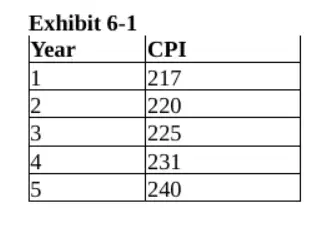
Refer to Exhibit 6-1. Prices rose by __________ percent from Year 1 to Year 2
1.38
0.14
1.29
1.94
3.00
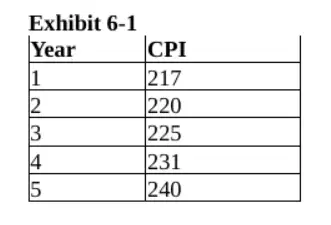
Refer to Exhibit 6-1. Prices rose by __________ percent from Year 2 to Year 3.
3.39
0.023
3.28
2.22
2.27
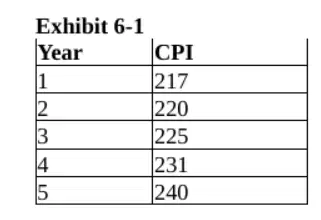
Refer to Exhibit 6-1. Prices rose by __________ percent from Year 4 to Year 5.
3.90
3.75
4.30
5.90
The civilian non-institutional population consists of everyone in the population who is
at least 16 years of age, in the armed forces, or institutionalized
at least 16 years of age
not in the armed forces
not institutionalized
at least 16 years of age ; not in the armed forces ; not institutionalized
A person in the civilian labor force falls into one of two categories
a person who works in a service industry or a person who works in a manufacturing industry
unemployed or employed
disemployed or unemployed
a self-employed worker or a non-self-employed worker
The unemployment rate equals the
number of employed persons divided by the number of unemployed persons
number of unemployed persons divided by the civilian non-institutional population
number of unemployed persons divided by the civilian labor force
sum of unemployed persons and discouraged workers divided by the civilian labor force
Suppose the civilian non-institutional population equals 250,000; there are 132,500 employed persons and 10,000 unemployed persons. How many persons are not in the labor force?
122,500
77,500
63,500
107,500
Suppose the civilian non-institutional population equals 100,000 persons; the civilian labor force equals 75,000 persons; there are 70,000 employed persons and 5,000 unemployed persons. If 5,000 persons who are currently "not in the labor force" decide to join the civilian labor force, and 3,000 of them are unemployed, then
both the unemployment and the employment rate rise
both the unemployment and the employment rate fall
the unemployment rate rises and the employment rate falls
the unemployment rate falls and the employment rate rises
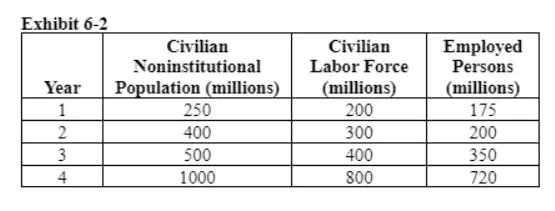
Refer to Exhibit 6-2. How many persons are not participating in the labor force in year 1?
25 million
50 million
75 million
175 million
200 million
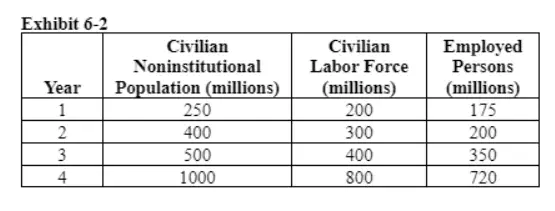
Refer to Exhibit 6-2. How many unemployed persons are there in year 1?
25 million
50 million
75 million
175 million
200 million
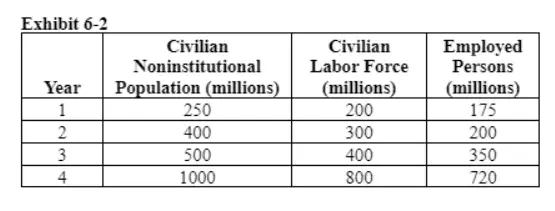
Refer to Exhibit 6-2. The unemployment rate in year 1 is
12.5%
70%
87.5%
30%
10%
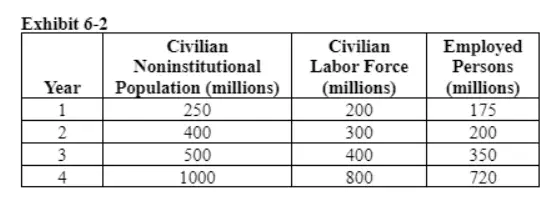
Refer to Exhibit 6-2. The employment rate in year 3 is
12.5%
33.33%
70%
66.66%
25%
In an economy with 200 million people, 140 million hold civilian jobs and 9 million are not working but are looking for jobs. The unemployment rate is
6.4%
6.0%
9.2%
27.4%
4.5%
In an economy with a population of 100 million persons, 42 million hold civilian jobs and 6 million are not working but are looking for jobs. The number counted as unemployed is
48 million
6 million
36 million
52 million
58 million
The cyclical unemployment rate is defined as the __________ unemployment rates.
sum of the structural and the frictional
difference between the structural and the frictional
difference between the existing (actual) and the natural
sum of the natural and the frictional
Assume that Ms. Sawyer's salary is $35,000, up from $31,000 last year, while the CPI is 187.5 this year, up from 180 last year. This means that Ms. Sawyer's real income has ____________ since last year.
increased
decreased
stayed the same
there is not enough information provided to answer this question
If the CPI is 230 in year 1 and 249 in year 2, what is the approximate percentage change in prices between the two years?
7.6%
8.3%
15.7%
11.4%
6.0%
Suppose that the price index in 1999 was 170 and your salary was $44,000. Suppose in 2016 the consumer price index will be 290. What salary will you have to earn in 2016 in order to equal your 1999 real income?
$66,000
$77,647
$75,059
$83,209
Jones lost his job in industry A, but he has skills that can be transferred to industry B (which is currently hiring). Smith lost a job in industry C, but his skills cannot be transferred to industry B or to any other industry. Jones is __________ unemployed and Smith is __________ unemployed.
structurally ; frictionally
structurally ; structurally
frictionally ; frictionally
frictionally ; structurally
If the CPI was 196.5 in 2005 and 172.2 in 2000, by what percentage did prices rise during the period 2000-2005?
0.10%
6.43%
10%
14.1%
A __________ is a person who was employed in the civilian labor force and was either fired or laid off.
new entrant
reentrant
job leaver
job fixer
none of the above
A(n) __________ is a person who was previously employed, hasn't worked for some time, and is currently reentering the labor force.
discourage worker
entrant
reentrant
job loser
job leaver

