
 Worksheets
Biology Benchmark STAAR Review
Total questions: 40
Worksheet time: 20mins
Amino acids are the monomer (a) , while nucleotides are the monomer of (b) .
All life on earth has 6 elements in common. They are Carbon, Hydrogen, Oxygen, Nitrogen, ____, and Sulfur.
Flourine
Calcium
Phosphorus
Potassium
Movement of particles from high to low concentration is....
Passive Transport
Active Transport

Identify the stage of mitosis.
Anaphase
Cytokinesis
Telophase
Metaphase
In meiosis, ___ ______ cells are produced.
4 identical
4 nonidentical
2 identical
2 nonidentical

What do viruses have in common with living cells? They both...
store genetic information
have chloroplasts
use glucose for cellular respiration
have endoplasmic reticulum

Which viral life cycle kills its host cell by lysing (rupturing)?
lytic
mitosis
lysogenic
meiosis
How would the DNA sequence GCATTC be transcribed to mRNA?
GCTAAG
GCATTC
CGUAAG
Which of the following is homozygous recessive?
AA
Aa
aa

In ALL cells, proteins are synthesized (created) by which organelle?
Golgi body
Mitoichondrion
Chromosomes
Ribosomes

Identify the process in the image.
Simple diffusion
Osmosis
Active transport
Facilitated diffusion

In DNA replication, the process is called "semiconservative" because 2 strands are produced, they are...
both completely new
both half new and half old
one completely new and one completely old
The entire set of genes in an organism is known as it's....
DNA sequence
Genotype
Genome
Phenotype

Diffusion is a passive process because it requires NO ENERGY (ATP). What type of diffusion is shown in this diagram?
Osmotic Diffusion
Simple Diffusion
Facilitated Diffusion

What model of a biological process is shown?
Mitosis
Transcription
DNA Replication
Translation
In DNA, adenine bonds with...
Uracil
Thymine
Guanine
Cytosine
All of the following are functions of proteins EXCEPT—
Store and transmit genetic information
Build tissues such as bone and muscle
Control the rate of reactions and regulate cell processes
Help fight disease

Which of these occurs just before the cell enters the G2 stage of the cell cycle?
the nuclear membrane disintegrates
Centrioles form
the nucleolus divides
DNA replicates

According to the graphs, the enzyme works best at what pH and temp?
Temp above 50 degrees C & pH above 12
Temp and pH have no effect on the action of this enzyme
Temp of 50 degrees C and a pH of 10
Temp of 35 degrees C and a pH of 8
If 20% of a DNA sample is made up of thymine (T), what percentage of the sample is made up of adenine (C)?
15%
20%
30%
60%
Identify the monomer. for carbohydrates
Amino acid
Nucleotide
Monosaccharide
Fatty acid
one
two
three
five
Bb
Homozygote
alleles
Blue eyes
Having two of the same genes for the trait is known as...
homozygous
heterozygous
DNA
phenotype
trait
allele
If green is dominant over purple, then which of the following would the possible genotype(s) of a purple individual?
gg
Gg
GG
Gg and gg
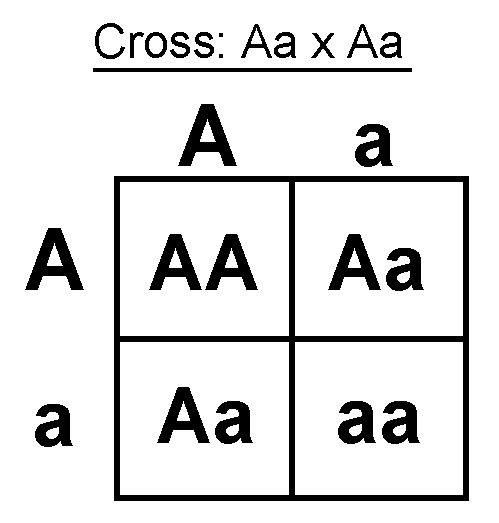
What is the genotypic ratio of the offspring?
3:1
1:3
1:2:1
2:2

What are the possible for this cross?
TT = 25% Tt= 50% tt=25%
100% TT
TT= 75% tt = 25%
Tt = 100%

Identify the hypertonic solution.
1st image (left)
2nd image (middle)
3rd image (right)

Equality
Balance
Homeostasis


The cell to the left is a _______, and the cell to the right is a ________.
eukaryote, prokaryote
prokaryote, eukaryote
The ______________ converts energy from food into a form of energy cells can use: ATP.
Cell membrane
Mitochondria
Nucleus
All of the above

What is the function of the cell membrane?
To control what comes in and out of the cell
To break down food inside the cell
to serve as a barrier
to eat the cells food

A large fluid-filled vesicle located in the cytoplasm of a plant cell.
Central vacuole
What is a rigid structure made of cellulose that give plant cell protection, support, and shape?

