
 Worksheets
REACTION KINETICS - CHEMICAL EQUILIBRIUM - ELECTROCHEMISTRY
Total questions: 118
Worksheet time: 2hrs 32mins
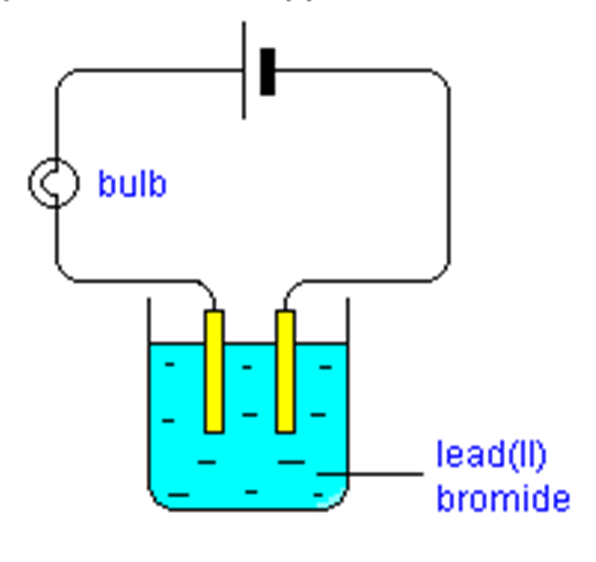
The diagram shows the electrolysis of lead(II) bromide using inert electrodes. Why does the bulb only light up when the lead(II) bromide is melted?
Bromine atoms in lead(II) bromide are converted to ions when it is melted
Electrons flow through the lead(II) bromide when it is melted
The ions in lead(II) bromide are mobile charge carriers in the molten state.
There are no ions in solid lead(II) bromide
What is the half-equation for the discharge of hydroxide ions?
2O2- --> O2 + 4e-
OH- --> OH + e
4OH- --> 2H2O + O2 + 4e-
2H2O + O2 + 4e- --> 4OH-

The picture shows electrolysis of copper(II) sulphate solution using graphite electrodes. Besides formation of brown solid on the cathode, what other observations can be made?
The mass of graphite anode decreases.
The blue colour solution becomes paler.
Bubbles of gas form at the anode.
The blue colour solution becomes darker.

What are the products at the electrodes when dilute sulfuric acid is electrolysed using inert electrodes?
A
B
C
D

The diagram shows the electrolysis of concentrated hydrochloric acid and concentrated aqueous
sodium chloride using carbon electrodes.
At which electrode(s) is hydrogen produced?
electrode 1 only
electrodes 1 and 3
electrode 2 only
electrodes 2 and 4
Polls of Graphite or Platinum through which an electric current enters the electrolyte are collectively called what ?
Electrodes
Anode
Cathode
Cation
In electrolysis, Oxidation occurs in which of the following electrodes?
Cathode
Anode
Both cathode and Anode
Non of the above
In electrolysis, reduction takes place in which of the following electrodes?
Cathode
Anode
Both cathode and anode
Non of the above

A
B
C
D

A
B
C
D

The diagram shows the electrolysis of dilute sulfuric acid.
Which substance is produced at the negative electrode?
hydrogen
oxygen
sulfur dioxide
water
What are the ions present in molten Al2O3?
Al2+ and O3-
Al2- and O3+
Al3+ and O2-
Al3- and O2+

The diagram shows apparatus for plating a spoon with silver.
Which statement is not correct?
Silver would stick to the spoon because it is a very reactive metal.
The electrolyte would be a silver salt dissolved in water.
The metal electrode would be made from silver..
The spoon would be connected to the negative terminal of the power supply.

The diagram shows the electroplating of a steel object.
A student made the following statements.
1 The object turns a reddish-brown colour.
2 The copper sulfate solution changes to a paler blue colour.
3 The copper electrode becomes smaller.
Which statements are correct?
1, 2 and 3
1 and 2 only
1 and 3 only
2 and 3 only

Sodium chloride solution is electrolysed and a gas is collected at each electrode. One gas decolourises moist litmus paper, the other gas burns with a pop.
Which statement is correct?
Chlorine gas is collected at the anode.
Hydrogen gas is collected at the anode.
Oxygen gas is collected at the cathode.
The cathode is the positive electrode.


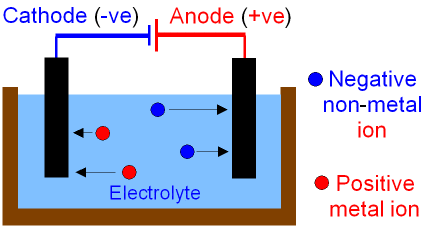

CO32- and OH- are attracted to the positive electrode (anode). What gas forms?
OH-
CO2
O2
H2

PO42- and OH- are attracted to the positive electrode (anode). What gas forms?
OH-
PO42-
O2
H2

If the fork is to be electroplated with silver metal, what electrolyte should be used?
Molten silver chloride
Aqueous silver nitrate
Sodium chloride solution
Copper(II) sulphate solution
Which is not a reason that cryolite is used in aluminum extraction?
Cryolite dissolves aluminum oxide
Cryolite reduces the melting point of aluminum oxide
Cryolite decreases the cost of aluminum extraction
Cryolite removes impurities from aluminum oxide
Which of the following solutions would produce hydrogen gas at the cathode upon electrolysis?
1 Dilute nitric acid
2 Aqueous potassium hydroxide
3 Aqueous sodium chloride
1 only
1 and 2
2 and 3
All of the above
The electrolytic deposition of a superior metal on a baser metal is:
electro-refining
electro-plating
electro-metallurgy
electrolysis
An electric current of 1.04A was passed through a solution of dilute sulphuric acid for 6 minutes. The volume of hydrogen produced at r.t.p. was 43.5 cm3. How many coulombs of charge were passed during the experiment?
6.24C
374.4C
373.4C
324.4C
An electric current of 1.04A was passed through a solution of dilute sulphuric acid for 6 minutes. The volume of hydrogen produced at r.t.p. was 43.5 cm3. How many coulombs of charge are required to liberate 1 mol of H2(g)? (F = 96500C mol-1)
96500C
19300C
193000C
289500C
A student conducted an experiment to calculate a value for the Faraday constant, F. An electric current of 0.3A was passed through the solution of copper (II) sulphate for exactly 40 minutes. 0.240g of copper was deposited at cathode. Use this information to calculate a value of F. (Ar of Cu is 63.5)
96500C
95250C
95350C
96400C

Which statement is correct on electrolysis of aqueous copper (II) sulphate using graphite electrodes?
Colourless gas is produced at negative electrode
Electrolyte does not change colour
Negative electrode decreases in mass
Colourless gas is produced at positive electrode

Which apparatus could be used to electroplate an iron nail with copper?
A
B
C
D
What is the Equation for Charge Flow?
Charge Flow = Current x Time (Q=It)
Charge Flow = Current / Time (Q=I/t)
Charge Flow = Time / Current (Q=t/I)
A current of 5.0 A flows for 4 hours through an aqueous solution of copper sulphate (VI). Calculate the mass of copper deposited at the cathode.
21.69 g
22.69 g
23.69 g
When a certain amount of electric charge flows through an aqueous solution of silver nitrate, 3.24 g of silver is deposited on the cathode.
Calculate the mass of aluminium, Al that will be deposited by the same quantity of charge.
0.27 g
0.29 g
0.40 g
How do you complete the circuit when using 2 half-cells?
acid bridge
base bridge
salt bridge
Different pairs of metals produce different voltages.
True
False

The E0 value for all electrolysis reactions is
positive
neutral
negative

The E0 value for all electrochemical cell reactions is
positive
neutral
negative
Which is not a reason for metal plating?
decorative purposes
prevent rust and corrosion
to make the metal stronger
all of the above


Diagram shows an electrolysis cell.
Which of the substances cause the bulb to light up when electricity passes through it?
Ethanol
Dilute ethanoic acid
Solid lead(II) bromide
Tetrachloromethane

Chemical cells convert
mechanical energy in to electrical energy
potential energy in to electrical energy
electrical energy in to chemical energy
chemical energy in to electrical energy
State one functions of salt bridge
to maintain the movement of electron
to allowing electron to flow and complete the circuit
to separate two electrolyte
to allowing movement of ion to complete the circuit
What is the name of the positive terminal in an electrolytic cell?
cathode
anode

The overall reaction in an electrochemical cell is
Zn(s) + Cu2+(aq) → Zn2+(aq) + Cu(s)
As the reaction in this cell takes place, the
mass of the Zn electrode decreases
Zn2+concentration remains the same
mass of the Cu electrode decreases
Cu2+ concentration remains the same
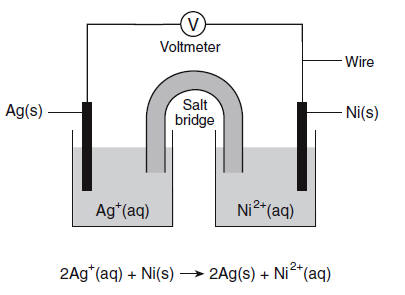
The anode is where oxidation occurs in...
A Galvanic Cell/ voltaic
A Electrolytic Cell
Both Galvanic and Electrolytic cells
In a Galvanic Cell, the anode is...
positive
negative
In a Galvanic Cell, the cathode is...
positive
negative
In a Galvanic cell, the electrons flow from the...
anode to the cathode
cathode to the anode
Ecell =
Ered - Eox
Ered + Eox
Eox - Ered
Eox + Ered
In a Galvanic Cell, the salt bridge...
completes the circuit so that electrons can flow through the wire
maintains charge balance
is soaked in an unreactive electrolyte such as KNO3
all of the above
Consider the galvanic cell reaction Zn (s) + Cu2+ (aq) → Cu (s) + Zn2+ (aq) When the cell is running spontaneously, which is the only true statement?
The copper electrode loses mass and the zinc electrode is the cathode.
The copper electrode gains mass and the copper electrode is the cathode.
The zinc electrode gains mass and the zinc electrode is the anode.
The zinc electrode loses mass and the zinc electrode is the cathode.

WHICH IS ANODE?
COPPER ELECTRODE
ZINC ELECTRODE
ZINC SULFATE SOLUTION
SALT BRIDGE
If an electrochemical reaction is spontaneous, what will Ecell be?
positive
negative


Which electrode will increase in size as the spontaneous reaction takes place?
anode
cathode

What is the equilibrium-constant expression for
CO2(g) + H2(g) ⇌ CO(g) + H2O(l)
Kc= [CO][H2O] / [CO2][H2]
Kc= [CO2][H2] / [CO]
Kc= [CO2][H2] / [CO][H2O]
Kc= [CO] / [CO2][H2]
Le Chatelier's Principle states that "If a (dynamic) equilibrium is disturbed by changing the conditions, the position of equilibrium __________"
shifts to increase the change
shifts to counteract the change
The following reaction : SO2 (g) + NO2 (g) ⇌ SO3 (g) + NO (g) had reached a state of equilibrium, was found to contain 0.40 mol L-1 SO3 , and 0.30 mol L-1 NO, 0.15 mol L-1NO2 , and 0.20 mol L-1 SO2. Calculate the equilibrium constant for this reaction.
What is the equilibrium expression for: Fe3O4(s) + 4H2(g) ⇌ 3Fe(s) + 4H2O(g) Kc =

Around what time does the reaction reach equilibrium?
25 min
70 min
45 min
80 min
A mixture of gases is allowed to reach equilibrium at 700oC in a 12.0 L flask. At equilibrium, the
mixture contains 0.208 M SO2, 1.12×10⁻⁶ M O2 and 0.725 M SO3.
2SO2(g) + O2(g) ⇌ 2SO3 (g)
What is the equilibrium constant, Kc?
9.22 x 10⁻⁸
3.11 x 10⁶
1.08 x 10⁷
4.56 x 10⁸
The reaction of carbon and carbon dioxide reached equilibrium according to the equation,
C(s) + CO2(g) ⇌ 2CO (g)
Kc = 0.122 at 1100 K
What is the value of Kp for this reaction?
0.035 atm
0.12 atm
11 atm
945 atm
Which is the correct statement for a chemical equilibrium?
The rate of the forward reaction is the same as that of the reverse reaction.
The total concentration of product equals that of reactants.
The rate constant of forward reaction equals that of the reverse reaction.
The product of equilibrium concentration of products and reactants equals to the Kc value.
In which the of the following equilibrium systems will the product concentration increase by using
higher pressure?
N2O4(g) ⇌ 2NO2(g)
O2(g) + C(s) ⇌ 2CO(g)
SbCl5(g) ⇌ SbCl3(g) + Cl2(g)
2SO2(g) + O2(g) ⇌ 2SO3(g)
At 2000K, the equilibrium constant KC for the reaction
N2 (g) + O2 (g) ⇌ 2NO (g)
is 4.0 x 10⁻⁴. Determine the concentration of NO at equilibrium if given the concentration of N2 and O2
at equilibrium is 0.25M and 0.33M, respectively.
1.7 x 10⁻⁵ M
5.7 X 10⁻³ M
3.3 X 10⁻⁵ M
6.8 X 10⁻³ M
Which equilibrium is NOT affected by the change of total pressure of the system?
NH4Cl(s) ⇌ NH3(g) + HCl(g)
PCl5(g) ⇌ PCl3(g) + Cl (g)
6H2O(l)+ 6CO2(g) ⇌ C6H12O6(s) + 6O2 (g)
2PbS (s) + 3O2 (g) ⇌ 2PbO(s) + 2SO2 (g)
The endothermic reaction
2NO(g) + Br2(g) ⇌ 2NOBr(g)
Has an equilibrium constant, KP= 116.6 at 25oC
Which of the statement below is NOT true?
the equilibrium constant KP for reverse reaction is 8.58 x 10⁻³
removing Br2 from the reaction vessel decrease the KP value
the equilibrium constant KC is 116.6 RT
KP increase as temperature increased
The equilibrium constant KC for the reaction
N2O4(g) ⇌ 2NO2(g)
is 0.212 at 100 oC. what is the value of KP?
14.28
1.74
198.62
6.49
Consider the following reaction:
2NaHCO3(s) ⇌ Na2CO3(s) + CO2(g) + H2O(g) ; Kp = 0.23
A sample of NaHCO3 is placed in an evacuated flask and is allowed to achieve equilibrium at 373 K.
What is the total gas pressure at equilibrium?
0.12 atm
0.24 atm
0.48 atm
0.96 atm
Hydrogen and carbon dioxide react according to the equation.
H2(g) + CO2(g) ⇌ CO(g) + H2O(g)
When 4.0 mol of hydrogen and 0.9 mol of carbon dioxide were used for this reaction, 0.1 mol of CO2 was found in the equilibrium mixture. Calculate Kc for the reaction.
0.4
0.8
2.0
2.4
The equilibrium constant, Kp, for the reaction,
N2(g) + O2(g) ⇌ 2NO(g)
is 1.3×10⁻¹⁵ at 298 K and 5.5×10⁻² at 2000 K. This means that
the forward reaction is exothermic.
more product is formed as temperature is increased.
the value of Kp depends on the amount of nitrogen used.
the value of Kp increases as the pressure exerted on the system increases
Calculate Kc for the reaction at 827 K when KP = 1.78 x 10³ atm,
2CO2(g) ⇌ 2CO(g) + O2(g)
1.22 x 10⁷
1.21 x 10⁵
2.62 x 101
2.59 x 10⁻¹
Which of the following statements is/are true regarding the following equilibrium?
N2(g) + 3Cl2(g) ⇌ 2NCl3(g) Kp = 1.12×10² at T K
Tick 1 (or more) CORRECT answer(s)
The Kp value for the reverse reaction is 8.93 ×10⁻³.
The forward and reverse reaction rates are the same.
The equilibrium shifts to the right when more NCl3 is added.
In the Haber process, the equilibrium between H2, N2 and NH3 is shown;
N2(g) +3H2(g) ⇌ 2NH3(g) ; ΔH= -ve
What are the ideal conditions needed to obtain the maximum yield of NH3?
low pressure, low temperature
low pressure, high temperature
high pressure, low temperature
high pressure, high temperature
After the adding the C, the system that has achieved an equilibrium is
3C(s) + 3H2(g) ⇌ CH4(g) + C2H2(g)
shift to the right
the volume of the container is decreased
no further changes occur
Kc decreases
2NOBr(g) + Cl2(g) ↔ 2NO(g) + 2BrCl(g)
if
2NOBr(g) ↔ 2NO(g) + Br2(g)
has a Kc = 0.014
Br2(g) + Cl2(g) ↔ 2BrCl(g)
has a Kc = 7.2
For the following reaction:
H2(g) + Cl2 (g) ↔ 2HCl(g),
calculate the concentration of HCl when KC= 2.3x10⁻⁵, [H2]= 0.0056mol, [Cl2]= 0.0048mol.
6.2 x 10⁻¹⁰ M
2.5 x 10⁻⁵ M
1.1 M
1.2 M
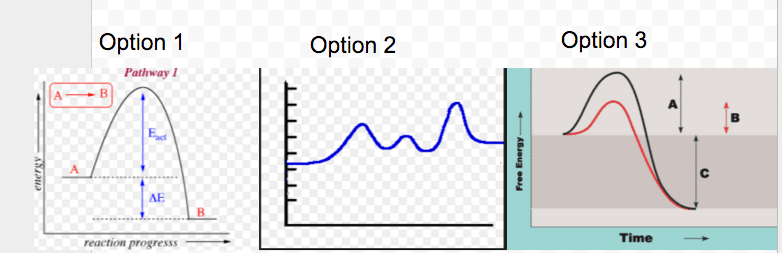
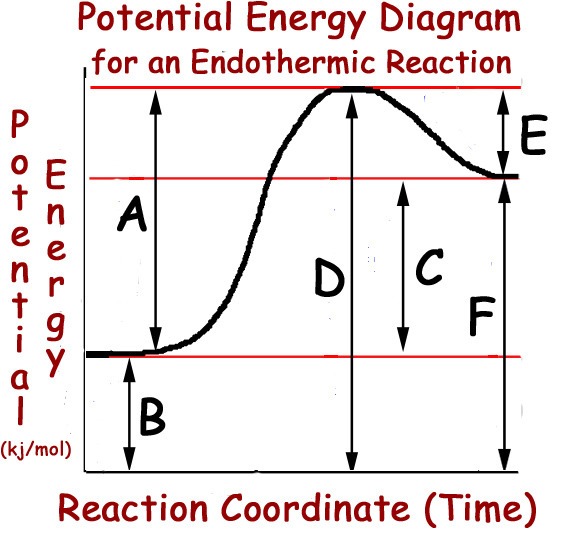
What letter represents the activation energy?
A
B
C
D

An endothermic reaction with high activation energy for the forward reaction is given by the diagram.
A
B
C
D
Which of the following represent the rate of reaction as
A → Product ?
rate = ΔtΔ[A]
rate = −ΔtΔ[A]
rate = Δ[A]Δ t
rate = −Δ[A]Δ t
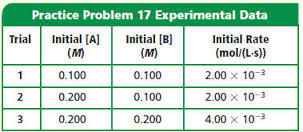
What two trials would you use to find the order for B?
trials 1 and 2
trials 1 and 3
trails 2 and 3
The first order rate constant for the decomposition of 0.5 M compound A at 100oC is 0.03 min-1. Calculate the half-life of A.
1.5 min
8.3 min
23.1 min
66.7 min
What is the unit for rate constant,K if rate law:
Rate = K [A]2
s-1
M s-1
M-1 s-1
M-2 s-1
The rate expression for the reaction
X(g) + 2Y(g) → 3Z(g) is
rate = k [Y]2
By which factor will the rate of reaction increase when the concentrations of X and Y are both increased by a factor of 3?
6
9
18
27
A --> product
The rate constant for above reaction is 0.5 s-1 . If the initial concentration of A is 0.1 M, how long will it take for [A] to drop to 0.025 M?
0.7 s
1.4 s
2.8 s
There is not enough information given.
The reaction A + 2B → products was found to have the rate law, k = k[A][B]2. Predict by what factor the rate of reaction will increase when the concentration of B is doubled and the concentration of A remained uncanged
2
4
6
8
For second order reaction, the initial concentration of reactant A is 0.24 M. If the rate constant is 8.1 x 10⁻² M-1 s-1, what is the concentration of A after 29 seconds?
0.02 M
0.15 M
0.30 M
0.45 M

How are the exponents n and m determined?
For the reaction below, which of the following is the correct differential rate equation?
NH3(g) + O2(g) → NO(g) + H2O(g)
rate = −dtd[NH3]=−dtd[O2]=dtd[NO]=dtd[H2O]
rate = −21dtd[NH3]=−31dtd[O2]=41dtd[NO]=21dtd[H2O]
rate = dtd[NH3]=dtd[O2]=−dtd[NO]=−dtd[H2O]
rate = −41dtd[NH3]=−51dtd[O2]=41dtd[NO]=61dtd[H2O]
Which of the following is a unit of rate of reaction?
s-1
Ms-1
M
M-1s-1
Determine the overall order of the reaction:
rate = k[A][B]0[D]
First order
Zero order
Second order
Third order

Determine the rate of formation of CO2 if the rate of deflation of O2 gas is 0.15 Ms-1.
0.15 Ms-1
0.30 Ms-1
0.10 Ms-1
0.225 Ms-1

One of the most common and important classes of catalysts are in living things, and are called ___
synovial fluids
amino acids
hormones
enzymes

In the nitric oxide reaction, doubling the hydrogen doubled the rate so the reaction is ___
first order, with respect to hydrogen
first order, overall
second order, with respect to hydrogen
second order, overall

The rate law describes the relationship between the initial concentrations of the reactants and ___
the final concentration of products
the rate at which they react
their kinetic energy
the equilibrium constant
what is the order of reaction if
k= 2.3 X 10 -5 lit mol-1 sec-1
3
2
1
0
Consider the Arrhenius equation given below and mark the correct option :
k=Ae−Ea/RT.


Given the hypothetical reaction A + B --> AB, ΔH = -50 kJ
If the activation energy for the forward reaction is 75 kJ, the activation energy for the reverse reaction is
90 kJ
-75 kJ
25 kJ
125 kJ

State the equation shown in diagram below
Activation energy
Arrhenius equation
Rate equation
Arrhenius Constant
Consider the reaction and its rate law given below.
2 A (g) + B(g) --> 2 C(g)
Rate = k[A][B]
At the beginning of one trial of this reaction, [A] = 3.0 M and [B] = 1.0 M. The observed rate for the formation of C is 0.36 mol L-1 s-1.
The numerical value of k, the rate constant is closest to
0.040
0.12
108
6.0

What is the rate law for the reaction?

