wayground logo

Free Printable Worksheets

Font size

S
M
L
XL
Worksheets

Ionic Compounds (Chapter 8)

Total questions: 115

Worksheet time: 2hrs 48mins

Name
Class
Date
1.

What happens when two negatively charged ions are pushed together?

a)

they will repel (move apart)

b)

they will be attracted to each other (move together)

2.

What happens when two oppositely charged ions are pushed together?

a)

they will repel (move apart)

b)

they will be attracted to each other (move together)

3.

The positive ions tend to _____________ electrons.

a)

lose

b)

gain

4.

The negative ions tend to _____________ electrons.

a)

lose

b)

gain

5.

Will a chlorine atom gain or lose electrons?

a)

gain

b)

lose

6.

Will a sodium atom gain or lose electrons?

a)

gain

b)

lose

7.

Why are sodium and chlorine attracted to each other?

a)

they have opposite charges

b)

they both have negative charges

c)

they both have positive charges

8.

How does oxygen become an oxide ion?

a)

it loses 2 electrons

b)

it gains 2 electrons

9.

How does magnesium become an magnesium ion?

a)

it loses 2 electrons

b)

it gains 2 electrons

10.

How does calcium become an calcium ion?

a)

it loses 2 electrons

b)

it gains 2 electrons

11.

Valence electrons are found

a)

in the innermost energy level of an atom

b)

in the middle energy levels of an atom

c)

in the outermost energy levels of an atom

12.

How many valence electrons does hydrogen have?

a)

1

b)

2

c)

3

d)

4

13.

When an atom loses an electron, it becomes a

a)

positive ion

b)

negative ion

c)

neutral ion

d)

neutral atom

14.

Why do all bonds form?

a)

so the number of protons equals the number of electrons

b)

so an atom can become unstable

c)

to fill the outermost energy level

15.
Ionic bonds are between...
a)
Metal and Non-metal
b)
Non-metal and Non-metal
c)
Metal and Metal
16.
How are ionic bonds formed?
a)
Transfer of electrons
b)
Sharing of electrons
17.
Why do elements bond?
a)
To be friends
b)
To create a new element
c)
To become stable
18.
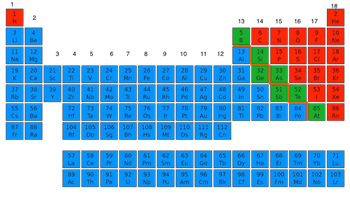
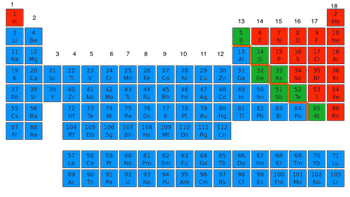
Where are the nonmetals located on the periodic table? 
a)
Blue
b)
Red
c)
Green
19.
Where are metals located on the periodic table?
a)
Blue
b)
Green
c)
Red
20.
Atoms that gain electrons become...
a)
negatively charged
b)
positively charged
c)
remain neutrally charged
d)
21
21.
What is the charge on a Hydrogen ion?
a)
+1
b)
1
c)
2
22.
How many valence electrons does calcium have?
a)
2
b)
4
c)
6
d)
7
23.
An atom that has gained or lost electrons is called ...
a)
a winner
b)
an isotope
c)
an ion
d)
a loser
24.

What type of elements form cations?

a)

metals

b)

nonmetals

c)

metalloids?

25.

Cations

a)

Gain electrons, has an overall positive charge

b)

Lose electrons, has an overall positive charge

c)

Lose electrons, has an overall negative charge

d)

Gain electrons, has an overall negative charge

26.

Anions

a)

Gain electrons, has an overall positive charge

b)

Lose electrons, has an overall positive charge

c)

Lose electrons, has an overall negative charge

d)

Gain electrons, has an overall negative charge

27.

How does oxygen become an oxide ion?

a)

it loses 2 electrons

b)

it gains 2 electrons

c)

it shares electrons

d)

it releases energy

28.

In order to have a stable arrangement of 8 valence electrons, metal atoms are likely to _________electrons.

a)

gain electrons.

b)

lose electrons

c)

gain protons

d)

lose protons

29.
Why do elements bond?
a)
To be friends
b)
To create a new element
c)
To become stable
30.
Is hydrogen considered a metal or a non-metal?
a)
A metal
b)
Nonmetal
c)
Metalloid
31.
Is this ionic bond drawn correctly?
a)
Yes
b)
No
32.
Ionic bonds are between...
a)
Metal and Non-metal
b)
Non-metal and Non-metal
c)
Metal and Metal
33.
Atoms are most stable when their outer shell is complete.
a)
true
b)
false
34.
Two or more atoms held together by a chemical bond is called what?
a)
A molecule
b)
A molecure
35.

How many Aluminum atoms are in Al2O3?

a)

3

b)

5

c)

2

d)

1

36.

Neutral atoms have the same number of

a)

protons and neutrons

b)

neutrons and electrons

c)

Protons and electrons

d)

isotopes and electrons

37.

An atom has 7 valence electrons. In order to get a full valence shell, it is easier for that atom to:

a)

lose 7 electrons

b)

gain 1 valence electron

c)

lose 1 valence electron

d)

gain 2 more valence electrons

38.

When naming ionic compounds, the ______ comes first

a)

nonmetal (negative ion)

b)

nonmetal (positive ion)

c)

metal (negative ion)

d)

metal (positive ion)

39.

When a bond is BROKEN, energy is ______

a)

released

b)

absorbed

40.

Which has a greater ionic character, KCl or K2O?

a)

KCl

b)

K2O

41.

What kind of bonds form in MgBr2?

a)

Ionic Bond

b)

Covalent Bond

c)

Both bonds

d)

Neither bond

42.
What type of elements will form an ionic bond?
a)
Metals + Metals
b)
Nonmetals + Nonmetals
c)
Metals + Nonmetals
d)
None of the above
43.
What is the formula for lithium oxide?
a)
LiO
b)
LiO2
c)
Li2O
d)
Li2O3
44.

What is the correct name for SrF2?

a)

fluoride strontium

b)

strontium fluorine

c)

strontium diflluoride

d)

strontium fluoride

45.

What is the correct name for VBr3?

a)

vanadium(III) bromide

b)

vanadium bromide

c)

vanadium(III) bromate

d)

vanadium tribromide

46.

What is the correct name for CrO?

a)

chromium monoxide

b)

chromium(I) oxide

c)

chromium(II) oxide

d)

chromium oxide

47.

What is the formula for copper(II) phosphide?

a)

Cu2P3

b)

Cu3P2

c)

Cu3(PO4)2

d)

Cu2P

48.
The roman numeral in a compound name indicates ___________________.
a)
the number of metal ions
b)
the charge of the metal ion
c)
nothing
d)
the number of total ions
49.
A(n) _________ is an ion with a positive (+) charge.
a)
anion
b)
cation
c)
ion
d)
solute
50.
________ molecules are found in nature as single atom elements
a)
polyatomic
b)
monatomic
c)
elemental
d)
diatomic
51.

Which of the following types of elements can exist in nature as diatomic molecules?

a)

alkali metals

b)

transition metals

c)

halogens

d)

noble gases.

52.
The desire for an element to have 8 atoms around it is called 
a)
Octet Rule
b)
Resonance
c)
Ionization energy
d)
Electronegativity
53.

Ionic compounds are held together by

a)

intermolecular forces

b)

electrostatic forces

c)

magnetic forces

d)

nuclear forces

54.
Which of the following has a full valence shell?
a)
Oxygen
b)
Neon
c)
Barium
d)
Carbon
55.

Which solid would be a good conductor?

a)

sodium chloride

b)

copper (II) sulfate

c)

glucose

d)

aluminum

56.
KCl
a)
Krypton Chloride
b)
Potassium Chlorine
c)
Potassium Chloride
d)
Potassium Monochloride
57.
LiBr is called
a)
lithium bromine
b)
lithium (I) bromine
c)
lithium bromide
d)
lithuim (I) bromide
58.
What is the correct formula for Sodium Oxide?
a)
NaO
b)
NaO2
c)
Na2O
d)
Na2O2
59.
What formula results when Ca+2  and  Br- ions bond?
a)
Ca2Br2
b)
CaBr
c)
Ca(br)2
d)
CaBr2
60.
What is the correct formula for Zinc(II) Bromide?
a)
ZnBr2
b)
ZNBr
c)
ZnBr
d)
Z2Br
61.
Name that Compound:
MgF2
a)
magnesium fluoride
b)
manganese Phosphide
c)
magnesium(III) fluoride
d)
magnesium fluoride(II)
62.
iron(III) chloride
a)
FeCl3
b)
FeCl
c)
Fe3Cl2
d)
Fe2Cl3
63.
calcium iodide
a)
CaI
b)
Ca2I
c)
CaI2
d)
Ca2I3
64.
Name the Compound:
SnO2
a)
tin(II) oxide
b)
tin(IV)oxide
c)
tin(II)oxegen 
d)
tin oxide
65.
What is an anion?
a)
positive ion
b)
negative ion
c)
neutral atom
d)
2 neutrons taken away
66.
What is a cation?
a)
positive ion
b)
Neutral atom
c)
Two additional protons
d)
negative ion
67.
Name this compound: 
BaBr2
a)
Bromide Baride
b)
Barium bromide
c)
Barium bromate
d)
Boron bromite
68.
Rb2O
a)
rubidium oxalate
b)
rubidium oxide
c)
rubidium (II) oxide
d)
rubidium oxygen
69.
Ag2O
a)
silver oxide
b)
silver (II) oxide
c)
silver oxygen
d)
silver(I)  Oxide
70.
What would be the proper chemical formula for combining Al3+ and l- :
a)
Al l3
b)
Al3l
c)
Al l
d)
All3
71.
What is the name of this compound: Li3N?
a)
Lithium Nitrogen
b)
Lithium nitride
c)
Lithium nitrite
d)
Lithium (III) nitride
72.
What is the formula for magnesium phosphide?
a)
Mg3P2
b)
Mg2P3
c)
Mg2PO3
d)
Mg3(PO3)2
73.
The chemical formula for an ionic compound of potassium and oxygen is
a)
KO.
b)
K2O.
c)
K2O2.
d)
KO2.
74.
The formula of this atom when it becomes an ion would be
a)
N-2
b)
N+3
c)
N-3
d)
N+2
75.
Na +  and  S -2
a)
Na2S
b)
NaS2
c)
Na2S2
d)
NaS
76.
+  and  N-3
a)
KN
b)
KN3
c)
K3N3
d)
K3N
77.
How many valence electrons does a bromine atom have?
a)
1
b)
2
c)
6
d)
7
78.
What is the charge of an atom that has lost one electron?
a)
-1
b)
-2
c)
+1
d)
+2
79.
Which of the following will form an ion with a 2- charge?
a)
Ca
b)
Se
c)
Ge
d)
N
80.
How do the following two elements bond together?
Al3+  O2-         
a)
AlO
b)
Al2O3
c)
Al3O6
d)
Al3O2
81.
A phosphorus atom needs to gain ___ electrons to achieve a full octet.
a)
3
b)
4
c)
6
d)
5
82.
If an element has 3 valence electrons, what charge will likely form on its ion ?
a)
+3
b)
+5
c)
-3
d)
-5
83.
What would be the proper chemical formula for combining Al3+ and l- :
a)
Al l3
b)
Al3l
c)
Al l
d)
All3
84.
What formula results when Ca+2  and  Br- ions bond?
a)
Ca2Br2
b)
CaBr
c)
Ca(br)2
d)
CaBr2
85.
Which is the charge that results when oxygen becomes an ion?
a)
+3
b)
+2
c)
-2
d)
-3
86.
Ionic bonds form between metals and ____.
a)
metalloids
b)
metals
c)
nonmetals
87.

What is the name of the compound CrN?

a)

chromium (II) nitride

b)

chromium (III) nitride

c)

chromium nitride

d)

chromium (I) nitride

88.

What is the name of the compound Mg3N2?

a)

manganese (II) nitride

b)

magnesium nitride

c)

magnesium nitrogen

d)

magnesium (II) nitride

89.

What is the correct name for this polyatomic ion: ClO

a)

hypochlorite

b)

chlorite

c)

chlorate

d)

perchlorate

90.

What is the correct name for this polyatomic ion: CN

a)

carbonate

b)

cyanide

c)

chromate

d)

chromite

91.

What is the correct name for this polyatomic ion: OH

a)

hydrogen carbonate

b)

oxonium

c)

hydroxide

d)

acetate

92.

What is the correct name for this polyatomic ion: NO3

a)

carbonate

b)

hydroxide

c)

nitrite

d)

nitrate

93.

What is the correct name for this polyatomic ion: CrO42–

a)

chromate

b)

dichromate

c)

carbonate

d)

ammonium

94.

What is the correct name for this polyatomic ion: PO43–

a)

phosphorus tetroxide

b)

phosphate

c)

sulphate

d)

hydroxide

95.

What is the correct formula for the polyatomic ion called chlorate?

a)

ClO

b)

ClO2

c)

ClO3

d)

ClO4

96.

What is the correct formula for the polyatomic ion called perchlorate?

a)

ClO

b)

ClO2

c)

ClO3

d)

ClO4

97.

What is the correct formula for the polyatomic ion called hydrogen carbonate?

a)

HCO3

b)

CO32–

c)

CrO42–

d)

CN

98.

What is the correct formula for the polyatomic ion called dichromate?

a)

CO32–

b)

Cr2O72–

c)

CrO42–

d)

CrO3

99.

What is the correct formula for the polyatomic ion called sulphate?

a)

SO32–

b)

HSO4

c)

SO42–

d)

CH3COO

100.

What is the correct formula for the polyatomic ion called ammonium?

a)

NH3+

b)

NH3

c)

CN+

d)

NH4+

101.

What is the name of AgNO3?

a)

Silver Nitrate

b)

Silver Mononitrate

c)

Silver (I) Nitrate

d)

Monosilver Nitrate

102.
What is the name of Mg(OH)2?
a)
Magnesium Hydride
b)
Magnesium Dihydride
c)
Magnesium Dihydroxide
d)
Magnesium Hydroxide
103.
What is the name of K3PO4?
a)
Tripotassium Phosphate
b)
Tripotassium Phosphite
c)
Potassium phosphide
d)
Potassium phosphate
104.
What is the name of NH4Cl?
a)
nitrogen tetrahydrogen chloride
b)
ammonium chlorine
c)
ammonium chloride
d)
ammonium chlorate
105.

Name the following compound: NaNO3

a)

Sodium Nitrogen Oxide

b)

Sodium nitrate

c)

Sodium nitrite

d)

Sodium nitride

106.
What is the name of Al(NO3)3?
a)
Aluminum trinitrate
b)
Monoaluminum nitrate
c)
Aluminum (III) nitrate
d)
Aluminum Nitrate
107.
What's the name of the compound NH4NO?
a)
nitrogen hydrogen oxygen
b)
ammonium nitrite
c)
nitrogenous water
d)
ammonium nitrate
108.
Name the following ionic compound: MgSO4
a)
magnesium sulfoxide
b)
magnesium sulfide
c)
magnesium sulfate
d)
magnesium oxide
109.
Name the following ionic compound: LiNO3
a)
lithium nitrate
b)
lithium III nitrate
c)
lithium nitride
d)
lithium oxide
110.
Which naming pattern is unique to polyatomic ionic compounds?
a)
they can have prefixes
b)
they can end in -ide
c)
they can end in -ate
d)
they use Roman Numerals
111.
What is the name of Al(NO3)3?
a)
Aluminum trinitrate
b)
Monoaluminum nitrate
c)
Aluminum (III) nitrate
d)
Aluminum Nitrate
112.

Polyatomic ions act as a single unit.

a)

True

b)

False

113.

Polyatomic ions are usually very tightly bounded together.

a)

True

b)

False

114.

Write the symbol for aluminum ion.

a)

Al3+

b)

Al3-

c)

Al5+

115.
The elements on the left side of the periodic table are generally always ______ and the elements on the right side of the periodic table are generally always ______.
a)
cations; anions
b)
anions; cations
c)
reactive; non-reactive
d)
non-reactive; reactive