
 Worksheets
2025 Midterm Exam Review
Total questions: 115
Worksheet time: 58mins
If there are two forces going in the opposite direction how would you find the net force?
The SI unit of measure for force.
Newton
force
net force
The sum of all the forces acting on an object is called the __________.
acceleration
net force
terminal velocity
none of the above
__________ is the measure of an objects speed, and what direction it is moving in.
Speed
Velocity
Acceleration
None of the above
__________ is the measure of the rate at which velocity changes.
Speed
Velocity
Acceleration
None of the above
When are you undergoing an acceleration in a car? (Choose all that are correct)
speed up
slow down
make turns
constant speed
The SI unit for acceleration is
mph
ft/sec
m/s2
m/s
In each of the following cases, determine where the car has no acceleration?
A car speeds up after a stoplight turns green.
A car slows down as it approaches a red light
A car with the cruise control set at 80 km/h going down a straight highway
A car turning a curve at a constant speed
A positive acceleration means that your object is _____.
not accelerating
not moving
speeding up
slowing down


You and your friend are moving a couch from one side to another. You push with a force of 20 N to the right and your friend pushes with a force of 25 N to the right.
5 N to the right
45 N to the left
45 N to the right

What is the net force?
10 N to the left
10 N to the right
50 N to the right
60 N to the left
Rough surfaces have _________ compared to smoother surfaces.
greater friction
less friction
the same level of friction
Objects with greater _________ also have greater inertia.
speed
mass
force
friction
Which has the MOST inertia?


Which one of Newton's laws are displayed
2nd law
1st law
3rd law

Which one of Newton's laws is shown
3rd law
2nd law
1st law

Which of Newton's laws is shown
1st law
3rd law
2nd law
An object in motion will stay in motion and an object at rest will stay at rest unless acted upon by an outside force. Which law does this describe
2nd law
1st law
3rd law

If there is a big mass, it would need a stronger force to accelerate it. Which law does this describe?
3rd law
1st law
2nd law
mass and acceleration
__________ energy is energy due to motion of an object.
nuclear
kinetic
potential
mechanical
Energy that is stored is called __________ energy.
nuclear
radiant
potential
kinetic
The energy that is stored in your food is called __________ energy.
electric
kinetic
chemical
gravitational potential
The more speed an object has, the __________ kinetic energy is has.
less
more
same
Temperature is the measure of the average __________ energy of the particles of a substance.
kinetic
potential
Which state of matter has a definite shape and volume?
solid
liquid
gas
plasma
Which state of matter has no definite shape, but has a definite volume?
solid
liquid
gas
plasma
solid
Which state of matter has particles that move quickly, and spread out to fill the container they are in?
solid
liquid
gas

When you place a bottle of water in the freezer what happens to the particles in the liquid?
They are getting bigger.
They are moving slower.
They are moving faster.
They are getting smaller.
Which of the following terms identifies the change from a liquid to a gas only at the surface of a liquid.
Which of the following terms identifies the change from a solid directly to a gas.
Which of the following terms identifies the change from a liquid to a gas.
condensation
freezing
vaporization
melting
Which of the following terms identifies the change from a gas to a liquid.
Which of the following terms identifies the change from a solid to a liquid.
melting
condensation
vaporization
freezing
When matter is heated what happens to the motion of the particles within the matter?
The particles move faster
The particles move slower
Heat does not affect the motion of the particles
When matter is cooled what happens to the motion of the particles within the matter?
The particles will slow down
The particles will speed up
Cooling will not affect the motion of the particles
What happens to particles as a substance vaporizes?
particles gain energy and vibrate so fast they break free from their fixed positions
particles lose energy and move more and more slowly until they become solid
particles gain enough energy to move independently-resulting in either evaporation or boiling
What happens to particles as a substance freezes?
particles gain energy and vibrate so fast they break free from their fixed positions
particles lose energy and move more and more slowly until they become solid
particles don't have energy
Directly proportional means that as one value increases __________.
Inversely proportional means as one value increases the other __________.

This graph shows a __________ proportional relationship.
directly
indirectly
This graph represents ___________ Law.
Charles'
Boyle's
Elements on the periodic table is aranged in order of ___________.
Which definition below best defines the term "element"?
A mixture of two or more substances that can be separated by physical means.
A pure substance made of only one kind of atom and cannot be broken down into simpler substances by chemical means.
A combination of two or more elements chemically bonded together.
A substance that contains atoms with different numbers of protons.
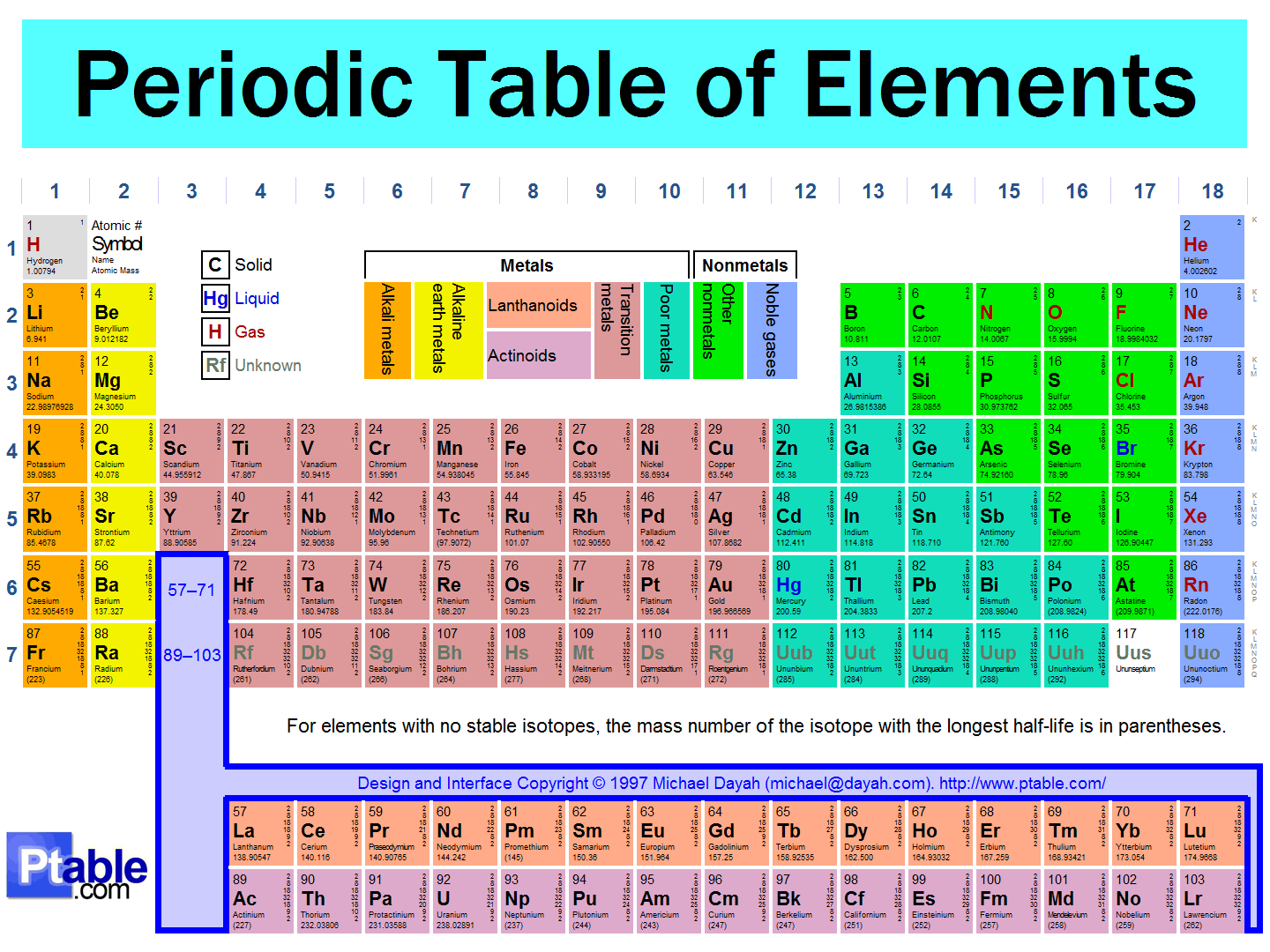
The horizontal (side to side) rows in the Periodic Table are called
groups
families
periods
atomic numbers

The vertical (up and down) columns in the Periodic Table are called
groups
towers
periods
atomic numbers
Elements in the same group ________.
have the same number of electron shells (size)
have similar chemical properties
increase in atomic mass but not in reactivity
are arranged in horizontal rows on the periodic table
Elements in the same period ________.
have the same number of valence electrons
have the same number of electron shells/are similar in size
have similar chemical properties.
are arranged in vertical columns on the periodic table.
What does the atomic number of an element represent?
The total number of protons in the nucleus of an atom.
The combined number of protons and neutrons in an atom.
The total number of electrons an atom can have.
The average mass of all the isotopes of the element.
What is a chemical symbol?
The abbreviation for the name of an element on the periodic table.
A shorthand notation for a chemical reaction.
A representation of the number of protons and neutrons in an atom.
A symbol that shows the charge of an atom.
The first letter of the chemical symbol is always __________, and if there is a second letter, it is always __________.
lowercase; uppercase
uppercase; lowercase
uppercase; uppercase
lowercase; lowercase
What group is Calcium (#20) in?
(a)
What period is Boron (#5) in?
(a)
What is the chemical symbol for the element in Period 3, Group 14.
(a)
What is the chemical symbol for the alkali metal with 19 protons?
(a)

Which of the following elements would have similar chemical properties to that of Chlorine (Cl)?
Bromine (Br)
Neon (Ne)
Carbon (C)
Oxygen (O)
What period and group is Silver?

The positive particles of an atom are ___________.
electrons
protons
neutrons
Particles in an atom that are neutral and have no charge are called __________.
protons
electrons
neutrons

Negatively charged particles that are in the orbitals around the nucleus are called __________
protons
neutrons
electrons
The center of an atom where its neutrons and protons are is called the _____________.
nucleus
electron cloud
center

A proton has a ___________ charge.
+1
-1
0
A neutron has _________ charge.
+1
-1
0
Protons and neutrons both have a mass of __________.
1 amu
0 amu
Electrons have a mass of __________.
1 amu
0 amu
An electron has a _________ charge
+1
-1
0
Typically in a neutral atom, which two subatomic particles are equal in number?
protons and neutrons
all subatomic particles are equal in number
neutrons and electrons
protons and electrons
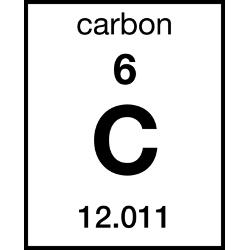
What does the 6 represent in the image?
An element is defined by its number of __________.
protons
electrons
neutrons
protons + electrons
The octet rule states that atoms tend to gain/lose electrons so that they have _____ valence electrons.
2
6
8
10
What is a positive ion called?
anion
cation
isotope
covalent
What is a negative ion called?
anion
cation
covalent
isotope
If an atom loses electrons, the charge will be ___________.
Negative
Positive
If an atom gains electrons, the charge will be __________.
Negative
Positive
What two types of atoms make an ionic bond?
Two non-metals
A metal and a non-metal
Two metals
Nitrogen has 5 valence electrons, therefore it will _________ valence electrons to become stable.
lose 5
gain 5
lose 3
gain 3
Calcium has 2 valence electrons, therefore it will _________ valence electrons to become stable.
lose 1
gain 1
lose 2
gain 2
A Bromine ion gains 1 electron, which of the following is the correct symbol for a Bromine ion?
Br-1
Br+1
Br+7
Br-7
An atom with 2 protons, 3 neutrons, and 4 electrons has a charge of (a) .
Which of the following is true about Ionic Bonds? (select ALL TRUE options)
High melting point
Low melting point
Can dissolve in water
Cannot dissolve in water
Can conduct electricity
What two types of atoms make a covalent bond?
Two non-metals
A metal and a non-metal
Two metals
Bonds that form because of opposite charges
When two non-metal atoms share valence electrons
When electrons are transferred between atoms
The chemical formula for Bromine monofluoride is:
Br1F1
BrF
Br2F
BrF2
Which of these element pairs would bond covalently?
Fr and K
Sc and O
F and Cl
He and Pt
dinitrogen pentoxide
N2O5
NO5
N5O2
N2O6
Which characteristic is typical of a nonpolar covalent bond?
Unequal sharing of electrons
High electronegativity difference
Equal sharing of electrons
Complete transfer of electrons
Which characteristic is typical of a polar covalent bond?
Equal sharing of electrons
Unequal sharing of electrons
Complete transfer of electrons
No sharing or transfer of electrons
Which of the following is a common property of covalent molecules?
High melting and boiling points
Good conductors of electricity in solid form
Low melting and boiling points

