wayground logo

Free Printable Worksheets

Font size

S
M
L
XL
Worksheets

First Semester Chemistry Final Exam Review

Total questions: 117

Worksheet time: 6hrs 44mins

Name
Class
Date
1.

How many significant figures does the following measurement have: 0.002040 m?

a)

6

b)

4

c)

3

d)

2

2.

Round 0.010229 min to four sig figs

a)

1022 min

b)

1023 min

c)

0.01023 min

d)

0.01022 min

3.
What is the measurement 1042 Liters rounded to 2 significant figures? 
a)
1040 L
b)
1.1 x 10³ L
c)
1.0 x 10L
d)
1050 L
4.

What is 98.907 g rounded to 1 significant figure?

a)

98.9 g

b)

90 g

c)

100 g

d)

98.91 g

5.

Solve and round to the correct number of significant figures:

12.5-mL + 20.05-mL + 2.69-mL

a)

35-mL

b)

35.2-mL

c)

35.24-mL

d)

35.240-mL

6.

Solve and round to the correct number of significant figures:

0.00040-m × 0.0021-m

a)

0.00000084-m2

b)

0.0000084-m2

c)

8 x 10⁻⁷-m2

d)

8.45 x 10⁻⁷-m2

7.

Solve and round to the correct number of significant figures:

1.3562-mL / 14.32 g

a)

0.09-mL/g

b)

0.097-mL/g

c)

0.0973-mL/g

d)

0.09471-mL/g

8.

How is volume derived?

a)

length X width

b)

force X length

c)

length X width X height

d)

mass/volume

9.

What is the unit abbreviation for density?

a)

g/cm3

b)

g/m3

c)

kg/cm3

d)

kg/m3

10.

Which prefix means 1 thousand times bigger?

a)
deka-
b)
centi-
c)
giga-
d)
kilo-
11.

Which prefix means 100 times smaller?

a)
milli-
b)
kilo-
c)
pico-
d)
centi-
12.

Which prefix means 1000 (thousand) times smaller?

a)
milli-
b)
mega-
c)
micro-
d)
nano-
13.

Which prefix means 1 x 10⁹ times smaller?

a)
micro-
b)
hecto-
c)
nano-
d)
centi-
14.

Which prefix means 1 x 10¹² times smaller?

a)
hecto-
b)
micro-
c)
nano-
d)
pico-
15.

Convert 300 meters to centimeters:

a)

3000 cm

b)

0.3 cm

c)

30,000 cm

d)

3 cm

16.
How would you write 4.3756 x 10in standard form?
a)
437,560,000
b)
0.00043756
c)
43,756
d)
4.3756
17.
Convert 15.34 cm to nm.
a)
4351 nm
b)
1.534 nm
c)
1.534 x 10 ^8 nm
d)
15.34 x 10^5 nm
18.
A combination of base units is ____ unit. An example of this unit is density (g/cm^3).
a)
derived
b)
standard
c)
base
d)
prefix
19.
Density is a derived unit because ---.
a)
volume is divided by mass.
b)
length times width times height.
c)
mass is multiplied by volume.
d)
mass is divided by volume.
20.
How many minutes are in a year?
a)
I can't count that high.
b)
525,600min
c)
52,560min
d)
31,536,000min
21.
How many gallons are in a pool that holds 758,000 Liters?
(1 gallon = 3.79 Liters)
a)
200
b)
20,000
c)
200,000
d)
2,000,000
22.

The length of a desk is 3.5 feet. How many centimeters is the length?

(there are 2.54 cm in an inch)

a)

60 cm

b)

120.23 cm

c)

106.68 cm

d)

117.12 cm

23.
Elijah earn $200 for 8 hours of work. What is the unit rate (in dollars per hour)?
a)
$50 per hour
b)
$12 per hour
c)
$192 per hour
d)
$25 per hour
24.
 Convert 2.5 grams into milligrams.
a)
25 mg
b)
25,000 mg
c)
250 mg
d)
2500 mg
25.

My cup of coffee hold 350 mL (milliliters) how many kL (kiloliters) is my coffee cup

a)

350 kL

b)

35 kL

c)

.35 kL

d)

.00035 kL

26.
A bar of copper has a mass of 216g and a volume of 24cm3. What is the density of copper?  
a)
9g/cm3
b)
.11g/cm3
c)
5184g/cm3
d)
322mL
27.
We start with 50 mL in a graduated cylinder and drop in an object.  The water rises to 64 mL.  What is the volume of this object?
a)
64 mL
b)
64
c)
14 mL
d)
14
28.
Which of the following is correct scientific notation?
a)
20.35 x 10⁴
b)
.2035 x 104
c)
2035 4
d)
2.035 x10⁴
29.
Which is true of matter?
a)
It takes up space but does not have mass.
b)
It has mass and takes up space. 
c)
It does not take up space.  
d)
Matter is not found on earth. 
30.
Which process converts water vapor into a liquid form?
a)
evaportation
b)
sublimation
c)
freezing
d)
condensation
31.

Mg is best described as...

a)

Element

b)

Compound

c)

Mixture

d)

Colloid

32.

Water, H2O, is best described as...

a)

Element

b)

Compound

c)

Homogeneous Mixture

d)

Heterogeneous Mixture

33.

Sugar is best described as...

a)

Element

b)

Compound

c)

Homogeneous Mixture

d)

Heterogeneous Mixture

34.

Gold is best described as...

a)

Element

b)

Compound

c)

Homogeneous Mixture

d)

Heterogeneous Mixture

35.

Pure Air is best described as...

a)

Element

b)

Compound

c)

Homogeneous Mixture

d)

Heterogeneous Mixture

36.
Is melting butter for popcorn a chemical or physical change?
a)
chemical
b)
physical
37.
Is burning wood a chemical or physical change?
a)
chemical
b)
physical
38.
The ability of a substance to dissolve in water is its ____.
a)
conductivity
b)
magnetism
c)
solubility
d)
reactivity
39.
Which of the following is an example of a CHEMICAL change?
a)
Burning a marshmallow
b)
Melting a marshmallow
40.
Combustibility is a measure of how easily a substance will ____.
a)
dissolve in water
b)
burn
c)
conduct electricity
d)
change color
41.
When you put peroxide on a cut, it bubbles up. This is an example of a ______.
a)
chemical reaction
b)
physical change
42.

leaves changing color

a)

chemical change

b)

physical change

43.

__________ are made up of solutes and solvents.

a)
Solutions
b)

Heterogenous Mixtures

c)

Pure Substances

44.
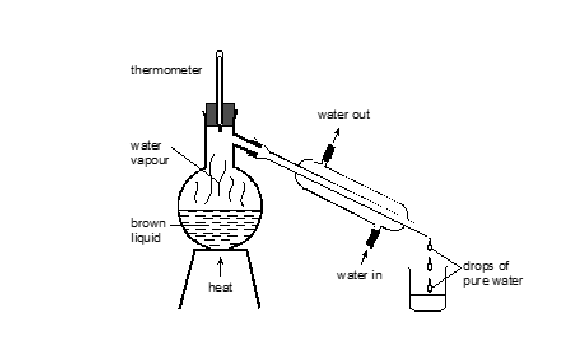
Which one of the following is the name for separation technique in the picture below
a)
distillation
b)
seiving
c)
evaporation
d)
decanting
45.
Which separation technique uses the apparatus shown in the diagram?
a)
filtration 
b)
 crystallisation
c)
distillation
d)
chromatography
46.

How can you separate salt from water so that you can retain the salt component?

a)
a) Evaporation
b)
b) Distillation
c)
c) Chromatography
d)
d) Filtration
47.

The pure liquid collected in the collection flask is called the:

a)

residue

b)

filtrate

c)

distillate

d)

doctrine

48.
The positive particles of an atom are 
a)
electrons 
b)
positrons 
c)
neutrons 
d)
protons 
49.
Particles in an atom that are neutral and have no charge are 
a)
negatrons 
b)
electrons 
c)
neutrons 
d)
protons 
50.
An atoms overall charge is 
a)
positive 
b)
depends on its mood 
c)
neutral 
d)
negative 
51.
If an atom has 3 electrons, how many protons does it have?
a)
1
b)
2
c)
4
d)
3
52.
The subatomic particle with a negative charge is the
a)
electron
b)
proton
c)
neutron
d)
nucleus 
53.
What is the atomic number?
a)
the number of protons
b)
the number of protons and neutrons
c)
the number of neutrons
d)
the number of protons and electrons
54.
What is the mass number?
a)
the number of protons
b)
the number of protons and neutrons
c)
the number of neutrons
d)
the number of protons and electrons
55.
An atom with an unequal number of protons and electrons is said to have (a) ___.
a)
no charge
b)
balance
c)
charge
d)
unbalance
56.
How many neutrons does the isotope of lithium have?
a)
8
b)
3
c)
4
d)
5
57.
How many protons does this isotope of titanium have?
a)
48
b)
22
c)
26
d)
70
58.
Nitrogen has three occurring isotopes: Nitrogen-13, Nitrogen-14, Nitrogen-15. Which isotope is the most abundant?
a)
Nitrogen-13
b)
Nitrogen-14
c)
Nitrogen-15
d)
Based on the information given, it cannot be determined
59.
Do the following atoms belong to the same element? Explain
       Aluminum-27
       An atom with 14 protons and 13 neutrons
a)
Yes because they have the same number of protons
b)
Yes because they have the same mass
c)
No because they have different number of protons
d)
No because they have different number of neutrons
60.
Calcium has three different isotopes. One has a mass of 35.00 amu; another has a mass of 41.00 amu; and another has a mass of 40.00 amu. Which isotope is the most abundant of the three?
a)
40.00 amu
b)
41.00 amu
c)
35.00 amu
d)
impossible to tell
61.
This particle determines what element you have - the elements identity.
a)
electron
b)
proton
c)
neutron
d)
valence shell
62.
All of the mass of an atom comes from what location?
a)
nucleus
b)
electron cloud
63.
What contribution did John Dalton make to atomic theory? 
a)
He discovered that every atom was positively charged. 
b)
He discovered that every element consisted of one type of atom.  
c)
He discovered that atoms had nuclei. 
d)
He discovered that atoms could be divided into smaller parts. 
64.
Place the following scientists in order, from earliest to latest: 
A) Ernest Rutherford
B) J.J. Thomson
C) John Dalton
a)
B,C,A
b)
C,A,B
c)
A,C,B
d)
C,B,A
65.
J.J. Thomson provided evidence that an atom...
a)
is the smallest particle of matter
b)
contains negatively charged particles
c)
has an overall negative charge
d)
has an overall positive charge
66.
Rutherford's gold foil experiment provided evidence that...
a)
negative and positive charges are spread evenly throughout the atom.
b)
alpha particles have a positive charge.
c)
gold is not a dense as previously thought.
d)
there is a dense positively charged nucleus at the center of an atom.
67.
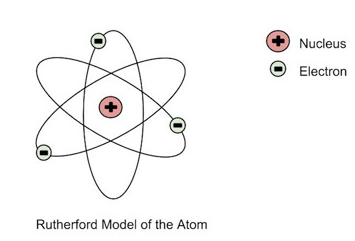
Who came up with this model of an atom?
a)
J.J. Thompson
b)
Ernest Rutherford
c)
Neils Bohr
d)
James Chadwick
68.
True or False: The majority of an atom is made up of empty space
a)
True
b)
False
69.
The majority of an atom's mass exists where?
a)
In the nucleus
b)
In the electron cloud
c)
In the space between the nucleus and the electrons
d)
In the neutrons
70.
Which particle is responsible for the chemical properties of an atom?
a)
Neutron
b)
Protons
c)
Valence Electrons
d)
Nucleus
71.
An alpha particle consists of 
a)
A proton and a neutron 
b)
2 protons and 2 neutrons 
c)
3 protons and 3 neutrons 
d)
One proton 
72.
The set of orbitals that are dumbbell shaped and directed along the x, y, and z axes are called 
a)
d orbitals.
b)
p orbitals.
c)
f orbitals.
d)
s orbitals
73.

How many atomic orbitals exist in a d orbtial?

a)

1

b)

7

c)

3

d)

5

74.
If electrons in an atom have the lowest possible energies, the atom is in the
a)
ground state.
b)
inert state.
c)
excited state.
d)
radiation-emitting state.
75.

An atomic emission spectrum is produced when an electron moves from one energy level

a)

into the nucleus.

b)

to another position in the same sublevel.

c)

to a higher energy level.

d)

to a lower energy level.

76.
According to the Bohr model of the atom, the single electron of a hydrogen atom circles the nucleus
a)
in specific, allowed orbits.
b)
in one fixed orbit at all times.
c)
at any of an infinite number of distances, depending on its energy.
d)
counterclockwise.
77.

An atomic orbital can at most hold how many electrons, according to the Pauli Exclusion Principle?

a)

1 electron

b)

2 electrons

c)

3 electrons

d)

4 electrons

78.

A three-dimensional region around a nucleus where an electron may be found is called a(n)

a)

orbit

b)

mitochondria

c)

atomic orbital

d)

nucleus

79.
All orbitals of equal energy are occupied by one electron before any single orbital is occupied by a second electron.
a)
Aufbau principle
b)
Pauli exclusion principle
c)
Hund’s rule
d)
Core Notation
80.
An electron occupies the lowest energy orbital that can receive it.
a)
Hund’s rule
b)
Pauli exclusion principle
c)
Bohr model of the atom
d)
Aufbau principle
81.
Which guideline, Hund’s rule or the Pauli exclusion principle, is violated in the following orbital diagrams?
a)
Aufbau's
b)
Hund's
c)
Pauli exclusive
82.
Which of the waves shown below has the higher frequency?
a)
wave A
b)
Wave B
83.
Identify the element for
[Xe] 6s2 4f14 5d4
a)
Cobalt
b)
Iron
c)
Tungstun
84.

What is the shape of the s orbital?

a)

dumbbell

b)

sphere

c)

clover

d)

flat

85.

What element has the electron configuration 1s2 2s2?

a)

Li

b)

Be

c)

He

d)

Mg

86.

When the frequency of a wave increases, what happens to the wavelength?

a)

The wavelength stays the same.

b)

The wavelength increases.

c)

The wavelength decreases.

d)

The wavelength is not related to the frequency.

87.

Which has the longest wavelength and, therefore, the lowest energy?

a)

Gamma Rays

b)

Radio Waves

c)

Visible Light

d)

Infrared rays

88.
The _______________ determines the color of visible light. 
a)
wavelength
b)
speed
c)
amplitude
d)
light
89.

Consider the spectrum for the hydrogen atom. in which situation will light be produced?

a)

electrons absorb energy as they move to an excited state

b)

electrons release energy as they move to an excited state

c)

electrons absorb energy as they return to the ground state

d)

electrons release energy as they return to the ground state

90.

Which energy level has the lowest energy?

a)

n = 1

b)

n = 2

c)

n = 3

d)

n = 4

91.
The arrows pointing down represents...
a)
photon absorption
b)
proton emission
c)
electron absorption
d)
electron transition
92.
The parallel lines represents...
a)
energy levels of the atom
b)
energy levels of the electrons
c)
energy levels of the photons
d)
energy levels of the nucleus
93.
There are seven arrows shown. Which would correspond to the longest wavelength?
a)
the left Lyman arrow
b)
the right Lyman arrow
c)
the left Balmer arrow
d)
the Paschen arrow
94.
Each column in the periodic table is called a 
a)
period
b)
group
c)
cluster
d)
unit
95.
Which group of the periodic table is composed of inert (not reactive)  gases?
a)
alkali metals
b)
alkaline earth metals
c)
halogens
d)
noble gases
96.
Elements which are shiny, conduct electricity and heat are called
a)
metal
b)
nonmetal
c)
metalloid
d)
nonexistent
97.
A horizontal row of elements in the periodic table.
a)
column
b)
group
c)
period
98.
Which is an alkali metal?
a)
Magnesium
b)
Iron
c)
Sodium
d)
Europium
99.
Elements in a ..................have similar chemical properties.  
a)
period
b)
group
c)
row
100.
In the modern periodic table elements are arranged by:
a)
atomic mass
b)
atomic number
c)
valence electrons
d)
number of isotopes
101.
The atoms along the staircase are called 
a)
metals
b)
nonmetals
c)
metalloids
d)
noble gases
102.
Which is a halogen?
a)
Helium
b)
Chlorine
c)
Oxygen
d)
Neptune
103.
States repeating properties of element change with atomic numbers.
a)
group
b)
period
c)
periodic law
104.
As you move left to right across a period, the atomic radius will ....
a)
decrease
b)
increase
c)
stay the same
105.
How did Mendeleev organize the elements in his periodic table?
a)
increasing mass only
b)
increasing atomic number only
c)
increasing atomic mass with periods and groups
d)
increasing atomic number with periods and groups
106.
Why did Mendeleev leave blanks in his periodic table?
a)
forgot elements
b)
left room for elements not yet discovered
c)
placed elements in wrong positions leaving gaps
107.
As you move from Aluminum to Gallium, the atomic radius will ....
a)
decrease
b)
increase
c)
stay the same
108.
As atoms of elements in group 16 are considered in order from top to bottom, the electronegativity of each successive element....
a)
decreases
b)
increases
c)
remains the same
d)
none of the above
109.
As you move down the periodic table atoms get bigger.  This is because ____________.
a)
The atoms have more mass.
b)
The atoms have more protons.
c)
The atoms have more energy levels
d)
The atoms have more nuetrons
110.
As you move across the periodic table atoms tend to get smaller because, ______________.
a)
the atoms have more mass.
b)
the atoms have less mass
c)
the atoms have more protons.
d)
the atoms have less electrons.
111.
Atoms that have a high electronegativity, _______________.
a)
give up their electrons more easily.
b)
hold on to their electrons more tightly.
c)
have more electron shells.
112.
Electronegativity is...
a)
how good an atom is at attracting electrons
b)
the ability of an atom to lose electrons
c)
the energy required to remove an electron from a specific atom
d)
how easy it is to make friends. 
113.
Ionization energy is...
a)
the energy required to add an electron to a specific atom
b)
how much energy it takes to remove an electron from an atom
c)
the energy required to shield the outer electrons from the nucleus
d)
a measure of the ability of an atom to attract electrons
114.
The atom with the largest atomic radius in Group 18 is - 
a)
Ar
b)
He
c)
Kr
d)
Rn
115.
Which statement correctly and completely identifies a trend?
a)
Atomic radius decreases across a period and increases down a group.
b)
Electronegativity decreases across a period and decreases down a group.
c)
Ionization energy increases across a period and increases down a group.
d)
Ionic radius increases across a period and increases down a group.
116.
The element with the largest electronegativity in the halogens is - 
a)
At
b)
F
c)
Cl
d)
Br
117.

Stable electron configurations contain

a)

Unfilled s orbitals

b)

Fewer electrons than unstable configurations

c)

Filled s and p orbitals

d)

Electrons with only a clockwise spin