
 Worksheets
RATE OF REACTION
Total questions: 120
Worksheet time: 1hrs 24mins
Which factors affect the rate of a reaction?
temperature
concentration
size
pressure
catalyst
Increase in temperature causes the particles to
slow down
move faster
stay apart from each other
move in the correct order
Why does a higher concentration increase the rate of reaction?
it increases the amount of reactants
it lowers the activation energy
it increases the energy of reactant particles
it increases the frequency of collision
Why does a higher temperature increase the rate of a reaction?
It increases both the frequency collision and energy of reactant particles
It only increases the frequency of collision
It only increases the energy of reactant particles
It reduces the activation energy of the reaction
Grinding an effervescent tablet into powder increases the rate of reaction due to increase of
concentration
total surface area
temperature
size

Which factors increase the rate of a reaction?
increasing temperature
increasing concentration
increasing total surface area
All of these
Increasing the temperature gives particles more __________.
time
energy
space
frequency
Why does breaking up a solid reactant increase the rate of reaction?
it creates more solid
it creates more energy
it increases the total surface area
it increases the concentration
Why does a higher concentration increase the rate of reaction?
it increases the amount of reactants
it lowers the activation energy
it increases the energy of particle collisions
it increases the frequency of collisions
Which graph shows the effect of increasing temperature on the rate of reaction of calcium carbonate with dilute hydrochloric acid?
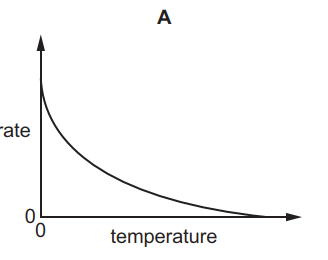
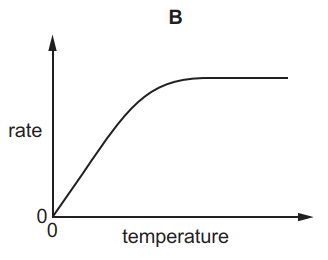
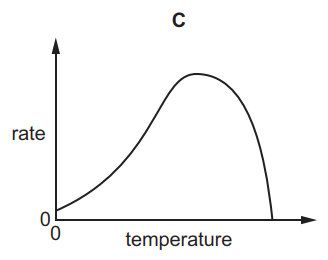
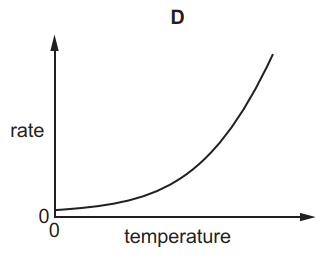
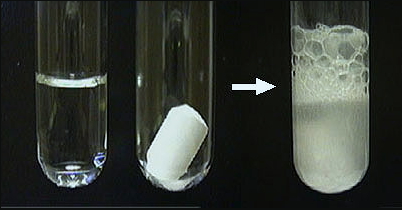
How could we make this reaction happen more quickly?
Decrease the concentration of the acid
crush the chalk to increase the surface area
Put the test tube in an ice bath

What is effective collision?
The collision that produce new substance.
The collision that has energy.
The collision that influence the rate of reaction.
The collision that break down all the cubstances.
Rate of reaction can be measured by ... .
Measuring the bubble amount.
Measuring the product decreases.
Measuring the product increases.
Measuring the reactant increases.

Look at the picture. What method is used to measure the rate of reaction according to the picture?
Product's mass measuring.
Product volume measuring.
Reactant volume measuring.
Reactant's mass measuring.
Look at the chemical reaction below:
Mg+ Cu(NO3)2-->
Write the product.
MgCu(NO3)2
CuMg(NO3)2
Cu+ Mg(NO3)2
CuMg+ (NO3)2
Which single displacement can occur?
Al+ Li2SO4Al
Li+ Al2(SO4)3
LiAl+ (SO4)3
Al+ Li
A student add marble chip into hydrochloric acid to produce carbondioxide bubble. Which way cannot ben used to speed up the chemical reaction?
Adding more marble chip.
Using high concentration of hydrochloric acid.
Use marble powder.
Heat the chemical reaction.
A student plan to investigate the rate of reaction written below:
Na2S2O3(aq)+ 2HCl(aq)--> 2NaCl(aq)+ H2O(l)+SO2(s)+ S(s)
The student did the experiment at home. He doesn't have electrical balance and syringe. What method the student can use?


Look at the picture. Differentiate the situation of those 3 chemical reaction.
Those three chemical reactions are the chemical reaction using the different time.
Those three chemical reactions are done in 3 different reactant.
Those three chemical reactions are done in 3 different temperature in which the red graph is the highest, follow by blue graph and yellow is the lowest.
Those three chemical reactions are done in 3 different temperature in which the yellow graph is the highest temperature, follow by blue graph and red.
A student investigate the reactivity of some unknown metals: X, Y and Z. She used the same amount of those metals in the test tubes, then add the same amount of hydrochloric acid. Those metals reacted to produce gass. X stop react after 45 sec. Y stop react after 26 sec. Z stop react after 65 sec.
Arrange the reactivity of those 3 metals from the most reactive to the least reactive.
X, Y, Z
Z, Y, X
Y, X, Z
Z, X, Y
A student want to investigate the influence of concentration to the rate of reaction written below:
Fe + HCl --> FeCl+ H2
What to keep the same and different?
We've to keep the same amount of Fe and HCl but set the different time to do the experiment.
We've to set all the same, unless the amount of HCl.
We have to keep the amount of Fe and HCl the same but using different HCl concentration.
We've to use catalyst and more Fe. But we keep using the same item of chemical.
Which factors affect the rate of a reaction?
temperature
concentration
size
pressure
catalyst
Increase in temperature causes the particles to
slow down
move faster
stay apart from each other
move in the correct order
Why does a higher concentration increase the rate of reaction?
it increases the amount of reactants
it lowers the activation energy
it increases the energy of reactant particles
it increases the frequency of collision
Why does a higher temperature increase the rate of a reaction?
It increases both the frequency collision and energy of reactant particles
It only increases the frequency of collision
It only increases the energy of reactant particles
It reduces the activation energy of the reaction
Grinding an effervescent tablet into powder increases the rate of reaction due to increase of
concentration
total surface area
temperature
size
Which factors increase the rate of a reaction?
increasing temperature
increasing concentration
increasing total surface area
All of these
Increasing the temperature gives particles more __________.
time
energy
space
frequency
Why does breaking up a solid reactant increase the rate of reaction?
it creates more solid
it creates more energy
it increases the total surface area
it increases the concentration
Why does a higher concentration increase the rate of reaction?
it increases the amount of reactants
it lowers the activation energy
it increases the energy of particle collisions
it increases the frequency of collisions
Which graph shows the effect of increasing temperature on the rate of reaction of calcium carbonate with dilute hydrochloric acid?
How could we make this reaction happen more quickly?
Decrease the concentration of the acid
crush the chalk to increase the surface area
Put the test tube in an ice bath
Why does catalyst increase the rate of reaction?
They can repel each others
It can decrease the activation energy
They can collide more often
They get more energy to collide

The diagram above reveals some reaction with their activation energy. Order the fastest rate of reaction to the slowest rate of reaction
B-A-C-D
B-A-D-C
C-D-A-B
D-C-A-B
Increase in temperature causes the particles to
slow down
move faster
stay apart from each other
move in the correct order
Why does a higher concentration increase the rate of reaction?
it increases the amount of reactants
it lowers the activation energy
it increases the energy of reactant particles
it increases the frequency of collision
Why does a higher temperature increase the rate of a reaction?
It increases both the frequency collision and energy of reactant particles
It only increases the frequency of collision
It only increases the energy of reactant particles
It reduces the activation energy of the reaction
Grinding an effervescent tablet into powder increases the rate of reaction due to increase of
concentration
total surface area
temperature
size
Which factors increase the rate of a reaction?
increasing temperature
increasing concentration
increasing total surface area
All of these
Increasing pressure causes the reacting particles
to bond together
to repel from each other
gain more kinetic energy
to move closer together
Increasing the temperature gives particles more __________.
time
energy
space
frequency
As the frequency of ________________ collision increases, the rate of reaction increases.
time
speed
effective
efficient
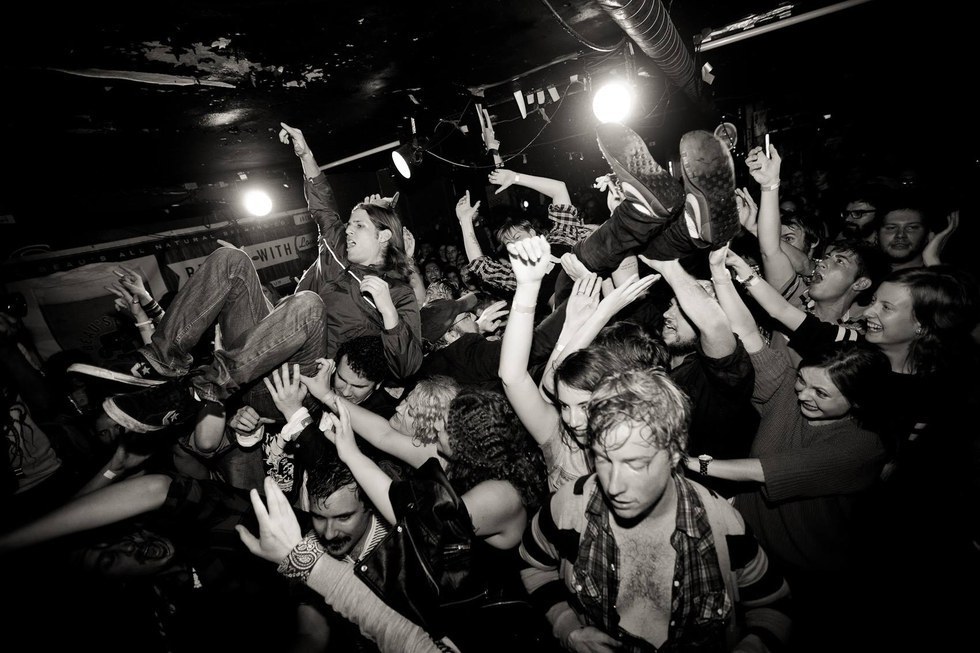
You add more bodies into a "mosh pit" to hope for more collisions. You have increased
temperature
concentration
pressure
catalyst
Why does a higher concentration increase the rate of reaction?
it increases the amount of reactants
it lowers the activation energy
it increases the energy of particle collisions
it increases the frequency of collisions
Which one shows that a chemical reaction has occurred?
dissolving
melting
formation of a gas
bending

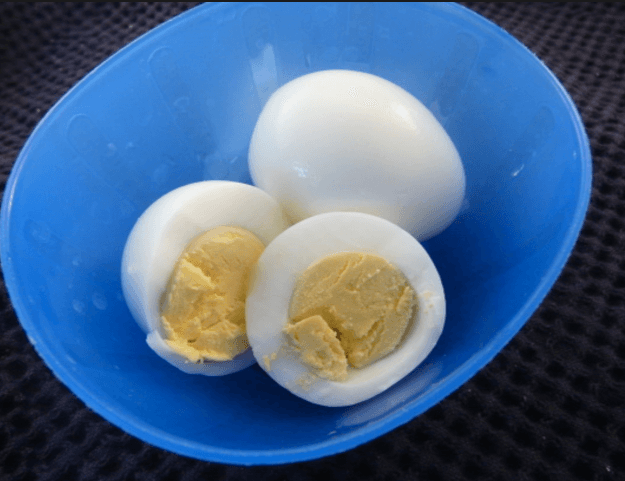
Hard-boiled eggs are the a result of a chemical change because
the eggs are the same size before vs after.
the eggs have different properties (smell, taste, color) before vs after.
the eggs weigh the same before vs after.
the eggs went through a phase change.
On a camping trip, Mr. Markowitz roasts a marshmallow in the campfire. He notices that the roasted marshmallow smells and tastes differently than the uncooked marshmallows. What change has taken place AND how does Mr. Markowitz know?
A chemical change because the marshmallow changed in taste, color, and smell
A chemical change because the marshmallow was heated up.
Only a physical change because the marshmallow changed in size
No change because the marshmallow is not a new substance
Which of the following is a clue that a chemical change has occurred? (Choose all correct answers.)
Formation of a gas (bubbles)
Color change
Phase change
Produces light or heat
Which of these is NOT a chemical reaction?
Single displacement
Synthesis
Decomposition
Stratification
Which factors affect the rate of a reaction?
temperature
concentration
size
pressure
catalyst
Increase in temperature causes the particles to
slow down
move faster
stay apart from each other
move in the correct order
Why does a higher concentration increase the rate of reaction?
it increases the amount of reactants
it lowers the activation energy
it increases the energy of reactant particles
it increases the frequency of collision
Why does a higher temperature increase the rate of a reaction?
It increases both the frequency collision and energy of reactant particles
It only increases the frequency of collision
It only increases the energy of reactant particles
It reduces the activation energy of the reaction
Grinding an effervescent tablet into powder increases the rate of reaction due to increase of
concentration
total surface area
temperature
size
Catalyst helps to
increase the amount of product obtained
to lower the activation energy
provide an alternative reaction route
decrease the frequency of collision
Which factors increase the rate of a reaction?
increasing temperature
increasing concentration
increasing total surface area
All of these
Increasing pressure causes the reacting particles
to bond together
to repel from each other
gain more kinetic energy
to move closer together
Increasing the temperature gives particles more __________.
time
energy
space
frequency
As the frequency of ________________ collision increases, the rate of reaction increases.
time
speed
effective
efficient
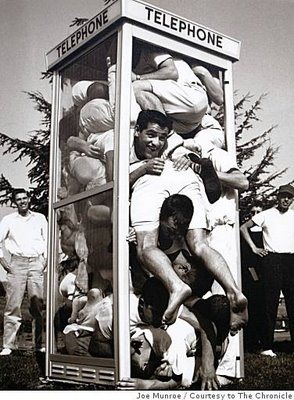
You make a space much smaller by increasing the ________________ hoping to increase the reaction rates.
temperature
concentration
catalyst
pressure
Why does breaking up a solid reactant increase the rate of reaction?
it creates more solid
it creates more energy
it increases the total surface area
it increases the concentration
Why does a higher concentration increase the rate of reaction?
it increases the amount of reactants
it lowers the activation energy
it increases the energy of particle collisions
it increases the frequency of collisions
List four factors that affects the rate of a reaction
temperature
concentration
surface area
volume
catalysts

Why does a higher concentration increase the rate of reaction?
it increases the amount of reactants
it lowers the activation energy
it increases the energy of particle collisions
it increases the frequency of particle collisions
Which of the following reactions occurs at the highest rate?
Photosynthesis
Rusting of iron
Combustion of hydrogen in oxygen
Combustion of magnesium in oxygen
The following equation shows the reaction between calcium carbonate, CaCO3 and hydrochloric acid, HCl:
CaCO3(aq) + 2HCl(aq) → CaCl2(aq) + CO2 (g) + H2O(l)
Which of the following is the suitable method to determine the rate of reaction?
Change in the temperature of the solution with time
Change in the volume of carbon dioxide gas with time
Change in the mass of water with time
Change in the concentration of hydrochloric acid with time

Table 4 shows the total volume of gas evolved at different intervals for the dissociation of hydrogen peroxide.
What is the average rate of reaction in the second minute?
14.0 cm3 min-1
16.0 cm3 min-1
18.0 cm3 min-1
28.0 cm3 min-1

An experiment is carried out to study the effect of concentration on the rate of reaction between sodium thiosulphate and hydrochloric acid.
Graph of the concentration of sodium thiosulphate against 1/time is as shown.
Based on the graph, what is the value of t if the experiment is repeated using sodium
thiosulphate solution 0.025 mol dm-3.
32.3 s
50.0 s
0.020 s
0.031s

Diagram 4 shows the graph of volume of carbon dioxide gas against time when 5 g of marble chips is added to
50 cm3 of 0.2 mol dm-3 hydrochloric acid.
At what time the rate of reaction the highest?
t1
t2
t3
t4

Diagram 7 shows a graph of the volume of gas produced against time for the reaction between zinc granules and hydrochloric acid.
The gradient of the graph decreases with time because
catalyst is not used
volume of mixture decreases
temperature of reaction decreases
concentration of hydrochloric acid decreases
The equation represents the reaction between sodium carbonate and hydrochloric acid.
Na2CO3 + 2 HCl → 2 NaCl + H2O + CO2
The mass of the beaker and its contents is plotted against time.
Which graph represents what happens when sodium carbonate reacts with an excess of dilute hydrochloric acid?


Table 9 shows the experiments carried out to study the rate of reaction between zinc carbonate and nitric acid.
Which of the following graph represents the two experiments?


Figure 12 shows the apparatus set-up to determine the rate of reaction between calcium carbonate and hydrochloric acid.
Which of the following is not correct in the apparatus set-up for this experiment?
Fixing of cork
Position of thistle funnel
Position of the delivery tube in the basin.
Position of the delivery tube in the conical flask.
Magnesium reacts with acid to produce hydrogen gas, H2.Which solution would give the highest initial rate of reaction?
100 cm3 of 1.0 mol dm-3 of nitric acid, HNO3
100 cm3 of 1.0 mol dm-3 of hydrochloric acid, HCl
100 cm3 of 1.0 mol dm-3 of sulphuric acid, H2SO4
100 cm3 of 1.0 mol dm-3 of ethanoic acid, CH3COOH

In an experiment, 25 cm3 of 0.2 mol dm-3 hydrogen peroxide solution decomposes to produce oxygen gas. Graph of volume of oxygen gas against time is sketched and curve R is obtained as shown in Diagram 12.
Which of the following solution will produce curve S?
20 cm3 of 0.10 mol dm-3 hydrogen peroxide
30 cm3 of 0.20 mol dm-3 hydrogen peroxide
20 cm3 of 0.30 mol dm-3 hydrogen peroxide
10 cm3 of 0.30 mol dm-3 hydrogen peroxide
Which manufacturing of the following is not a characteristic of catalyst?
A catalyst is specific in its reaction.
A catalyst influences the quantity of product of a reaction.
The chemical property of a catalyst remains unchanged at the end of the reaction.
Only a little amount of a catalyst is needed to influence the rate of reaction.

Diagram 12 shows an energy profile diagram. Ea is the activation energy for the decomposition of hydrogen peroxide.
P
Which of the following is the activation energy for the dissociation of hydrogen peroxide when manganese(IV) oxide is added?
P
Q
R
S
Which of the following explains the meaning of effective collision?
The collision where its energy is less than the activation energy
The collision that has a low energy
The collision which takes place before a reaction
The collision that causes a reaction
Which of the following is the meaning of activation energy?
The maximum energy that the particles need to produce effective collision
The amount of energy used by the particles during a collision
The minimum amount of energy that particles must have in order to react
The amount of kinetic energy of molecules during a collision
Which factors affect the rate of a reaction?
temperature
concentration
size
pressure
catalyst
Increase in temperature causes the particles to
slow down
move faster
stay apart from each other
move in the correct order
Why does a higher concentration increase the rate of reaction?
it increases the amount of reactants
it lowers the activation energy
it increases the energy of reactant particles
it increases the frequency of collision
Why does a higher temperature increase the rate of a reaction?
It increases both the frequency collision and energy of reactant particles
It only increases the frequency of collision
It only increases the energy of reactant particles
It reduces the activation energy of the reaction
Grinding an effervescent tablet into powder increases the rate of reaction due to increase of
concentration
total surface area
temperature
size
Catalyst helps to
increase the amount of product obtained
to lower the activation energy
provide an alternative reaction route
decrease the frequency of collision
Which factors increase the rate of a reaction?
increasing temperature
increasing concentration
increasing total surface area
All of these
Increasing pressure causes the reacting particles
to bond together
to repel from each other
gain more kinetic energy
to move closer together
Increasing the temperature gives particles more __________.
time
energy
space
frequency
As the frequency of ________________ collision increases, the rate of reaction increases.
time
speed
effective
efficient
You add more bodies into a "mosh pit" to hope for more collisions. You have increased
temperature
concentration
pressure
catalyst
You make a space much smaller by increasing the ________________ hoping to increase the reaction rates.
temperature
concentration
catalyst
pressure
Why does breaking up a solid reactant increase the rate of reaction?
it creates more solid
it creates more energy
it increases the total surface area
it increases the concentration
Why does a higher concentration increase the rate of reaction?
it increases the amount of reactants
it lowers the activation energy
it increases the energy of particle collisions
it increases the frequency of collisions
List three factors that affect the rate of a reaction
temperature
concentration
surface area
volume
A temperature increase causes the particles ......
to slow down
move faster
collide higher
in the right order
Why does a higher concentration increase the rate of reaction?
it increases the amount of reactants
it lowers the activation energy
it increases the energy of particle collisions
it increases the frequency of particle collisions
Why does a higher temperature increase the rate of a reaction?
it increases both the frequency and energy of particle collisions
it only increases the frequency of particle collisions
it only increases the energy of particle collisions
it reduces the activation energy of the reaction
The rate of a reaction is how _____________ a reaction occurs.
Quickly
Easily
Unusually
Differently
How could we make this reaction happen more quickly?
Decrease the concentration of the acid
crush the chalk to increase the surface area
Put the test tube in an ice bath
Which has more surface area?
Large chunks of chalk
Cube of sugar
Powdered sugar
Small chunks of sugar

