
 Worksheets
Mid-Term
Total questions: 120
Worksheet time: 2hrs 41mins
sharpening a pencil
physical change
physical property
chemical change
chemical property
flammability of a substance
physical change
physical property
chemical change
chemical property
size of an object
physical change
physical property
chemical change
chemical property
inflating a tire
physical change
physical property
chemical change
chemical property
freezing point
physical change
physical property
chemical change
chemical property
drawing copper into a wire
physical change
physical property
chemical change
chemical property
corrosion of a bicycle frame
physical change
physical property
chemical change
chemical property
fragrance of a flower
physical change
physical property
chemical change
chemical property
formation of water when hydrogen burns
physical change
physical property
chemical change
chemical property
boiling water
physical change
physical property
chemical change
chemical property
a burning candle
physical change
physical property
chemical change
chemical property
oranges squeezed to make orange juice
physical change
physical property
chemical change
chemical property
a change in size, shape, or state of matter
physical change
physical property
chemical change
chemical property
a characteristic that indicates whether a substance can change to another substance
physical change
physical property
chemical change
chemical property
a change of one substance to another
physical change
physical property
chemical change
chemical property
a characteristic that can be observed without changing the substance
physical change
physical property
chemical change
chemical property
boiling an egg
physical change
physical property
chemical change
chemical property
milk going sour
physical change
physical property
chemical change
chemical property
density
physical change
physical property
chemical change
chemical property
sugar dissolving in water
physical change
physical property
chemical change
chemical property

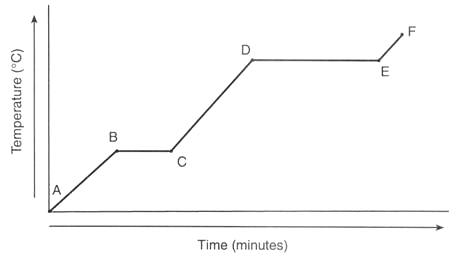
What state/phase is the object likely from points A to B?
Solid
Liquid
Gas
Plasma

Is the substance gaining or losing energy?
Gaining
Losing

Use the graph below to answer this question. What state of matter would the substance be at point F?
solid
liquid
gas

Use the graph below to answer this question. Which point on the graph represents the boiling point?
B
C
D
E

Use the graph below to answer this question. At which point is the substance a solid?
A
C
E
F

Use the graph below to answer this question. Which phase change is taking place if the substance is losing energy from point C to point B?
melting
freezing
evaporation
condensation
What is happening to the particles in the substance between points A and B?
Melting
Freezing
Speeding Up
Slowing Down


Find the volume if you have a substance with a mass of 3.5g and a density of 7.5g/cm3
26.25cm3
2.14cm3
.47cm3
.79cm3

The number of protons in the nucleus of an atom is called the --
atom
proton
atomic mass number
atomic number
A subatomic particle that has a negative charge is called --
a proton
a neutron
an electron
the nucleus
A neutron is ---
a subatomic particle with a negative charge.
a subatomic particle with a neutral charge.
the center of the atom where subatomic particles are found.
a subatomic particle with a positive charge.
An arrangement of elements in order of their atomic numbers such that elements with similar properties fall in the same column or group.
Atomic Number
Electron Cloud
Periodic Table
Nucleus
A subatomic particle with a positive charge is called --
a proton
a neutron
an electron
a nucleus
The smallest unit of an element that maintains the properties of that element is known as--
a proton
a neutron
an element
an atom
A region around the nucleus of an atom where electrons are found.
Electron Nucleus
Electron Cloud
Cloud of Electrons
Electron
An atom's central region, which is made up of protons and neutrons is called--
Electron Cloud
Nucleolus
Nucleus
Atomic Number
Which subatomic particle(s) are found in the nucleus of the atom? Choose all that apply.
proton
neutron
electron
What is the correct definition for isotopes?
atoms with the same number of protons and neutrons
Atoms with the same number of protons but different number of neutrons
Atoms with the same number of neutrons but different number of protons
Atoms with no mass

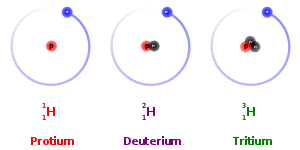
What is the difference between these 3 Lithium isotopes?
no difference
they have the same atomic number
they have the same mass number and atomic number
they have different mass numbers
atomic number = number of electrons = number of
(a)
mass number = atomic number + number of
(a)



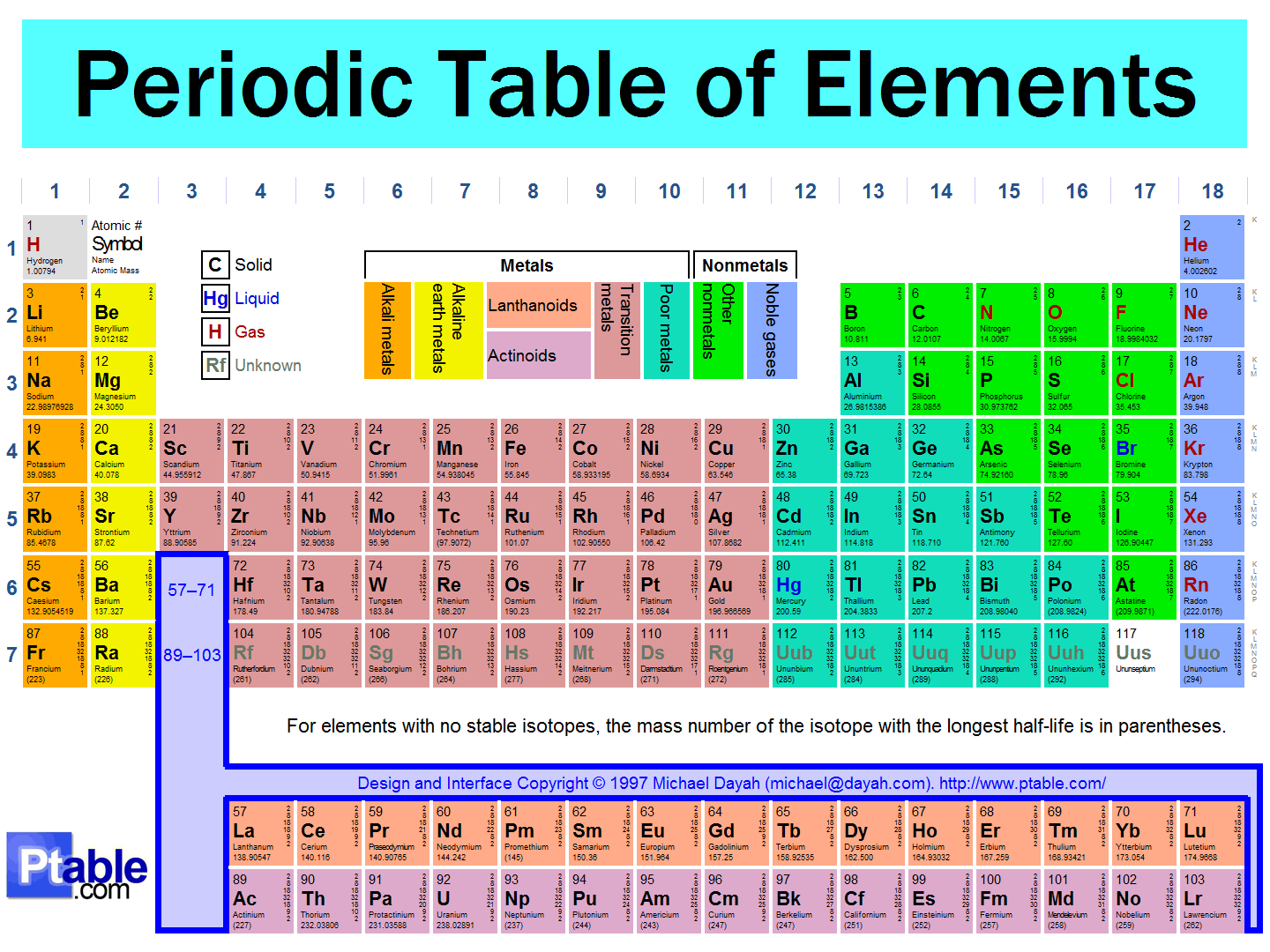



What family is highlighted in the picture?
Alkali Metals
Alkaline Earth Metals
Halogens
Noble Gases

What family is highlighted in the picture?
Alkali Metals
Alkaline Earth Metals
Halogens
Noble Gases

What family is highlighted in the picture?
Boron Group
Alkaline Earth Metals
Transition Metals
Lanthanides

What family is yellow in the picture?
Boron Group
Carbon Group
Transition Metals
Noble Gases
What family is dark purple in the picture?
Boron Group
Halogens
Transition Metals
Noble Gases

What family is highlighted in the picture?
Boron Group
Halogens
Transition Metals
Noble Gases
What group of metals is the MOST reactive?
Transition Metals
Metalloids
Alkaline Earth Metals
Alkali Metals
What group of nonmetals is the MOST reactive?
Noble Gases
Nitrogen Group
Halogens
Lanthanides
What are the majority of elements on the periodic table?
Nonmetals
Metals
Metalloids

What type of elements are red in the picture?
Nonmetals
Metals
Metalloids
What type of elements are green in the picture?
Nonmetals
Metals
Metalloids
What type of elements are blue in the picture?
Nonmetals
Metals
Metalloids

What does the Bohr Model represent?
The structure of molecules
The structure of the Solar System
The structure of an atom
The structure of East Hills

Which element is this?
Nickel
Neon
Sodium
Nitrogen

What is the mass number of this atom?
1
3
4
7

How many valence electrons?
2
3
4
5

How many valence electrons?
2
3
4
5
What is a valence electron?
Electrons in the first energy shell
Electrons in the second energy shell
Electrons in the outer shell
Total number of electrons

How many valence electrons?
2
4
6
8

What group does this element belong to?
1
2
17
18

What element is represented in this Bohr Model?
Carbon
Hydrogen
Aluminum
Lithium

How many electrons can fit on the 1st energy level (orbital) for any Bohr Model?
2
6
8
10

What is the mass of this atom?
9
10
19
28
How many electrons can go in the Second energy level?
2
8
18
32
What is a Lewis Dot Structure?
It shows all of the particles in the atom.
Contains protons and neutrons
Only shows the element symbol and it's outer most electron shell
Contains protons and electrons

Is this a correct dot diagram for fluorine (F)
Yes
No

Nonmetals tend to
gain electrons
lose electrons

Metals tend to
gain electrons
lose electrons
Cr3+ O2-
K1+ S2-
Al3+ O2-
When a nonmetal gains electrons, it becomes this type of ion.
Anion
Cation
When a metal loses electrons, it becomes this type of ion.
anion
cation
Why do ionic compounds have high melting and boiling points?
Because they are solid
Because the ionic bond is strong.
Because they have a strong hold on their electrons
At which state is the ionic compound capable of conducting electricity
gas
liquid
solid
The name of FeCl₂ is
iron chloride
iron (II) chloride
iron (I) chloride
iron dichloride
LiBr is called
lithium bromine
lithium (I) bromine
lithium bromide
lithuim (I) bromide
Which of these combinations is an ionic compound made of?
Metal and Metal
Nonmetal and Nonmetal
Metal and Nonmetal
Cation and Cation
Name the following ionic compound: BeCl2
beryllium chlorine
beryllium II chloride
beryllium chloride
beryllium dichloride
NH4NO3
Na2SO3
When naming ionic compounds with transition metals you need to include roman numerals to show the _____ of the metal..
atomic number
mass number
charge
ionization energy
Which of the following combinations would need roman numerals in the name?
potassium + fluorine
beryllium + oxygen
boron + iodine
gold + oxygen
The name of FeCl₂ is
iron chloride
iron (II) chloride
iron (I) chloride
iron dichloride
When naming a compound, which of these is written first?
Metal
Nonmetal
Anion
Cation
When naming a compound, what must the last part be?
the element with "ide" at the end
the element with the ending "ite"
the name of the element
the element with "ide" at the end, unless its a polyatomic ion

