
 Worksheets
Periodic Table & Trends
Total questions: 122
Worksheet time: 6hrs 12mins
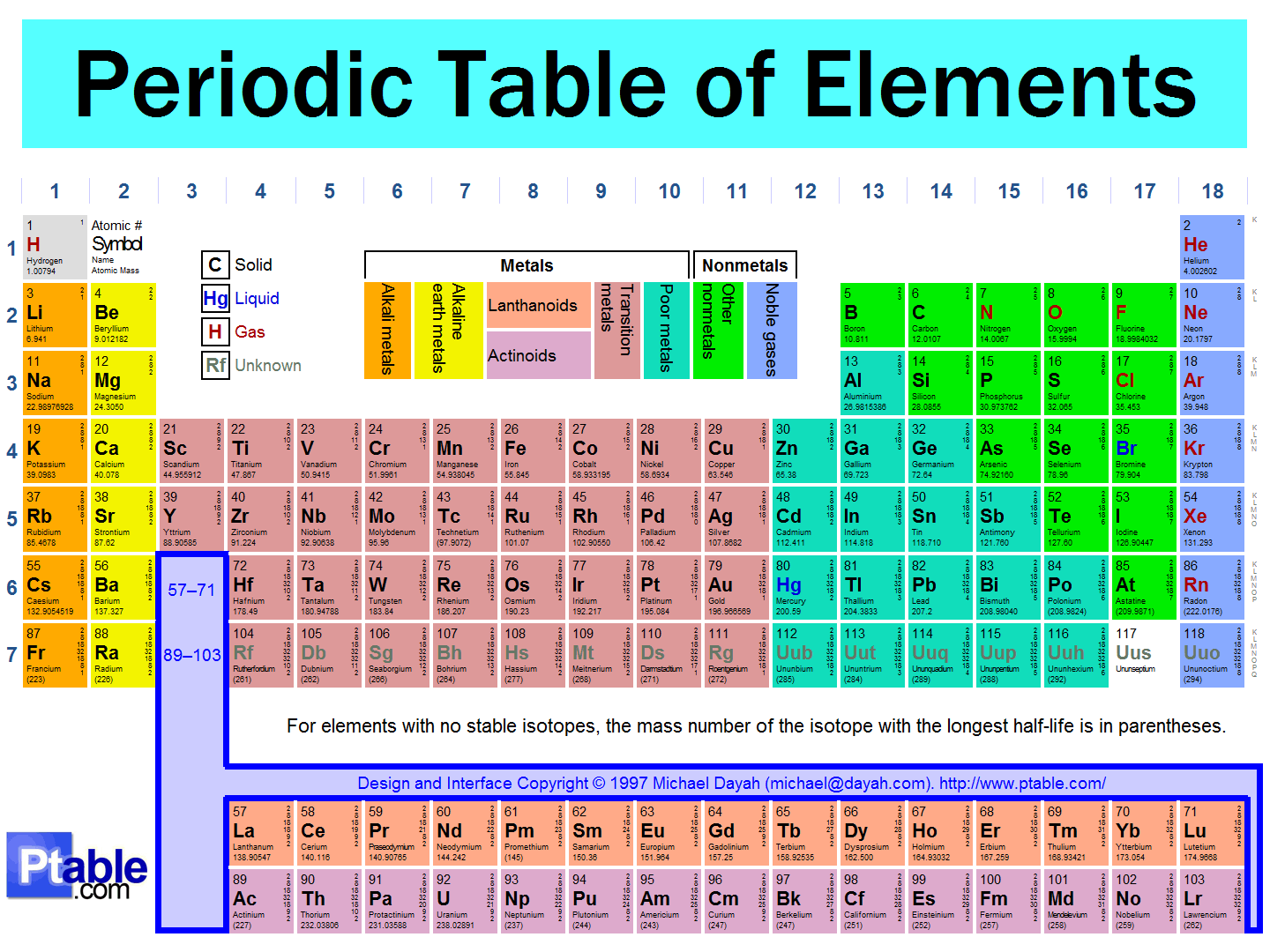
The vertical (up and down) columns in the Periodic Table are called
groups
towers
periods
atomic numbers
The vertical (up and down) columns in the Periodic Table are called
groups
towers
periods
atomic numbers

N or C?


Which element has the highest electronegativity?


What is the name of the family that is highlighted?
Alkali Metal Family
Halogen Family
Noble Gas Family
Transition Metal Family

Which element has 3 valence electrons?
A
B
E
C

What happens to the atomic numbers as you move from left to right on the periodic table?
Increase
Decrease
Stay the same
Nothing
Which of the following elements is most likely to have similar properties to those of sodium (Na)?
Magnesium (Mg)
Sulfur (S)
Francium (Fr)
Titanium (Ti)
Two elements that have similar physical and chemical properties are most likely in the same...
period
row
group
Which element is located in period 4 and group 5?
Vanadium (V)
Zirconium (Zr)
Niobium (Nb)
Titanium (Ti)
In which group would an element that is a gas most likely be located?
1
3
12
18
As you move down a group on the periodic table, the number of valence electrons....
Increases
Decreases
Remains the same
As you move from left to right on the periodic table, the number of valence electrons.......
Increases
Decreases
Remains the same
The common charge on an atom in group 17 would be....
+1
+7
-7
-1
17
Which of the following is true of atomic radius?
The radius is mainly due to how large an atom's nucleus is.
The radius is mainly due to the size of the electron cloud.
The atomic radius is a way we measure the mass of an atom.
Neutrons account for the majority of an atom's radius.
As you move from left to right on the periodic table, the number of valence electrons.......
Increases
Decreases
Remains the same
As you move down a group on the periodic table, the number of valence electrons....
Increases
Decreases
Remains the same
The common charge on an atom in group 17 would be....
+1
+7
-7
-1
17
Which of the following is true of atomic radius?
The radius is mainly due to how large an atom's nucleus is.
The radius is mainly due to the size of the electron cloud.
The atomic radius is a way we measure the mass of an atom.
Neutrons account for the majority of an atom's radius.

Why are elements at the bottom of the PT larger than those at the top?
They have more orbitals
They have more valence electrons
They have more charge
They have a weaker attraction
Why are elements at the top of the PT have higher electronegativity than those at the bottom?
They have fewer orbitals, this makes them smaller and since electrons are closer to the nucleus there will be a stronger ability to attract electrons
They have fewer valence electrons
They have more orbitals, this makes them larger and since electrons are further from the nucleus there will be a stronger ability to attract electrons
Why are elements at the top of the PT have higher ionization energy than those at the bottom?
They have fewer orbitals, this makes them smaller and since electrons are closer to the nucleus the attraction is stronger which makes it more difficult to remove
They have fewer valence electrons
They have more orbitals, this makes them larger and since electrons are further from the nucleus the attraction is weaker which make it easier to remove
Why are elements at the left of the PT larger than those at right?
They have fewer orbitals
They have more valence electrons
Their electrons have a stronger attraction because there's more charge
Their electrons have a weaker attraction because there's less charge
Why are elements at the right of the PT have more electronegativity than those at left?
They have fewer orbitals
They have more charge which gives them a stronger attraction for electrons. (Non-metals form anions)
The have less valence electrons
They have less charge which gives them a stronger attraction. (Metals form cations)
Why are elements at the right of the PT have higher ionization energy than those at left?
They have more orbitals
Since they are much larger its difficult to find their valence electrons
They have more charge and are closer to completing the octet rule which is difficult to remove electrons
They have less charge and its very easy to remove electrons from metals
What is the difference between ionization energy and electronegativity?
Ionization energy is the ability to attract a valence electron while, electronegativity is the energy needed to remove a valence electron.
Ionization energy is the energy needed to remove a valence electron while, electronegativity is the ability to attract a valence electron.
Ionization energy is the level of attraction between electrons and the nucleus while, electronegativity is the sharing of pairs of electrons.
What is the difference between electronegativity and atomic radius?
electronegativity is the level of attraction between electrons and the nucleus while, atomic radius is the energy needed to remove electrons.
electronegativity is the energy needed to remove electrons while, atomic radius is the level of attraction between electrons and the nucleus.
electronegativity is the level of attraction between electrons and the nucleus while, atomic radius is the size of the atom
Beryllium (Be) has an atomic number of 4 & Magnesium (Mg) has an atomic number of 12. They have very similar chemical properties and will behave the same in a chemical reaction. How should they be placed on the periodic table?
They should be placed in the same group with Mg on the top and Be below.
They should be placed in the same group with Be on the top and Mg below.
They should be placed in the same period with Mg on the left and Be on the right.
They should be placed in the same period with Be on the left and Mg right.

Which are most reactive families on the periodic table.
Alkali metals & Transition Metals
Noble gases & Oxygen Family
Halogens & Alkali metals
Halogens & Noble gases
What is it about group 1 and group 17 elements that make them so reactive?
They have more orbitals than the rest of the elements
They have less charge than the rest of the elements
They are the two families that are closest to completing the octet rule
They have more charge than the rest of the elements


As you move down a group, atomic radius increases because...
you add more and more valence electrons
you add more and more protons
you add more and more orbitals
you add more and more charge

Which element has a full valence shell and completed the octet rule?
F
D
C
E
Which element has 3 valence electrons?
A
B
E
C

Use your periodic table to rank the following elements according to their atomic radius (Smallest to Largest):
Nickel, Silver, Sulfur, Francium & Calcium.
S < Ni < Ag < Ca < Fr
S < Ag < Ni < Ca < Fr
S < Ca < Ag < Ni < Fr
Ni < Ag < S < Fr < Ca
Use your periodic table to rank the following elements according to their Ionization Energy (Lowest to highest):
Carbon, Cobalt, Cesium, Helium & Krypton
Cs < Co < C < Kr < He
Cs < C < Co < Kr < He
Cs < Kr < Co < C < He
Co < C < Kr < Cs < He
Use your periodic table to rank the following elements according to their Electronegativity (Lowest to highest):
Lithium, Titanium, Silicon, Fluorine & Nitrogen
Li < Ti < Si < N < F
Li < Si < N < Ti < F
Li < N < Si < Ti < F
Ti < Si < Li < F < N
Use your periodic table to determine which of the following elements are larger than Sulfur (S):
(Select all that apply)
Phosphorus (P)
Arsenic (As)
Chlorine (Cl)
Nitrogen (N)
Fluorine (F)
Which element has the highest electronegativity?

N or C?
Which of the alkaline-earth metals has the smallest electronegativity
Be
Sc
Ra
Sr
Which alkali metal is the least reactive?
Li
Na
H
Fr
Of the halogens, which has the smallest electronegativity?
F
Cl
At
Ne
Which elements have 1 valence electron?
period 1
group 1
group 4
which elements have 4 valence electrons?
group 3
group 4
group 14
Which element is located in Group 11 & Period 4?
Vanadium
Cadmium
Copper
Rhodium
What element is located in Group 18 & Period 5?
Xenon
Krypton
Radon
Helium
Which element is located in Group 3 & Period 5?
Yttrium
Scandium
Lanthanum
Magnesium
Which element is located in Group 5 & Period 4?
Nitrogen
Phosphorus
Antimony
Vandium
Which element is located in Group 1 & Period 2?
Hydrogen
Beryllium
Lithium
Sodium

Which of these has the smallest ionization energy?
N
P
As
Ne
Which of these is a metal?
Li
Si
S
Ne
Which of these has the largest atomic mass?
K
Ca
Sc
The element with the highest electronegativity is -
At
F
Cl
Br
Which atom has the smallest metallic character?
O
Ba
Co
K
The ionization energy of Na is larger than Cs because...
Na has a greater effective nuclear charge
Na has fewer energy levels and less shielding
Cs has a greater effective nuclear charge than Na
Cs has more valence electrons than Na
For groups 13 through 18, the number of valence electrons is equal to the group number
plus 1
plus the period number
minus the period number
minus 10

Using just the valence electrons on each atom determine which 2 atoms should be in the same group.
atom 1 and 2
atom 3 and 4
atom 1 and 4
atom 2 and 3
N or C?

Where would you expect to find the smallest atoms?
upper left
upper right
lower left
lower right lower right

Why are the ionic radii generally larger for group 15 than for group 17?
Atoms in group 15 are larger than atoms in group 17.
Atoms in group 15 have more protons than atoms in group 17
Ions forming from group 15 atoms have a greater negative charge than ions forming from group 17 atoms.
Atoms in group 15 are less likely to lose electrons than atoms in group 17.

